
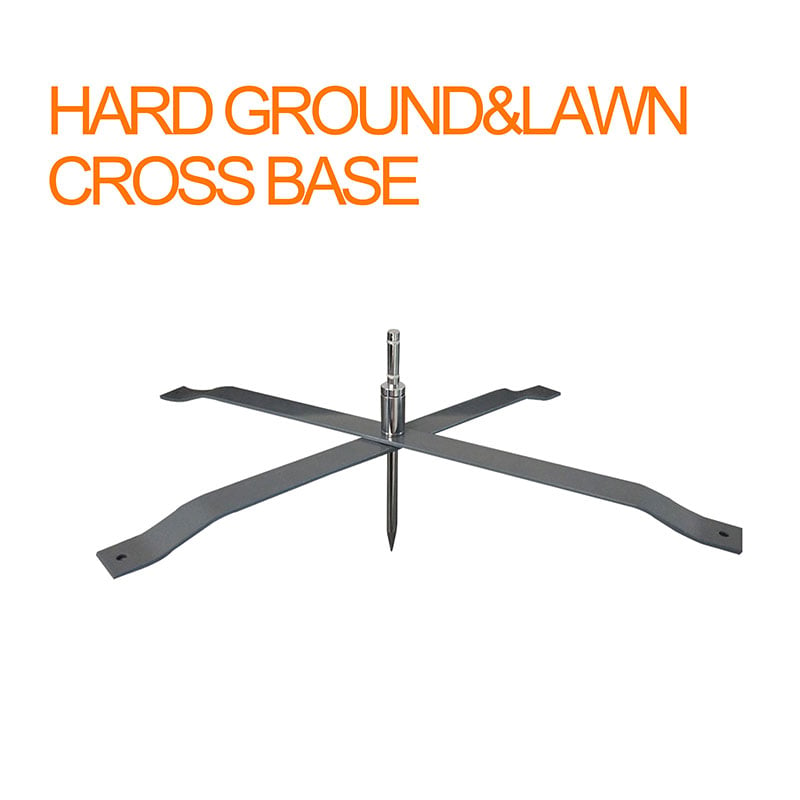
Three summers ago I stood on a Miami sidewalk at 2 p.m., watching a real estate agency's brand-new 11-ft feather flag go over sideways for the third time that week. The agency had spent $200 on a premium, dye-sublimated flag. The base was a generic cross base that weighed about three pounds, sitting bare on the concrete with nothing on it. Thirty-five-degree heat, a 15-mph Gulf breeze, and the whole investment was flat on the pavement.
Compare that with a Houston dealership we work with. They run the same size flag on an under-wheel base, front tire parked directly on the plate. When a thunderstorm front pushed 30-mph gusts through their lot, their flags stayed up while three neighboring lots had flags down.
Same flag. Same wind. Different base. Different outcome.
That contrast is the whole point of this guide. The flag gets the attention, but the flag base is what decides whether your campaign is still standing at closing time — and, over a year, whether you're re-buying flags or printing your fourth message on the same pole.
Why the base deserves more of your budget than you think
From an engineering standpoint, a feather flag is a sail mounted on a lever. The pole multiplies the force from the fabric, and the base is the only thing pushing back. When a base fails, the failure chain is expensive:
1. Zero impressions — a tipped flag is invisible to traffic.
2. Hardware damage — a pole that hits the pavement often cracks or splinters at the joint.
3. Fabric damage — flags that slap the ground tear at the hem and scuff the print.
4. Safety exposure — a falling pole in a pedestrian zone or parking lot is a liability, not an inconvenience.
The market context explains why this hardware matters commercially. The promotional, logo, corporate, and advertising flags market was valued at roughly USD 415.75 million in 2025 and is forecast to reach USD 588.5 million by 2032, a 4.85% CAGR—with North America the largest regional market at about USD 147.36 million. Flag kits specifically (flag + pole + base hardware) are projected to grow from USD 241.5 million (2025) to USD 361.8 million (2032), a 5.85% CAGR. Within every kit, the base is the component most likely to be underspecified—because it is also the one buyers think about last.
Let's fix that. Here is the physics, then the decision matrix, then the math that tells you what to buy.
The physics your base has to beat
Wind force on a flag follows the standard drag equation:
F = Cd × q × A
where **F** is the lateral wind force, Cd is the drag coefficient (roughly 0.8–1.2 for feather flags), q is dynamic wind pressure, andA is the flag's surface area.
Dynamic wind pressure grows with the square of wind speed, which is why small wind increases cause large force jumps:
| Wind speed | Dynamic pressure (q) |
|---|---|
| 10 mph | 0.26 psf |
| 15 mph | 0.58 psf |
| 20 mph | 1.03 psf |
| 25 mph | 1.61 psf |
| 30 mph | 2.32 psf |
Now apply it to real products. A typical medium 11-ft flag has about 33 sq ft of fabric:
| Wind speed | Lateral force on an 11-ft flag |
|---|---|
| 15 mph | ~19 lbs |
| 20 mph | ~34 lbs |
| 25 mph | ~53 lbs |
A small 8-ft flag (~20 sq ft) generates roughly 32 lbs of force at 25 mph.
Here is the part most buyers miss: the base doesn't just hold weight — it resists a tipping moment (force × pole height). A 34-lb lateral force at 20 mph, applied at the center of a 10-ft pole, produces a tipping torque of well over 300 ft-lbs. That's why a 3-lb bare cross base is a wind vane, and why industry engineering guidance specifies 20–70 lbs of base weight depending on flag size and conditions — with 25 mph as the maximum safe wind speed for standard installations, and flags of any size coming down above 25 mph sustained.
4. The decision matrix: match the surface, then the base
Choosing a base is a two-question process, not a catalog browse:
1. Where is the flag going? Grass/soil → ground spike. Hard surface (concrete, asphalt, tile, indoor floor) → a surface base.
2. Is it outdoors? If yes on a hard surface, you will add anchoring weight — that is non-negotiable, not optional.
| Surface | Primary base | Anchoring | Typical scenario |
|---|---|---|---|
| Grass / soil / soft ground | Ground spike (flag spike / ground stake base) | Driven full depth into soil | Open houses, farmers' markets, roadside shoulders, lawns |
| Concrete / asphalt / pavement, short-term | Cross base + water bag | Water bag, 25–30 lbs when full | Storefronts, plazas, parking lots, event weekends |
| Concrete / asphalt / pavement, semi-permanent | **Large water-fillable base** | Base filled with water or sand | Seasonal displays, multi-week events |
| Any hard surface with a vehicle present | Under-wheel base | Vehicle weight on the plate | Car dealerships, car shows, tailgating |
| Indoor hard floor (trade show, lobby) | Cross base + sand/weight | Optional weight | Indoor events, malls, store entrances |
| No usable ground at all (fence, wall, pole) | Wall / pole / fence mounts** | Fixed hardware | Balconies, fences, railings, bike racks.
The base-by-base breakdown
1. Ground spike — the "soft surface" champion
The ground spike—also sold as a flag spike or a ground stake base—is a heavy steel stake, typically ~60 cm (24") long with ~40 cm (16") driven into the ground, weighing around 1 kg (2.2 lbs). On our own hardware, the standard configuration is a steel ground spike with a rotator; the flagpole's rotator bearing locks into a machined collar at the top, so the whole assembly weathervanes with the wind instead of fighting it—which is what keeps the fabric from wrapping and the pole from fatiguing.
Pros: Best wind stability on firm soil — the soil itself is the anchor; it is nearly invisible (clean, professional look); and it is typically the most economical base in a kit.
Cons: 100% useless on concrete, asphalt, pavement, or any indoor surface. Also, before hammering, check for buried irrigation lines or utilities—an $8 spike can cost a lot more if it hits a sprinkler manifold.
Best for: Real estate open-house lawns, farmers' markets in parks, roadside businesses with a grass shoulder, church and community lawns.
2. Cross base + water bag—the "hard surface" standard
The cross (X) base is a foldable steel stand, usually powder-coated, with a center spindle that accepts the pole's rotator. Alone, it weighs only ~3 lbs—enough to stand upright indoors, nothing more. Outdoors it **requires a water bag**: a donut-shaped vinyl bladder that fits over the spindle and holds **25–30 lbs when filled with water** (more with sand).
Pros: The only standard option for hard, flat surfaces; folds flat for transport; reusable across unlimited events.
Cons: Without the bag it tips in the slightest breeze — the most common deployment failure in the industry. And water bags are a consumable: UV and abrasion degrade vinyl, so plan a replacement cycle.
-Best for: Sidewalk storefronts, plazas, parking-lot events, and every trade show floor.
Rule of thumb: if a cross base sits outdoors, a water bag is 100% required—treat it as part of the base, not an accessory.
3. Large water tank — the semi-permanent workhorse
Instead of a separate bag, this is a hollow HDPE (high-density polyethylene) base that you fill directly. A typical unit holds about 3 US gallons — roughly 24 lbs of water or 36 lbs of sand (1 gallon of water ≈ 8 lbs; 1 gallon of sand ≈ 12 lbs).
Pros: All-in-one, no loose bag to lose or replace; heavy-duty plastic won't rust; excellent for semi-permanent and high-traffic placements.
Cons: Bulky to ship empty (freight weight) and heavy when full — plan setup/teardown labor accordingly.
Best for: Seasonal displays, multi-week campaigns, high-wind or high-traffic locations where you set it once and leave it.
4. Tyre base—the dealership favorite
A flat steel plate with a spindle; you drive a vehicle's tire onto the plate, and the vehicle's weight becomes the anchor.
Pros: Essentially unlimited holding force — a 4,000-lb car is not going to blow over. Zero fill time, zero consumables.
Cons: Only works where a vehicle can be parked on the plate; not for pedestrian-only locations.
Best for: Car dealerships, auto shows, tailgating lots — the same scenario as our Houston client.
5. Specialty mounts — when there's no ground at all
When a flag must live on a fence, railing, wall, or pole, fixed hardware replaces the base entirely: wall brackets (0°/25°/90°), pole clamps with rotating spindles, and fence/bike-rack mounts. These are the right call for balconies, chain-link perimeters, and temporary barricades where a base would be a trip hazard.
How much weight do you actually need? Use the chart
Engineering guidance for standard installations (20–70 lbs depending on flag size and conditions):
| Flag size | Light wind (0–10 mph) | Strong wind (20–30 mph) | Above 25 mph sustained |
|---|---|---|---|
| Small (8 ft) | 20 lbs min / 25 lbs recommended | 40 lbs min | Take the flag down |
| Medium (11 ft) | 30 lbs min | 55 lbs min | Take the flag. |
| Large (15 ft) | 40 lbs min | 70 lbs min | Take the flag down** |
Two practical translations of this table:
- A cross base + water bag (25–30 lbs) covers a medium flag only in light wind. In a genuinely windy market (20+ mph afternoons), step up to a large water-fillable base (24–36 lbs or more)** or add a second ballast—or take flags down in gusts, which is what the engineering guidance recommends.
Sand beats water for ballast (~12 lbs/gallon vs ~8 lbs/gallon), and it won't freeze in winter—but it also won't drain, so it adds permanent shipping/transport weight.
Material matters: what the base is made of decides its lifespan
All bases are not created equal, and the material choice shows up on the balance sheet:
| Material | Strength | Corrosion / UV | Weight | Typical use |
|---|---|---|---|---|
| Powder-coated steel | High | Good — needs coating thickness (60–80 micron) to survive salt air | Medium | Cross bases, spikes, under-wheel plates |
| Galvanized steel | High | Very good | Medium | Ground spikes exposed to soil moisture |
| HDPE plastic | Medium-high | Excellent — no rust, UV-stable | Light | Water-fillable bases |
| Cast iron | Very high | Good if painted | Heavy | Premium / permanent bases |
Coastal operators take note: bare or thinly coated steel on a salt-air sidewalk will show rust bloom within a season. Specify powder coating at 60–80 microns (or galvanizing for buried spikes) and check the supplier's coating certificate. For ballast that lives outdoors year-round, HDPE is the low-maintenance choice.
There's a second material decision hiding in the kit — the pole. A carbon-fiber pole flexes under gusts (up to ~25% deflection) and returns to shape, absorbing peak load before it ever reaches the base; a fiberglass pole flexes a bit more (~30%) but fatigues differently. Pairing a wind-flexible pole with a correctly sized base is how multi-season deployments survive without damage—which is why at WZRODS we spec carbon poles alongside our cross bases and spikes for windy markets.
Ground spike wins on absolute cost — but only on grass, and only if you have grass everywhere.
The cross base and Flag Base Weight Bag cost the most over 3 years per position, yet it is the only system that is simultaneously outdoor-hard-surface-capable, portable, and reusable across unlimited event moves. For a retailer that relocates displays weekly, that portability is the value—the bag replacement is the price of it.
A water tank is the best-value choice for a fixed, semi-permanent hard-surface position.
A tyre base is the cheapest hard-surface option where a vehicle can park on it—but it only exists in parking scenarios.
The hidden line item nobody quotes is shipping weight: bases ship mostly as metal and plastic bulk. A heavier cast-iron base adds freight cost on every container; HDPE water bases ship light empty and heavy full. When you source in volume, ask your supplier for the empty shipping weight per SKU—it changes your landed-cost math more than the unit price does.
Sourcing & compliance: the questions a buyer asks
When you buy bases in volume, three things separate a pro from a gambler:
1. Material compliance:
Powder coatings and plastics should be REACH-compliant for EU-bound stock. Ask for the coating/plastic material certificate—a one-page document that saves you from a compliance rejection at the port.
2. Customs classification:
Steel bases (cross bases, spikes, and under-wheel plates) typically classify in HS Chapter 73—either heading 7308 (structures and parts thereof of iron or steel) or 7326 (other articles of iron or steel). The correct 10-digit line depends on the exact product, so confirm the final classification and duty rate with your forwarder or licensed customs broker before quoting landed cost; HTS lines and tariff treatment change, and trade agreements can zero them out.
3. Wind-test documentation:
A serious supplier can share real wind/drop test data for their bases and poles. If they can't, the "25-mph rating" on the spec sheet is marketing, not engineering. Ask for the test method.
4.MOQ matters too
Mixed-SKU containers (spikes + cross bases + bags + poles) are the standard way to control average freight cost—ask your supplier whether their MOQ applies per SKU or per container.
The 60-second decision checklist
Print this and keep it with the hardware:
-Where? Grass/soil → ground spike (flag spike / ground stake base). Hard surface → surface base. No ground → wall/pole/fence mount.
-Outdoors on a hard surface? → water bag is mandatory, not optional.
Windy market? → Size the ballast to the chart (55 lbs for an 11-ft flag at 20+ mph), and take flags down above 25 mph sustained.
Coastal or rainy? → powder-coated (60–80 µm) or galvanized steel, or HDPE—never bare steel.
Fixed position vs. mobile? → fixed = water-fillable base; mobile = cross base + bag.
Got a vehicle? → an Tyre base wins on cost and stability.
Volume buyer? → confirm REACH certificates, the HTS line with your broker, and empty shipping weight per SKU.
Leave a Comment