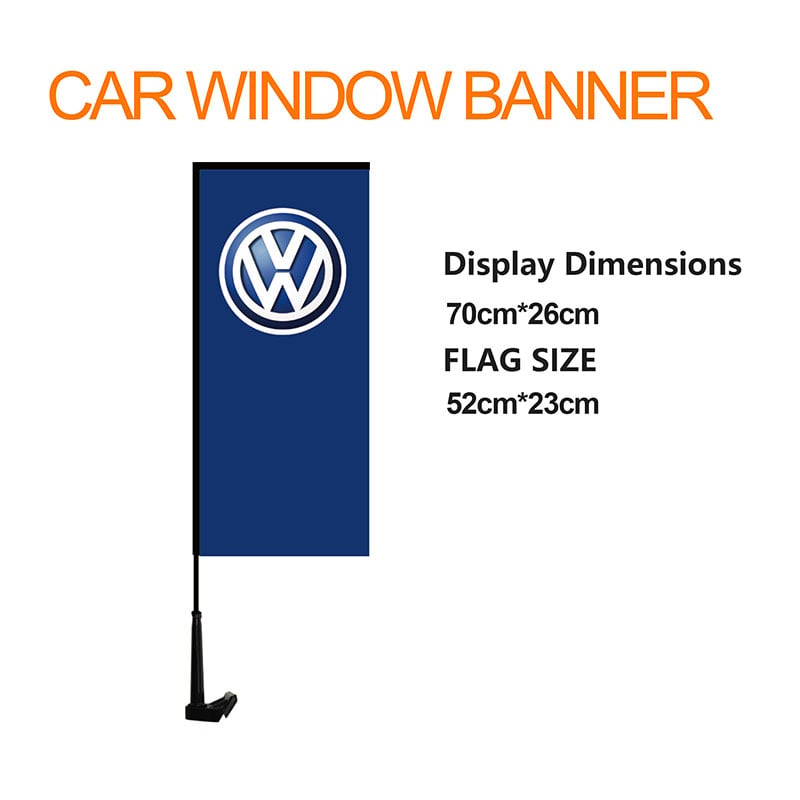
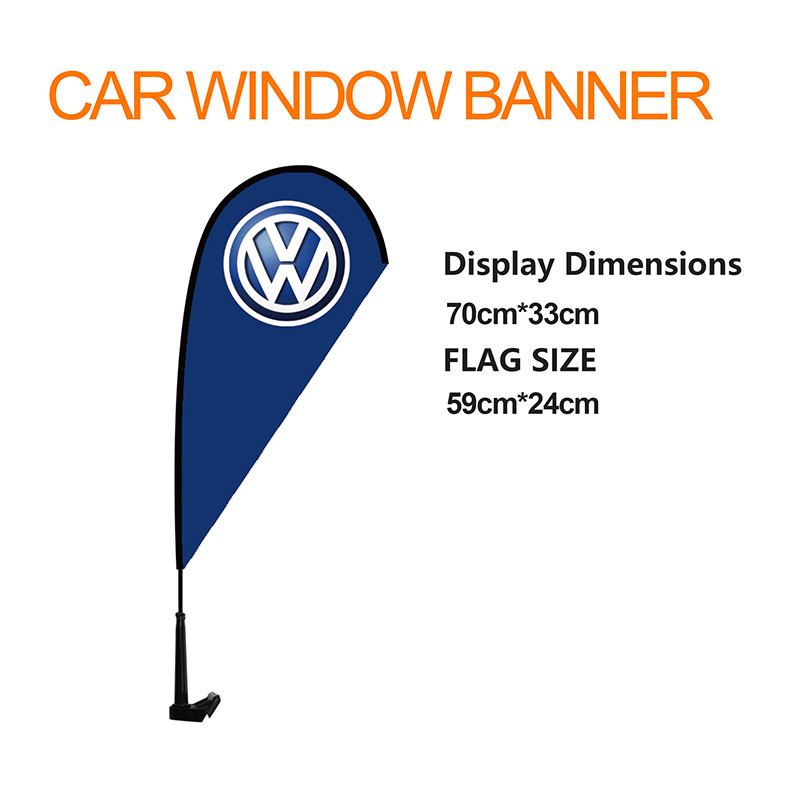
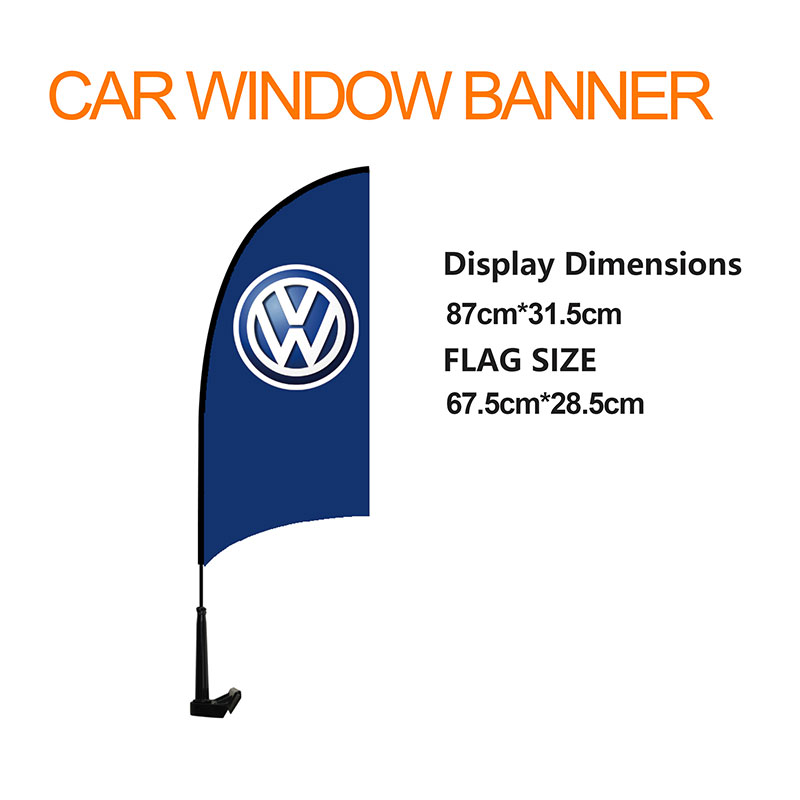
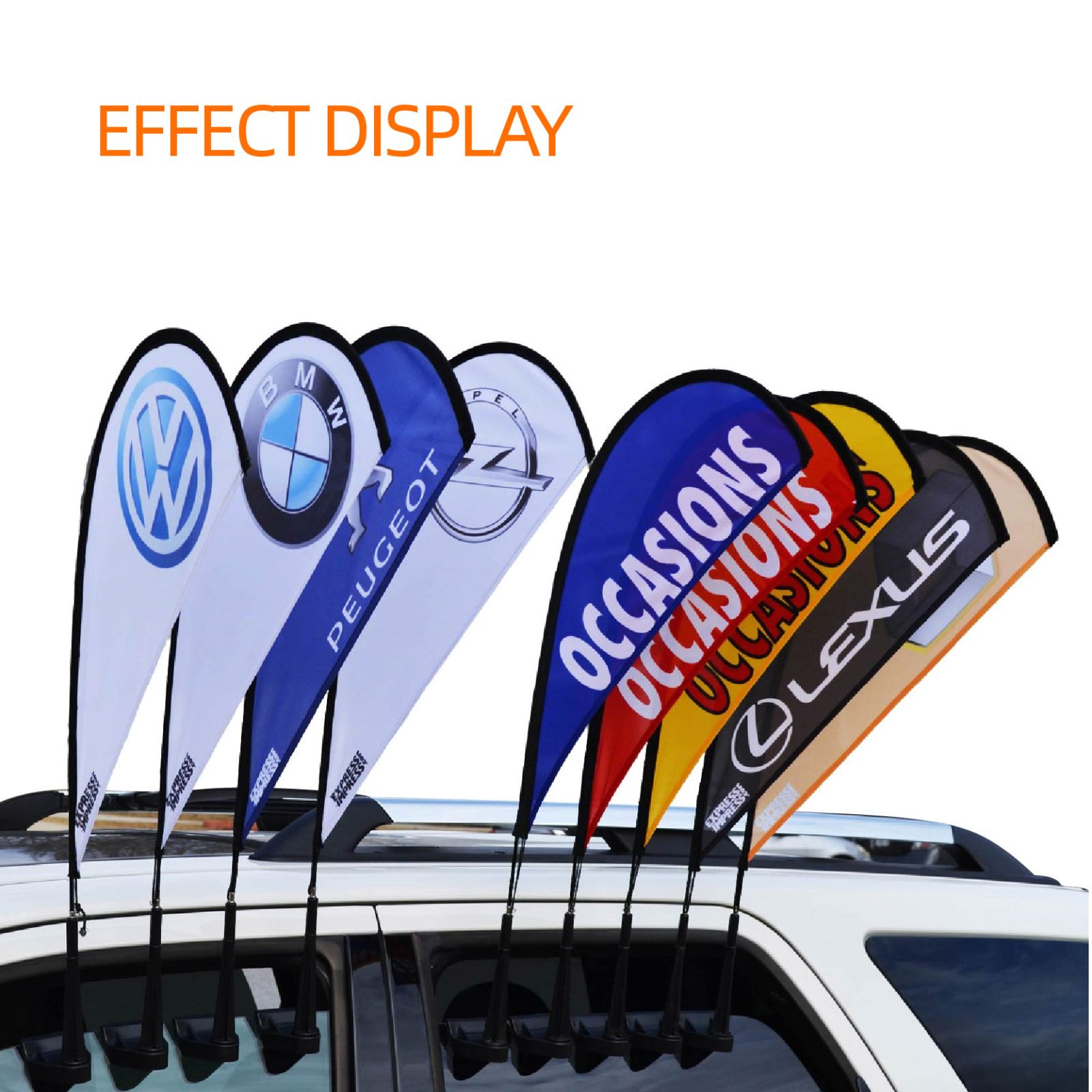
Car Window Flag
WZRODS car window flag comes in 3 shapes for brand promotion. Easy window clip installation, 360° rotation and wind-free display. Ideal for car lots, clubs and street fairs for stable low-speed vehicl…


 Article
 Specifications
- Origin
- Shandong, China
- Brand
- Wzrods
- Model
- CWF75/CWH73/CWS70
- Pole Material
- Carbon Composite
- Banner Material
- Nylon
- Color
- CMYK 4 Color Printing
- Usage
- Advertising
- Application Spec
- Point of Sale, Indoor Display, Promotional Counters, Retail
- Printing Method
- Heat Transfer Printing
- Style
- Corporate, Cross, Sports, Holiday, Seasonal, Angel, Patriotic, Political, FLYING
- Product Type
- promotional products
- Warranty
- 3 Years
- Flag Shape
- Teardrop/ Feather/ Rectangle
- Feather Display Size
- 75cm*33cm
- Teardrop Display Size
- 59cm*24cm
- Pole Length
- 89cm
- Artwork Format
- AI, PDF
 Product Description
Shipping & Packaging
- Unit Weight
- 0.500 kg
- Unit Size
- 56X10X10 cm
- Packaging
- Standard export carton
- Lead Time
- 15-30 days
Pricing
- MOQ
- 2 pieces
- Price Range
- USD 3 – 3.4
* FOB Qingdao. Excludes shipping & taxes. Accessories & customization confirmed separately.
 Sample Service
- Sample Available
- Yes
- Sample Price
- piece 50
- Max Sample Qty
- 1
 Customization Options

Light Custom
Logo, color, size adjustments

Fast Turnaround
Quick custom order processing
3-Day Design
Free mockup within 3 days
Car Window Flag - The Complete B2B Buyer's Resource - WZRODS
In fall 2019, a seasoned promotional-products distributor rushed 2,000 aluminum window flags to a large dealership group for a nationwide weekend sale. By noon on day one, a steady 15‑mph breeze had left nearly one flag in three drooping, deformed, or snapped clean off the clip. The marketing director was furious. The distributor’s reputation took a direct hit. The episode surfaced a truth buyers usually learn only after it is too late: the pole material matters far more than the unit price.
A car window flag—pole, printed nylon panel, rotating joint, and window clip—seems simple. Yet a dozen variables decide whether it lasts three years or becomes trash after a single outing. For international B2B buyers—trade show organizers, event planners, distributors, and importers—the central question is not “Which flag costs the least to buy?” It is “Which display piece costs the least to own, clears customs with the least friction, and never embarrasses the user in front of a paying customer?” This guide answers that question with data pulled from hundreds of exhibition booths, car‑lot promotions, and street‑fair deployments.
1. What a Car Window display piece Must Do Before You Ever Consider Price
A window sign is not passive fabric. It is a rotating signboard that must endure vibration, UV exposure, thermal shock, and—in coastal markets—salt‑laden air. Three shapes dominate: feather (tall, curved, height‑driven visibility in a crowded lot), teardrop (brand messaging near eye level, popular for sidewalk displays), and rectangle (traditional flag silhouette, often chosen for political rallies or sports convoys). No shape can rescue a pole that fails.
The pole material is where most mistakes are made. Aluminum is cheap to extrude and widely available, so it dominates the low end. Under repeated flexing—every gust of wind, every door slam, every minor bump—aluminum accumulates plastic deformation. Once bent, it stays bent. The sign begins to point a little lower each week until the entire message tilts toward the pavement. Corrosion accelerates the decline: chlorides from road salt or sea spray attack the anodized layer, creating pits that concentrate stress and eventually crack the pole. For a distributor serving tropical or coastal regions, warranty claims from aluminum failures can consume a full year’s margin.
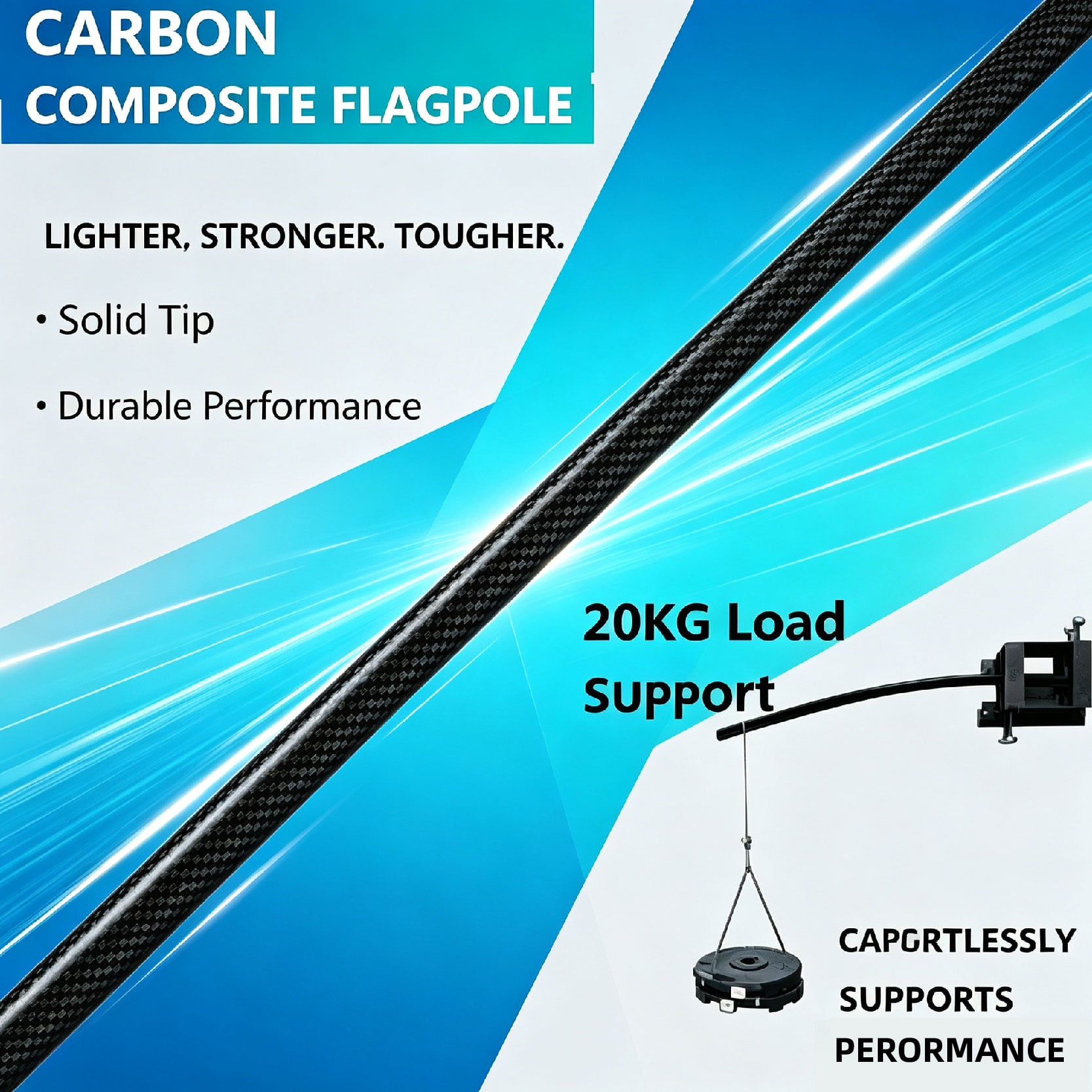
Carbon composite poles behave like a spring. They deflect under load and snap back to true zero‑degree alignment. There is no metal to rust. At 0.5 kg per complete unit, a carbon pole is dramatically lighter than the typical aluminum pole (0.85–1.10 kg). That weight delta trims freight charges and customs valuation in one stroke. carbon composite articles fall under a different Harmonized System heading—typically 6815.10, non‑electrical graphite or carbon articles—so many countries assign a lower general duty rate and avoid the anti‑dumping measures that now target Chinese aluminum extrusions. The graphic, printed on nylon with CMYK heat‑transfer dyes, stays taut; a 360‑degree rotating joint keeps the message readable regardless of vehicle orientation.
Insist on seeing the data. WZRODS’s carbon pole, subjected to cyclic wind loads at 55 mph, shows less than 0.5 degrees of permanent set after 10,000 flex cycles. A comparable aluminum pole begins to sag after a few hundred. The question to ask yourself: “How many times will I have to replace this flag before the campaign ends, and what does the labor for that replacement cost?”
2. Product Comparison: Carbon Composite vs. Aluminum
The physics are straightforward. A carbon composite pole stores and releases energy like a watch spring; aluminum accumulates damage like a paperclip bent back and forth. The table below makes the differences measurable.
| Feature | WZRODS Carbon Composite | Typical Aluminum Alternative |
|---|---|---|
| Unit Weight (pole + clip + banner) | 0.500 kg | 0.85–1.10 kg |
| Wind Resistance (max speed without permanent set) | 55 mph (88 km/h); after 10,000 cycles, permanent set < 0.5° | ~25 mph (40 km/h) before plastic deformation begins |
| Corrosion Resistance | 100% rust‑proof; no metal in pole | Anodized layer can fail in salt air; pitting common after 6–12 months coastal exposure |
| Rotation Mechanism | 360° self‑lubricating polymer bearing | Often a simple metal‑to‑metal swivel; can seize with dirt |
| Installation Time | Under 5 seconds: clip slides onto window, no tools | Comparable, though extra weight can make alignment fussier |
| Typical Lifespan in Outdoor Commercial Use | 3+ years (backed by a 3‑year warranty) | 6–18 months, depending on environment |
| Import Duty Classification (selected markets) | Often HS 6815.10 (carbon articles); lower MFN rates; rarely attracts anti‑dumping actions | Aluminum extrusion codes; under active anti‑dumping scrutiny in EU, USA, India, Brazil |
The freight arithmetic alone rewards attention. A 40‑foot high‑cube container holds approximately 12,142 carbon composite kits, giving a total cargo weight of around 6,071 kg. The same container filled with heavier aluminum kits could exceed 12,000 kg, pushing the shipment into a higher freight bracket—particularly painful for air freight or LCL consolidations. For high‑volume distributors moving tens of thousands of units a year, the cumulative landed‑cost impact often outweighs any ex‑works price difference.
The clip uses a polymer pad that grips window glass without scratching it. Lower weight reduces the lever‑arm force on the glass, a detail that matters because vehicle manufacturers set maximum weight limits for window‑mounted items to protect the window‑regulator mechanism. A 0.5 kg flag falls well within those internal standards; an aluminum pole approaching twice that mass puts more stress on the system.
3. ROI Analysis: True Landed Cost and the Lower Duty Code
Stop comparing a unit price in dollars and walking away. A genuine return‑on‑investment calculation must include: ex‑works price, international freight, customs duty and clearance fees, and the replacement rate over your planning horizon. Only then does the true cost per effective display‑day appear.
Consider a distributor buying 5,000 banners for a year‑long campaign across coastal dealerships in Southeast Asia. The table below illustrates the first‑year comparison. (Duty rates are illustrative; actual rates vary by country of import and specific tariff classification. Verify with your customs broker.)
5,000‑Unit Campaign, Coastal Environment, One‑Year Horizon
| Cost Element | Aluminum Option | Carbon Composite (WZRODS) |
|---|---|---|
| Ex‑Works (per unit) | $2.80 | $3.40 |
| Sea Freight (est.) | $2,200 | $1,700 |
| Duty & Clearance | $1,680 (12% illustrative) | $850 (5% illustrative) |
| Year‑One Replacements (30% failure) | $4,960 (incl. freight/duty on 1,500 units) | $0 |
| Total Year‑One Cost | $24,840 | $19,550 |
| Cost per Effective Banner | $4.97 | $3.91 |
The carbon composite option saves more than a dollar per banner in year one while delivering a product that never droops mid‑campaign. Over three years, the gap widens: the aluminum fleet would need another replacement cycle, while the carbon poles remain under warranty with zero additional units required.
Equipping your sales force with a banner that collapses on day two is like sending a team into a client meeting with a torn shirt. The initial sticker price looks low, but the logistical tail—apologetic phone calls, credit notes, and re‑shipping—erases the savings. Dealerships know that a drooping flag makes the entire lot look neglected. A crisp, permanently spinning banner catches the eye and signals attention to detail. That is free, perpetual advertising you do not have to manage.
4. Industry Applications: From the Car Lot to the Convention Center Floor
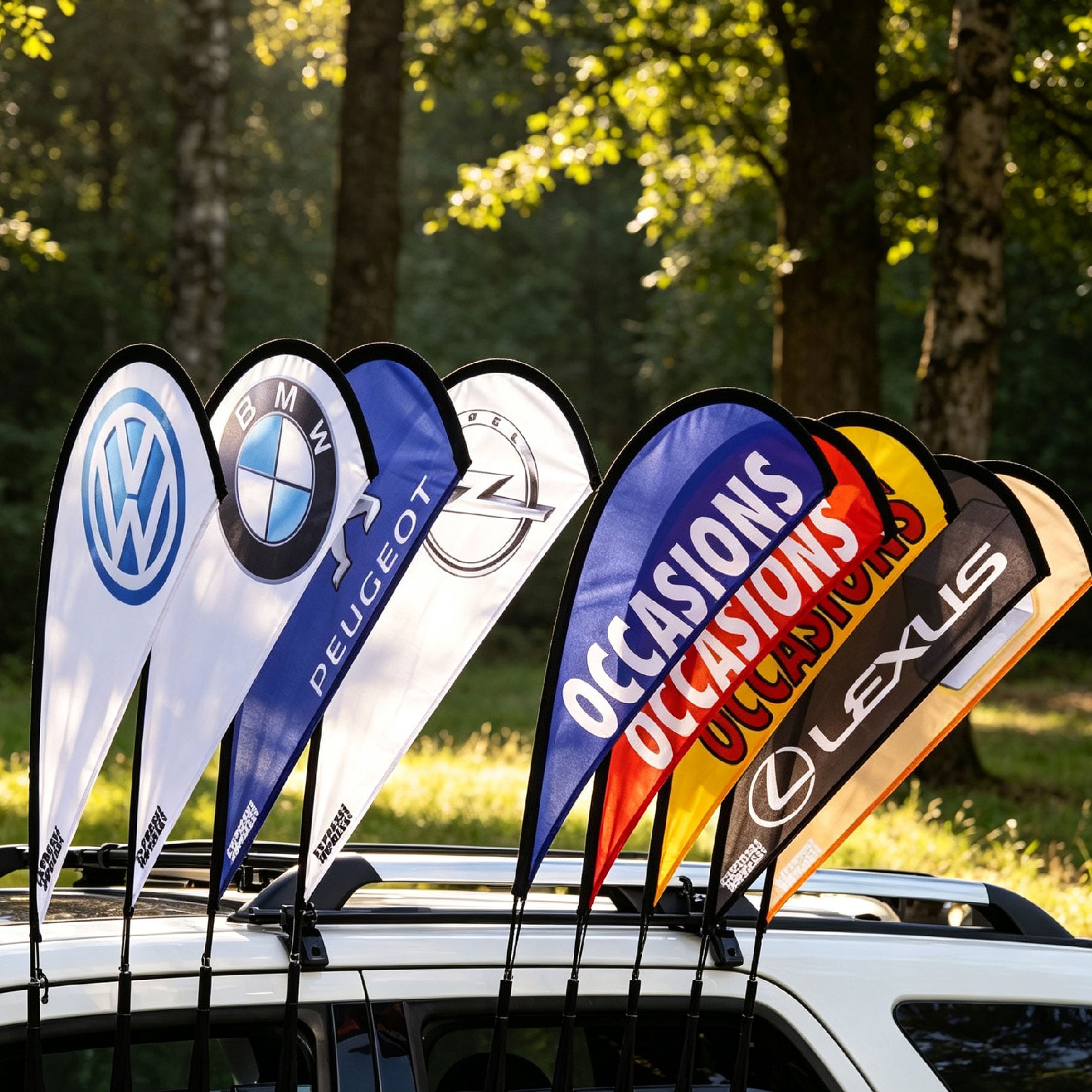
A window banner travels well beyond the automotive lot. Its portability and clip‑and‑forget design unlock use cases that ground‑staked flags cannot serve. Understanding these applications lets a B2B buyer widen the addressable market far past the initial niche.
4.1 Automotive Dealerships and Used‑Car Lots
This is the core habitat. Twenty identical sedans become a sea of sameness until a feather‑shaped banner on every other window announces “0% Financing” or “Certified Pre‑Owned.” The banner must survive repeated install‑remove cycles; salespeople may reposition flags several times a day. A heavy aluminum pole dropped on asphalt dents and looks beat, while a carbon composite pole bounces with a scuff. Every flag pointing straight up conveys managerial competence.
4.2 Street Fairs, Food Truck Rallies, and Farmers’ Markets
Vendors need lightweight signage that clips onto any vehicle without damaging paint. The rotating rectangle banner is popular here because it accommodates wide price lists or menu items. These events frequently occur near the coast (seafood festivals in Malaysia, Florida markets). The 100% rust‑proof carbon pole eliminates the white oxide streaks that aluminum poles can leave on car doors.
4.3 Corporate Events and Trade Show Booths
Trade show floors ban large outdoor banners, but a window banner clipped to a service cart or a booth frame creates an affordable pop‑up directional sign. Organizers have used teardrop banners on registration desks to guide attendees through queues. The feather shape lifts a logo above crowd height. Event planners who ship materials internationally appreciate 0.5 kg per unit—100 banners can travel as excess baggage without the punitive fees heavier alternatives attract.
4.4 Political Campaigns and Public Gatherings
A candidate’s convoy needs visibility. A rectangle or feather banner clipped to a campaign SUV puts the name at pedestrian eye level. With a 35‑mph safe‑speed rating, the WZRODS flag stays stable on city streets. Tool‑free installation means a volunteer outfits ten vehicles in under two minutes—critical when timelines are tight.
5. Inside the Factory: How a Carbon Composite Pole Earns Its Three‑Year Warranty
A buyer who does not understand how the product is made ends up paying for defects that could have been prevented. WZRODS’s manufacturing process in Shandong, China, differs from a typical aluminum‑pole line at almost every step, and those differences compound into reliability.
Carbon composite poles are produced by pultrusion, not extrusion. What I've learned: Continuous carbon‑fiber tows are pulled through a resin bath, then through a heated die that cures the composite into a precise, thin‑walled tube. The fibers align along the pole’s length, giving it enormous flexural strength exactly where wind applies force. The cured tube is cut to 89 cm, with wall thickness controlled to ±0.05 mm. Injection‑molded polymer fittings that hold the rotating joint and the banner clip are affixed to the ends. The rotation mechanism uses a self‑lubricating polymer ring—no oil, no maintenance.
Printing runs on a parallel line. Nylon fabric is coated to accept heat‑transfer dyes, then CMYK artwork is applied at 200°C under pressure. The dye fuses into the fabric rather than sitting on top; the banner will not crack or peel when folded, and it resists fading for the life of the pole. Vector files (AI or PDF) produce the best results. Standard production lead‑time is 15 to 30 days, with a 3‑day fast‑customization service for design proofing.
Quality control is deliberately old‑fashioned in one respect: a sample from every production batch is mounted on a test rig and subjected to cyclical wind loads at 55 mph for 48 continuous hours. The pole must show no more than 0.5 degrees of permanent set. The clip must retain its grip without cracking. This “show, don’t tell” discipline is what supports a warranty that covers the pole, rotation mechanism, and clip for three full years—far longer than the six‑ or twelve‑month promises typical of aluminum flags.
6. Trends Shaping the Portable Signage Market Now
Three forces are converging to make carbon composite the standard pole material for vehicle‑mounted flags. Buyers who act now position themselves ahead of the curve.
Regulatory pressure on aluminum imports. Since 2020, the European Union, United States, India, and other jurisdictions have tightened anti‑dumping duties on Chinese aluminum extrusions. A container of aluminum flag poles can suddenly face a 30% duty surcharge, making the aluminum product more expensive than carbon composite overnight. Because carbon composite articles fall under a separate tariff chapter, they slip through without triggering those aggressive levies. This is not a loophole; it is the direct result of material classification, and it rewards buyers who understand customs law.
Freight cost volatility. Ocean rates remain elevated. Every kilogram saved on a 40‑foot container reduces exposure to rate swings. A lighter product also makes air freight viable for rush orders—500 carbon banners can fly to a last‑minute political rally for a manageable surcharge because the package weighs half as much as the aluminum alternative.
Sustainability demands. Corporate clients increasingly request “green” promotional items. Carbon composite is not curbside recyclable today, but its 3‑year service life means far fewer units are manufactured and discarded over time. That aligns with the waste‑hierarchy principle of reduction before recycling. WZRODS is exploring bio‑based resins for future iterations. For now, the strongest environmental argument is straightforward: a product that lasts three years outdoors without replacement drastically cuts the plastic and metal waste stream.
7. Upgrade Solution: Transitioning Your Distribution Line from Aluminum to Carbon Composite—Without Confusing Your Customers
The final piece is not the product itself, but the story you wrap around it. Swapping one SKU for another silently leaves margin and loyalty on the table. Treat the migration as a deliberate upgrade program.
First, buy a sample. WZRODS charges $50 for one unit (limit one, no free samples). Hand it to your most skeptical sales manager. Let him bend the pole into a U and watch it spring back. That's real money. That visual evidence of elastic recovery beats any brochure. Then calculate your own landed cost using your country’s real duty rate. More often than not, the carbon composite banner is already cheaper to land than the aluminum product you currently stock.
Second, create a one‑page PDF. Show a side‑by‑side photo: a permanently bent aluminum pole next to a straight carbon pole. Caption it: “One weekend sale. Which image did you leave your customers?” Train your sales team to lead with the warranty and the freight saving, not the materials science. Business buyers care about money and reliability; they will accept a slightly higher unit price once they see the long‑run math.
Third, incentivize the first container. With 12,142 kits in a 40HQ, a full‑container launch promotion—for example, “Buy 200, get 10 free”—is easily absorbed by the improved margin from lower after‑sale service costs. Once an end user experiences a flag that never droops, they will not willingly go back to aluminum. You capture a recurring revenue stream that is immune to corrosion‑based complaints.
A car window banner looks like a commodity. The buyer who masters the materials, the freight arithmetic, and the duty codes will not suffer the fate of that distributor in 2019. You will build a reputation as the supplier whose flags never make a dealership look shabby. That reputation is worth far more than the few cents of price difference on an invoice.
Frequently Asked Questions
1. What exactly comes in one unit of the car window banner?
Each complete kit includes one carbon composite pole in the selected shape (feather, teardrop, or rectangle), one printed nylon banner, the 360‑degree rotation joint, and the window‑clip attachment. You need nothing else to deploy it.
2. What is the minimum order quantity?
The MOQ is two pieces. This low threshold lets importers and distributors test the product before committing to volume.
3. Can I get a free sample?
No. The sample policy is one piece at $50, with a maximum of one sample per customer. The sample is a fully functional unit and can be used to demonstrate the product to your own clients.
4. What artwork file formats do you accept?
Vector files work best for sharp printing: Adobe Illustrator (AI) or PDF. Heat‑transfer printing requires high‑resolution sources to avoid pixelation. If you need design assistance, WZRODS offers a 3‑day image design service under the fast‑customization option.
5. How long does printing and production take?
Standard lead time is 15 to 30 days from order confirmation, depending on quantity and current production queue. The 3‑day fast‑customization service is available for design and sample proofing; full production then follows the standard schedule.
6. Can the banner rotate in windless conditions?
Yes. The rotation mechanism is free‑spinning and does not depend on wind. Even when the vehicle is stationary, the lightest air current or a passing pedestrian can set the banner turning, keeping the printed message visible from multiple angles.
7. What is the maximum vehicle speed for safe use?
The flag is designed for stationary and low‑speed applications. It remains stable and safe at speeds up to 35 mph (approximately 56 km/h). This covers city driving, slow‑moving convoys, and moving between parking areas.
8. Will the clip damage the car window or paint?
No. The clip uses a polymer grip pad that holds the glass firmly without scratching it. The entire assembly weighs only 0.5 kg, so there is minimal leverage force on the window mechanism. It is compatible with virtually any modern car window.
9. How does the carbon composite pole handle coastal, salty air?
It is completely unaffected. Unlike aluminum, which can corrode through pitting when its anodized layer is breached, carbon composite has no metal component to oxidize. There is no rust, no white oxide residue, and no loss of structural integrity after years of marine exposure.
10. What kind of warranty comes with the product?
WZRODS provides a 3‑year warranty against manufacturing defects and premature structural failure. The warranty covers the pole, the rotation mechanism, and the clip. The fabric banner is warranted against fading and peeling under normal outdoor use for the same period.
11. Can I mix different shapes in one order?
Yes. You can order any combination of feather, teardrop, and rectangle shapes as long as the total quantity meets the MOQ of two pieces. Unit price may vary slightly by shape due to banner‑size differences, but the pole and clip are standardized.
12. How many units fit in a container?
Approximately 12,142 car window banner kits can be packed into a 40‑foot high‑cube container (68 cubic meters). The exact number depends on the mix of shapes and packaging configuration, but this figure provides a reliable basis for freight and inventory planning.
13. What payment terms are available?
WZRODS accepts T/T (telegraphic transfer), L/C (letter of credit), and Western Union. Terms are negotiated at the time of order; regular buyers may qualify for more favorable conditions.
14. Do you offer private labeling or custom packaging?
Yes. Custom branding on the banner is the core service. Custom packaging—such as retail boxes with your logo—can be discussed during the quoting process. MOQs for custom packaging may be higher than for standard packaging.
15. Where do I send my purchase order or inquiry?
All inquiries can be directed through the official WZRODS trade channels. The company ships from Shandong, China, and serves distributors and event planners worldwide. For large tenders, you may request a formal proforma invoice that details the ex‑works price, estimated freight, and applicable HS code so you can calculate your exact landed cost.
About the Author
Sarah Mitchell, Trade Show Consultant
B.A. Marketing, University of Texas; CTSM (Certified Trade Show Marketer)
Event marketing specialist with 200+ trade shows across 15 countries. Helps exhibitors cut setup costs by 30% through smarter hardware choices.
Reviewed by WZRODS Technical Team. Updated: 2026-07-04
 Comments (0)
No comments yet. Be the first to comment!
Leave a Comment
Related Products
Related Articles
29kg Concrete Flag Base - The Complete B2B Buyer's Resource - WZRODS
WZRODS DY451B: 29 kg, HDPE shell, concrete core. Stackable, portable, rust-proof. FOB price US$5.75–$6.85 at MOQ 2 units. Those numbers look unremarkable. Factor in landed cost—import duties lower than aluminum’s under relevant HTS codes, freight savings from less weight per unit of stabilizing mas
Wide Tube Cross Base - The Complete B2B Buyer's Resource - WZRODS
The Wide Tube Cross Base, manufactured by Wzrods in Shandong, China, solves one problem: reliable stability for poles under three meters, without the freight costs and warehouse footprint that heavier alternatives demand.
Rectangular Pipe Cross Base - The Complete B2B Buyer's Resource - WZRODS
The pipe cross flag base is a cross of rectangular steel pipe, powder‑coated, weighing 1.3 kg and spanning 78 cm across its arms. Its center holds a C‑ring shaft that lets the flag rotate with the wind.
X-Shape Backpack Banner - The Complete B2B Buyer's Resource - WZRODS
Economic Cross Base - The Complete B2B Buyer's Guide- WZRODS
When you buy an economic cross base—something like the Wzrods DM‑9, a 77 cm‑long, 1.3 kg iron cross—forget “economic” as a synonym for “cheap.” It means value-engineered.
How to Choose the Right Feather Flag Base for Different Surfaces
Feather Flag - Professional Banner Poles & Systems Manufacturer - WZRODS
How to choose a high-quality backpack flag
The backpack flag concept centers on a frame carried on the back, similar to a backpack, specifically engineered to support a raised flag or banner.