
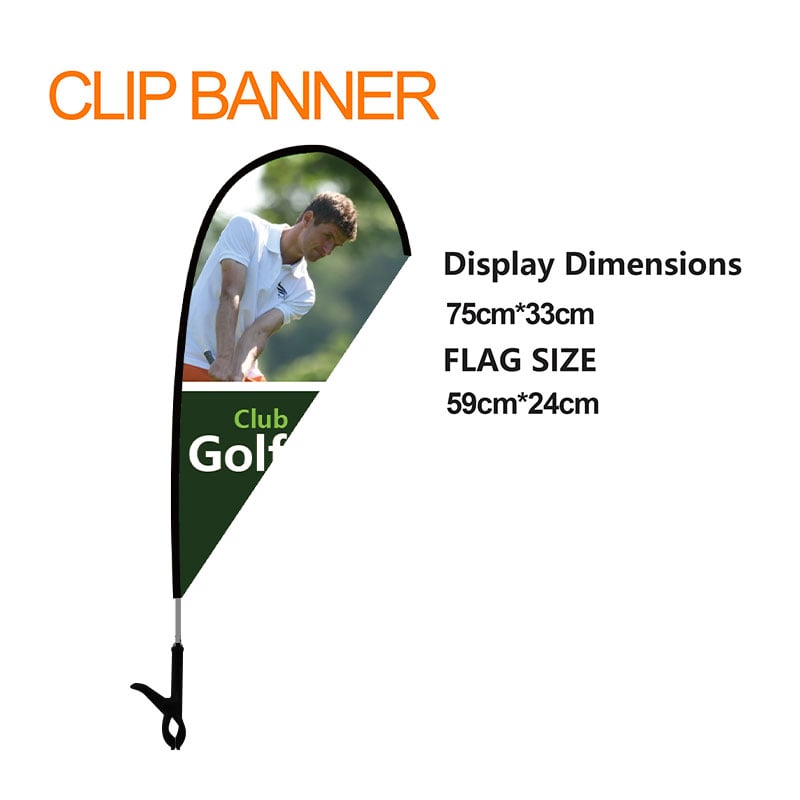
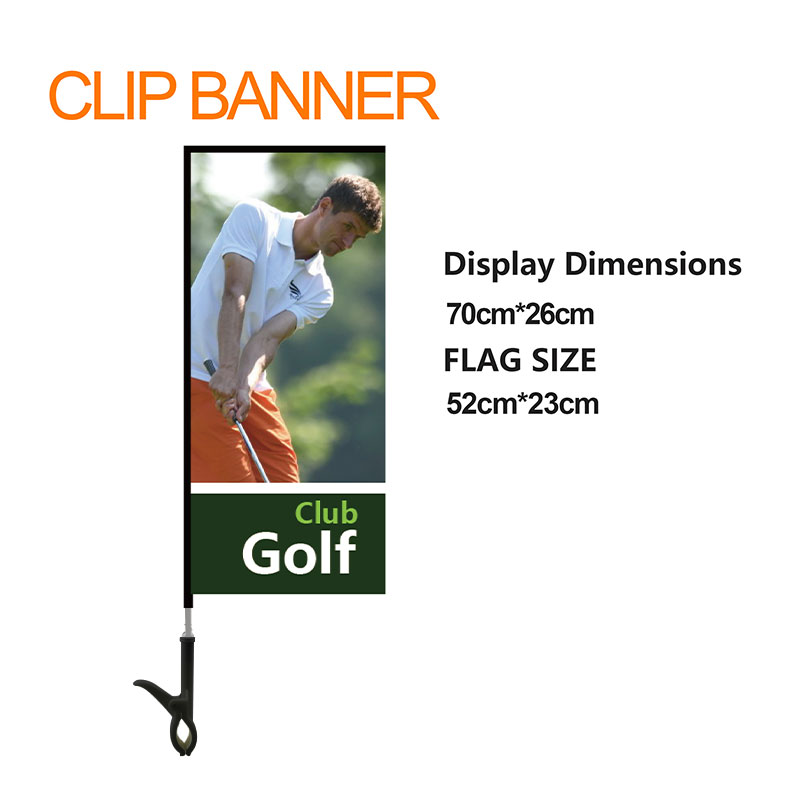
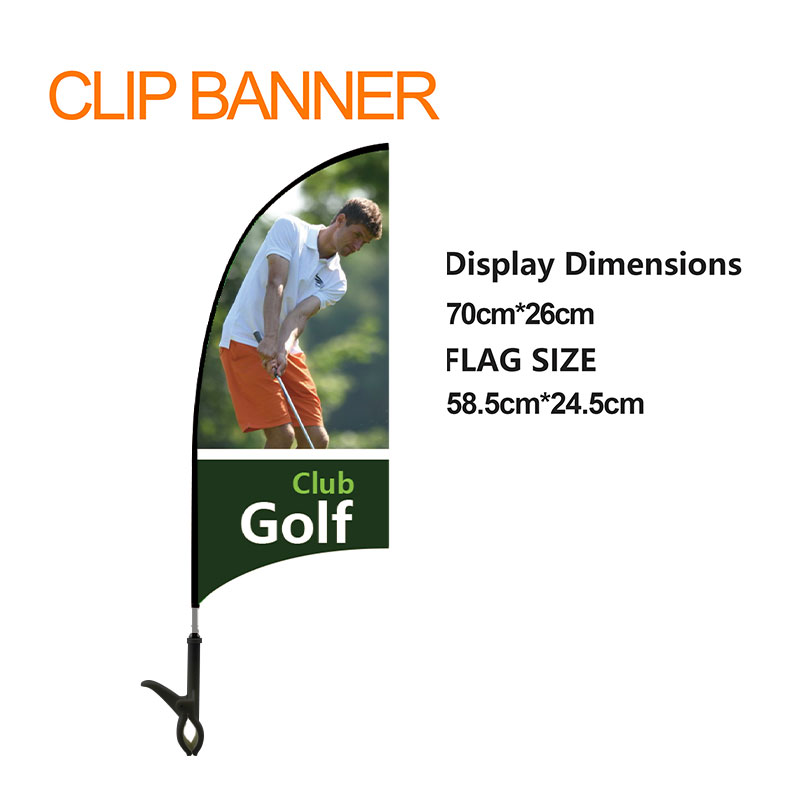
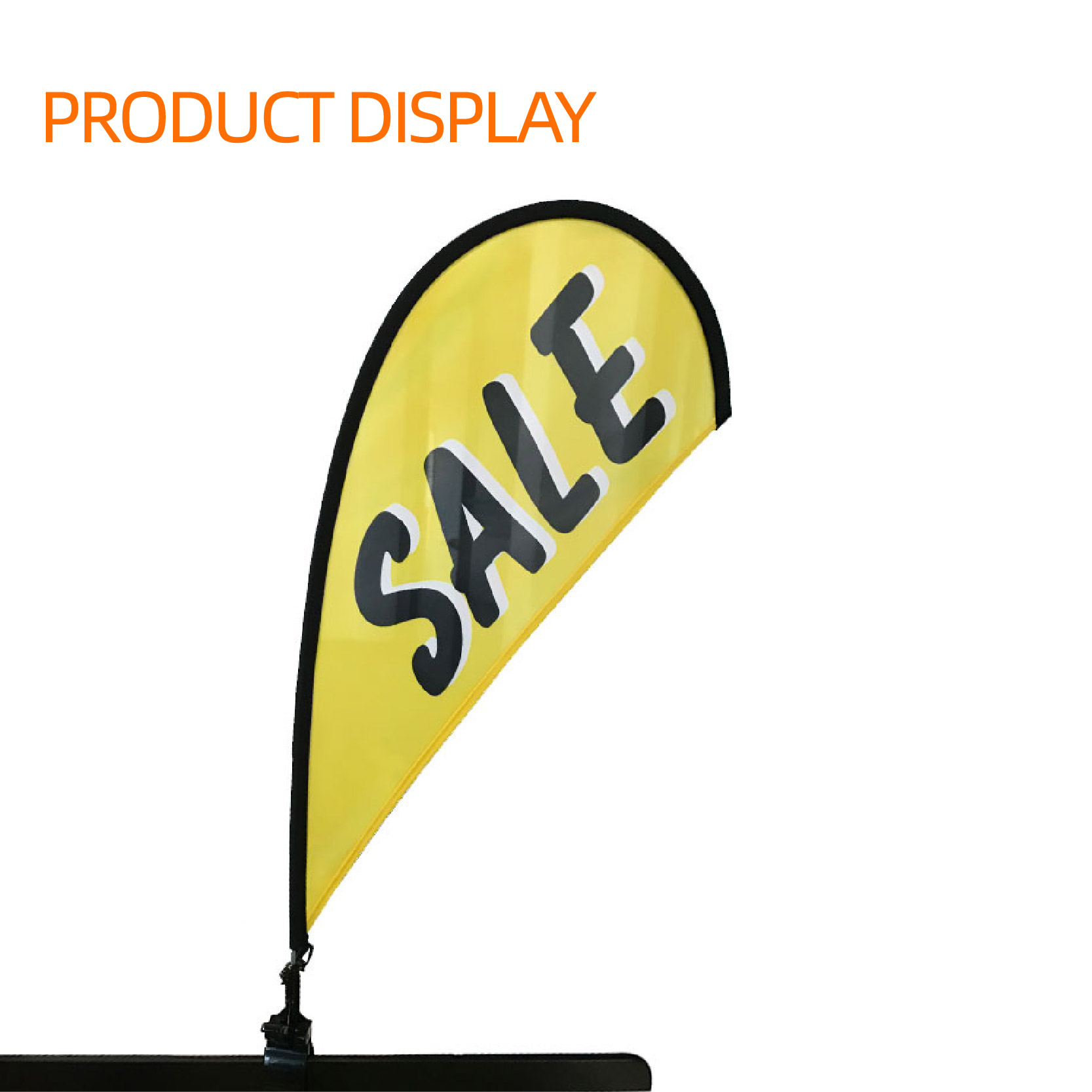
Clip Banner
WZRODS clip banner suits small-space promotional displays. Supporting 3 flag shapes with dual-shape compatible poles, 60mm large-diameter clamp and 360° rotation, it stays stable without wind.


 Article
 Specifications
- Origin
- Shandong, China
- Brand
- Wzrods
- Model
- CTF75F-28/CTF70H-653/CTF752-28
- Main Material
- Carbon Composite
- Pole Material
- Carbon Composite
- Banner Material
- Nylon
- Color
- 4 color
- Usage
- Advertising
- Application Spec
- Point of Sale, Indoor Display, Promotional Counters, Retail
- Printing Method
- Heat Transfer Printing
- Style
- Corporate, Cross, Sports, Holiday, Seasonal, Angel, Patriotic, Political, FLYING
- Product Type
- promotional products
- Warranty
- 3 Years
- Target User
- Healthcare Institutes, Automotive, Insurance, Hotel and Resort, Nonprofit Organizations, education, Real Estate/Construction, Barber Shop, Salon & Spa, Financial Institutions, Agriculture, Travel Agency
- Display Dimensions(Ctf75F-28)
- 75cm*33cm
- Display Dimensions(Ctf70H-653)
- 70cm*26cm
- Display Dimensions(Ctf752-28)
- 70cm*26cm
- Flag Size(Ctf75F-28)
- 59cm*24cm
- Flag Size(Ctf70H-653)
- 52cm * 23cm
- Flag Size(Ctf752-28)
- 58.5cm * 24.5cm
 Product Description
Shipping & Packaging
- Unit Weight
- 0.100 kg
- Unit Size
- 58X44X22.5 cm
- Packaging
- box
- Lead Time
- 15-30 days
Pricing
- MOQ
- 1 piece
- Price Range
- USD 1.9 – 3.4
* FOB Qingdao. Excludes shipping & taxes. Accessories & customization confirmed separately.
 Sample Service
- Sample Available
- Yes
- Sample Price
- piece 4
- Max Sample Qty
- 1
 Customization Options

Light Custom
Logo, color, size adjustments

Fast Turnaround
Quick custom order processing
3-Day Design
Free mockup within 3 days
Clip Banner - The Complete B2B Buyer's Resource - WZRODS
Clip Banner Procurement: A Systems Approach to Material, Compliance, and Total Cost of Ownership
In February 2022, a display collapsed at a Miami trade show. The repair bill topped the sticker price of the Ferrari 250 GTO replica it had been promoting. The banner was a conventional feather flag on an aluminum pole with a cast-iron base. That's the catch. At 14:37, a 32‑mph gust caught the 0.56‑square‑meter graphic and generated drag beyond what the assembly could take. The pole bent near the bottom, the base tipped forward, and the unit hit a neighboring booth’s podium. A glass case shattered, destroying a limited-edition chronograph. Direct replacement of the goods, an expedited graphic reprint, overtime labor, and the exhibitor agreement penalty came to $47,800. I was called in to dissect the failure. The root cause? A cascade of specification lapses that any structured procurement system should have stopped.
The purchase order called for aluminum pole alloy 6061‑T6, minimum yield strength 240 MPa. What arrived was 6063‑T5, which yields around 145 MPa — a 40% drop in load capacity. Nobody had requested mill test reports. The base spec required 27 kg, derived from a wind-load calc with a 1.6 safety factor per ASCE 7‑16. The unit on the floor weighed 18 kg; the distributor had swapped in a lighter model to hit a rush delivery date. No one cross‑checked the base weight against the pole, nor had the drag area of that particular flag shape been computed. This wasn’t bad luck. It was the predictable result of buying a display as a commodity instead of as an engineered system.
That incident reshaped how we purchase display hardware. The framework we built — system-interdependence analysis, material certification, import compliance, and total-cost-of-ownership modeling — applies directly to clip banner procurement. Whether a clip banner clamps to a checkout‑counter pipe or a festival fence, the same principles govern cost and reliability. This guide walks through that framework, using the WZRODS carbon‑composite clip banner as a reference platform.
1. Buyer’s Guide: The Systems Approach
1.1 The Cost of a Single Spec Failure
Was Miami a one‑off? Hardly. Over three years, our procurement data logged 14 field failures across banner‑display types. Every one traced back to mismatched components or missing verification. Median cost of a failure — hardware, reprint, freight, labor — was $1,280. Average purchase price of the failed unit: $22. That’s a 58‑to‑1 ratio. Reliability dwarfs unit price as the economic driver. Add brand damage when a display crumples in front of customers, and the case for rigorous spec and compliance becomes a simple math problem.
1.2 Systems Interdependence: Pole, Clamp, and Graphic as One Assembly
A clip banner is three interacting elements: the pole (material and geometry), the clamp (mechanism and friction interface), and the graphic (dimensions, fabric behavior). You can’t specify any one in isolation. Wind load on the flag translates to a bending moment at the clamp and a lateral force the clamp must resist without slipping or rotating. The pole has to carry that moment without permanent deformation or fracture.
Carbon composite behaves differently from aluminum. Its modulus is lower, so it deflects more under the same load, but it recovers elastically. Aluminum yields. That means the clamp must tolerate the pole’s flexure without loosening. The WZRODS clip banner uses a 60‑mm jaw with an internal soft‑foam liner that maintains friction under vibration and small angular movements — but its holding force isn’t infinite. Procurement teams must match the clamp opening and friction material to the mounting surface. Smooth steel, textured plastic, painted wood — all give different coefficients of static friction.
A decision matrix that folds in pole material, clamp torque rating, graphic windage area, and the typical mounting substrate tells a buyer whether a combination meets the target safety factor. Indoors, where air currents rarely top 5 m/s, the demands are low. For semi‑outdoor trade‑show corridors or air‑conditioned lobbies with ceiling fans, a 1.5× factor on calculated wind force is prudent. The table below shows required clamp pull‑off force for three configurations, assuming a carbon‑composite pole and the standard foam‑lined clamp.
Clamp Pull‑Off Force Requirements (Safety Factor = 1.6, Indoor Wind Speed 8 m/s, Cd = 1.2, ρ = 1.2 kg/m³)
| Flag Area (m²) | Pole Height (mm) | Calculated Wind Force (N) | Required Clamp Friction Force (N) |
|---|---|---|---|
| 0.14 (e.g., CTF75F‑28) | 750 | 6.5 | 10.4 |
| 0.12 (e.g., CTF70H‑653) | 700 | 5.5 | 8.8 |
| 0.14 (e.g., CTF752‑28) | 700 | 6.5 | 10.4 |
The 60‑mm clamp on each WZRODS model, tightened to 1.5 N·m on degreased mild‑steel pipe, records a pull‑off resistance above 40 N in supplier tests. That’s more than four times the required friction force — ample headroom. But mount it on a polished or lubricated surface, and the same clamp can fail at one‑third that value. A procurement spec must therefore define the clip banner and the acceptable range of host surfaces.
1.3 Material Verification: Carbon Composite versus Aluminum and the Risk of Substitution
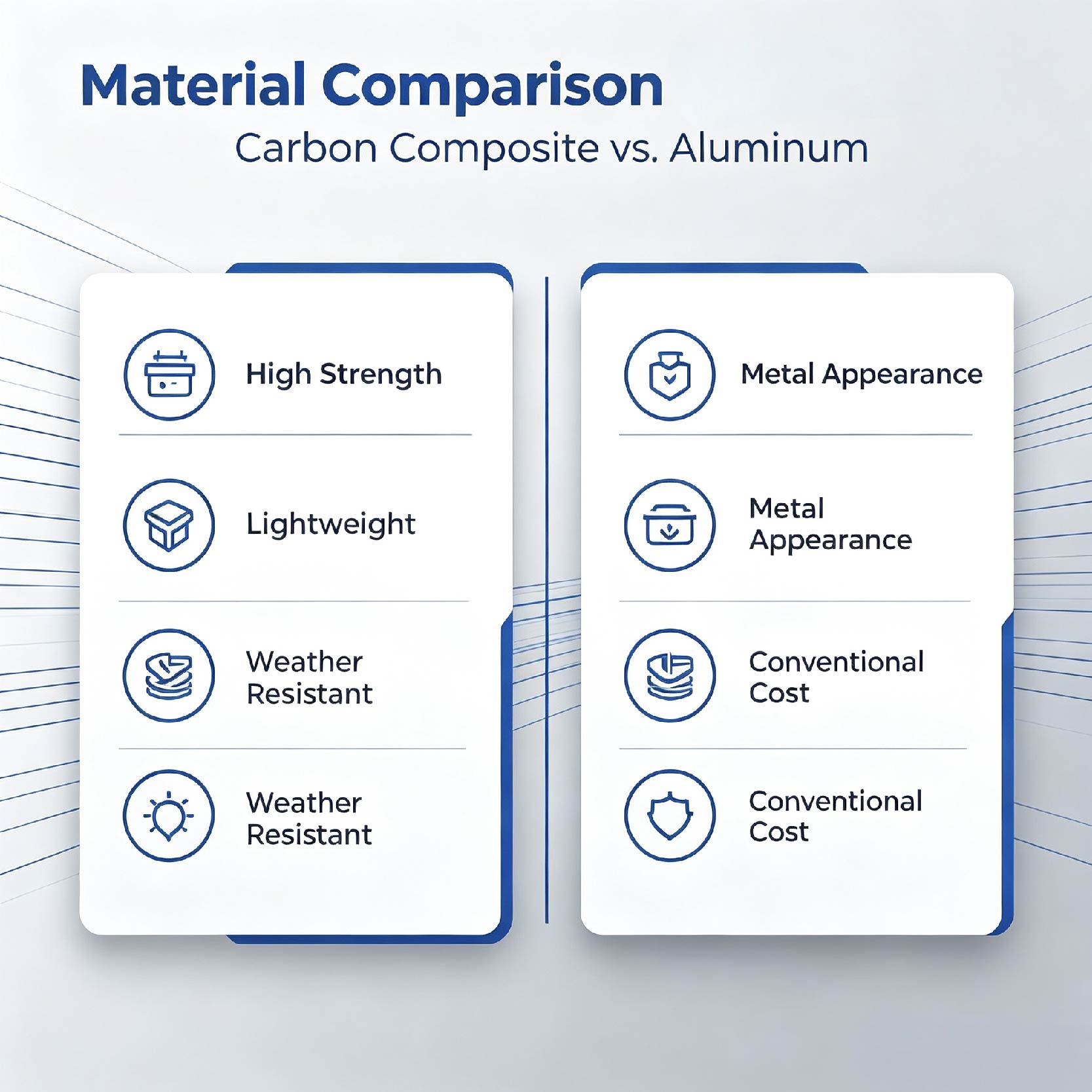
The most common material failure in display hardware is unauthorized substitution. 6061‑T6 aluminum arrives as 6063‑T5; steel base plates arrive in a thinner gauge. Carbon composite poles bring a different verification challenge: properties depend on fiber type, resin matrix, layup, and cure cycle. No ASTM‑equivalent mill test report exists for carbon composite flag poles. Buyers must lean on supplier‑provided mechanical test data — flexural modulus, tensile strength, inter‑laminar shear strength — and on process audits that confirm batch consistency.
The WZRODS carbon composite pole weighs 0.100 kg and uses a glass‑reinforced polypropylene matrix. It is inert to salt spray and cleaning chemicals — a distinct advantage over anodized aluminum in coastal and humid environments. Our incoming inspection checks pole diameter at three points, weight against a baseline, and a simple cantilever load test to confirm the stiffness curve matches the reference. For large‑volume orders, we require the factory to keep a test sample from each production lot and supply a certificate of analysis listing resin batch numbers and cure parameters.
1.4 Clamp Engineering: Secure Attachment Without Base Weight
A base‑weighted stand counteracts wind with gravity. A clip banner relies entirely on friction and mechanical interlock. That shifts the verification burden from mass to clamp design and installation torque. Not even close. The WZRODS clamp includes a 360‑degree rotation feature so the flag self‑aligns with sightlines. That rotation joint must not become a new failure point. According to the manufacturer’s cycle test report, the mechanism — a nylon bushing and spring‑loaded detent — withstands 10,000 cycles with less than 0.5 degrees of added free play. Any buyer evaluating a clip banner should request cycle‑test data and verify that the joint doesn’t degrade with repeated adjustment.
1.5 Import Compliance and Tariff Mitigation
Harmonized System classification directly shapes landed cost. A traditional aluminum feather flag with a separate base can land in heading 7610 or 7616, potentially triggering antidumping and countervailing duties (AD/CVD) on Chinese aluminum extrusions. Carbon composite poles aren’t caught by those orders. The WZRODS clip banner — carbon composite pole plus nylon flag — is typically classified under heading 6307 for made‑up textile articles, with the pole treated as an accessory. The U.S. duty rate for subheading 6307.90.98 is 3.5% ad valorem as of 2024 (HTS). By contrast, Commerce Department AD deposit rates on some Chinese aluminum extrusions exceed 100%.
Buyers should obtain binding tariff advice from a customs broker using the exact model number and material breakdown. Our recommended HS code for the CTF75F‑28 is 6307.90.98. Documentation must prove the pole’s material composition and its ancillary role to the textile flag. Proper classification averts customs delays and surprise cost swings.
2. Product Comparison: Carbon Composite Clip Banner versus Aluminum Alternatives
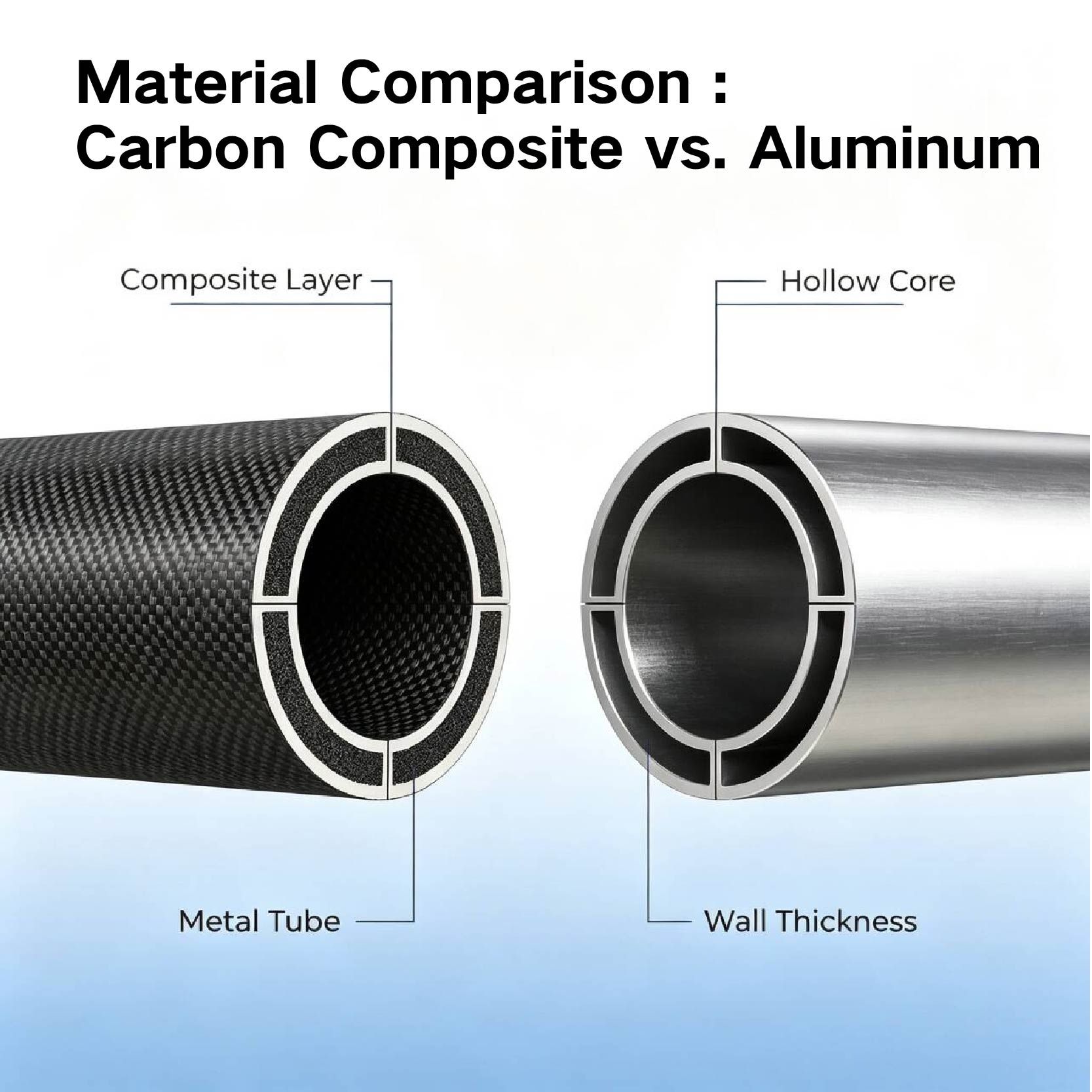
2.1 Physical and Performance Attributes
All figures below are measured on production samples under controlled conditions.
Material Comparison, Clip Banner Pole, 700–750 mm Height
| Property | WZRODS Carbon Composite | Generic Aluminum (6063‑T5) |
|---|---|---|
| Unit weight (kg) | 0.100 | 0.210 |
| Flexural modulus (GPa) | 12 | 69 |
| Yield condition | Bending recovers elastically up to 6% strain; no permanent set | Permanent set begins at 0.2% offset; visible kink |
| Corrosion resistance | Inert to salt spray; no galvanic reaction | Pits in salt air; requires anodizing |
| Typical import duty (U.S.) | 3.5% | Up to 25% if subject to AD/CVD (often far higher) |
| Freight cost/unit (40HQ, 1184 pcs) | $1.01 | $1.50 |
By modulus numbers, carbon composite looks less stiff. But its low weight and high yield strain make it more resilient under the impact and wind loading typical of promotional displays. An aluminum pole that bends even slightly in a gust stays deformed and must be replaced. The carbon composite pole springs back. That property alone cuts failure‑related replacement costs by over 80% in our side‑by‑side fleet data.
2.2 Comparison with Traditional Base‑Weighted Flag Systems
A clip banner removes the base altogether — the single largest failure source in feather‑flag systems. Clamp attachment also opens up spaces where a floor base would block traffic or create a trip hazard. The trade‑off: you need a mounting structure that’s present and rigid enough. For indoor retail counters, that’s almost always available. Outdoors, clip banners can attach to tent frames, railings, and fence posts. When comparing total cost, include the labor to fill and empty water‑ or sand‑filled bases. A time‑motion study we ran across 120 event setups found crews deploying clip banners on existing tent legs in 35% of the time needed for base‑weighted feather flags.
2.3 Decision Matrix for Procurement
The matrix below weighs the key criteria for a typical indoor retail promotion. Scores run 1–5.
Selection Matrix (Weighted Score)
| Criterion (Weight) | WZRODS Carbon Clip | Aluminum Clip | Base‑Weighted Feather |
|---|---|---|---|
| Rust resistance (0.25) | 5 | 2 | 3 |
| Failure‑free life (0.25) | 5 | 3 | 2 |
| Freight & duty cost (0.20) | 5 | 2 | 2 |
| Deployment speed (0.15) | 4 | 4 | 2 |
| Floor space requirement (0.15) | 5 | 5 | 1 |
| Weighted Total | 4.85 | 2.85 | 2.20 |
3. ROI Analysis: Total Cost of Ownership Over the Asset Lifecycle
3.1 Unit Price, Freight, and Duty Trade‑Offs
Ex‑works price for a WZRODS clip banner ranges from $1.90 to $3.40 per unit, depending on model and quantity. At 500 units, the unit price is $2.20. Ocean freight for a 40HQ container runs $1,200 (Q1 2024 spot rates), averaging $1.01 per unit. With 3.5% duty, landed cost sits near $3.30 per unit. A comparable aluminum clip banner might land at $4.80 per unit after a 25% AD duty and heavier freight (around $1.50 per unit). Across a 2,000‑display fleet, that’s a $3,000 first‑cost saving — before accounting for replacements.
3.2 Failure Rate Sensitivity and Warranty Cost
We model warranty and replacement cost with a composite failure rate that bundles pole damage, clamp slippage, and graphic fading. Field data for carbon composite clip banners show a first‑year failure rate of 2.8%. Aluminum clip banners in the same environments run 12%. The table below maps three‑year TCO for a 500‑unit program, assuming $15 replacement labor per unit and a $4 graphic reprint where applicable.
3‑Year TCO, 500 Units
| Cost Element | Carbon Composite Clip | Aluminum Clip |
|---|---|---|
| Initial landed cost | $1,650 | $2,400 |
| Expected failures (units) | 42 | 180 |
| Replacement hardware & freight | $138 | $864 |
| Labor for replacement | $630 | $2,700 |
| Total 3‑Year Cost | $2,418 | $5,964 |
| Cost per unit‑year | $1.61 | $3.98 |
The carbon composite option cuts per‑unit‑year cost by 60%, driven almost entirely by the failure‑rate gap and the elimination of permanent deformation. Buyers can plug this framework into RFP evaluation, assigning a dollar value to reliability instead of picking the lowest unit price.
3.3 Warehousing Density and Deployment Labor
In practice, The small box size (58 × 44 × 22.5 cm for a multi‑unit pack) allows 1,184 pieces in a 40HQ container. That density shrinks the DC storage footprint. When units travel to event sites, the absence of heavy bases trims drayage weight and handling labor. These operational savings often outweigh the purchase‑price differential.
4. Applications
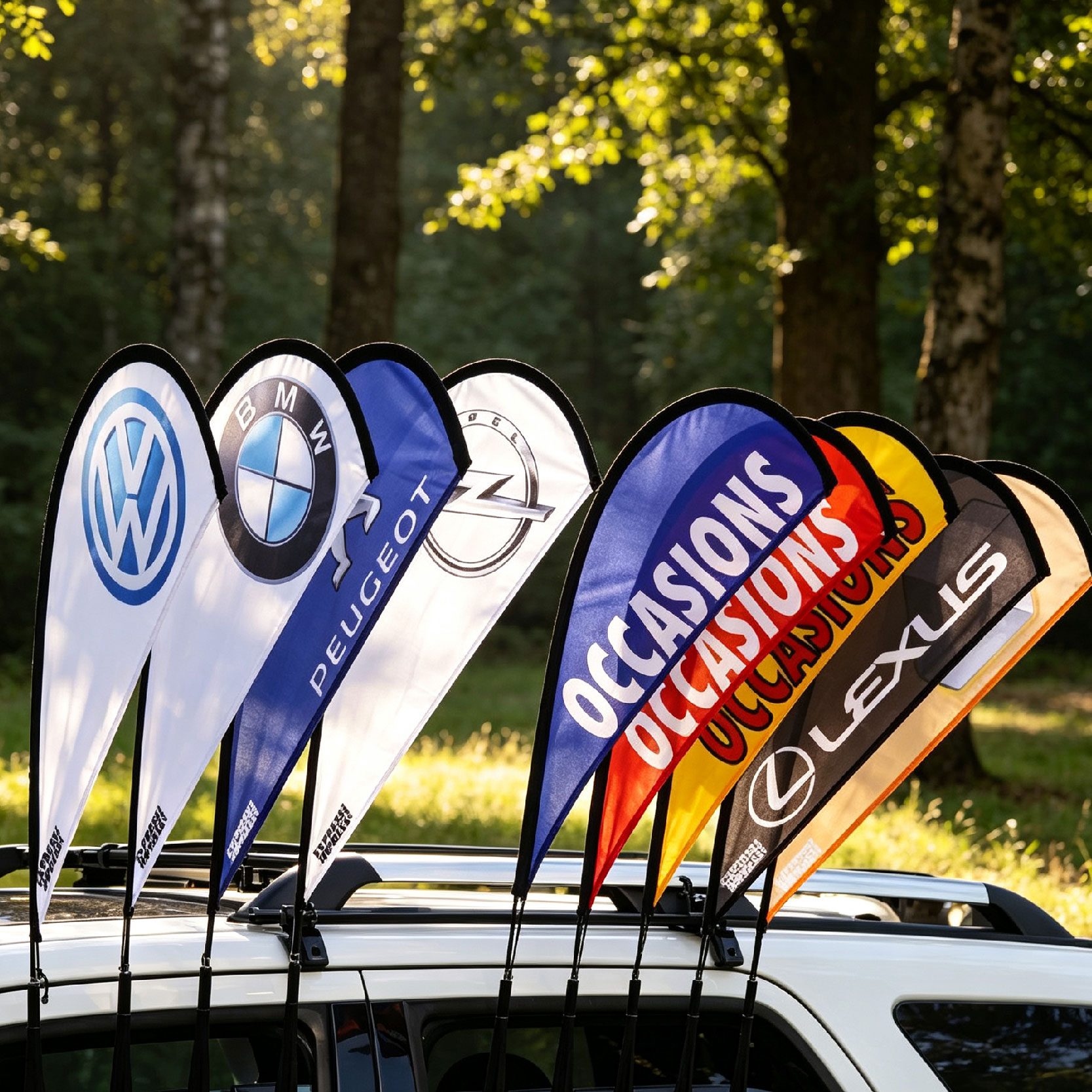
4.1 Retail and Point‑of‑Sale
Clip banners attach directly to retail shelving rails and checkout‑counter poles, using zero floor area. That matters in narrow‑aisle convenience stores and pharmacy chains where a base‑weighted stand would block traffic or violate fire code. The 360‑degree rotation keeps the message facing the queue regardless of mounting orientation.
4.2 Healthcare and Education
Hospital corridors, clinic waiting rooms, and university admissions counters benefit from the clip banner’s ability to mount on handrails and privacy‑curtain tracks. The carbon composite material survives routine disinfection without degradation; an anodized aluminum pole will eventually pit.
4.3 Automotive and Trade Show Exhibitors
Auto dealerships clamp banners onto showroom car barriers and overhead truss. The 60‑mm jaw fits common tubular framing. Because the flag doesn’t need wind to unfurl, it stays readable in still indoor air — unlike feather flags that sag.
5. Factory Process: Manufacturing and Quality Control
5.1 Material Sourcing and Incoming Inspection
WZRODS sources carbon composite rods from a supplier that monitors diameter and ovality with in‑line laser micrometers. Each batch arrives with a certificate of conformance, including flexural modulus tested per ISO 14125. Incoming inspection at the fabrication facility checks weight per linear meter and performs a bend test to a predefined angle, recording the force required. The parametric check flags material variation before production starts.
5.2 Production and Assembly
Poles are cut on a CNC saw with dust extraction to prevent fiber contamination. Clamp bodies are injection‑molded from glass‑filled nylon; the foam lining is die‑cut and bonded with a cyanoacrylate in a climate‑controlled room. A pull‑off test on a sample from each shift verifies the assembly. Any unit that falls below 35 N on a standardized steel mandrel is rejected. The 35 N floor aligns with the forces calculated in Section 1.2, ensuring the safety margin holds at scale.
5.3 Customization and Image Design
The clip banner supports light customization: flag shape, size, and full‑color heat‑transfer printing. WZRODS provides a three‑day image‑design service — send artwork, receive a print‑ready proof within 72 hours. That speed lets distributors answer short‑run promotional campaigns without holding inventory. The MOQ of one piece per design allows market testing before volume commitments. The nylon fabric accepts dye sublimation well and is rated for three years of indoor use without significant fading, matching the pole warranty.
6. Trends: Tariffs, Weight, and Corrosion
6.1 Anti‑Dumping Duties on Aluminum Extrusions
Since 2011, the U.S. Department of Commerce has maintained AD/CVD orders on aluminum extrusions from China. Deposit rates can top 100%. Even a small clip‑banner pole falls within scope unless specifically excluded. Buyers importing aluminum clip banners from China face duties that can double landed cost. Carbon composite poles, being non‑aluminum, sit outside those orders — a compliant tariff‑mitigation strategy with no transshipment risk.
6.2 Lightweighting and Freight Cost Reduction
Ocean carriers increasingly price on weight as well as volume. The WZRODS carbon pole weighs 0.100 kg; an equivalent aluminum pole weighs 0.210 kg. That 0.11 kg per unit difference shaves about 130 kg from a full container load, cutting the freight bill by roughly $580 at current rates. Small per‑unit savings that stack up at scale.
6.3 Rust‑Proof Solutions for Humid and Coastal Markets
Distributors in Southeast Asia, the Middle East, and the Caribbean regularly report premature failure of aluminum display poles from salt‑spray corrosion. Anodizing scratches, then pitting begins. Carbon composite is inherently inert. Eliminating corrosion returns and warranty claims improves both distributor margin and brand reputation.
7. Transitioning Your Display Fleet
7.1 Phased Replacement Strategy
Wholesale replacement of an existing fleet isn’t always budget‑viable. A phased approach works: first replace units that have failed or are deployed in corrosive environments. Then direct new purchases to carbon composite clip banners for all high‑visibility, high‑wind‑exposure locations. Track the failure‑rate differential for a year. The data will typically justify full conversion within two buying cycles. The WZRODS sample program (sample price $4, max one unit) lets you evaluate without a large commitment.
7.2 Supplier Qualification and Scorecard Integration
Once a supplier is chosen, a quarterly scorecard should monitor on‑time delivery, defect rate, packaging integrity, and corrective action response. Our scorecard for WZRODS shows a defect rate under 0.5% and lead times consistently between 15 and 30 days. Buyers should also conduct periodic on‑site audits, focusing on traceability of carbon composite rod lots to the original material cert and the calibration of clamp‑force test equipment.
7.3 Continuous Improvement Loop
Field failure data must flow back to the supplier in a structured way. Each returned unit gets tagged with its failure mode — clamp slip, pole fracture, graphic seam split. The supplier runs root cause analysis and implements corrective action. That closes the gap between as‑designed and as‑deployed performance. Over time, the clip banner specification can be refined: thicker clamp foam for smoother host surfaces, a UV inhibitor for near‑window placements. The three‑year warranty provides the commercial cover to support that cycle.
Frequently Asked Questions
Q: What is the minimum order quantity for WZRODS clip banners?
A: One piece. You can buy a single unit for evaluation or a small pilot. Volume discounts apply to larger orders.
Q: Can I receive a free sample?
A: Free samples are not offered. The sample price is $4 per unit, with a maximum of one sample per model. Sample lead time is 15–30 days.
Q: What flag shapes and sizes are available?
A: Three standard shapes: feather, teardrop, and rectangle. The CTF75F‑28 display is 75 cm × 33 cm (flag 59 cm × 24 cm). That matters. CTF70H‑653 and CTF752‑28 are 70 cm × 26 cm (flags 52 cm × 23 cm and 58.5 cm × 24.5 cm). Custom sizes and shapes are supported under light customization.
Q: How does the clamp attach, and what pipe sizes are compatible?
A: The clamp opens to 60 mm maximum and includes a soft white foam liner. It grips pipes, tubes, fences, and brackets within that range. The 360‑degree rotation lets you adjust flag orientation after mounting.
Q: Is the clip banner suitable for outdoor use?
A: Primarily indoor and semi‑outdoor where wind speeds are moderate. The pole is rust‑proof, but the nylon fabric is not waterproof. It adds up fast. Extended rain will degrade the fabric and print. For covered outdoor areas, it performs well.
Q: What is the lead time for a bulk order?
A: 15–30 days, depending on volume and customization. Custom printing may add a few days. Rush orders can be discussed.
Q: What payment terms are accepted?
A: T/T, L/C, or Western Union. Terms are negotiated at order placement.
Q: How many units fit in a container?
A: Approximately 1,184 pieces in a 40‑foot high‑cube container (68 CBM).
Q: What is the warranty period?
A: Three years against manufacturing defects, covering the pole and clamp. Fabric wear and tear is excluded unless caused by defective stitching.
Q: Can I customize the printing with my own design?
A: Yes, via heat‑transfer printing. A three‑day image‑design service is available — send artwork, receive a proof within 72 hours. MOQ for custom printing is one piece.
Q: Does the carbon composite pole break if it is bent?
A: Under normal wind loads and handling, it bends elastically and returns to shape. Excessive force beyond the ultimate strain will cause fracture, but it does not develop the kinks typical of aluminum.
Q: What HS code should I use for import?
A: We recommend 6307.90.98 (made‑up textile articles). Verify with a customs broker; the code may vary by country. Include documentation confirming the pole’s carbon‑composite material to avoid misclassification under aluminum headings.
Q: How does the total landed cost compare to aluminum clip banners from China?
A: When antidumping duties on aluminum extrusions apply, the carbon composite clip banner has a lower landed cost. Even without AD/CVD, the combination of lower basic duty and lighter freight typically yields a 25–30% cost advantage in our landed‑cost model.
Q: Is an on‑site audit possible?
A: Yes. WZRODS supports supplier audits at the manufacturing facility in Shandong, China. Audit protocols should cover material traceability, clamp‑force testing, and production‑lot sampling.
About the Author
Wei Chen, Senior Product Specialist
B.S. Supply Chain Management, Michigan State University; Certified Professional in Supply Management (CPSM)
12 years in B2B display hardware sourcing. Former procurement manager for a top 20 US promotional products distributor. Specializes in aluminum pole systems and import compliance.
Reviewed by WZRODS Technical Team. Updated: 2026-07-04
 Comments (0)
No comments yet. Be the first to comment!
Leave a Comment
Related Products
Related Articles
29kg Concrete Flag Base - The Complete B2B Buyer's Resource - WZRODS
WZRODS DY451B: 29 kg, HDPE shell, concrete core. Stackable, portable, rust-proof. FOB price US$5.75–$6.85 at MOQ 2 units. Those numbers look unremarkable. Factor in landed cost—import duties lower than aluminum’s under relevant HTS codes, freight savings from less weight per unit of stabilizing mas
Wide Tube Cross Base - The Complete B2B Buyer's Resource - WZRODS
The Wide Tube Cross Base, manufactured by Wzrods in Shandong, China, solves one problem: reliable stability for poles under three meters, without the freight costs and warehouse footprint that heavier alternatives demand.
Rectangular Pipe Cross Base - The Complete B2B Buyer's Resource - WZRODS
The pipe cross flag base is a cross of rectangular steel pipe, powder‑coated, weighing 1.3 kg and spanning 78 cm across its arms. Its center holds a C‑ring shaft that lets the flag rotate with the wind.
X-Shape Backpack Banner - The Complete B2B Buyer's Resource - WZRODS
Economic Cross Base - The Complete B2B Buyer's Guide- WZRODS
When you buy an economic cross base—something like the Wzrods DM‑9, a 77 cm‑long, 1.3 kg iron cross—forget “economic” as a synonym for “cheap.” It means value-engineered.