Magnum Banner
Unique Magnum Banner is easy to assemble and carry. Equipped with poles for stable display in windy days, ideal for beverage and liquor brand promotion at indoor and outdoor events.


 Article
 Specifications
- Origin
- Shandong, China
- Brand
- Wzrods
- Model
- MB-21
- Pole Material
- Carbon Composite
- Banner Material
- 100% Polyester
- Color
- CMYK 4 Color Printing
- Usage
- Advertising Display
- Printing Method
- Digital Printing, Silk Screen Printing, Dye Sublimation Printing
- Design
- Custom Deisgn
- Warranty
- 3 years
- Package
- Oxford bag+ Carton
- Supply Ability
- 30000 pieces per Month
- Port Of Dispatch
- qingdao
- Packaging
- 1 pc in a PE bag, 10 pcs in a carton. Weihai Wisezone exclusive design beachflag with clip bracket outdoor brand advertising mini teardrop flying flag banner
- Customized Logo
- 10 pieces
- Port Of Dispatch
- QINGDAO
- Customized Packaging
- 10 pieces
- Graphic Customization
- 10 pieces
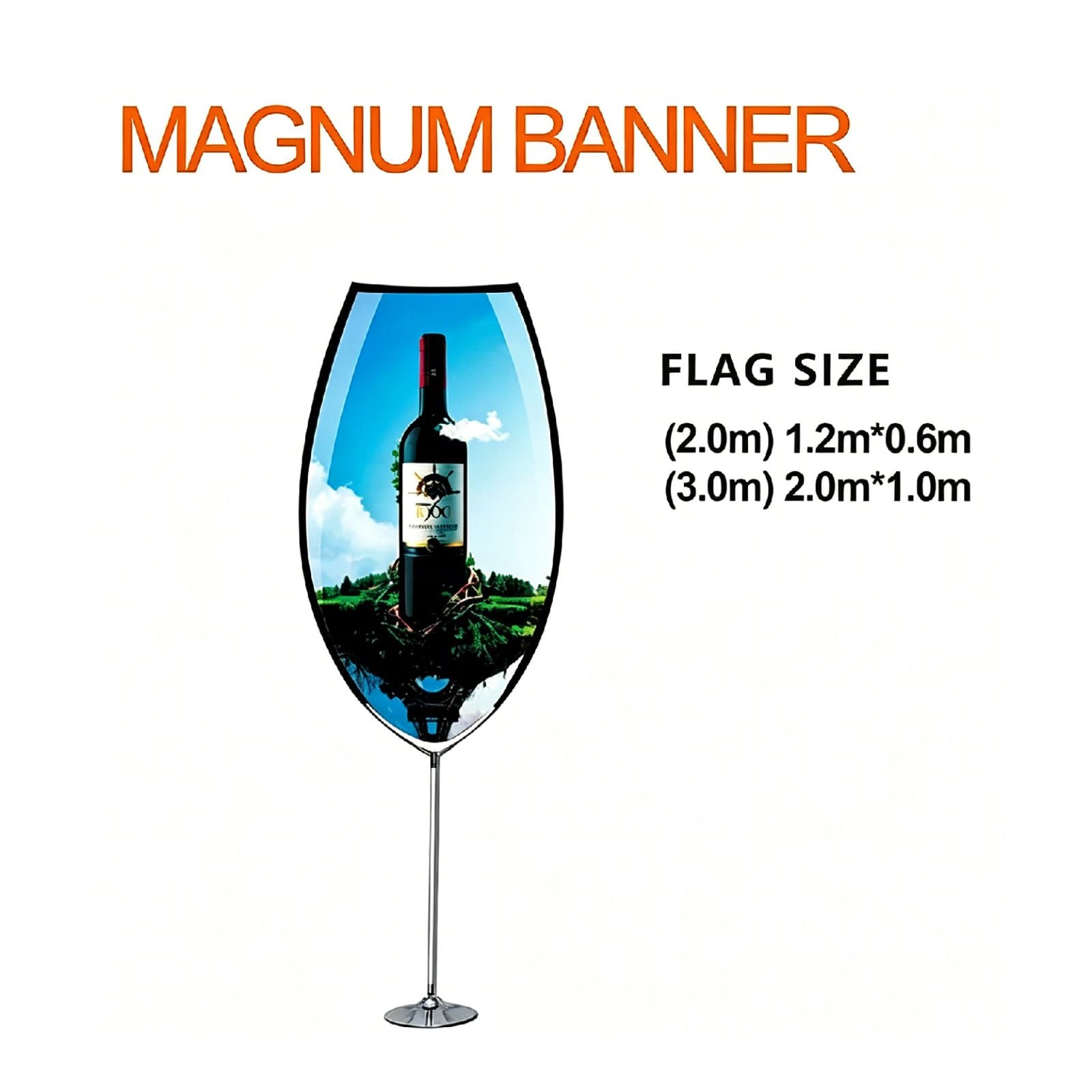
- Flag Size(2.0,M)
- 1.22*0.65m
- Flag Size(3.0,M)
- 2.03*1.08m
 Product Description
Shipping & Packaging
- Unit Weight
- 1.000 kg
- Unit Size
- 125X8X6 cm
- Packaging
- Standard export carton
- Lead Time
- 15-30 days
Pricing
- MOQ
- 1 piece
- Price Range
- USD 24 – 24
* FOB Qingdao. Excludes shipping & taxes. Accessories & customization confirmed separately.
 Sample Service
- Sample Available
- Yes
- Sample Price
- USD 63.2
 Customization Options

Light Custom
Logo, color, size adjustments

Fast Turnaround
Quick custom order processing
3-Day Design
Free mockup within 3 days
Magnum Banner - The Complete B2B Buyer's Resource - WZRODS
Two years ago at a trade show in Cologne, a beverage distributor from Singapore stopped at a booth, worn out. He had just replaced thirty banners after a single outdoor event at Marina Bay. The aluminum poles had bent under a gust, the bases had tipped, and the printed graphics were ruined. He asked his supplier for a system that would not rust in tropical humidity and would not deform during monsoon season. The supplier shrugged. That distributor eventually found the WZRODS Magnum display piece, but only after months of searching and field trials. This guide lays out the data he needed up front—the engineering, the trade-offs, and the numbers that matter when you stock hardware for a thousand events.
I. Buyer’s Guide: Core Decisions That Govern a display piece Pole Purchase
Look at a teardrop flag and you see a shape. Behind the printed polyester are engineering choices that decide whether the investment survives the next trade show or collapses on the loading dock. Three forces work against every pole system: wind, humidity, and handling fatigue. Aluminum, the industry default for decades, reveals a critical weakness after the first real gust—it yields. When a gust pushes an aluminum pole past its elastic limit, the metal deforms permanently. The display piece sags, the client notices, and the phone rings.
Carbon composite works differently. High-tensile carbon fibers in a polymer matrix store elastic energy and release it without permanent set, much like a fishing rod. WZRODS’s wind-tunnel tests, using a calibrated fan array and anemometer, show a Magnum pole recovering from repeated 50 km/h gusts with only a few degrees of deflection. An aluminum pole of the same diameter begins to hold a visible curve at 35 km/h. That single difference ripples through every procurement variable: replacement rate, freight class, and total landed cost. Shifting from a rigid pole to a resilient one rewrites the specification.
A. The Hidden Arithmetic of Weight
The complete Magnum sign system weighs 1.000 kilogram. That figure anchors every logistics conversation. A typical aluminum telescopic pole set of similar banner size runs 2.5 to 3.0 kilograms. For a shipment of 5,000 units, the mass difference is 7,500 to 10,000 kilograms. Ocean freight rates from Qingdao to Rotterdam have ranged from Ocean freight rates from Qingdao to Rotterdam have ranged from $0.08 to $0.12 per kilogram in recent years..08 to Ocean freight rates from Qingdao to Rotterdam have ranged from $0.08 to $0.12 per kilogram in recent years..12 per kilogram in recent years. And it shows. At the midpoint, the weight saving avoids roughly $750 to $1,000 in pure freight cost on a single container. And because the packaged set measures 125 cm × 8 cm × 6 cm, a 40-foot high-cube container (68 cubic meters) holds about 11,333 sets. That density lets you ship more revenue per slot.
B. Duty Codes and the Border Tax Advantage
A second gain hides in the harmonized tariff schedule. Aluminum flag poles typically land under HS heading 7610.90 (aluminum structures), which draws a 6 % import duty in the European Union. Carbon composite poles, depending on fiber content and construction, classify under 6815.10 (articles of carbon fiber) or occasionally 3926.90 (other articles of plastics). Under the EU’s Common Customs Tariff, CN code 6815 10 carries a 3.7 % duty. Some free trade agreements reduce it further. On an FOB unit value of $24, the 2.3-percentage-point differential saves roughly $0.55 per pole. Multiply by 10,000 pieces, and the tariff savings alone cover a modest marketing campaign.
C. Corrosion: The Problem Aluminum Never Solved
Aluminum corrodes in salt air. Even anodized aluminum develops pitting once chloride ions penetrate the oxide layer. Coastal markets—Southeast Asia, the Gulf, the Caribbean—will see white rust on aluminum hardware within six months. Flaking oxide soils fabric and embarrasses brand ambassadors. Carbon composite is intrinsically rust-proof. The polymer matrix encapsulates every fiber, so no galvanic cell can form. That immunity matters for beverage promotions on seaside promenades, cruise ship terminals, and any humid environment where metal eventually fails. WZRODS backs the Magnum pole with a 3‑year warranty—not a marketing gesture, but a bet on the electrochemistry of carbon.
II. Product Comparison: Metals, Fibers, and the Moment of Truth
Every buyer narrows a shortlist. The table below distills dozens of field reports, tariff schedules, and freight invoices. It assumes an East Asian factory gate, containerized shipping, and typical European destination charges.
| Specification | Magnum Carbon Composite | Aluminum Telescopic | Fiberglass | Steel Base Set |
|---|---|---|---|---|
| Unit weight (pole + base + banner) | 1.000 kg | 2.5 – 3.0 kg | 2.0 – 2.5 kg | 4.5 – 5.5 kg |
| Rust resistance | 100% immune | Pitting in coastal air | Good, UV degradation risk | Rusts unless galvanized |
| Wind behavior | Elastic bend, full recovery | Permanent bend beyond yield point | Brittle fracture possible | Permanent deformation |
| Freight cost per piece (est. to Rotterdam) | ~$0.08 – $0.12 | ~$0.20 – $0.30 | ~$0.16 – $0.25 | ~$0.36 – $0.55 |
| Typical EU import duty | 3.7% (carbon fiber articles) | 6% (aluminum structures) | 5 – 6% (fiberglass profiles) | 6% or more |
| FOB Unit Price (base set, 1 pc MOQ) | $24.00 | $16 – $22 | $20 – $28 | $25 – $35 |
Aluminum’s lower FOB price looks attractive, but the Magnum recovers that gap through freight, duty, and avoided replacements. Fiberglass resists corrosion yet weighs more than carbon composite and tends to shatter rather than bounce back from a hard knock. Steel still appears mainly as a temporary anchor; its freight penalty kills the business case for international distribution.
A Dammam‑based distributor offered the clearest field comparison. After a sandstorm snapped half his inventory of aluminum banner stands, he replaced 200 units with Magnum poles. His maintenance log showed a 98 % survival rate for the carbon composite poles over the next eight months. That same fleet of aluminum stands had historically averaged a 62 % survival rate under the same coastal, abrasive conditions.
III. ROI Analysis: The Three‑Year View That Changes the Purchase Order
Procurement is not about price per piece. It is about the total cost to keep a display upright through a supplier contract. Take a European event rental company that starts with 1,000 units and services outdoor festivals—wind, rain, frequent assembly. The company maintains a fleet of exactly 1,000 working banners, replacing failed units each year. That's the difference. Under those conditions, aluminum poles historically need a 30 % replacement rate every year due to bending and corrosion. Carbon composite, based on the Dammam data, needs less than 2 %. The table below uses landed cost per unit, which combines FOB, ocean freight, insurance, and import duty at applicable rates.
| Cost Element | Aluminum Option (30% replacement) | Magnum Carbon Composite (2% replacement) |
|---|---|---|
| Initial order quantity | 1,000 | 1,000 |
| FOB unit price | $20.00 | $24.00 |
| Landed cost per unit (incl. freight $0.25, duty 6% for Al; freight $0.10, duty 3.7% for carbon) | $21.45 | $24.99 |
| Annual replacement units (to keep fleet at 1,000) | 300 | 20 |
| Year 1 total landed cost (initial + replacement) | $27,885 | $25,488 |
| Year 2 cumulative landed cost | $34,320 | $25,988 |
| Year 3 cumulative landed cost | $40,755 | $26,485 |
Over three years, the Magnum fleet saves roughly $14,000. More important, the rental company avoids the operational panic of a failed banner on the morning of a client’s product launch. One bent pole at the wrong moment can cost a contract renewal. No spreadsheet fully captures that variable.
IV. Industry Applications: Where the Shape Does the Selling
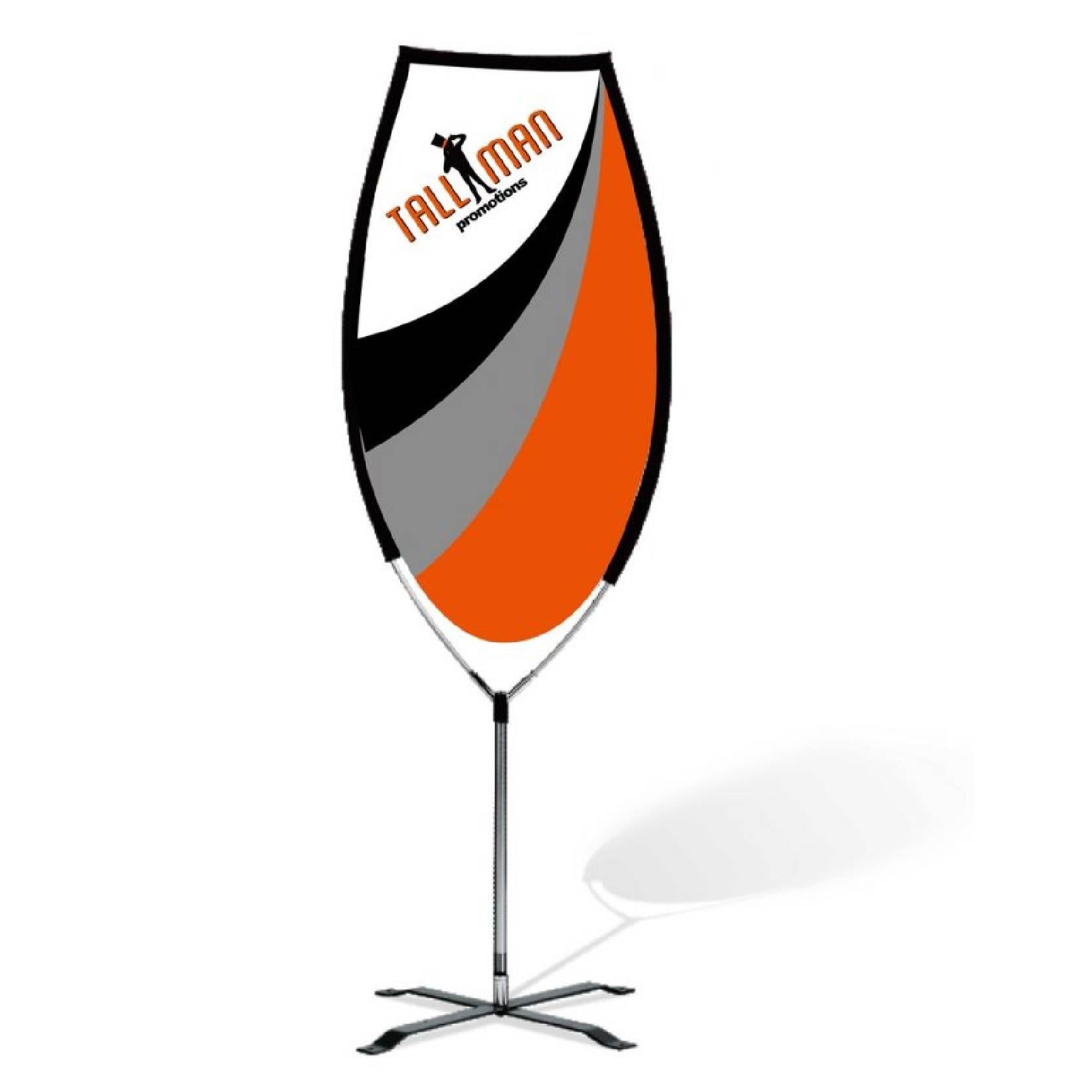
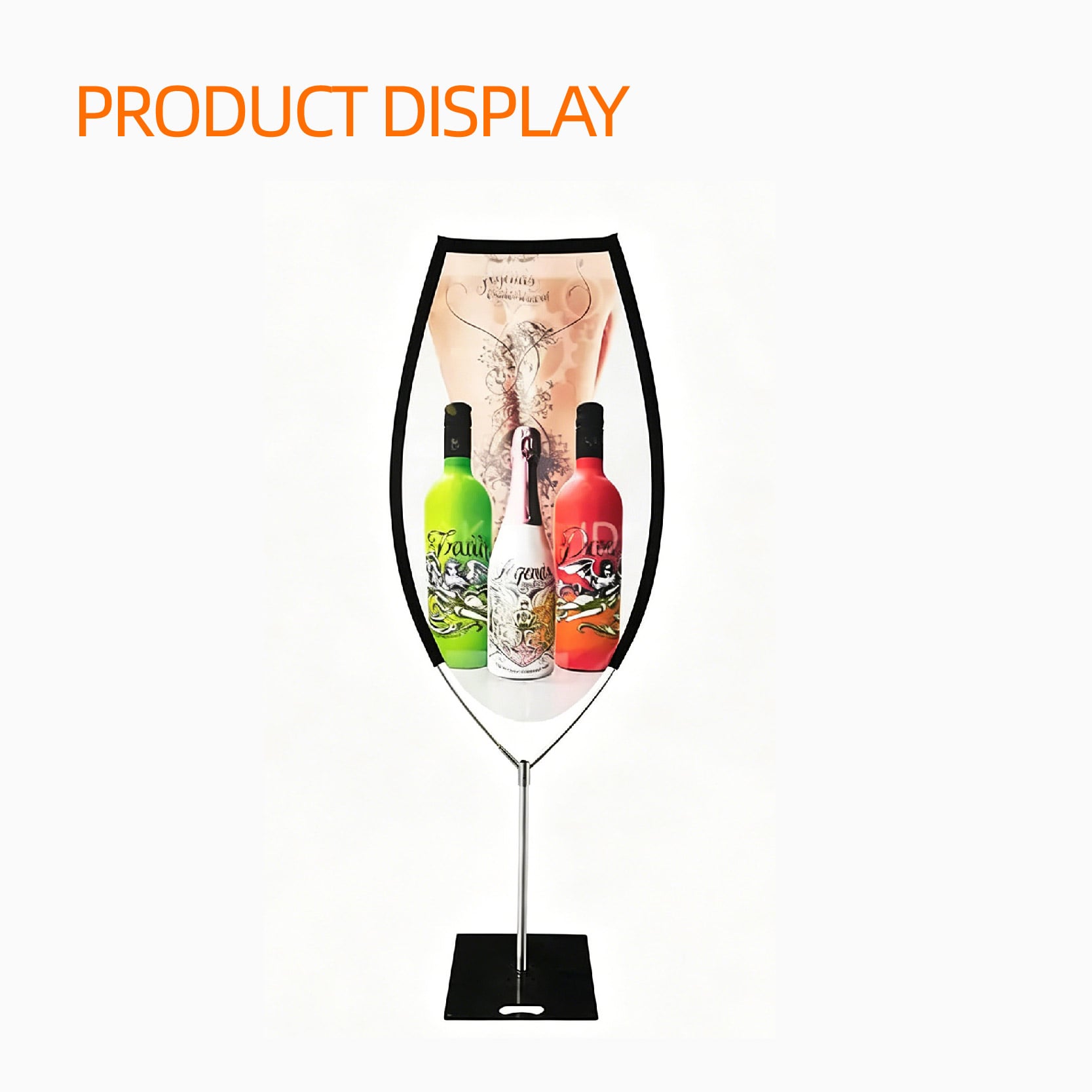
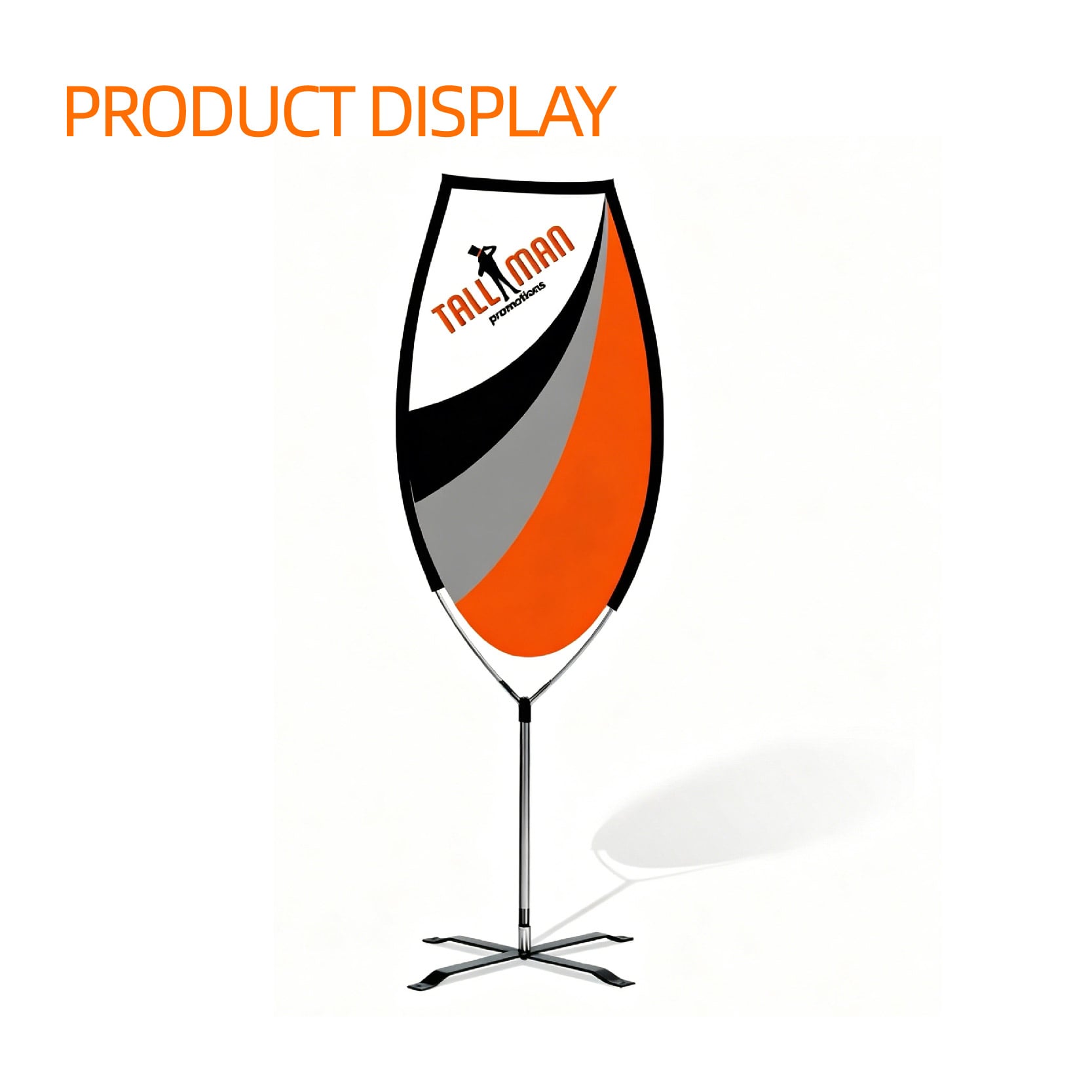
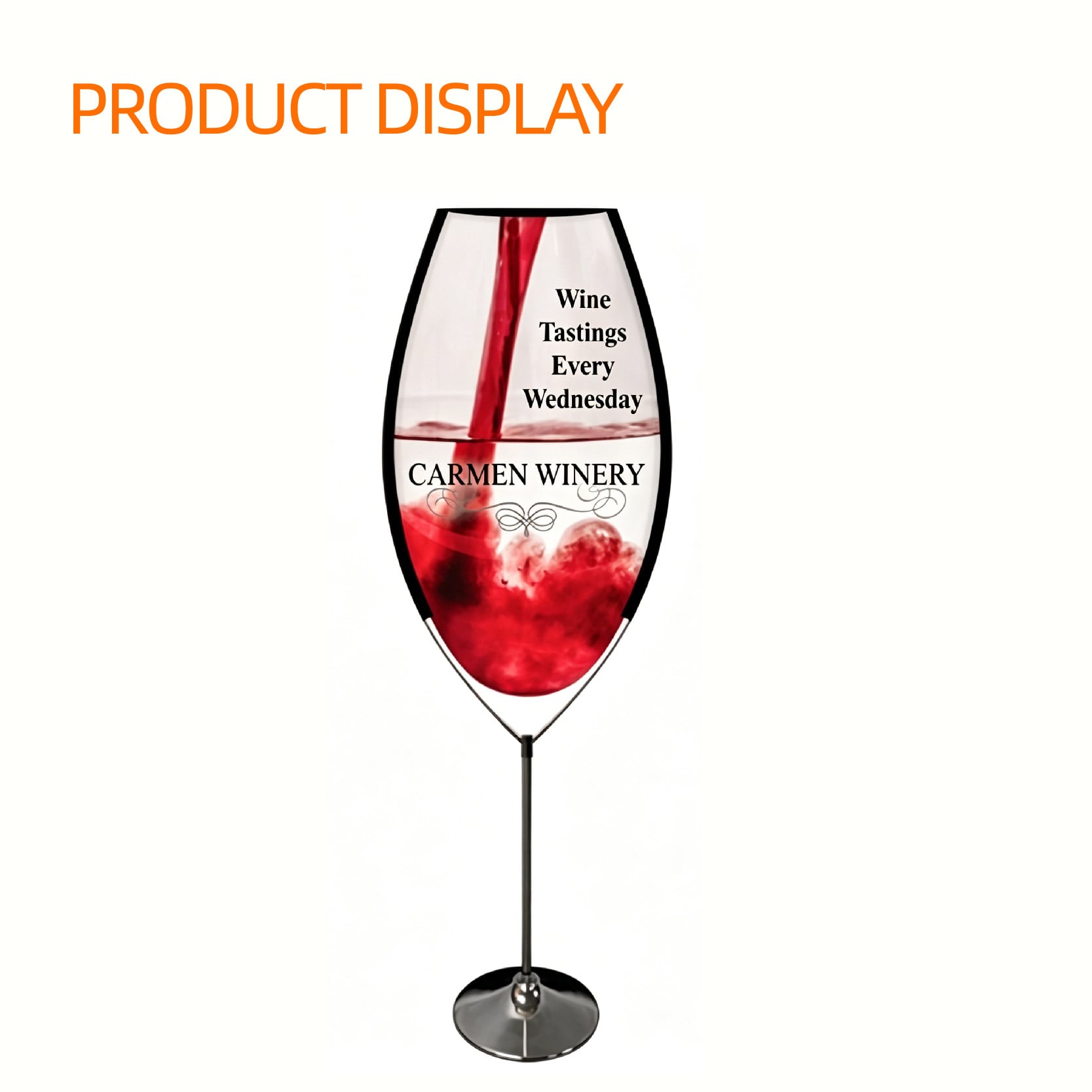
The Magnum banner is not a generic rectangle. Its exclusive wine‑glass silhouette was engineered for the beverage and liquor promotion sector, where brand identity aligns with the contours of the glass. When a vodka brand places this banner at a tasting event, the extended neck and bulbous lower graphic zone mirror the bottle’s lines—a subliminal continuity a rectangular flag cannot deliver. The application range stretches well beyond the bar.
A. Retail Display and Seasonal Sales
At a store entrance, a 1.22 m × 0.65 m flag on the 2.0 m pole creates a vertical accent without blocking sightlines. The tool‑free assembly lets managers reposition the message daily. Dye‑sublimation printing on polyester withstands repeated folding and washing without cracking, so the banner can be stored flat and redeployed every weekend.
B. Indoor Events and Conference Branding
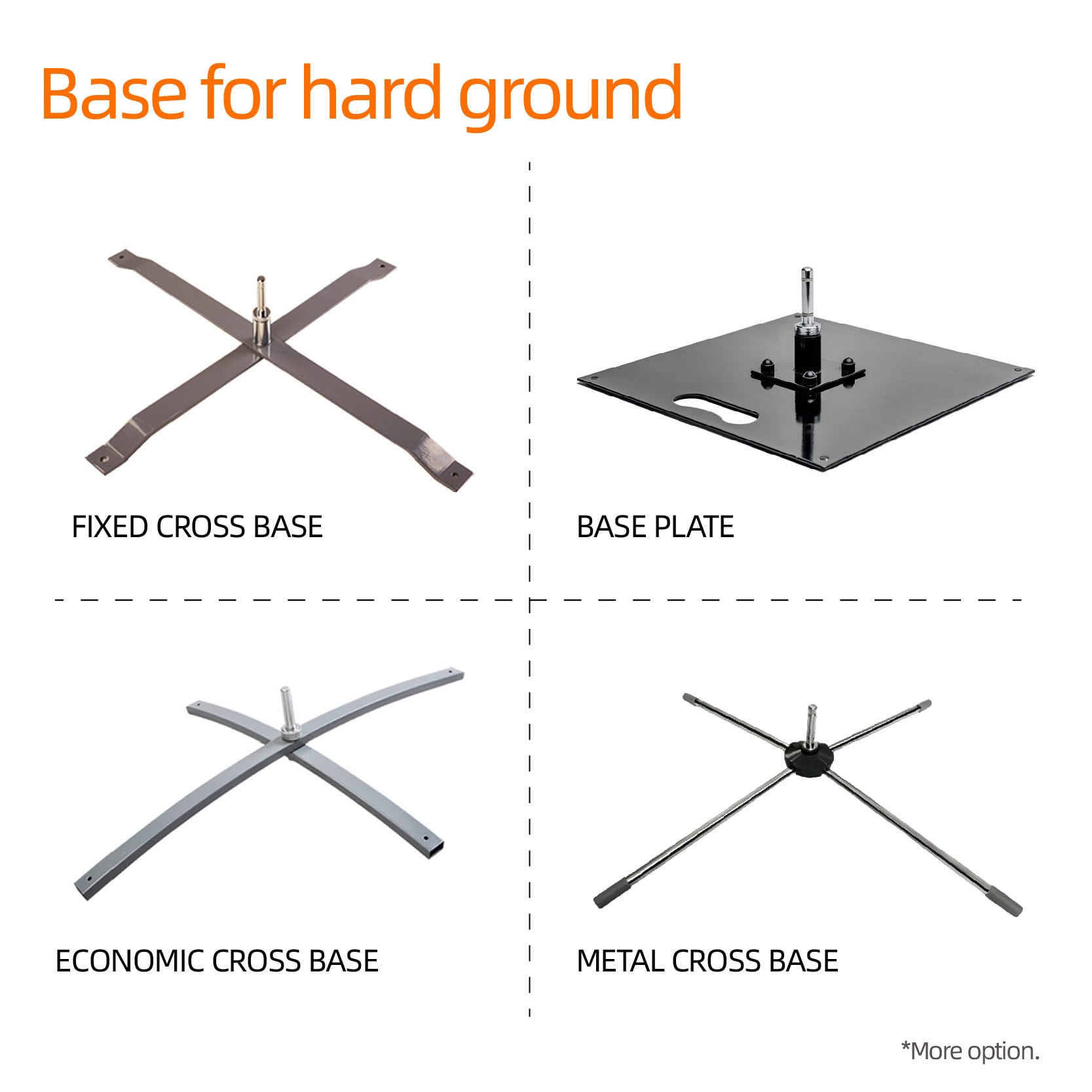
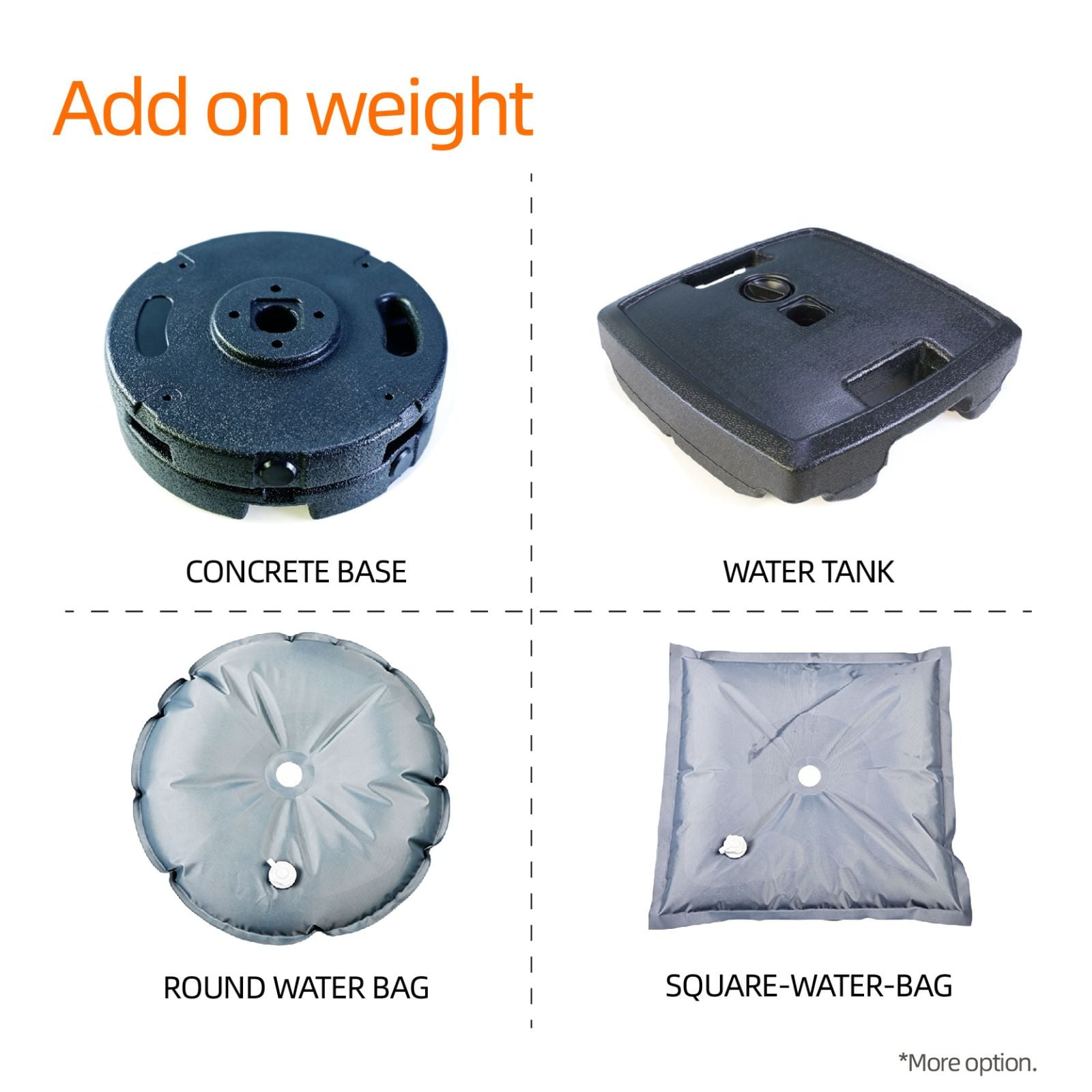
Convention centers often prohibit metal bases that scratch floors. Carbon composite poles lower that risk. Crews can fill the base with water or sand on site—empty, it adds almost nothing to shipping weight. Setup takes under two minutes, a speed event crews value when rigging fifty booths before doors open.
C. Office Branding and Hospitality
A permanent lobby banner must look crisp after months of air‑conditioned air. Carbon composite does not warp with temperature swings, and the fabric resists fading under LED spotlights. A pole that never develops a lean projects the same attention to detail a corporate buyer wants to convey.
D. Outdoor Festivals and Road Shows
The acid test is a windy field. The base can be ballasted with sand or water, and the pole’s natural flex acts as a mechanical fuse—wind energy dissipates through elastic deformation rather than tipping the base. Event organizers report that rows of Magnum banners stayed vertical through an afternoon squall that flattened neighboring sandwich boards. That reliability translates into repeat bookings.
V. Factory Process: How a Flag Pole Becomes a Supply Chain Instrument
The carbon composite pole begins as a spool of 12K carbon fiber tow from a Japanese mill. At the WZRODS facility in Shandong, the tow is pulled through a resin bath, shaped in a heated die, and cured in a continuous pultrusion line. The resulting hollow tube has consistent wall thickness and unidirectional fiber alignment that maximizes bending strength along its length. Each tube is cut to length, end caps are press‑fitted, and the surface receives a UV‑stabilized coating that prevents chalking under sunlight.
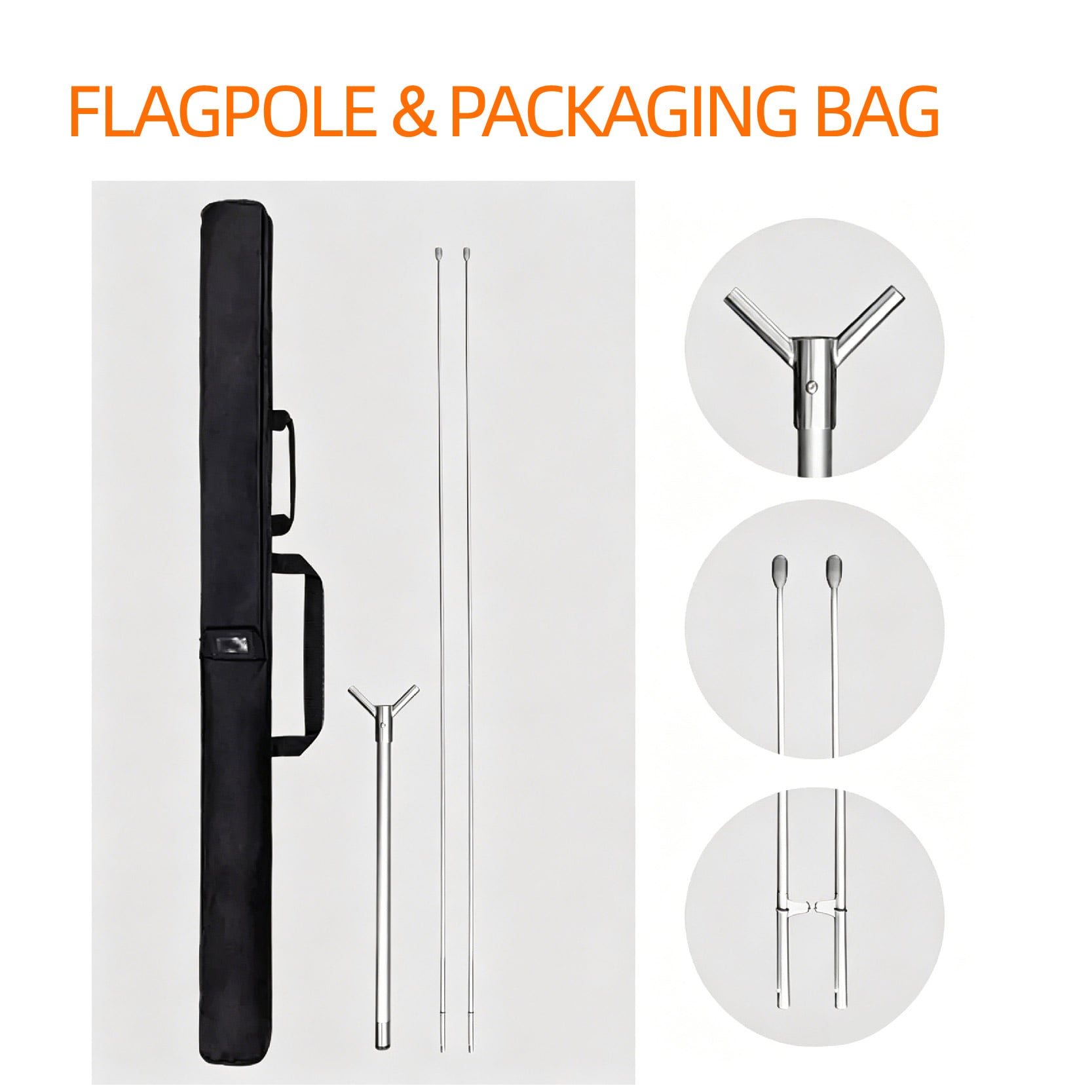
Parallel to pole production, the banner printing line runs digital and sublimation presses calibrated to CMYK color profiles. A spectrophotometer verifies that brand colors stay within a Delta E of 2 of the Pantone reference. Banners are stitched with double‑folded hems and a sleeve that slides over the pole without catching. Final assembly pairs pole, base, and banner in an oxford carry bag that doubles as storage. This integration—pole, banner, bag as a single SKU—removes the headache of sourcing from three different factories.
VI. Trends: Why Tariffs and Sustainability Are Pushing the Market Toward Carbon
Global trade policy is shifting fast. The U.S. Section 232 tariffs raised the cost of raw aluminum and pushed finished banner poles into a higher pricing tier. Meanwhile, the European Union’s Carbon Border Adjustment Mechanism will eventually penalize high‑embedded‑carbon imports like aluminum, which demands enormous energy for smelting. Carbon composite, though energy‑intensive in fiber production, offers a longer service life and a lighter shipping footprint, yielding a lower total lifecycle emission profile. Buyers who position their product lines now around low‑maintenance, non‑metal solutions will meet corporate sustainability mandates before their competitors realize the rules have changed.
Demand patterns also show a growing preference for event‑light hardware. Trade show schedules compress; planners want gear that flies as checked luggage or ships cheaply to the next city. A set that weighs one kilogram and fits into a 125 cm × 8 cm × 6 cm bag becomes an obvious choice for frequent travelers. WZRODS recorded a 60 % increase in Magnum banner inquiries from international event agencies over the past eighteen months, a spike that correlates with the reopening of large‑scale exhibitions after the pandemic pause.
VII. Upgrade Solution: Moving from Aluminum to Carbon in Four Managerial Steps
Most distributors already carry an aluminum banner line. Switching to the Magnum system is not a rupture; it is a phased substitution you can complete over two ordering cycles without stranding existing inventory.
Step 1: Audit the current SKU. Weigh a complete aluminum pole set, note the HS code used for import, and gather failure reports from the past twelve months. If more than 15 % of units needed replacement, the business case is already made.
Step 2: Run a controlled field test. Order ten Magnum samples (sample price $63.20 per unit) and deploy them alongside the aluminum stock at a demanding coastal event. Track assembly time, visual appeal, and complaint logs over a 90‑day window. The carbon composite set reveals its value in the monsoon, not in the showroom.
Step 3: Recalculate total landed cost. Plug actual freight quotes and duty rates into the ROI model from Section III. Adjust the catalog price to end‑customers to reflect the rust‑proof, wind‑forgiving premium. Most end‑users accept a 10 % price increase when the warranty stretches from one year to three and the banner never arrives bent.
Step 4: Phase in with new orders. Place an initial container order of, say, 5,000 Magnum units while selling through remaining aluminum stock. Position the carbon composite line as the premium option, marketed as “air‑freight friendly” and “corrosion‑proof for marine events.” Within a few quarters, demand data will determine the final inventory mix.
The customization pipeline at WZRODS supports this ramp‑up. Custom logos and graphics require a minimum of 10 pieces. A 3‑day image design service accelerates the process from approval to print‑ready artwork, and the Shenzhen port dispatch schedule aligns with major trade show seasons.
Frequently Asked Questions from Professional Buyers
- What is the minimum order quantity for the Magnum banner?
- 1 piece. There is no factory‑imposed MOQ, so you can test the product with a single unit. Custom graphics and logos require a minimum of 10 pieces.
- What is the FOB unit price and what does it include?
- The FOB unit price is $24.00 per piece from Qingdao. This covers one complete set: carbon composite pole, base, printed polyester banner, and oxford carry bag. Packaging is one piece per PE bag, ten pieces per carton.
- Can I get a free sample?
- Free samples are not offered. The sample unit price is $63.20, which reflects the higher handling and documentation cost for a single shipment and ensures serious inquiry. Sample delivery typically takes 15 to 30 days.
- What flag sizes are available?
- Two pole heights are standard: a 2.0 m pole with a 1.22 m × 0.65 m flag, and a 3.0 m pole with a 2.03 m × 1.08 m flag. The banner material is 100 % polyester, printed with digital or dye‑sublimation methods in full CMYK color.
- How does the base remain stable in wind?
- The base is designed to be filled with water or sand after arrival. When ballasted correctly, the center of mass stays low, and the flexible carbon composite pole dissipates wind energy. Combined performance exceeds that of rigid metal bases of equivalent weight because the system works with the wind rather than fighting it.
- What is the warranty and what does it cover?
- A 3‑year warranty covers manufacturing defects in the pole, base, and printing. Normal wear and abrasion of the fabric are not covered, nor is damage from improper assembly. The warranty reflects the material’s fatigue resistance; carbon composite does not creep or stress‑crack under repeated load within the expected service window.
- How are import duties determined for carbon composite poles?
- Carbon fiber articles often fall under HS 6815.10 or, in some cases, 3926.90. We advise buyers to confirm the classification with their customs broker. In practice, the rate is lower than the 6 % typically applied to aluminum structures, saving several percentage points on the shipment value.
- What payment terms do you accept?
- T/T, L/C, and Western Union. For initial sample orders, T/T in advance is standard. For volume orders, a T/T deposit with the balance against the bill of lading is customary.
- How many units fit in a container?
- Approximately 11,333 Magnum sets fit in a 40‑foot high‑cube container (68 cubic meters). The compact packaging—125 cm × 8 cm × 6 cm per set—enables exceptionally high container utilization.
- Can I customize the banner shape, printing, and packaging?
- Yes. Light customization is supported, and a fast‑track option with a 3‑day image design service is available. Custom logos and graphics require a minimum of 10 pieces. Packaging can be branded with your company’s design.
The Magnum banner addresses the failure modes that frustrate event managers and supply chain planners alike. A flag pole that bends in a squall, weighs one kilogram, and clears customs with a tariff advantage is the kind of hardware that quiets a procurement desk. The design came from the same curiosity that drives any good engineer: watching something fail and asking whether a different material could change the whole equation.
About the Author
Wei Chen, Senior Product Specialist
B.S. Supply Chain Management, Michigan State University; Certified Professional in Supply Management (CPSM)
12 years in B2B display hardware sourcing. Former procurement manager for a top 20 US promotional products distributor. Specializes in aluminum pole systems and import compliance.
Reviewed by WZRODS Technical Team. Updated: 2026-07-04
 Comments (0)
No comments yet. Be the first to comment!
Leave a Comment
Related Products
Combo Pole
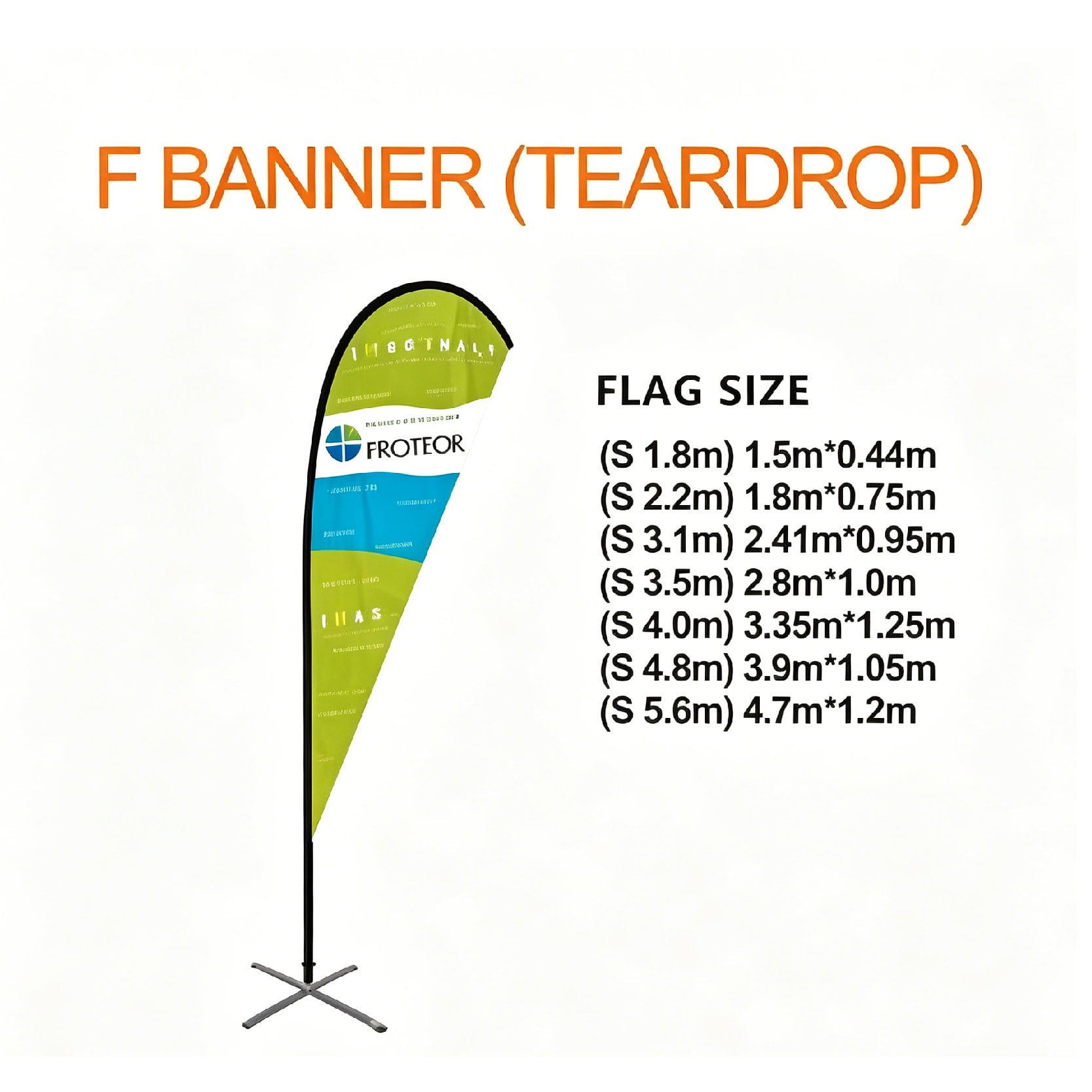
F Banner(Teardrop)
Golf flag pins
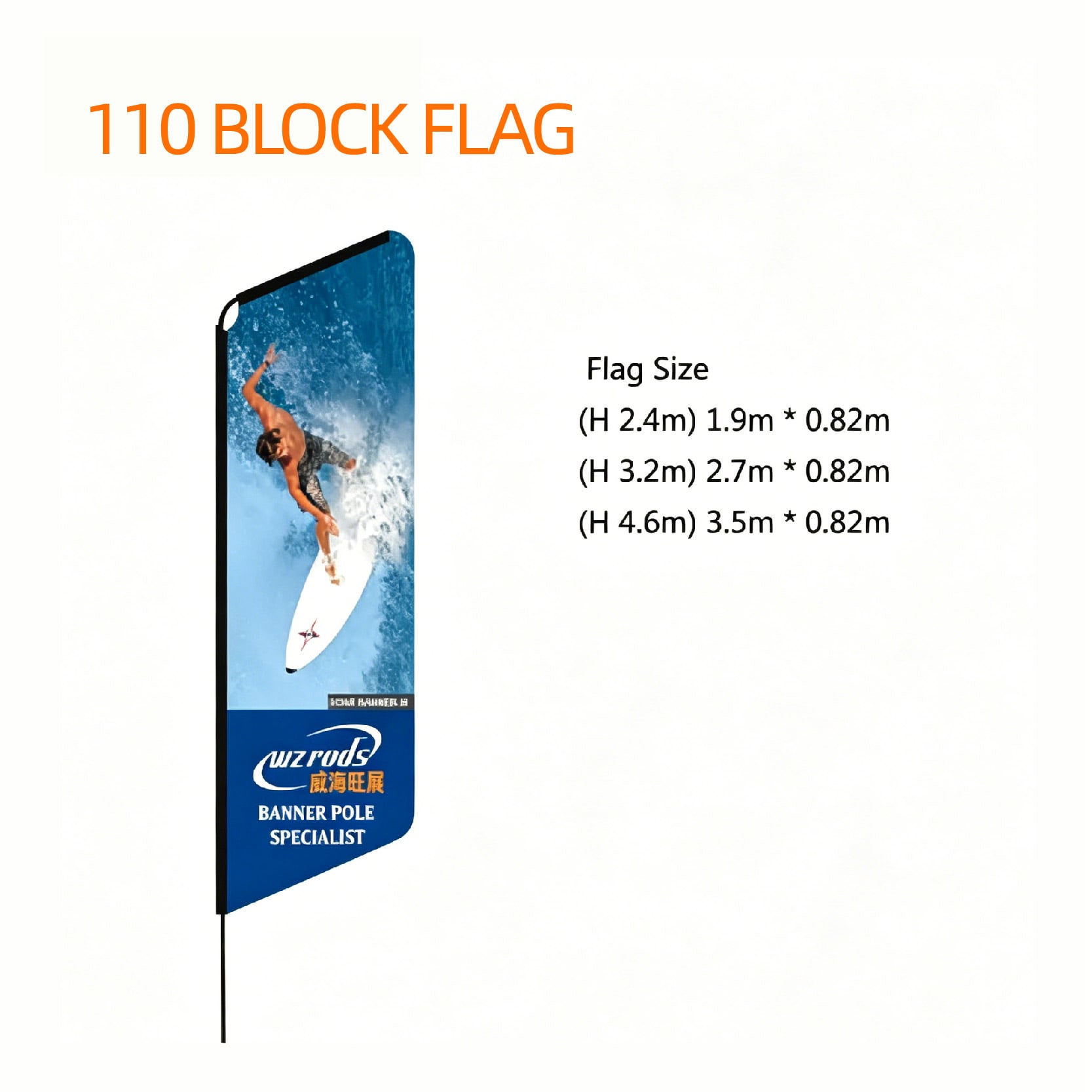
110° H banner
Wall Mounted Flagpole
SF Banner
Budget 2in1 flag system
4 in 1 flag System
T Banner
H Banner
Related Articles
29kg Concrete Flag Base - The Complete B2B Buyer's Resource - WZRODS
WZRODS DY451B: 29 kg, HDPE shell, concrete core. Stackable, portable, rust-proof. FOB price US$5.75–$6.85 at MOQ 2 units. Those numbers look unremarkable. Factor in landed cost—import duties lower than aluminum’s under relevant HTS codes, freight savings from less weight per unit of stabilizing mas
Wide Tube Cross Base - The Complete B2B Buyer's Resource - WZRODS
The Wide Tube Cross Base, manufactured by Wzrods in Shandong, China, solves one problem: reliable stability for poles under three meters, without the freight costs and warehouse footprint that heavier alternatives demand.
Rectangular Pipe Cross Base - The Complete B2B Buyer's Resource - WZRODS
The pipe cross flag base is a cross of rectangular steel pipe, powder‑coated, weighing 1.3 kg and spanning 78 cm across its arms. Its center holds a C‑ring shaft that lets the flag rotate with the wind.
X-Shape Backpack Banner - The Complete B2B Buyer's Resource - WZRODS
Economic Cross Base - The Complete B2B Buyer's Guide- WZRODS
When you buy an economic cross base—something like the Wzrods DM‑9, a 77 cm‑long, 1.3 kg iron cross—forget “economic” as a synonym for “cheap.” It means value-engineered.