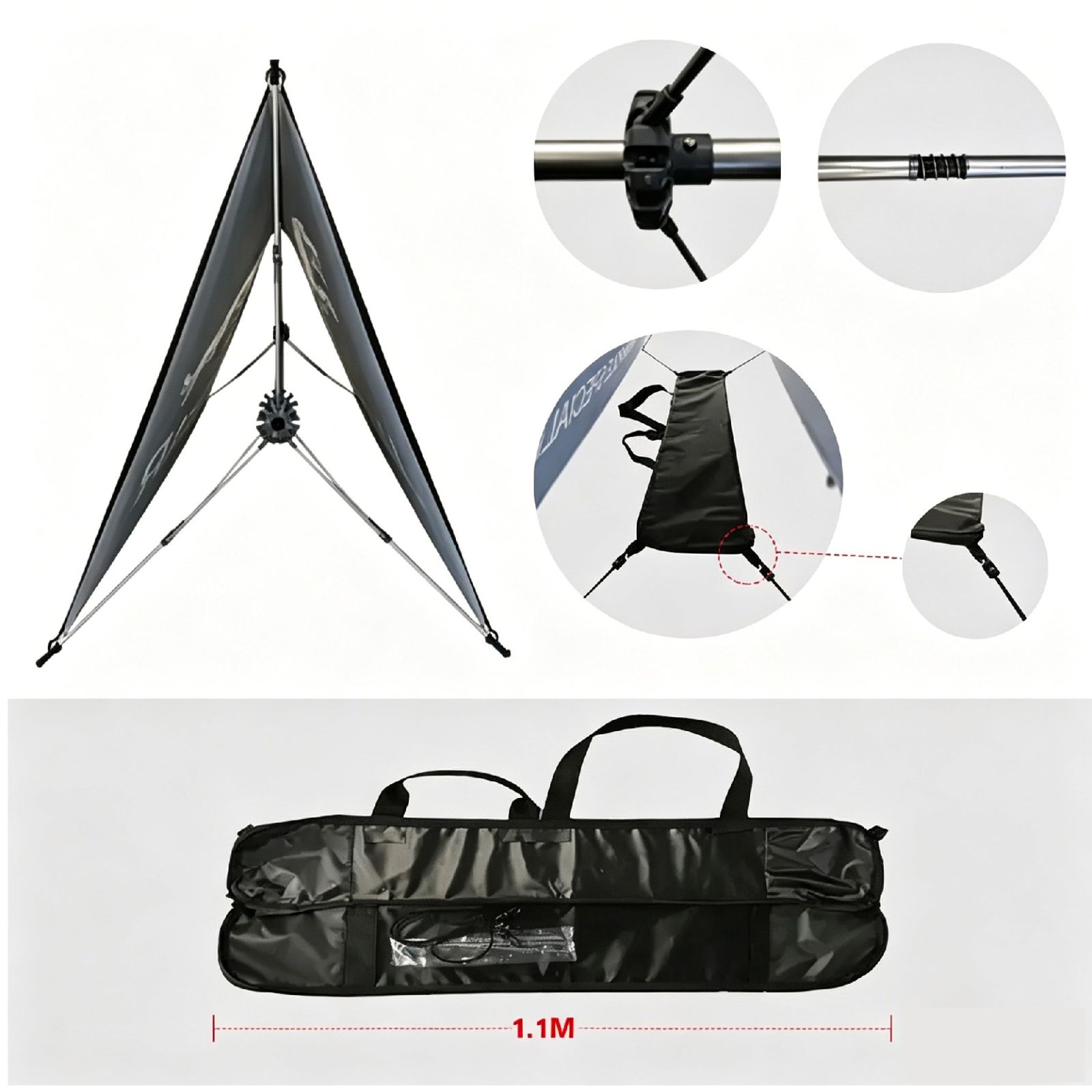
A-Frame Banner
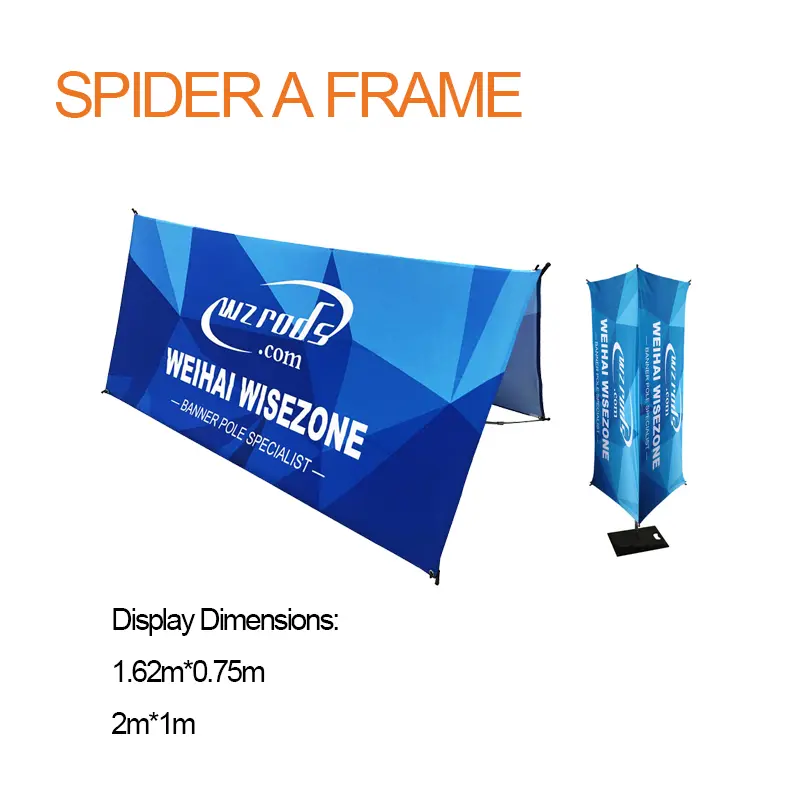
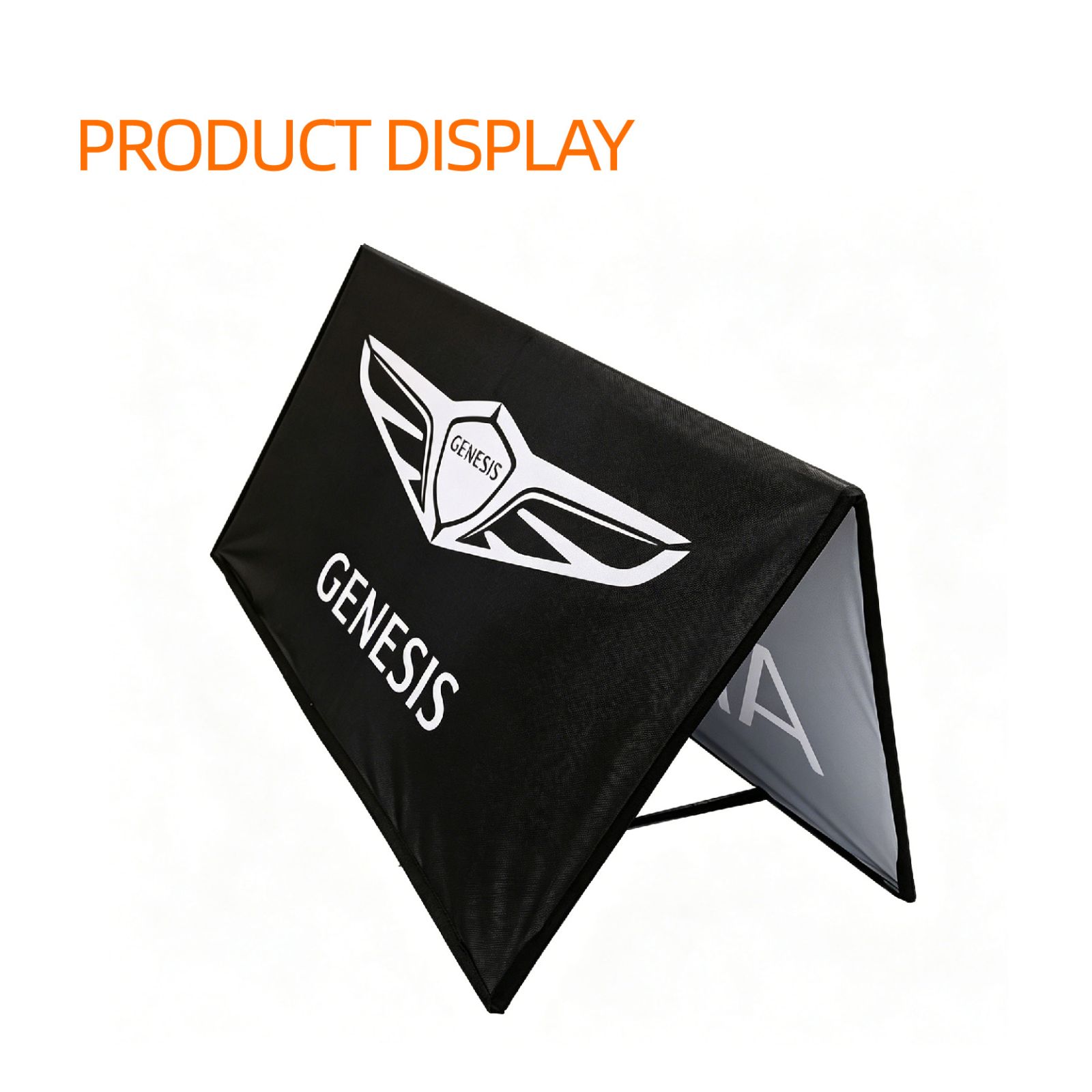
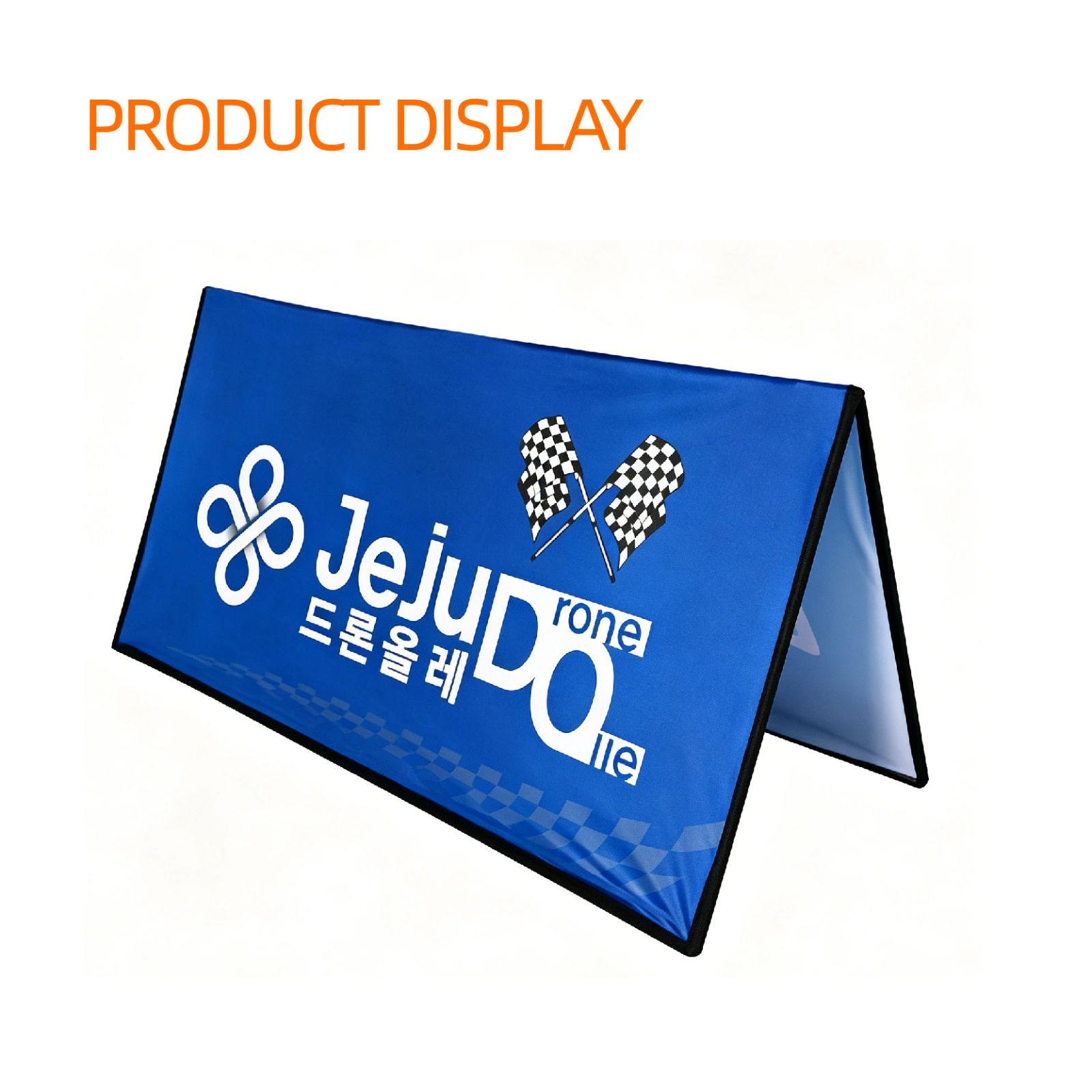
Spider A-frame sideline banner stand with dual-purpose oxford bag. Easy setup, stable placement, ideal for sports venues, parades and outdoor commercial advertising displays.


 Article
 Specifications
- Origin
- Shandong, China
- Brand
- Wzrods
- Model
- WSJ-21/16
- Main Material
- 100% Polyester
- Pole Material
- Carbon Composite
- Banner Material
- 100% Polyester
- Color
- CMYK 4 Color Printing
- Application Spec
- Trade Shows, Retail Display, Product Launches, Exhibitions
- Printing Method
- Dye sublimation printing, Dye Sublimation Printing
- Moq
- 2pc
- Feature
- Folding, Eco-Friendly, Waterproof
- Style
- Scrolling, Sporty
- Design
- Custom Desgin
- Packaging
- Polybag
- Customized Logo
- 2 sets
- Graphic Customization
- 2 sets
- Customized Packaging
- 100 sets
- Pole Color
- Black
- Display Size
- 2.0m * 1.0m
- Packing
- PE Bag
- Supply Ability
- 2000 sets per Month
 Product Description
Shipping & Packaging
- Unit Weight
- 14.000 kg
- Unit Size
- 115X90X6 cm
- Packaging
- Each set pole and accessories in a PE bag, 5pcs in a carton
- Lead Time
- 15-30 days
Pricing
- MOQ
- 1 sets
- Price Range
- USD 17.2 – 49.9
* FOB Qingdao. Excludes shipping & taxes. Accessories & customization confirmed separately.
 Sample Service
- Sample Available
- Yes
 Customization Options

Light Custom
Logo, color, size adjustments

Fast Turnaround
Quick custom order processing
3-Day Design
Free mockup within 3 days
A-Frame Banner - The Complete B2B Buyer's Resource - WZRODS
The Spider A-Frame: A Complete Guide for the International Buyer
The takeaway: The first time a trade show booth collapses, nobody forgets it. The banner tips forward. The aluminum pole bends. The graphic hits the floor. Someone scrambles to prop it back up while prospects walk past. The exhibitor paid for that space by the square foot. Now that square foot holds a pile of broken hardware.
This happens more often than anyone admits. The causes are always simple. A gust of wind from the loading dock. A carpet seam that caught the base. A pole that had been bent once before and was waiting to fail. In each case the failure was not in the moment of collapse. The failure was in the purchase decision made months earlier, when someone chose the cheaper aluminum stand because the price looked right on the spreadsheet.
The Spider A-frame addresses this problem at the material level. It is a sideline banner stand built on carbon composite poles. The frame uses an umbrella-style structure to stretch banner fabric into a stable triangular display. The system weighs 14 kilograms. It folds flat. It does not rust. These are the facts. The implications of these facts matter more than the facts themselves, and that is what this guide will examine.
1. Buyer's Guide: What the Spider A-Frame Is and How to Evaluate It
1.1 The System, Plainly Described
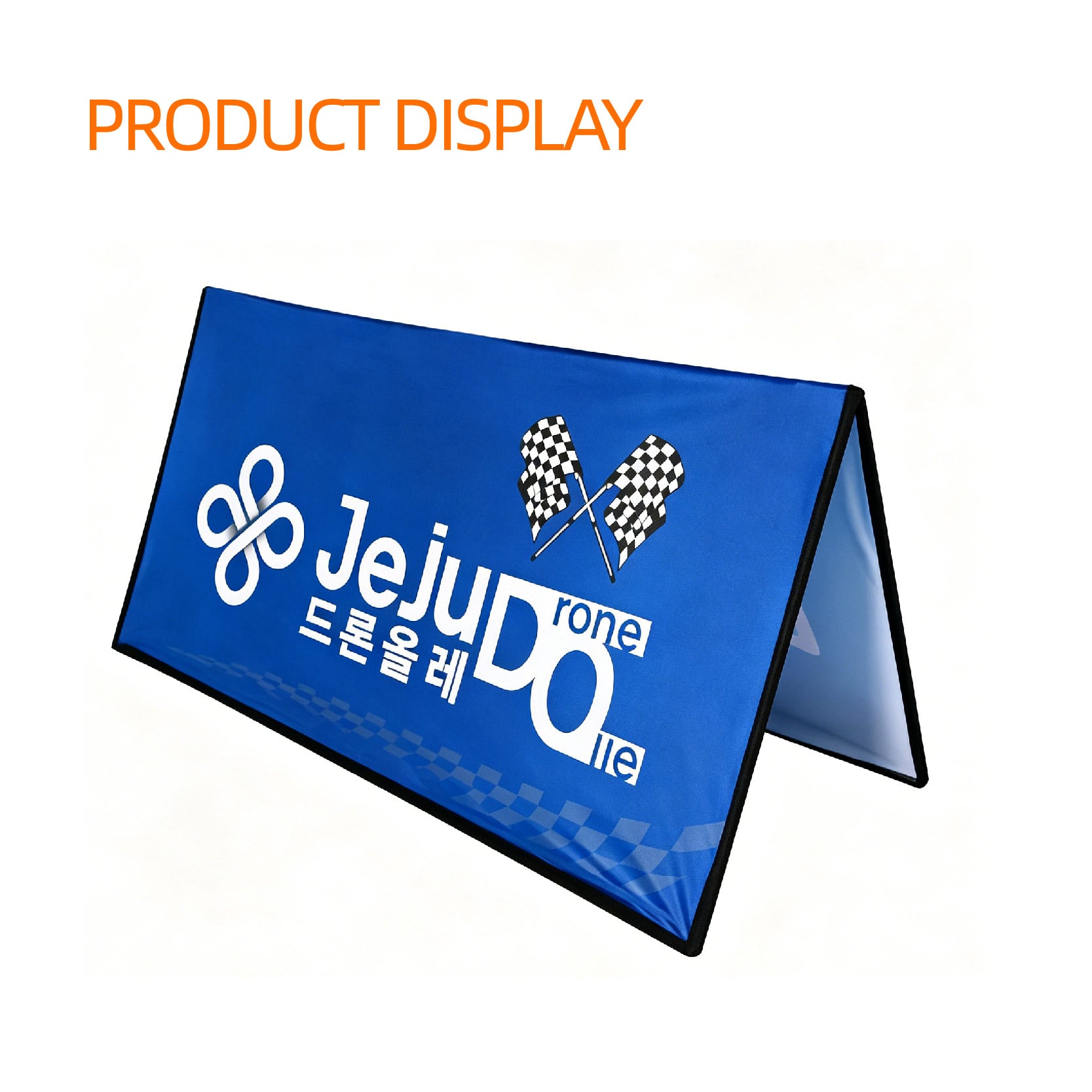
The Spider A-frame consists of carbon composite poles connected in a collapsible frame. The frame opens like an umbrella. Banner fabric stretches across the front face. The display area measures two meters high by one meter wide. When the event ends, the frame folds into a package measuring 115 by 90 by 6 centimeters. Each unit ships with an oxford storage bag. That bag serves two purposes. It holds the frame and graphics during transport. At the event site, it can be filled with sand or water and used as a weight bag to anchor the stand on hard ground.
The banner material is 100% polyester. Printing uses dye sublimation in CMYK four-color process. The pole color is black. The system is designed for outdoor and indoor use. It works at trade shows. It works at sports venues. It works at parades and retail displays and product launches. It can be used singly or arranged in rows for barrier signage and directional signs.
One unit. One bag. One display. The design eliminates the need for separate weights, separate stakes, or separate storage solutions. That elimination matters when calculating freight costs and setup time.
1.2 Key Specifications and What They Mean
The specification sheet lists numbers. Here is what those numbers translate to in practice.
Pole material: Carbon Composite. Carbon composite differs from aluminum in a fundamental way. Aluminum bends under stress and stays bent. Carbon composite flexes and returns to its original shape. This is not a marketing claim. It is a property of the material. Fiber-reinforced polymer can deflect significantly under load and recover completely when the load is removed. Aluminum, once it passes its yield point, deforms permanently. The practical result: a carbon composite pole that gets knocked over stands back up and works. An aluminum pole that gets knocked over may never stand straight again.
Unit weight: 14.000 kg. Fourteen kilograms is light enough for one person to carry. It is also light enough to reduce freight costs compared to heavier aluminum alternatives. In a 40HQ container, approximately 1,095 units fit into 68 cubic meters. The math on per-unit shipping cost favors the lighter product every time.
Rust-proof: 100%. Carbon composite does not corrode. Aluminum corrodes in salt air. This matters for coastal markets, tropical markets, and humid markets. A distributor in Singapore or Miami storing inventory in a non-climate-controlled warehouse will see aluminum stands develop pitting and white oxidation within months. Carbon composite stands show no change. The material is inert to the conditions that destroy metal.
Display size: 2.0m × 1.0m. Two square meters of visible area. That is enough for a brand logo, a sponsor message, a directional arrow, or a promotional graphic. The height places the message at eye level for adults walking past. The width provides enough space for readable text and recognizable imagery without overwhelming the footprint of the event space.
Packaging: PE bag, 5 units per carton. The polybag protects each unit. The carton consolidates five units for efficient container loading. At 1,095 units per 40HQ, the per-unit freight cost drops substantially compared to bulkier alternatives. Packaging design is not glamorous. It is, however, the difference between a profitable import deal and one where the freight eats the margin.
1.3 How to Evaluate a Supplier of Carbon Composite Display Stands
The factory that produces the Spider A-frame is located in Shandong, China. Shandong has a concentration of composite material manufacturers. The supply chain for carbon fiber fabric, epoxy resin, and molding equipment exists within a 200-kilometer radius. This geographic concentration reduces raw material costs and production lead times.
When evaluating a supplier, several factors separate the reliable from the unreliable:
Customization capability. The factory should offer light customization and fast customization. The Spider A-frame supports custom logo printing (minimum 2 sets), custom graphic design (minimum 2 sets), and custom packaging (minimum 100 sets). A three-day image design service is available. If a supplier cannot turn around a custom design in three days, the production pipeline is either overloaded or disorganized. Neither condition benefits the buyer.
Minimum order quantity. The MOQ is 2 pieces. This is low. It serves two types of buyers: the distributor who wants to test market response before committing to container quantities, and the event planner who needs a few units for an upcoming show. Beware of suppliers who advertise low MOQ but cannot deliver consistent quality at low volumes. The test order is not just about the product. It is about the supplier relationship.
Lead time. Fifteen to thirty days. This range is normal for custom-printed display hardware. The variation depends on order volume and customization complexity. A supplier who promises faster delivery without explaining how should be questioned. A supplier who consistently delivers within the stated range should be kept.
Sample policy. Free samples are not offered. This is worth noting. Some buyers see free samples as a mark of supplier confidence. In practice, free samples in the display hardware industry often mean the supplier builds the sample cost into future order pricing. Paying for samples establishes a straightforward transaction. The sample delivery time is 15-30 days, consistent with production lead times.
Payment terms. T/T, L/C, and Western Union are accepted. This range covers the standard methods for international trade. L/C availability indicates the supplier has worked with serious importers before.
2. Product Comparison: Carbon Composite Versus the Alternatives
2.1 Carbon Composite vs. Aluminum: A Direct Comparison
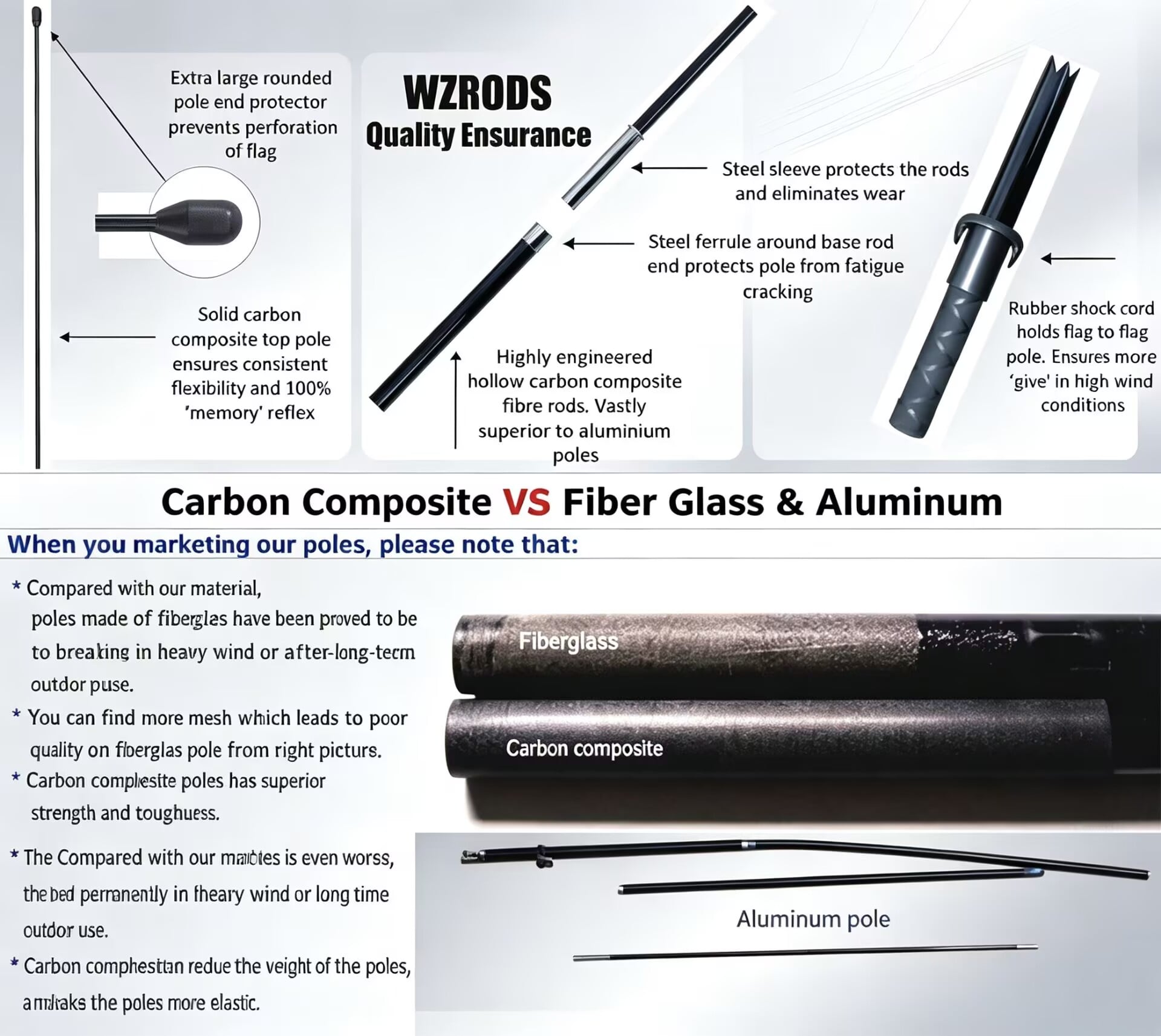
Aluminum has been the default material for portable display stands for decades. The reasons are understandable. Aluminum is relatively light. It is relatively strong. It is relatively cheap. Those three "relatively" qualifiers hide the trade-offs.
Here is what happens to an aluminum A-frame stand over its service life:
Month one: The stand is unpacked, assembled, and used. It works. The poles are straight. The connections are tight. The banner looks professional.
Month three: The stand has been set up and taken down perhaps a dozen times. The poles have minor scratches from handling. In a humid environment, the scratches begin to show white oxidation. The connections are slightly looser because the aluminum has deformed microscopically at the stress points.
Month six: One pole has a visible bend. It happened during setup when someone applied force at the wrong angle. The bend is permanent. The stand still works, but the banner does not stretch as taut. Wrinkles appear in the graphic. The display looks tired.
Month twelve: The stand has been knocked over twice by wind or foot traffic. Two poles are bent. The connections rattle. The graphic has permanent creases from uneven tension. The stand is retired or replaced.
Now consider carbon composite under the same conditions:
Month one: Same as aluminum. Works. Straight. Professional.
Month three: The poles have minor scratches. No oxidation. Carbon composite does not react with moisture or salt. The connections remain tight because the material has not deformed.
Month six: The stand was set up with excessive force. The pole flexed. It returned to straight. No bend. No permanent deformation. The banner remains taut.
Month twelve: The stand has been knocked over multiple times. It has been rained on. It has been transported in the back of a truck. The poles are straight. The connections are solid. The graphic may need replacement from normal wear, but the frame is functionally identical to month one.
The difference is not subtle. It is the difference between a product that degrades and a product that endures.
2.2 Total Landed Cost Comparison
The unit price of the Spider A-frame ranges from USD 17.20 to USD 49.90 depending on order volume and customization. An aluminum alternative may be priced lower at the factory gate. The factory gate price is one number among many. Here are the other numbers:
Cost Factor Comparison: Carbon Composite vs. Aluminum A-Frame Stands
| Cost Factor | Carbon Composite (Spider A-Frame) | Aluminum Alternative | Difference |
|---|---|---|---|
| Unit factory price (typical range) | $17.20 - $49.90 | $12.00 - $35.00 | Aluminum lower by 20-40% |
| Unit weight | 14.0 kg | 16-20 kg | Carbon composite lighter by 2-6 kg |
| Units per 40HQ container | ~1,095 | ~800-950 | Carbon composite fits 15-37% more units |
| Per-unit ocean freight (estimated) | $3.50 - $5.00 | $4.50 - $7.00 | Carbon composite lower by $1.00-$2.00 |
| Import duty rate (typical HTS for composite vs. metal) | Lower bracket (composite goods) | Higher bracket (metal goods) | Varies by country; typically 2-5% advantage |
| Replacement rate over 3 years | 5-10% | 30-50% | Carbon composite lasts significantly longer |
| Total landed cost per usable unit-year | Lowest | Higher when factoring replacements | Carbon composite wins on lifecycle basis |
The replacement rate is the number that gets overlooked most often. A distributor selling aluminum stands will process returns, handle warranty claims, and manage replacement inventory. Those costs are real. They consume staff time and warehouse space. Carbon composite stands generate fewer returns because fewer units fail. The lower replacement rate is not a feature on the spec sheet. It is a feature of the business model.
2.3 Spider A-Frame vs. Traditional Banner Stands
Traditional banner stands use a single vertical pole with a tensioned graphic that rolls up into a base. They work well indoors on flat floors. They fail outdoors. Wind catches the banner like a sail. The base is too light to resist. The pole bends or the stand tips. Setup requires a perfectly level surface. Storage requires careful rolling to avoid creasing the graphic.
The Spider A-frame addresses each of these failure modes:
Wind resistance: The triangular A-frame structure distributes wind load across two legs and the banner surface. The frame flexes rather than resists. Wind energy dissipates through the flex. When using the oxford bag filled with sand or water as a weight, the stand remains stable on hard ground.
Setup surface: The A-frame design does not require a perfectly level surface. The two legs find their own equilibrium. Uneven ground that would topple a single-pole stand merely tilts the Spider A-frame slightly. It still stands. It still displays.
Storage: The frame folds flat. The oxford bag holds everything. No rolling. No tension mechanisms to break. The graphic can be folded or rolled depending on preference, but the frame itself has no delicate parts.
3. ROI Analysis: The Numbers Behind the Decision
3.1 Freight and Duty: Where the Margin Lives
International buyers live and die by landed cost. The difference between a profitable product line and a breakeven one often comes down to freight optimization and duty classification.
The Spider A-frame at 14 kilograms per unit moves through the supply chain efficiently. In a 40HQ container, 1,095 units consume 68 cubic meters. The per-unit ocean freight cost from Qingdao or Shanghai to Rotterdam, Los Angeles, or Dubai falls in the $3.50 to $5.00 range depending on spot rates. A heavier aluminum stand at 18 kilograms would cost proportionally more and fit fewer units per container.
The duty advantage comes from HTS classification. Carbon composite goods fall under different tariff codes than metal goods. The exact rate depends on the importing country. In general, composite materials attract lower duty rates than aluminum products in most jurisdictions. A buyer importing into the EU, for example, may see a 2-4% duty on composite display stands versus 4-6% on aluminum equivalents. Over a container load, that difference is meaningful.
3.2 Replacement Rate and Longevity
A distributor who sells 1,000 aluminum A-frame stands per year can expect 300-500 replacement requests within three years. Those replacements cost money directly (new units) and indirectly (customer service time, shipping, warehouse handling). A distributor who sells 1,000 carbon composite stands can expect 50-100 replacement requests over the same period.
The math: if each replacement costs $25 in direct and indirect costs, the aluminum distributor spends $7,500-$12,500 on replacement overhead that the carbon composite distributor does not spend. That is margin that drops to the key point.
For the end user, the calculation is even simpler. An event company that buys 20 carbon composite stands at $40 each spends $800. If those stands last four years with no replacements, the annual cost is $200. The same company buying 20 aluminum stands at $25 each spends $500 upfront, but replaces 10 of them over four years at a total cost of $750. The "cheaper" aluminum option costs more.
3.3 The Cost of a Failed Display
There is a cost that does not appear on any invoice. It is the cost of a display that fails during an event. A banner that falls over. A frame that breaks. A graphic that looks wrinkled and unprofessional. The exhibitor paid for booth space. They paid for travel. They paid for staff time. All of that investment is undermined by a $30 display stand that could not stay upright.
This cost is hard to quantify. It is real. Event managers remember which hardware failed. They do not buy that hardware again. They tell colleagues. The brand that supplied the failed stand loses future sales that never show up as line items because they never happened.
The Spider A-frame is not the cheapest stand on the market. It is the stand that does not fail in ways that cost far more than the purchase price.
4. Industry Applications: Where the Spider A-Frame Performs
4.1 Trade Shows and Exhibitions
Trade show floors are controlled environments with their own hazards. Forklifts move crates. Attendees bump into displays. Air conditioning creates unpredictable air currents. The exhibitor needs signage that stays put and looks sharp for the duration of the show.
The Spider A-frame serves as a sideline banner stand along booth perimeters. It can be placed at the entrance to define the space. It can be positioned inside the booth to direct traffic flow. That's the difference. The two-meter height makes it visible above booth furniture and across aisles. The one-meter width provides enough graphic area for a brand message without dominating the booth footprint.
Setup takes one person less than two minutes. The frame unfolds, the banner attaches, the stand is ready. Takedown is the same process in reverse. For exhibitors who move from show to show on a tight schedule, this speed matters. Union labor at convention centers charges by the hour. Faster setup means lower labor cost.
4.2 Sports Venues and Parades
Outdoor events introduce wind, uneven ground, and exposure to elements. The Spider A-frame is designed for these conditions. The carbon composite poles flex in wind rather than fighting it. The oxford bag filled with sand provides a stable base that does not blow over.
At sports venues, the stands serve as sponsor signage along sidelines, barrier markers, and directional signs. The ability to arrange multiple units in a row creates a continuous branded barrier. Each unit is independent, so if one is knocked over by a ball or a player, the others remain standing. The knocked-over unit picks back up and continues working.
At parades, the stands define the parade route, mark sponsor zones, and provide branding opportunities. They are set up in the morning, endure hours of wind and crowd proximity, and are taken down in the evening. The 14-kilogram weight makes them portable enough for a small crew to deploy and recover quickly.
4.3 Retail Display and Product Launches
Retail environments demand displays that look professional and do not create hazards. A display that tips over in a store is a liability. The triangular A-frame structure provides inherent stability that single-pole banner stands lack.
For product launches, the Spider A-frame can be customized with launch-specific graphics. The three-day image design service means a brand can order stands with new artwork and receive them in time for a launch event. The minimum order of two units allows for targeted deployments without excess inventory.
The stands can be used outdoors at store entrances or indoors on the sales floor. They do not require power, lighting, or special mounting. They are self-contained display units that work wherever they are placed.
5. Factory Process: How the Spider A-Frame Is Made
5.1 Carbon Composite Pole Production
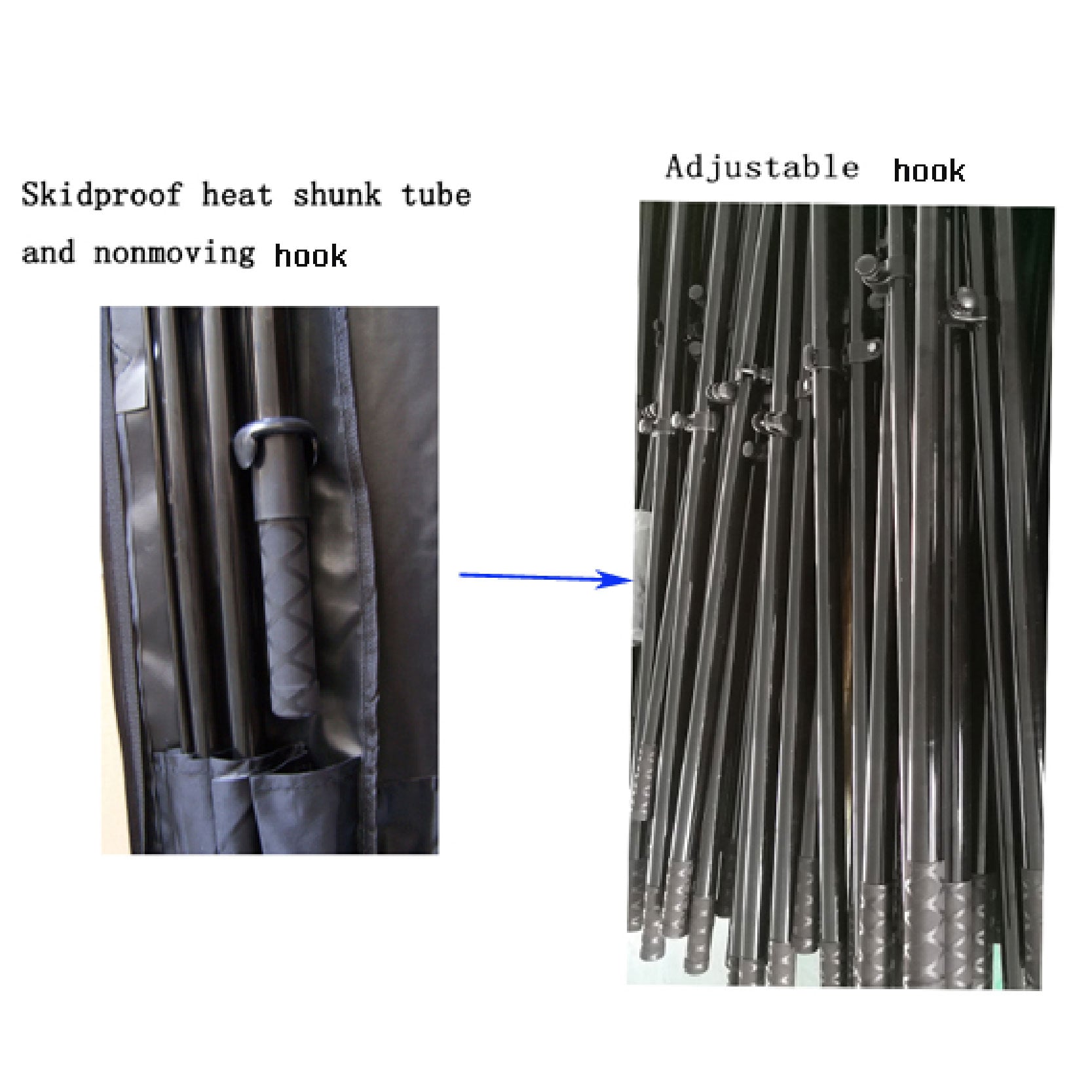
Carbon composite poles begin as carbon fiber fabric. The fabric is woven from carbon filaments, each thinner than a human hair. Thousands of these filaments are bundled into tows, and the tows are woven into fabric. The fabric arrives at the factory on rolls.
The manufacturing process uses pultrusion or roll-wrapping, depending on the pole specification. In pultrusion, carbon fiber fabric is pulled through a resin bath and then through a heated die that shapes and cures the composite. In roll-wrapping, the fabric is wrapped around a mandrel, impregnated with resin, and cured in an oven. Both processes produce hollow tubes with exceptional strength-to-weight ratios.
The key quality parameter is fiber alignment. Carbon fiber derives its strength from the orientation of the filaments. Fibers aligned along the length of the pole provide bending strength. Fibers oriented at an angle provide torsional strength. The Spider A-frame poles use a layup optimized for the bending and recovery demands of a display stand that will be flexed repeatedly.
After curing, the poles are cut to length, finished, and assembled into the frame mechanism. The connections are designed for repeated assembly and disassembly without loosening.
5.2 Quality Control Standards
Quality control in carbon composite manufacturing has several checkpoints:
Incoming material inspection: Carbon fiber fabric is checked for weave consistency, areal weight, and absence of defects. Resin is checked for viscosity and pot life. Material that does not meet specification is rejected before production begins.
In-process inspection: During curing, temperature and pull speed (for pultrusion) or oven temperature and time (for roll-wrapping) are monitored continuously. Deviations from the process window are flagged immediately.
Finished product testing: Sample poles from each production batch are subjected to bend testing. A pole is flexed to a specified deflection and released. It must return to within 1% of its original straightness. Poles that fail this test trigger a batch review.
Assembly check: Each completed Spider A-frame is assembled and disassembled at least once before packaging. This identifies any fitment issues before the unit reaches the customer.
5.3 Customization Workflow
When a buyer orders custom-printed Spider A-frames, the workflow proceeds as follows:
Day 1: Buyer submits artwork or design brief. The in-house design team reviews for print feasibility. Issues with resolution, color space, or bleed are flagged within 24 hours.
Day 2-3: Design file is prepared for dye sublimation. Color profiles are adjusted for the specific polyester fabric. A digital proof is sent to the buyer for approval if requested.
Day 4: Approved design goes to production. The fabric is printed using dye sublimation. Heat and pressure transfer the dye from the transfer paper into the polyester fibers. The color becomes part of the fabric, not a layer on top of it.
Day 5-15: Printed graphics are paired with carbon composite frames. Each unit is assembled for quality check, then disassembled and packed in its PE bag with the oxford storage bag.
The three-day image design turnaround means a buyer can submit artwork on Monday and have a production-ready file by Thursday. This is fast. It is enabled by having design staff in-house rather than outsourced.
6. Trends: The Direction of Display Hardware
6.1 The Shift Away from Aluminum
The event industry is moving away from aluminum for portable display structures. The reasons are accumulating:
Aluminum prices have been volatile. Tariffs on aluminum products have increased in multiple jurisdictions. The corrosion problem in humid and coastal markets has no cost-effective solution. Aluminum's permanent deformation under load creates a replacement cycle that buyers increasingly recognize as wasteful.
Carbon composite addresses each of these issues. The raw material cost for carbon fiber has declined steadily as production capacity has expanded. The composite does not corrode. It does not permanently deform under normal service loads. It is simply the better material for this application, and the market is recognizing that fact.
Distributors who stock carbon composite products are positioning themselves ahead of this shift. Distributors who continue to stock only aluminum will find themselves competing on price in a market that is increasingly aware of total cost.
6.2 Lightweight Display Systems
Weight reduction is a dominant trend across all categories of event hardware. Lighter displays cost less to ship. They are easier to handle during setup and takedown. They reduce labor costs. They reduce the risk of injury from lifting. They reduce the carbon footprint of event logistics.
At 14 kilograms, the Spider A-frame is light enough for one person to carry and set up without assistance. This matters at events where labor is scarce or expensive. It matters for rental companies that send displays to client sites and need the client to handle them. It matters for distributors calculating the freight cost per unit in a container.
The trend toward lightweight systems is not reversible. Shipping costs are not going down. Labor costs are not going down. The incentive to reduce weight at every point in the supply chain grows stronger every year.
6.3 Sustainability in Event Hardware
The event industry generates enormous waste. Single-use signage, disposable booth materials, and short-lived hardware all contribute. There is growing pressure from corporate clients to reduce the environmental impact of events.
The Spider A-frame contributes to sustainability in two ways. First, its longevity means fewer units are manufactured, shipped, and discarded over time. A stand that lasts four years replaces four stands that each last one year. That is a 75% reduction in material throughput.
Second, the lower weight reduces transportation emissions per unit. A container of carbon composite stands ships more units on less fuel per unit than a container of heavier aluminum stands. Over thousands of units and multiple shipping lanes, the difference accumulates.
Sustainability claims must be substantiated. The claim here is straightforward: longer product life and lower shipping weight reduce environmental impact. No complicated certifications are required to understand that a product that lasts longer and weighs less is more sustainable than the alternative.
7. Upgrade Solution: From Basic to Professional Display Strategy
7.1 When to Upgrade from Basic Banner Stands
Many event marketers start with basic single-pole banner stands. They are the entry-level option. They work for indoor events on flat floors. The limitations become apparent quickly:
The stand tips over when someone brushes past it. The graphic wrinkles because the tension mechanism loosens. The base is heavy but not heavy enough for outdoor use. The pole bends in transit. The entire unit is discarded after one season.
The upgrade point arrives when the cost of these failures exceeds the price difference between a basic stand and a Spider A-frame. For most professional users, that point is reached within the first year.
The Spider A-frame is the upgrade. It addresses the tipping problem with its triangular structure and weight-bag capability. It addresses the wrinkling problem with a frame that maintains consistent tension. It addresses the bending problem with carbon composite that flexes and recovers. It addresses the longevity problem by being built from materials that do not degrade.
7.2 Integrating the Spider A-Frame into Booth Strategy
A trade show booth is a system. The walls define the space. The lighting creates the atmosphere. The furniture supports the interactions. The signage communicates the message. Each element must perform its function reliably for the booth to succeed.
The Spider A-frame serves the signage function. It can be deployed in several configurations:
Perimeter markers: Place stands at the boundaries of the booth space to define the area and present brand messaging to attendees approaching from any direction.
Directional signage: Use stands to guide attendee flow through the booth, directing traffic from entry to product displays to meeting areas.
Sponsor recognition: For events with multiple sponsors, dedicated stands provide visible acknowledgment that sponsors value.
Outdoor extension: For booths with outdoor components, the Spider A-frame works in conditions where indoor-only stands fail.
The stands are independent units. They do not require connection to booth walls, power, or rigging. They can be repositioned during the event as needs change. This flexibility is valuable when the booth layout evolves from setup through the show to breakdown.
7.3 Building a Long-Term Hardware Inventory
For distributors and rental companies, building inventory is a capital allocation decision. Each dollar spent on hardware is a dollar not spent on marketing, sales, or other priorities. The goal is hardware that generates revenue over the longest possible period with the lowest possible maintenance cost.
Carbon composite stands support this goal. The initial purchase price is higher than aluminum alternatives. The total cost over the service life is lower. The revenue generated per unit over its usable life is higher because the unit is available for rental or sale for more events.
A rental company that buys 100 Spider A-frames and rents them for $15 per event will recover the investment faster than with aluminum stands that require more frequent replacement and generate customer complaints about condition. The carbon composite stands stay in service. The aluminum stands cycle out. The difference compounds over time.
8. Frequently Asked Questions
What is the minimum order quantity for the Spider A-frame?
The MOQ is 2 pieces. This allows buyers to test the product before committing to larger volumes. For customized packaging, the minimum is 100 sets. For custom logos and graphics, the minimum is 2 sets.
How long does delivery take?
Lead time is 15 to 30 days from order confirmation, depending on order volume and customization requirements. Sample delivery follows the same timeline. The factory is located in Shandong, China, with shipping available from major ports including Qingdao and Shanghai.
What payment methods are accepted?
T/T (telegraphic transfer), L/C (letter of credit), and Western Union are accepted. These methods cover the standard international trade options for both new and established buyer relationships.
Is the Spider A-frame suitable for outdoor use?
Yes. The carbon composite poles are rust-proof and wind-tested. The oxford storage bag doubles as a weight bag that can be filled with sand or water to anchor the stand on hard ground. The A-frame design provides inherent stability in wind compared to single-pole banner stands.
How does carbon composite compare to aluminum?
Carbon composite is lighter, does not corrode, and flexes under load rather than bending permanently. Aluminum is cheaper initially but heavier, prone to corrosion in humid or coastal environments, and deforms permanently when stressed. Over a typical service life, carbon composite costs less when factoring in replacement rate, freight savings, and duty advantages.
What are the shipping dimensions and weight?
Each unit weighs 14.000 kilograms and packs into a package measuring 115 × 90 × 6 centimeters. Approximately 1,095 units fit in a 40HQ container (68 cubic meters). The compact packing reduces per-unit freight cost compared to bulkier alternatives.
Can the graphics be customized?
Yes. Custom logo printing is available with a minimum of 2 sets. Custom graphic design is available with a minimum of 2 sets. The printing method is dye sublimation on 100% polyester fabric, producing CMYK four-color results. A three-day image design service is available for buyers who need fast turnaround on custom artwork.
Does the factory provide free samples?
No. Free samples are not offered. Samples are available for purchase with delivery within 15-30 days. This policy reflects the cost of carbon composite materials and custom printing. Buyers who purchase samples receive the same quality as production orders.
What is the warranty or return policy?
The Spider A-frame is manufactured to withstand normal trade show and event use. Carbon composite poles are tested for bend recovery before shipping. Buyers should discuss specific warranty terms with the supplier at the time of order, as terms may vary by order volume and region.
How many units fit in a container?
Approximately 1,095 units fit in a 40HQ container. This high packing density is a direct result of the 14-kilogram weight and the compact folded dimensions. It translates to lower per-unit ocean freight costs.
What HTS code applies for import duty purposes?
Carbon composite display stands typically fall under HTS codes for composite goods rather than metal goods. The exact code depends on the importing country. Buyers should consult with their customs broker for the specific code applicable in their jurisdiction. In general, composite goods attract lower duty rates than aluminum goods in most markets.
Is the Spider A-frame easy to set up?
Yes. The umbrella-style frame structure unfolds and locks into place. The banner fabric attaches to the frame. Setup takes one person less than two minutes. Takedown is equally fast. No tools are required.
What is included with each unit?
Each Spider A-frame unit includes the carbon composite pole frame, a 100% polyester printed banner, and an oxford storage bag. The bag serves as both a transport case and a weight bag for outdoor use.
Can the stands be used in rows?
Yes. Multiple Spider A-frames can be arranged in rows to create barrier signage, continuous branded displays, or directional markers. Each unit is independent, so damage to one does not affect the others.
About the Author
Sarah Mitchell, Trade Show Consultant
B.A. Marketing, University of Texas; CTSM (Certified Trade Show Marketer)
Event marketing specialist with 200+ trade shows across 15 countries. Helps exhibitors cut setup costs by 30% through smarter hardware choices.
Reviewed by WZRODS Technical Team. Updated: 2026-07-04
 Comments (0)
No comments yet. Be the first to comment!
Leave a Comment
Related Products
Foldable Horizontal Square
Toblerone Banner
Pyramid Banner
Tower Banner
Bean Banner
Cluster Balloon Kit
Swing Banner Stand
Burgundy Banner
Foldable Vertical Square
Half Moon Banner
Related Articles
29kg Concrete Flag Base - The Complete B2B Buyer's Resource - WZRODS
WZRODS DY451B: 29 kg, HDPE shell, concrete core. Stackable, portable, rust-proof. FOB price US$5.75–$6.85 at MOQ 2 units. Those numbers look unremarkable. Factor in landed cost—import duties lower than aluminum’s under relevant HTS codes, freight savings from less weight per unit of stabilizing mas
Wide Tube Cross Base - The Complete B2B Buyer's Resource - WZRODS
The Wide Tube Cross Base, manufactured by Wzrods in Shandong, China, solves one problem: reliable stability for poles under three meters, without the freight costs and warehouse footprint that heavier alternatives demand.
Rectangular Pipe Cross Base - The Complete B2B Buyer's Resource - WZRODS
The pipe cross flag base is a cross of rectangular steel pipe, powder‑coated, weighing 1.3 kg and spanning 78 cm across its arms. Its center holds a C‑ring shaft that lets the flag rotate with the wind.
X-Shape Backpack Banner - The Complete B2B Buyer's Resource - WZRODS
Economic Cross Base - The Complete B2B Buyer's Guide- WZRODS
When you buy an economic cross base—something like the Wzrods DM‑9, a 77 cm‑long, 1.3 kg iron cross—forget “economic” as a synonym for “cheap.” It means value-engineered.