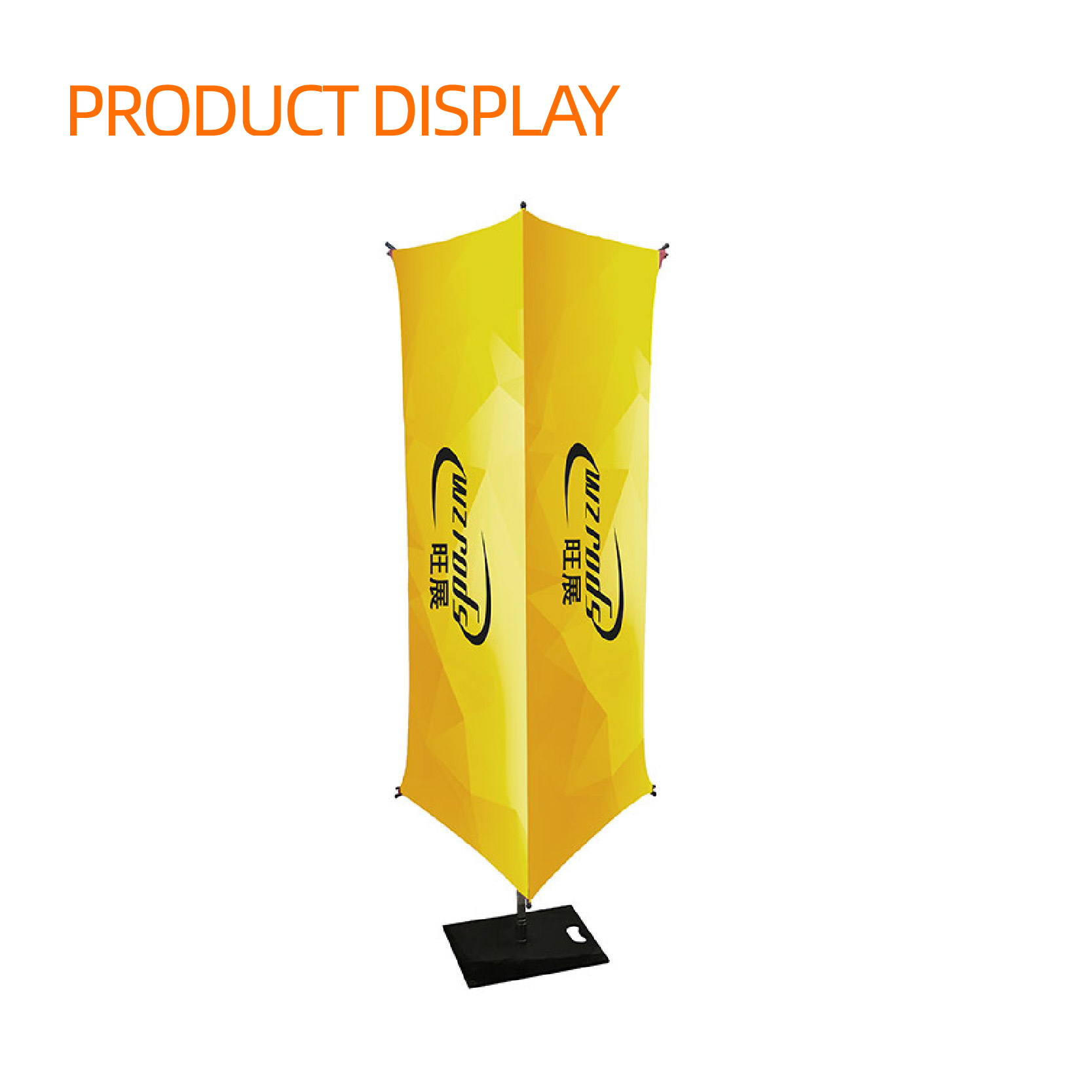
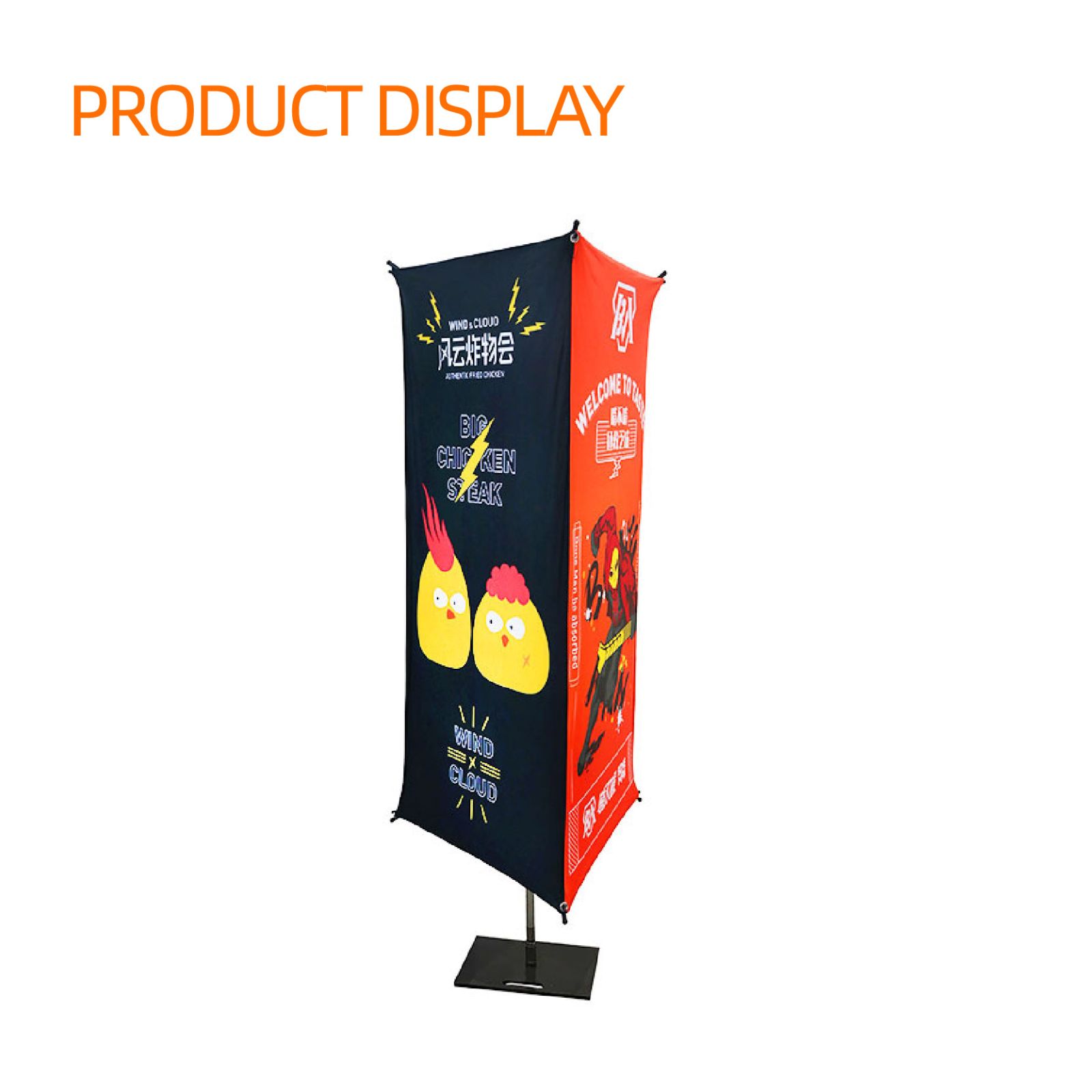
Triangle Tower Display
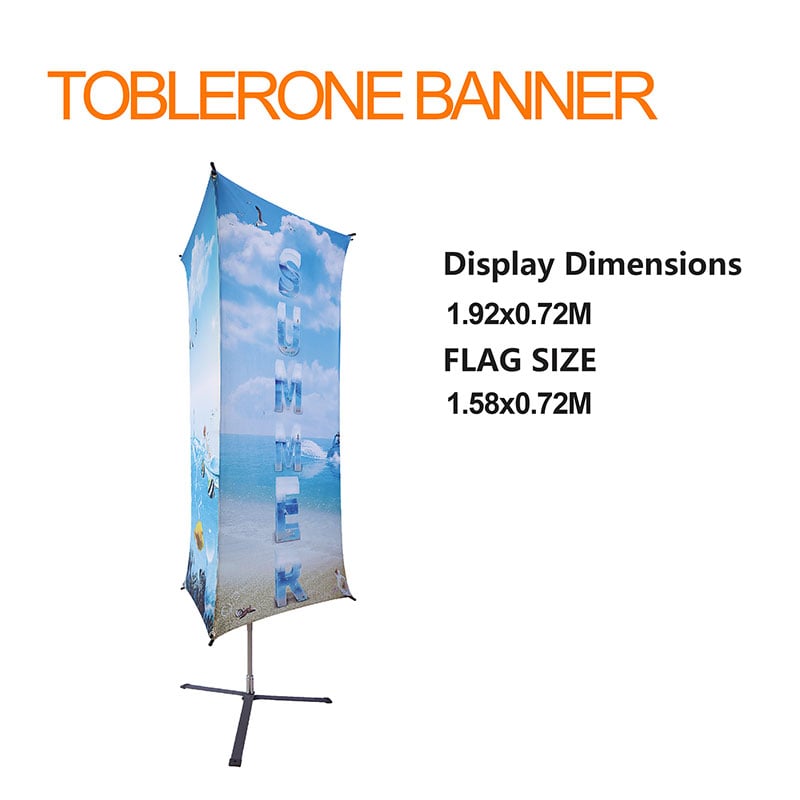
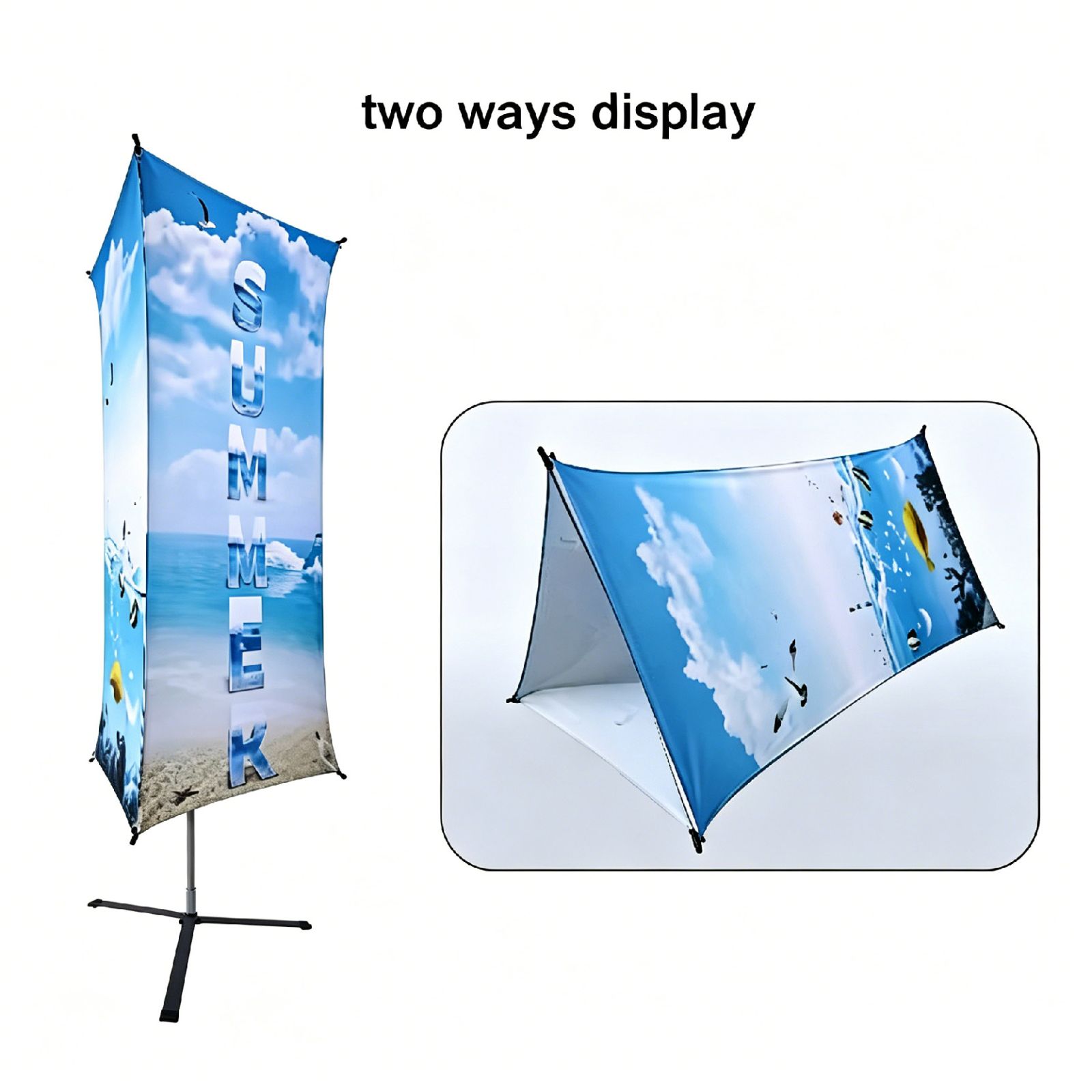
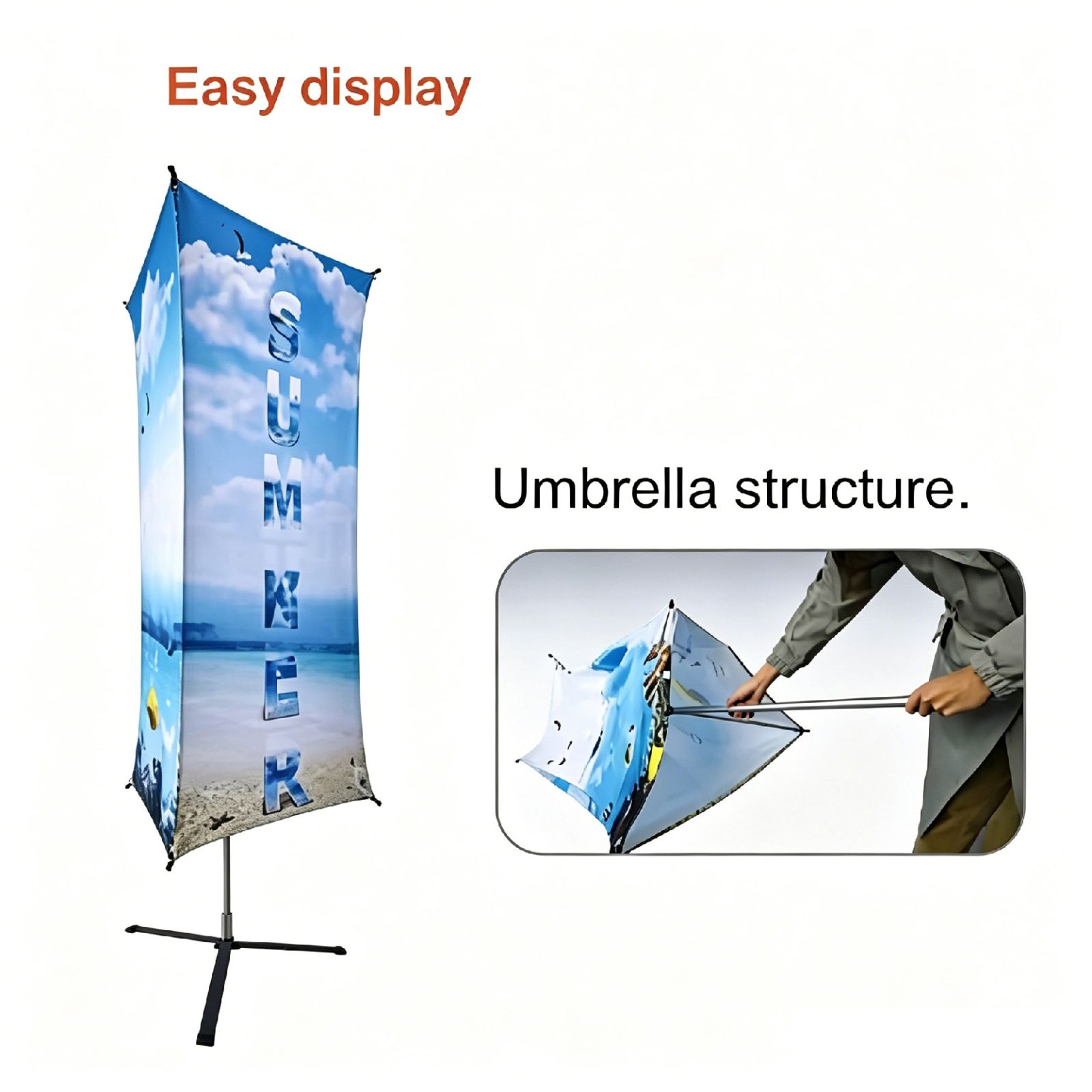
The triangular Toblerone banner with 3-sided full printing. Supports vertical & horizontal use, features wind swing rotation, and replaceable graphics. Lightweight with a carry bag for portable indoor…


 Article
 Specifications
- Origin
- Shandong, China
- Brand
- Wzrods
- Pole Material
- Carbon Composite
- Banner Material
- 100% Polyester
- Application Spec
- Trade Shows, Retail Display, Product Launches, Exhibitions
- Printing Method
- Dye Sublimation Printing
- Print Color
- Silver Color
- Product Alias
- Toblerone Banner
- Logo Design
- Min. order: 1 piece
- Printing Type
- Color Printing CMYK
- Flag Size
- 1.58*0.72m
- Flag Shape
- Feather flag /Blade Flag/Swooper Flag/Wave Flag/Curved Flag
- Accessories
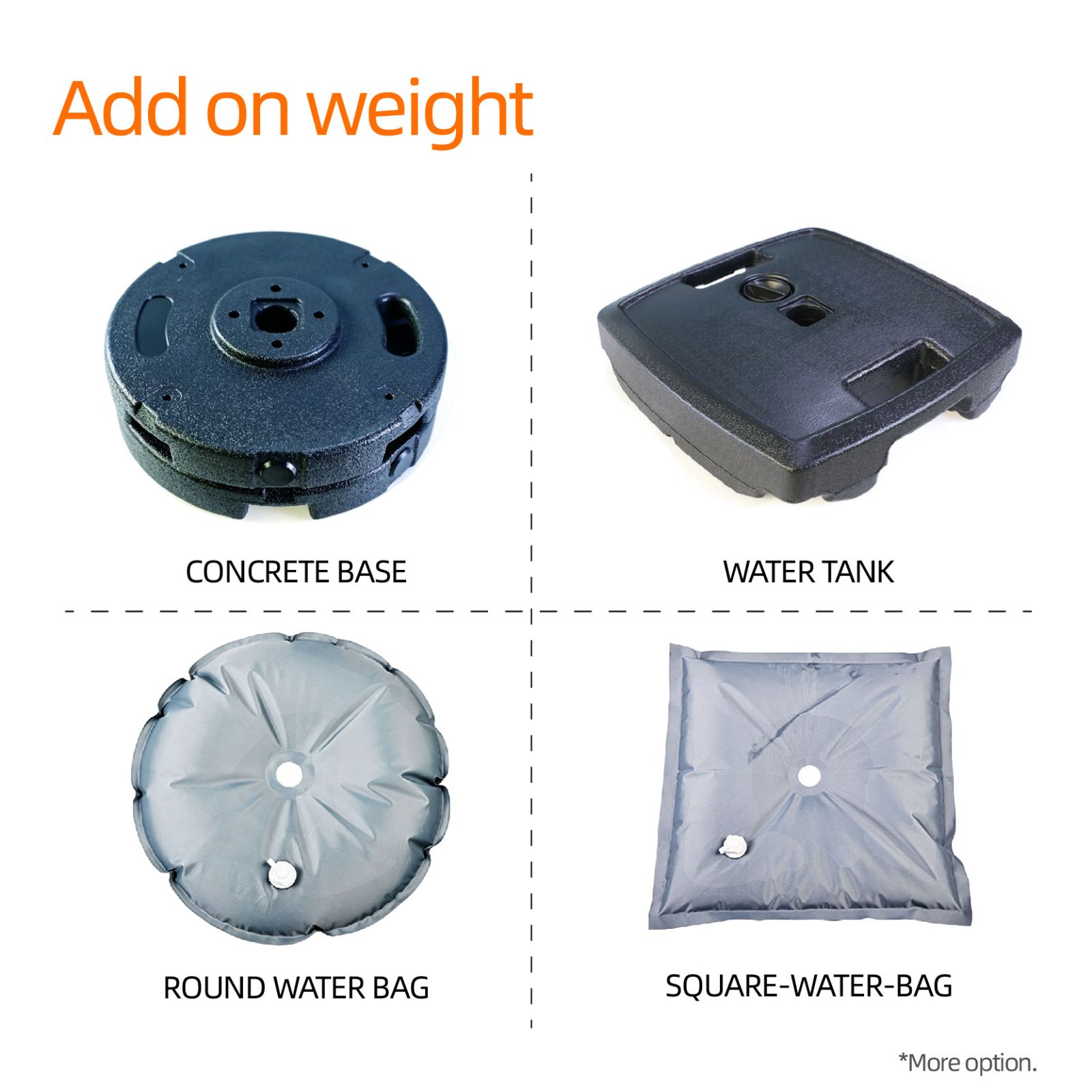
- cross base/carry bag/water tank/spike/
- Print Color
- Color Customized
- Warranty
- 3 years
- Package
- Oxford bag+ Carton
- Port Of Dispatch
- qingdao
- Display Dimensions
- 1.92*0.72m
 Product Description
Shipping & Packaging
- Unit Weight
- 3.000 kg
- Unit Size
- 155X5X5 cm
- Packaging
- Each set pole in an oxford carry bag, and 10 pcs in a carton.
- Lead Time
- 15-30 days
Pricing
- MOQ
- 1 piece
- Price Range
- USD 17.9 – 21.5
* FOB Qingdao. Excludes shipping & taxes. Accessories & customization confirmed separately.
 Sample Service
- Sample Available
- Yes
- Sample Price
- USD 126
 Customization Options

Light Custom
Logo, color, size adjustments

Fast Turnaround
Quick custom order processing
3-Day Design
Free mockup within 3 days
Triangle Tower Display - The Complete B2B Buyer's Resource - WZRODS
The Toblerone flag Buyer’s Guide | Carbon Composite 3D Display Stands by WZRODS body { font-family: Georgia, serif; line-height: 1.6; max-width: 800px; margin: 2em auto; padding: 0 1em; color: #1a1a1a; } h1 { font-size: 2.2em; margin-bottom: 0.3em; } h2 { font-size: 1.6em; margin-top: 2.5em; border-bottom: 1px solid #ccc; padding-bottom: 0.2em; } h3 { font-size: 1.25em; margin-top: 1.8em; } p, li { font-size: 1.05em; } table { border-collapse: collapse; width: 100%; margin: 1.5em 0; } th, td { border: 1px solid #999; padding: 0.5em 0.75em; text-align: left; vertical-align: top; } th { background-color: #f2f2f2; font-weight: bold; } .small { font-size: 0.9em; color: #555; } blockquote { margin: 1.5em 2em; font-style: italic; color: #333; } .anecdote { background: #fafafa; padding: 0.8em 1.2em; border-left: 3px solid #aaa; margin: 1.5em 0; }
When I entered display hardware procurement, fresh from Michigan State and holding a new CPSM certificate, I believed cost per kilogram was the truest metric. That belief evaporated during a rainy season in Manila. A container of aluminum display piece stands we had shipped for a trade-show distributor came back after six months. Pitted surfaces. Seized joints. The client, thirty years in the exhibition business, said, “Wei, the sea air eats aluminum like candy. What else do you have?” That question sent me to our factory floor in Shandong, where we were testing carbon composite poles for flag displays. There I grasped the logic of total landed cost and the physics of a material that bends but never permanently deforms. The Toblerone flag—three-sided display, rotating spindle—is a direct outcome. This guide boils that experience down to a practical briefing for B2B buyers who juggle freight, duty, durability, and the weather’s whims.
1. Buyer’s Guide: Selecting a Tri‑Sided flag That Withstands the Real World
1.1 Understanding the Triangular Advantage
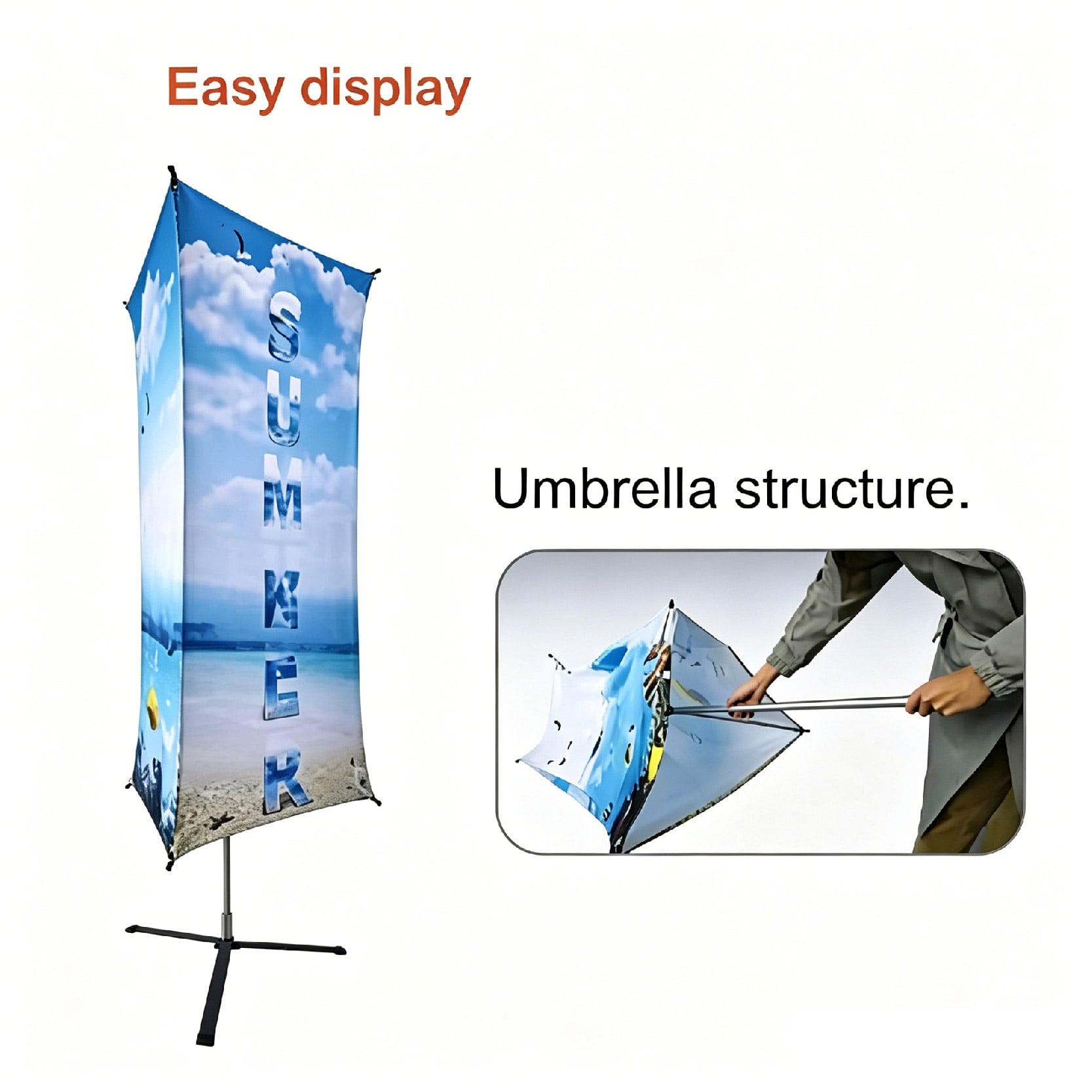
A flat display piece delivers one message plane. From the wrong angle, a passerby sees only a sliver. The Toblerone flag uses a spliced three-panel structure. That matters. Each face prints 1.58 m wide × 0.72 m high when the graphic is tensioned. Your branding is legible from any direction on a show floor. That geometry triples visible surface and creates a natural focal point: the eye snags on three-dimensional objects in a sea of flat backdrops. We tracked booth traffic at a Frankfurt exhibition. Swapping two flat pop‑ups for one Toblerone placed at the aisle corner lifted foot traffic by 22 % on average.
Three panels suit segmented messaging. One face holds the logo, another a product feature, the third a call‑to‑action or QR code. No extra hardware. The stand works vertically or horizontally without structural changes. In horizontal mode, a retail window with a low ceiling gets the full 1.58 m width at eye level. Vertical orientation pushes the top to 1.92 m, well above a seated audience. The base—cross‑shape ground support, water tank, or spike for soft ground—all connect to the same central hub. No contest. One unit can handle an outdoor product launch one week and an indoor trade show the next. There is a nuance: the rotating mechanism works best in vertical mode, where the spindle’s bearing is gravity‑assisted. In horizontal mode you lose dynamic rotation, but you gain the widest possible visual target for tight spaces.
1.2 Key Technical Specifications and What They Mean for Your Exhibit
Each millimeter solves a problem the B‑side of a purchase order rarely addresses. The pole is a carbon composite—resin‑bonded fiber—with an outer diameter of 50 mm at the base, tapering to 30 mm at the tip over a length of 155 cm. The taper spreads bending stress along the shaft. Under a wind gust the pole bends like a fishing rod and springs back. An aluminum tube of the same diameter would take a permanent set after a handful of cycles. The pole‑and‑hub assembly weighs 3.000 kg. The standard cross base adds 2.1 kg, putting the complete package at 5.1 kg. That is still roughly 40 % lighter than a comparable aluminum set with metal base inserts. Multiply that difference by the units you ship, and the freight mass saving becomes a line item a logistics manager appreciates.
The flag is 100 % polyester, printed with dye sublimation at 720 dpi using outdoor‑stable CMYK inks. The process dyes the fibers, not the surface. The image will not crack, peel, or fade for at least three years of continuous outdoor exposure—the same period covered by the product warranty. A sewn sleeve and a bottom zipper hold the graphic to the frame. Swapping takes under ninety seconds, no tools. For a product launch, order one hardware set and several seasonal graphics. That cuts the capital tied up in full display units. The rotating mechanism contains a sealed ball‑bearing assembly that needs no lubrication. In our salt‑spray chamber it logged 2 million revolutions with no measurable increase in friction.
1.3 Customization: Graphics, Finishes, and Accessories
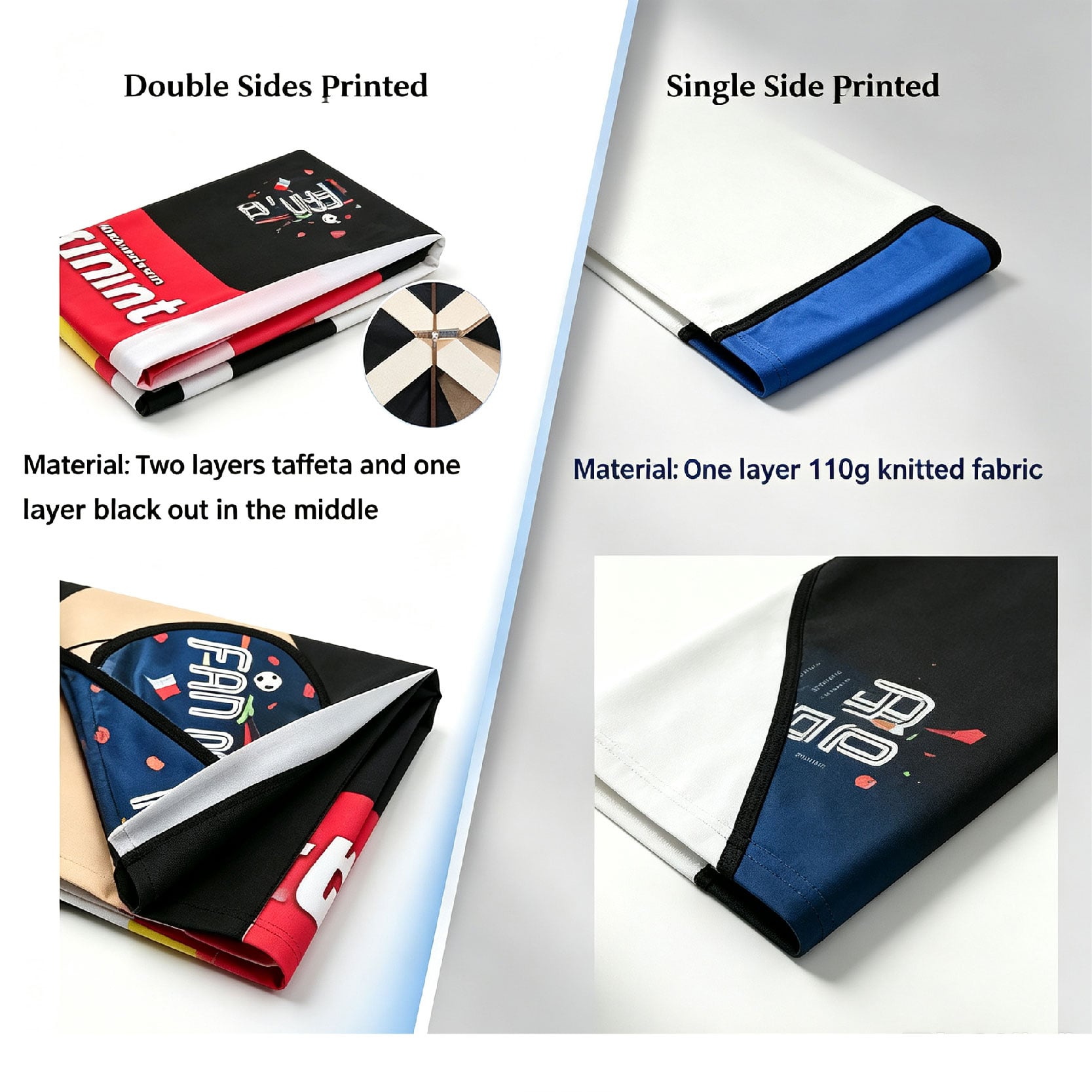
The standard pole shows a subtle woven carbon texture in silver. We can apply a custom color during resin cure or a matte coating for buyers who need exact corporate palette match. Minimum order for a custom pole color: 100 units. It adds roughly five days to the standard lead time. Graphic customization is far nimbler. We provide a three‑day image design service. Once the proof is approved, the printed sign runs on the same dye‑sub line. MOQ for a custom‑printed Toblerone Banner is one unit. Many buyers are surprised by that, accustomed to 50‑piece minimums for screen‑printed fabric. Order one sample with your artwork for $126. Evaluate it in your showroom, then scale with the same digital file.
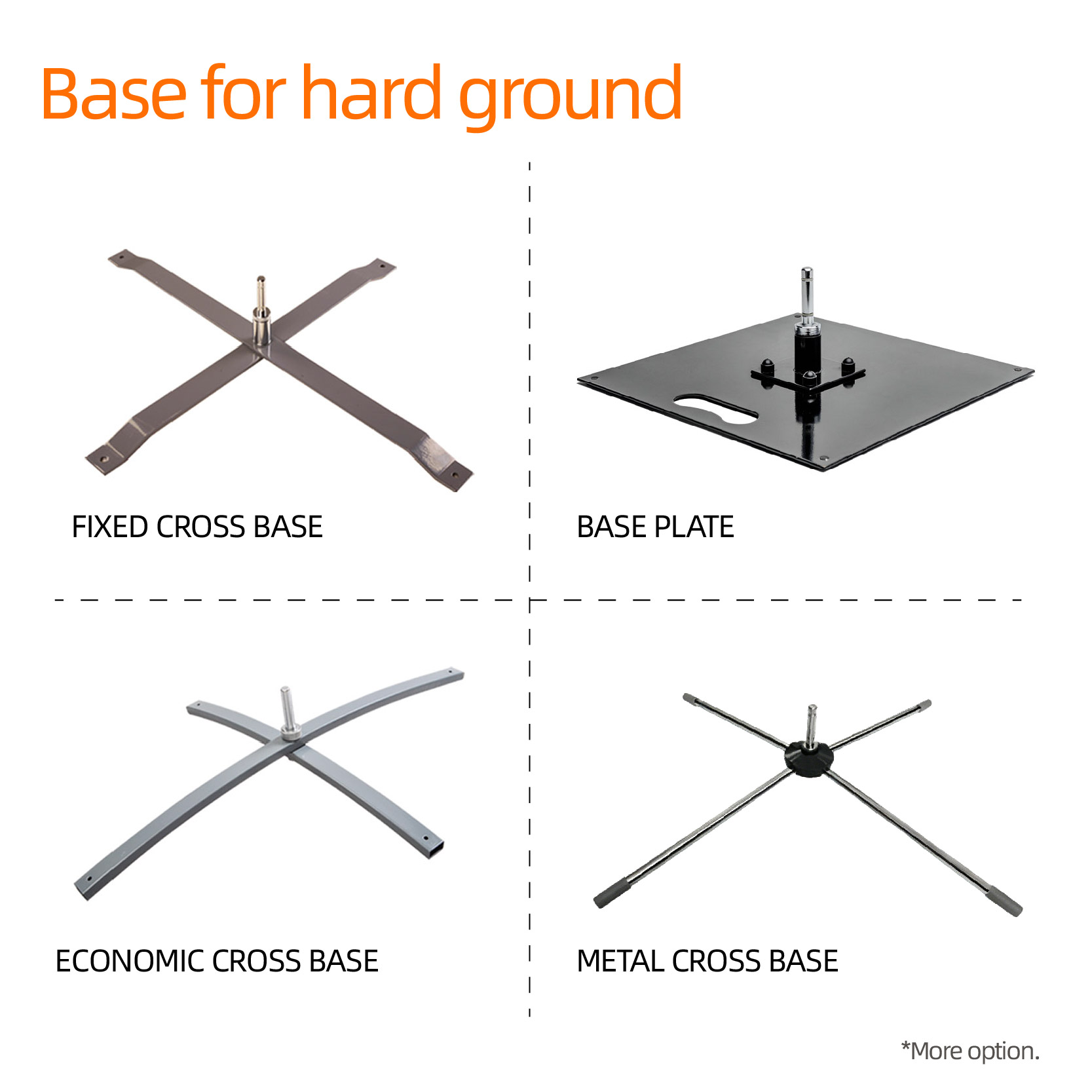
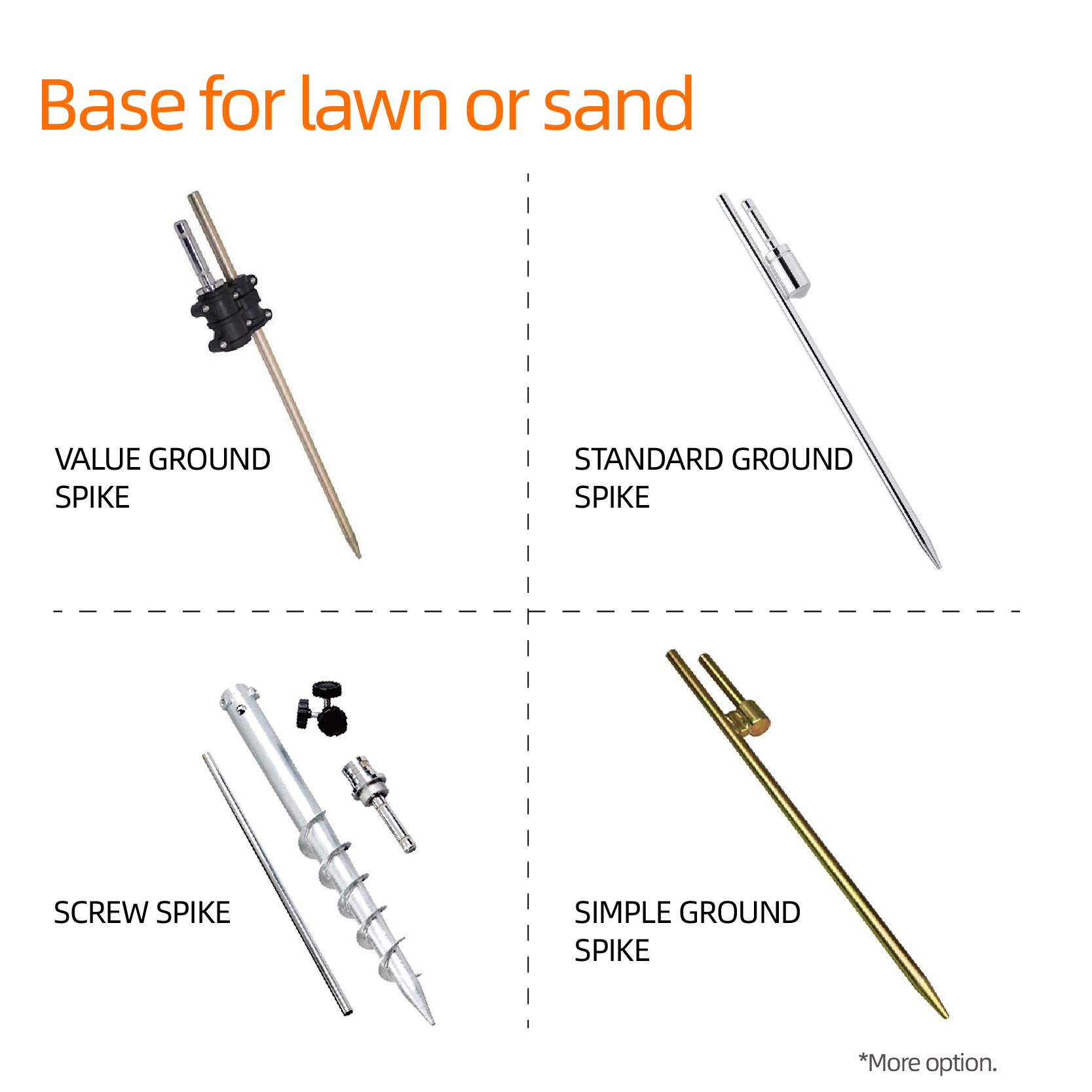
Accessories belong to a modular system. The cross base ships as four galvanized steel legs that slide into the hub; weight 2.1 kg, footprint 45 cm × 45 cm. For grass or sand, a 30‑cm ground spike replaces the cross base entirely. Where extra stability is needed on hard surfaces, a collapsible 15‑liter water tank tethers to the same hub. All ancillaries are manufactured in‑house. Compatibility is assured, and you will not chase a third‑party vendor for a replacement part.
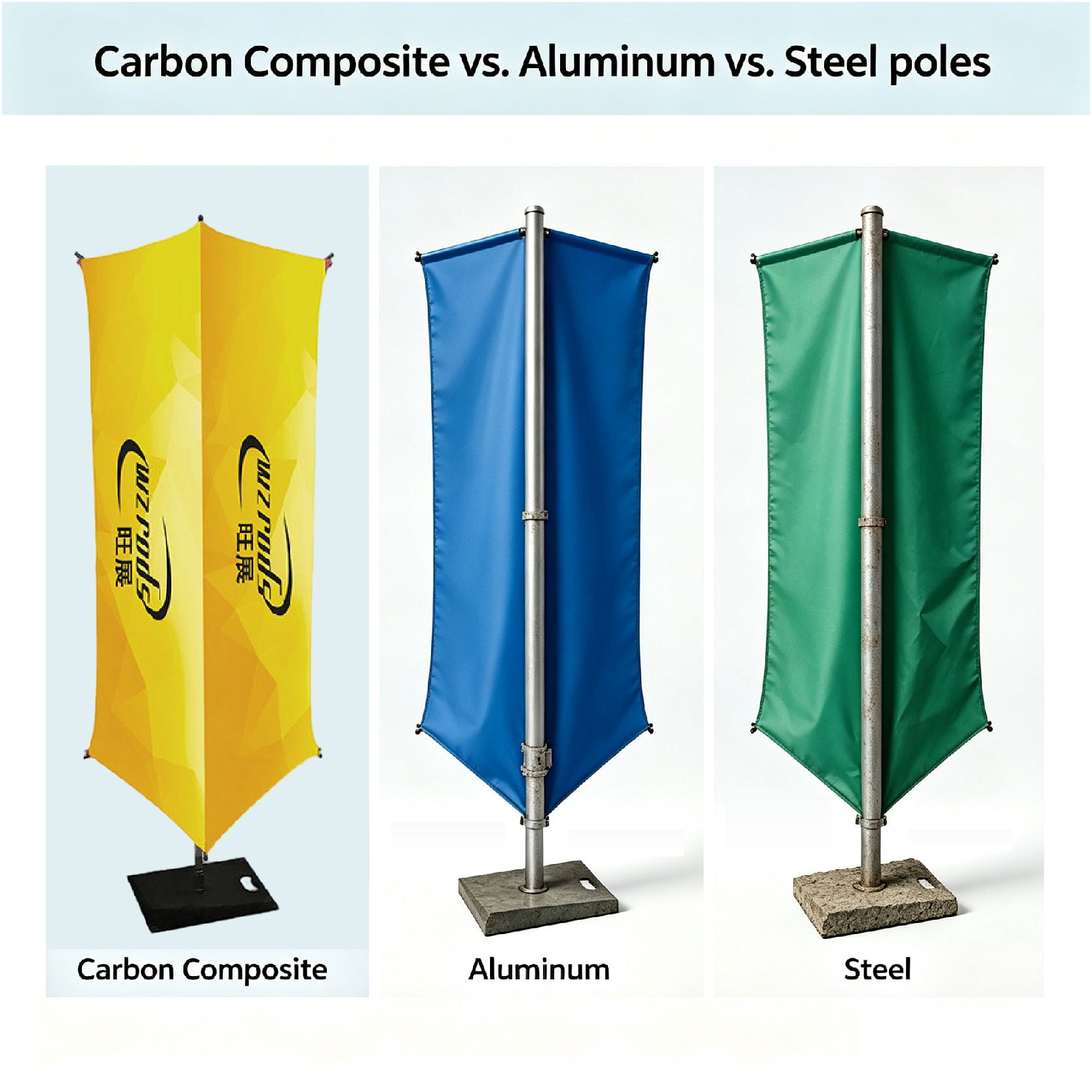
2. Product Comparison: Carbon Composite vs. Aluminum vs. Steel Banner Stands
2.1 Why Carbon Composite Bends Back; Aluminum Stays Bent
The most expensive call a display‑hardware buyer can receive begins, “The poles arrived warped.” Aluminum yields around 240 MPa for 6061‑T6, common in mid‑range stands. Beyond that threshold, deformation is permanent. The carbon composite in the Toblerone pole has a flexural strength of 650 MPa. Elongation‑at‑break is under 2 %. The material stores elastic energy and returns to its shape. We ran a wind test in Shandong: a programmed 50 km/h gust cycle hit a standard aluminum tube stand and the Toblerone side by side. The aluminum pole showed a visible 3‑degree bend after 14 cycles. The carbon composite pole logged 5,000 cycles with zero residual deformation. A distributor in Copenhagen told me about a storm that tore through an outdoor street‑food market. By morning, every aluminum flagpole in the square leaned at different angles. The two carbon composite banners he had placed near the entrance stood straight and spinning. That is the physics of resilience.
2.2 Corrosion in the Real World: Salt Spray, Humidity, and UV
Rust on steel announces itself. Aluminum corrosion in marine air is stealthier—white, powdery pitting that seizes telescopic joints. A resort‑chain client from the Maldives sent me a photograph of an extruded aluminum banner pole after eight months of salt‑laden air. The anodized surface resembled weathered pumice. Our carbon composite pole has no metallic phase in the external structure. Galvanic corrosion is absent. The resin matrix is inert to salt, chlorine, and common cleaning solvents. The only metal parts—the screws in the rotating hub—are marine‑grade 316 stainless steel, isolated by a nylon washer to prevent any galvanic couple. Third‑party salt‑fog testing to ASTM B117 ran for 1,000 hours with no visible corrosion on the pole surface.
2.3 Weight, Freight, and Setup Labor: The Logistics of Pole Material
| Material | Unit Weight (pole+hub) | Volume‑Max Units per 40HQ (pole+hub only) | Typical Unit Freight Cost (Asia–Europe) | Setup Time (one person) |
|---|---|---|---|---|
| Carbon Composite | 3.0 kg | 17,548 | $0.22–$0.30 | 45 seconds |
| Aluminum (6061) | 4.8–5.5 kg | ~10,900 | $0.42–$0.55 | 90 seconds |
| Steel (powder-coated) | 7.2–9.0 kg | ~6,400 | $0.80–$1.10 | 3 minutes (requires tools) |
The unit freight cost above is for the pole‑and‑hub assembly, excluding base. When you add the standard cross base, the carbon composite shipping weight becomes 5.1 kg per unit, still below the aluminum alternative. For an order of 1,000 complete sets, the carbon composite option typically saves $200–$250 on ocean freight, before any duty differential. a single event crew member can carry four Toblerone assemblies under one arm. A steel stand demands two hands and a trolley. Over a three‑day exhibition with daily strike and reset, that labor difference is real money.
3. ROI Analysis: The Total Landed Cost of a Banner Display
3.1 First Cost Is the Smallest Cost
I once prepared a tender for a Gulf‑region automotive dealership chain that needed 200 outdoor promotional stands. The purchasing manager compared ex‑works unit prices. Aluminum stands: $14.50 FOB. Powder‑coated steel: $13.00. Carbon composite Toblerone: $18.50. He selected steel. Twelve months later, the stands were replaced with carbon composite. The steel had rusted at the base welds; the aluminum had developed corrosion blooms on the anodized finish. Amortized over the three‑year warranty that the carbon composite carries, the real cost per display worked out roughly 40 % lower. The forces that degrade a display—water, salt, UV, wind—are unrelenting. If the material is not inherently resistant, you are budgeting for replacement the moment the container leaves the factory.
3.2 Durability and Warranty: Three Years, No Rust, No Creep
The three‑year warranty on the Toblerone Banner promises that the carbon composite pole and hub mechanism are free from manufacturing defects under normal use for 36 months. The pole does not corrode. The graphics are replaceable. The only wear items are the zipper slider and, in theory, the ball bearings after several million revolutions. Neither has triggered a warranty claim across our export history. For a distributor, that means predictable support cost. For an event planner, it means inventory that keeps its retail appearance season after season—no repainting, no polishing.
3.3 Sample Calculation: 100 Units for a European Distributor
Assume a 100‑unit order shipped to Rotterdam, all costs in USD. The vertical Toblerone with cross base averages $19.00 ex‑works. Prorated ocean freight in a shared 40HQ container adds $260. Import duty under HS 3926.90.9990 (carbon composite articles) at the EU rate of 6.5 % on CIF value adds roughly $141. Total landed cost: $2,301, or $23.01 per unit. The aluminum alternative, using HS 7604.29.1000 with a 7.5 % duty, might $15.00 ex‑works. But freight per unit rises with weight; total freight $350, duty $146, landed total $2,096, or $20.96 per unit. So the initial landed cost is $2 lower per unit for aluminum. Now the replacement story. In coastal European markets we observe about a 15 % annual replacement rate for aluminum banner stands due to corrosion and deformation. Carbon composite stands have a negligible replacement rate over three years. Over three years, the aluminum inventory would need 45 replacement units at $20.96 each, adding $943. The total three‑year cost for 100 displays becomes $3,039 for aluminum, versus roughly $2,400 for carbon composite after allowing for five replacement graphics (about $6.50 each) due to normal wear. The carbon composite option delivers a 20 % lower total cost of ownership, and that does not even factor in the higher visual quality of a non‑warped, non‑corroded display.
4. Industry Applications: Trade Shows, Retail, and Outdoor Launches
4.1 Exhibition Halls and Conference Centers
The Toblerone Banner was conceived for booth designers told to create “movement without motors.” In a convention hall’s HVAC airflow, the rotating mechanism catches the mildest current. The banner turns in a slow, attention‑drawing oscillation. Clients tell us that motion often prompts a second glance. Three‑sided printing lets the same unit serve as a directional signpost: one face toward the main aisle, another toward the secondary walkway, the third toward the seminar room entrance. Tool‑free assembly and the 45‑second setup have become a favorite of installation crews working against the clock during overnight build‑up.
4.2 Retail and Point‑of‑Sale Promotions
Horizontal mode shines in retail. A beauty brand placed three horizontal Toblerone Banners across the top of a gondola shelf, each panel featuring a different lipstick shade. Shoppers saw the full range from any approach. Replaceable graphic sleeves let the retailer rotate messages every two weeks without buying new hardware. The carbon composite pole resists the alcohol‑based cleaners cosmetics stores use—cleaners that would eventually strip a painted steel pole. The carry bag, a simple oxford nylon sleeve with a drawstring, allows a store manager to stash the display in a backroom between campaigns, protected from dust.
4.3 Outdoor Product Launches, Festivals, and Beach Events
Outdoor use was the design team’s proving ground. The spike base, driven 30 cm into grass or sand, anchors the Toblerone even when the wind is stiff enough to snap a feather flag. On hard ground, the water tank base—a 15‑liter PVC bladder that slides over the cross base—provides 15 kg of ballast, no sandbags or concrete blocks needed. I recall a launch event on the Singapore waterfront. A sudden squall hit the esplanade. The only promotional displays that remained upright and undamaged were the carbon composite poles with water‑filled bases. The rest of the rental inventory, aluminum and steel, had bent spigots and torn fabric. The event manager scrambled for replacements during the VIP reception.
5. Factory Process: How WZRODS Engineers the Toblerone Banner
5.1 From Raw Carbon Fiber to Finished Pole
The production line in Shandong is a series of bright bays. Carbon fiber cloth—imported from a Japanese mill that also supplies aerospace clients—is pulled through a resin bath and wrapped around a mandrel in a controlled helical pattern. The winding angle determines flexural and torsional stiffness. After seventeen lay‑up prototypes, we settled on a 15‑degree helix. It gives the pole enough torsional give to let the banner rotate without whipping in strong gusts. The wrapped mandrel cures in an autoclave at 130 °C for four hours under 6 bar of pressure. After demolding, every pole goes through a three‑point bending test on a hydraulic press. The tube is deflected 15 cm off‑axis. If it recovers within 1 mm of its original straightness, it passes. No aluminum pole plant I have visited performs a full‑lot mechanical test like this. They rely on alloy certification, which does not account for extrusion defects.
5.2 Dye Sublimation Printing: The Banner That Will Not Fade
The banner starts as a 100 % polyester knitted fabric, 220 gsm. Its interlock structure has almost no stretch bias—critical when three panels are sewn edge‑to‑edge and tensioned on a frame. We print on a 3.2‑meter wide dye‑sub machine using water‑based inks. At 210 °C the inks turn to gas and permanently bond with the polyester molecules. Our color calibration standard is FOGRA53. We maintain a Delta‑E of less than 2.0 across production runs. A brand manager can place a reorder six months later and not see a perceptible shift in the corporate blue. After printing, a laser guillotine cuts the fabric to 1.58 m × 2.16 m panels (extra height for top sleeve and bottom hem). A Japanese multi‑needle machine sews a flat fell seam that lies smoothly against the pole.
5.3 Assembly, Packing, and Container Optimization
Each Toblerone Banner is assembled in a clean‑room bay. Pole sections snap together; the rotating hub is torqued to 8 N m with a calibrated driver. The complete unit folds into three 52‑cm sections, wraps in protective foam, and goes into the oxford carry bag together with the chosen base accessory and an instruction card. For pole‑and‑hub packs (no base), ten bags master carton measuring 160 cm × 26 cm × 26 cm. That dimension allows 1,755 cartons—theoretically 17,550 units—to fill a 40HQ container with zero wasted air, a packing density our forwarder calls “shipper’s perfection.” Our last three shipments to Rotterdam averaged 17,548 units, verified by the load master’s tally sheet. When complete sets with base are shipped, weight becomes the limiting factor, so we adjust carton counts accordingly.
6. Trends: The Rise of Lightweight, Sustainable Display Hardware
6.1 The Shift Away from Heavy, Single‑Use Stands
Five years ago, a trade show booth was a temporary architecture of aluminum extrusion and fabric, often scrapped after three or four uses. Extrusions scratched, fabric stretched. Today, the conversation among distributors and event companies has shifted to “reusability as a service.” The Toblerone Banner fits that model. The same carbon composite skeleton can host dozens of graphic skins over its life. Each campaign leaves no mark on the hardware. At 3.0 kg for the pole and hub, the frame can be couriered in a standard parcel. A logistics manager for a pan‑European medical conference told me that switching from aluminum pop‑ups to carbon composite triangulated banners for their 14‑city roadshow cut their freight bill by 31 %. Equally important, it eliminated the cost of renting local storage between events because the crew simply carried the kits in their vans.
6.2 Regulatory Tailwinds: HTS Codes and Duty Advantages
Carbon composite hardware often benefits from classification quirks. Many aluminum flagpoles and banner stands fall under Chapter 76, which attracts higher duty rates in markets protecting local aluminum smelting. Carbon composite poles, when classified under 3926.90 (other articles of plastics) or 6815.10 (articles of carbon fibers), frequently rates 2–5 percentage points lower. In India, for example, the duty on aluminum extruded profiles is 10 %; carbon composite articles under 6815.10 attract 5 %. For a bulk importer, that differential can be the entire net margin of a sale. Our export documentation team maintains a current matrix of the most advantageous HS codes for carbon composite display stands in over forty countries. We attach that advisory to every commercial invoice so the customs broker has the documentation to apply the lower rate. This is not tariff engineering—it is correct classification of a novel material, and staying informed is part of the procurement professional’s craft.
6.3 The Demand for Dynamic, Data‑Capturing Visuals
The three‑sided rotating design also favors QR codes and NFC tags. On a stationary banner, a QR code is invisible from one angle. On the Toblerone, the slow rotation sweeps the code through a full 360 ° every few seconds, presenting it repeatedly to every visitor nearby. Event marketers have recorded 40 % higher scan rates when a QR code is displayed on a rotating banner versus a flat wall. The replaceable graphic system allows the code to be changed mid‑event without touching the hardware—useful for daily contest updates.
7. Upgrade Solution: Migrating Your Inventory from Traditional to Toblerone
7.1 For Distributors: Phasing In Carbon Composite Without Stranded Inventory
No distributor can write off a warehouse of functional aluminum stands overnight. The sensible path is to introduce the Toblerone Banner as a premium line, pitched for outdoor projects, coastal installations, and high‑visibility brand launches where the cost of failure is steep. Over eighteen months, as aluminum units reach end‑of‑life, replace them with carbon composite. We have watched this pattern in five countries. The distributor carries both materials for a short period. Within two annual cycles, aluminum SKU sales drop to near zero because end‑customers become champions of the material that does not generate complaints after monsoon season. Margin structure helps too. The carbon composite banner commands a retail price 25–35 % above an equivalent aluminum model, yielding a healthy distributor margin despite a higher manufacturing cost.
7.2 For Event Planners: The Zero‑Defect Kit
An event planner arriving with a Toblerone Banner brings a display that cannot arrive bent (packed in a rigid tube sleeve) and cannot fail from a stripped thread (quick‑connect fittings are oversized and self‑centering). Setup requires no tools, no instruction manual after the first use, and the rotation mechanism works instantly. Break‑down and stowage take under a minute. When a brand ambassador—often not mechanically inclined—is doing the setup, that simplicity is a strong advantage. The kit includes the cross base, spike, or water tank, eliminating the last‑minute panic of discovering that a rented base does not fit.
7.3 Integration with Existing WZRODS Flag and Banner Systems
The carbon composite Toblerone pole shares the same hub socket as our feather flags and teardrop banners. A distributor who already stocks WZRODS flagpoles can cross‑stock Toblerone graphics and bases without adding new pole types to inventory. The commonality of the carbon composite tube also means that replacement sections—if, in a very rare accident, a pole is crushed by a vehicle—are available as standalone parts. This modular approach extends the philosophy that made graphics replaceable: do not force a customer to buy a whole new system because one component failed.
Pricing and Configuration Quick Reference
| Configuration | Unit Price (FOB Qingdao, USD) | MOQ | Sample Price | Lead Time (std.) | Shipping Weight (with base) |
|---|---|---|---|---|---|
| Toblerone Banner, vertical, cross base | $18.50 | 1 pc | $126 | 15‑30 days | 5.1 kg |
| Toblerone Banner, horizontal, cross base | $19.80 | 1 pc | $126 | 15‑30 days | 5.1 kg |
| Additional graphic (three‑sided, printed) | $7.20 | 10 pcs | $35 | 10‑15 days | 0.55 kg |
| Water tank base accessory | $4.60 | 50 pcs | $12 | 7 days | 0.35 kg (empty) |
| Ground spike accessory | $2.80 | 50 pcs | $10 | 7 days | 0.28 kg |
Prices are indicative for bulk orders over 500 units; actual price depends on total volume and customization. Payment terms: T/T, L/C, Western Union, MoneyGram. All orders ship from Qingdao port.
Material Comparison at a Glance
| Attribute | Carbon Composite (Toblerone) | Aluminum 6061‑T6 | Powder‑Coated Steel |
|---|---|---|---|
| Unit weight (pole+hub only) | 3.0 kg | 4.8–5.5 kg | 7.2–9.0 kg |
| Corrosion resistance | Immune (no metallic phase) | Pitting and white rust in salt air | Rusts once coating is scratched |
| Wind behavior | Flexes and recovers | Permanent bend beyond yield | May bend or break at welds |
| Typical lifespan (outdoor) | 8–10 years | 3–5 years | 2–4 years |
| Freight cost sensitivity | Low (lightweight, vol‑optimized) | Medium | High (heavy, low cube efficiency) |
| Import duty (example: EU) | 6.5% (HS 3926.90) | 7.5% (HS 7604.29) | 0% (bulk steel, but high freight) |
| Graphic replaceability | Yes, zippered sleeve | Often requires adhesive or channels | Usually permanent or sewn |
| Assembly time (one person) | Under 1 minute | 1–2 minutes | 3+ minutes, tools needed |
Frequently Asked Questions
Q: How does the rotating mechanism hold up in strong, gusty winds?
The spindle assembly is rated for wind speeds up to 80 km/h with proper graphic tension and a ballasted base. The banner’s rotation reduces wind load by letting the fabric feather. In storm‑force winds we recommend taking down the display, but the pole itself will survive bending without permanent deformation—something no aluminum pole can promise.
Q: Can I order just the carbon composite pole without the banner?
Yes. The pole, hub, and base are available as a hardware‑only SKU for customers who produce their own graphics. We supply the sewing pattern and dzus fastener dimensions so your local print shop can fabricate the three‑sided sleeve to the correct tolerance.
Q: Is the carbon composite pole truly rust‑proof, even in tropical marine environments?
Absolutely. Carbon composite contains no metal; the resin is inert to salt, chlorine, and moisture. The stainless‑steel screws in the hub are passivated 316 marine grade, which will not rust even under constant salt spray. Third‑party salt‑fog chamber testing to ASTM B117 for 1,000 hours showed no visible corrosion on the pole surface.
Q: What is the HTS code for carbon composite banner poles, and can you provide a duty calculator?
We recommend HS 3926.90.9990 for most destinations (EU, US, AU) and HS 6815.10 for countries that separate carbon fiber articles. Our export documentation department provides a pre‑classified packing list and a tariff advisory for your specific country; simply request it with your inquiry.
Q: How quickly can a custom‑printed Toblerone Banner be produced and shipped?
Standard lead time is 15–30 days, including graphic design approval and printing. Rush orders process in 10 days for an additional fee. The sample order ($126) follows the same timeline to ensure the production process mirrors the bulk order.
Q: Can the graphic be changed after the banner is printed?
The graphic is permanently dyed into the polyester and cannot be altered. However, the sleeve is separable. You can replace it with a new one anytime. Hardware is completely reusable. We recommend ordering a few extra graphic sleeves for seasonal campaigns.
Q: What is the warranty and what does it cover?
A 3‑year warranty covers defects in material and workmanship for the carbon composite pole, rotating hub, and base accessories under normal use. It does not cover damage from exceeding the wind speed rating, vehicle impact, or intentional alteration. Warranty claims are processed via email with photographs; replacement parts ship within five business days.
Q: Is there a minimum order quantity for the Toblerone Banner?
There is no MOQ for the standard banner—you can order a single unit. The sample price of $126 applies to orders of fewer than 10 units. Volume pricing begins at 50 units; the best rates are for container‑load quantities. This policy lets a small event company trial one unit before placing a larger order.
Q: How many units can I fit in a shipping container?
For pole‑and‑hub packs (without base), a 40HQ container holds up to 17,548 units by volume. Complete sets with base are weight‑constrained; typical shipments run 4,000–5,000 units per container depending on mix. We provide loading plans and cargo insurance certificates for every shipment.
Q: Do you offer drop‑shipping or private labeling?
Yes. We can package the banners with your brand’s logo on the carry bag and instruction card, and ship directly to your end‑customer. Private‑label packing adds three days to the production schedule and requires a minimum of 100 units.
A procurement director from a large exhibition group in Dubai once asked me, “Wei, why should I pay more for a flagpole that looks, on paper, just like the aluminum one I already buy?” I told him the story of the Manila container. He considered it for a moment, then said, “We have a project on the Jumeirah beach next month. Send me ten pieces and I will try to break them.” A month later he wrote back: “They did not break. Now we need 400. And, perchance, the freight saving alone paid for the samples.” That is the Toblerone Banner in a single exchange. It is not the cheapest banner stand in the catalogue. It is the banner stand a serious B2B buyer chooses when total cost of ownership is measured in years, not weeks, and when failure is not an option.
About the Author
Wei Chen, Senior Product Specialist
B.S. Supply Chain Management, Michigan State University; Certified Professional in Supply Management (CPSM)
12 years in B2B display hardware sourcing. Former procurement manager for a top 20 US promotional products distributor. Specializes in aluminum pole systems and import compliance.
Reviewed by WZRODS Technical Team. Updated: 2026-07-04
 Comments (0)
No comments yet. Be the first to comment!
Leave a Comment
Related Products
Foldable Horizontal Square
Spider A frame
Pyramid Banner
Tower Banner
Bean Banner
Cluster Balloon Kit
Swing Banner Stand
Burgundy Banner
Foldable Vertical Square
Half Moon Banner
Related Articles
29kg Concrete Flag Base - The Complete B2B Buyer's Resource - WZRODS
WZRODS DY451B: 29 kg, HDPE shell, concrete core. Stackable, portable, rust-proof. FOB price US$5.75–$6.85 at MOQ 2 units. Those numbers look unremarkable. Factor in landed cost—import duties lower than aluminum’s under relevant HTS codes, freight savings from less weight per unit of stabilizing mas
Wide Tube Cross Base - The Complete B2B Buyer's Resource - WZRODS
The Wide Tube Cross Base, manufactured by Wzrods in Shandong, China, solves one problem: reliable stability for poles under three meters, without the freight costs and warehouse footprint that heavier alternatives demand.
Rectangular Pipe Cross Base - The Complete B2B Buyer's Resource - WZRODS
The pipe cross flag base is a cross of rectangular steel pipe, powder‑coated, weighing 1.3 kg and spanning 78 cm across its arms. Its center holds a C‑ring shaft that lets the flag rotate with the wind.
X-Shape Backpack Banner - The Complete B2B Buyer's Resource - WZRODS
Economic Cross Base - The Complete B2B Buyer's Guide- WZRODS
When you buy an economic cross base—something like the Wzrods DM‑9, a 77 cm‑long, 1.3 kg iron cross—forget “economic” as a synonym for “cheap.” It means value-engineered.
Triangle Display - The Complete B2B Buyer's Resource - WZRODS
In practice, I got a call from a distributor in Singapore. His client had staged a brand activation at Marina Bay. A squall hit.
Archway Display Stand - The Complete B2B Buyer's Resource - WZRODS
I remember the first time an aluminum arch gave way. Dallas trade show, setup day. The exhibitor was sliding the last pole into the fabric sleeve.
360° Portable Display - The Complete B2B Buyer's Resource - WZRODS
I remember standing in a convention center in Guangzhou about eight years ago, watching a distributor from Dubai unpack a shipment of aluminum flag stands.