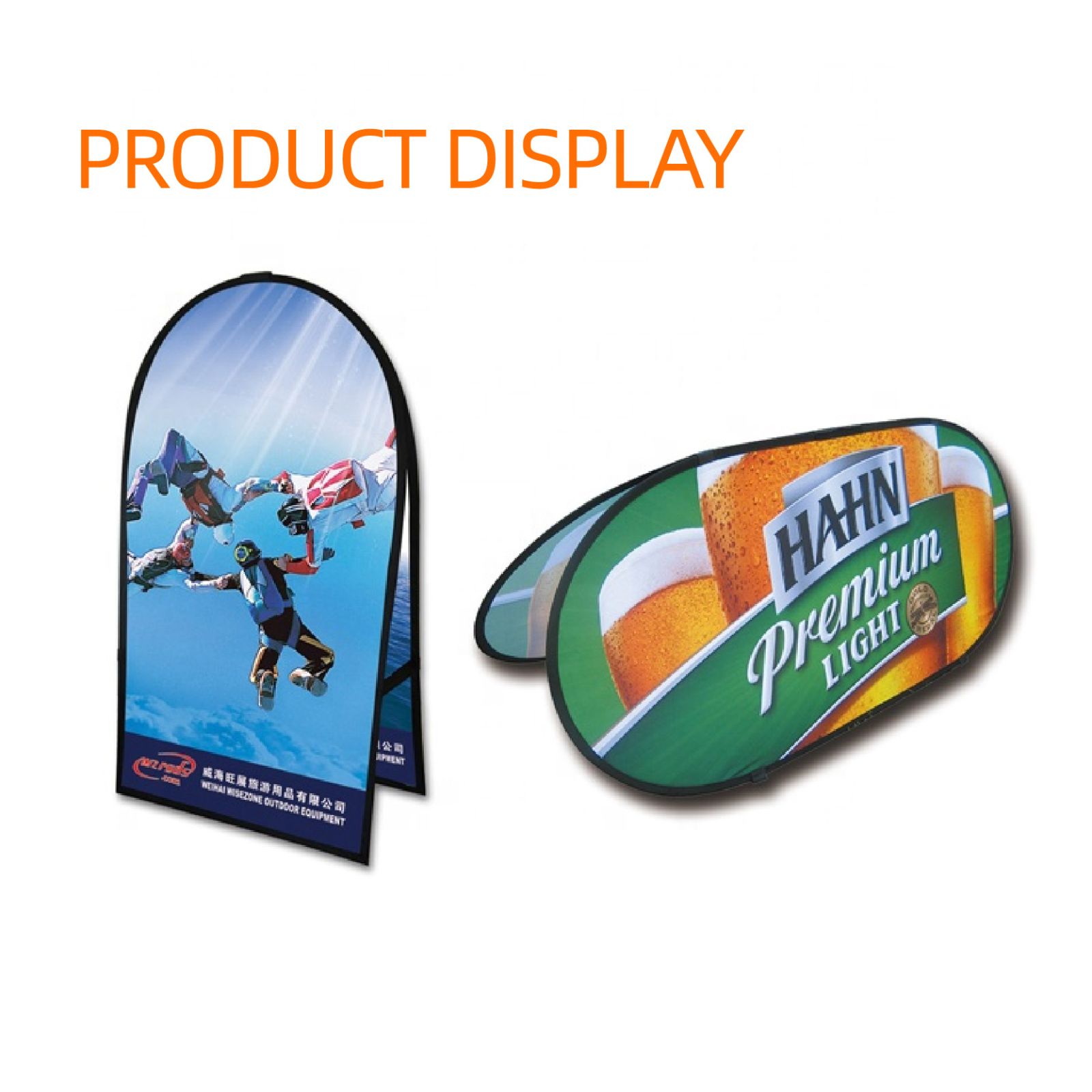
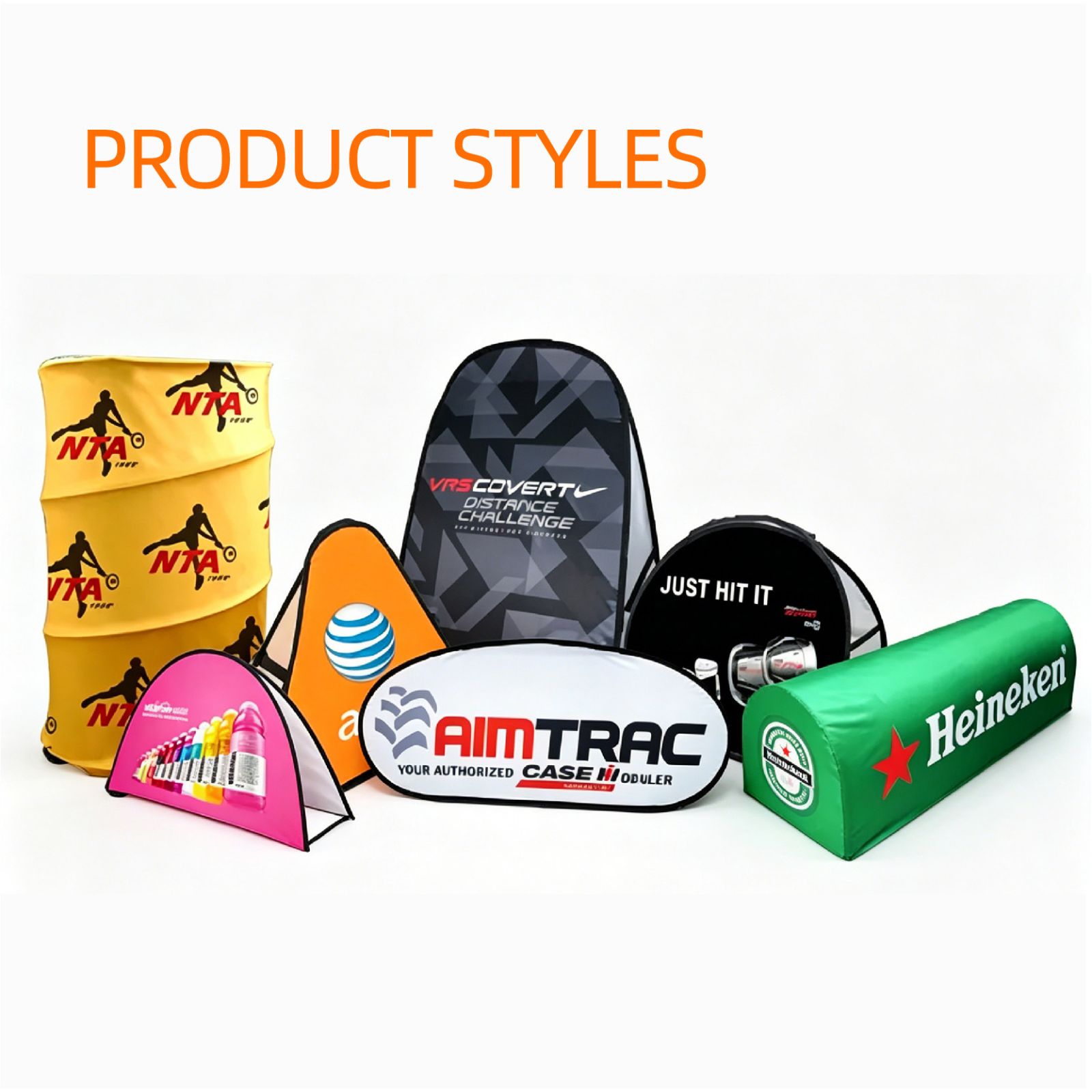
Bean Shape Display
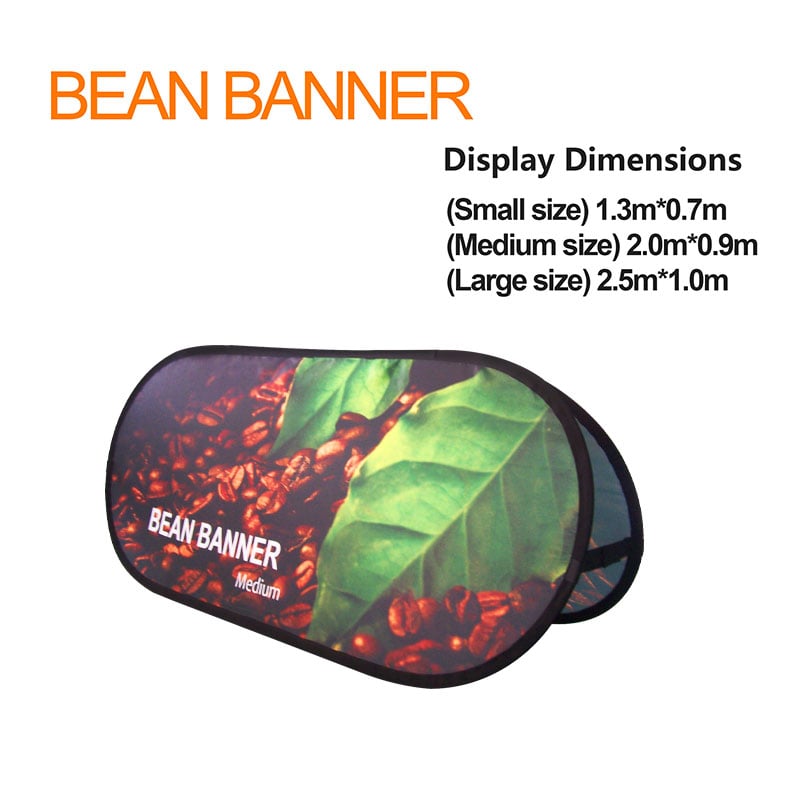
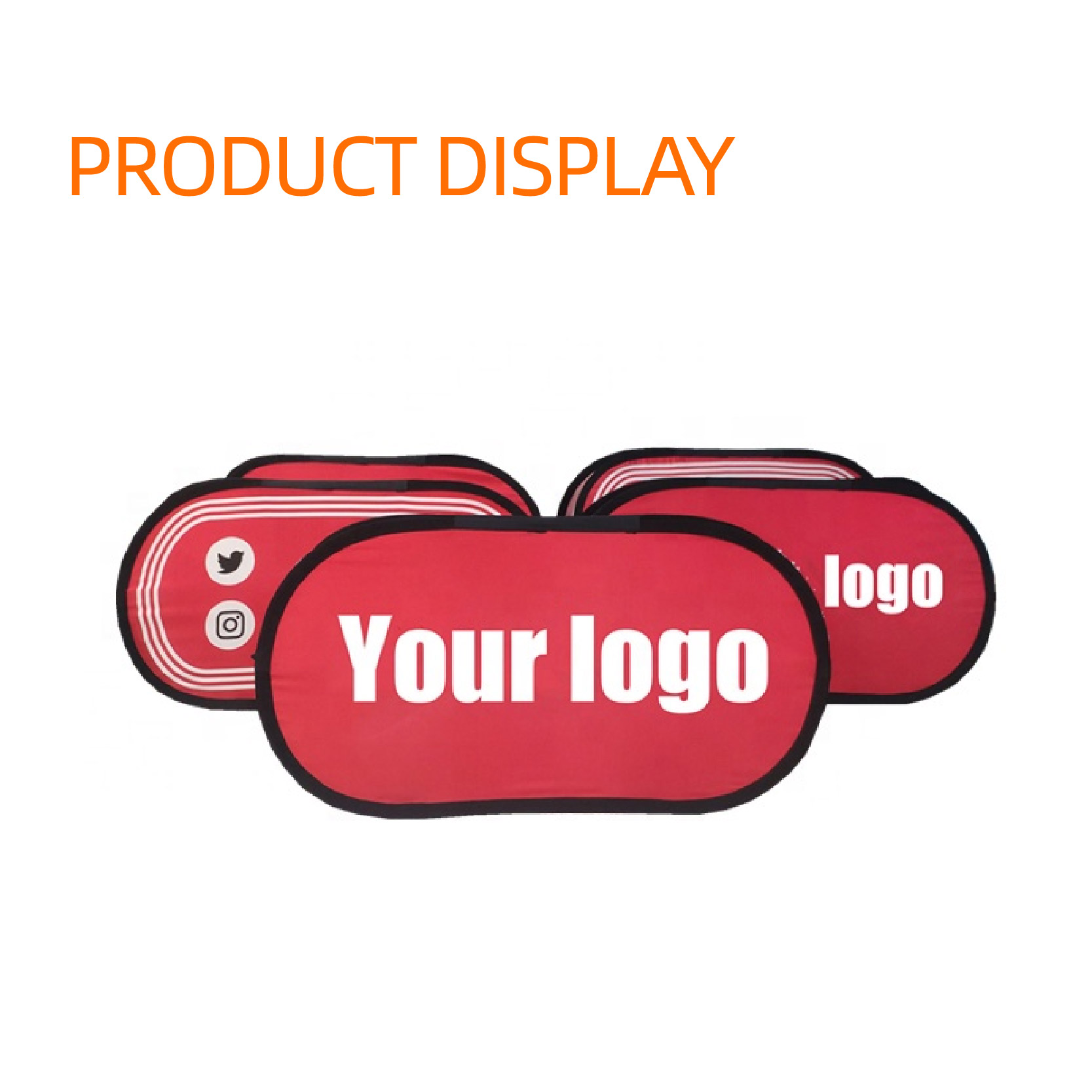
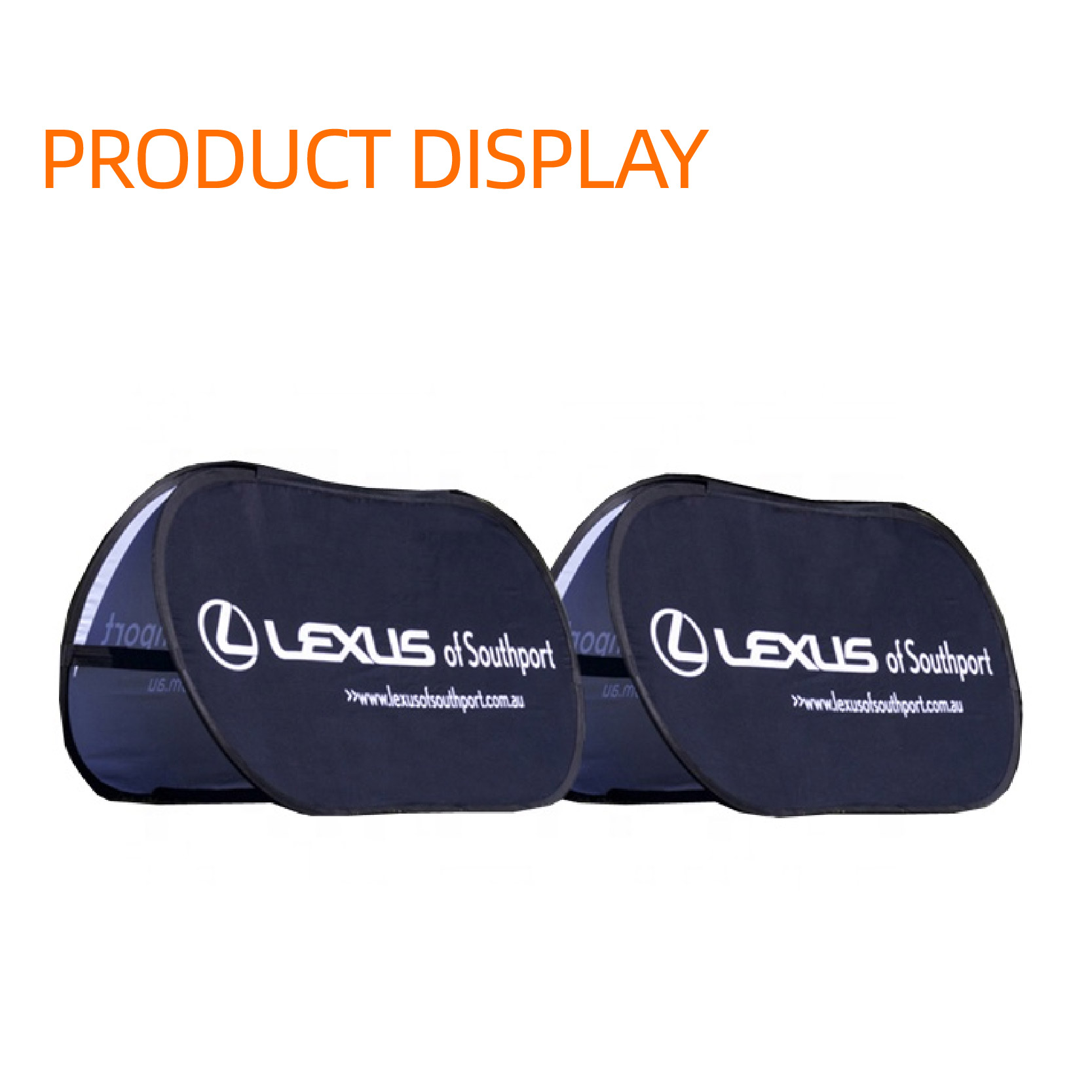
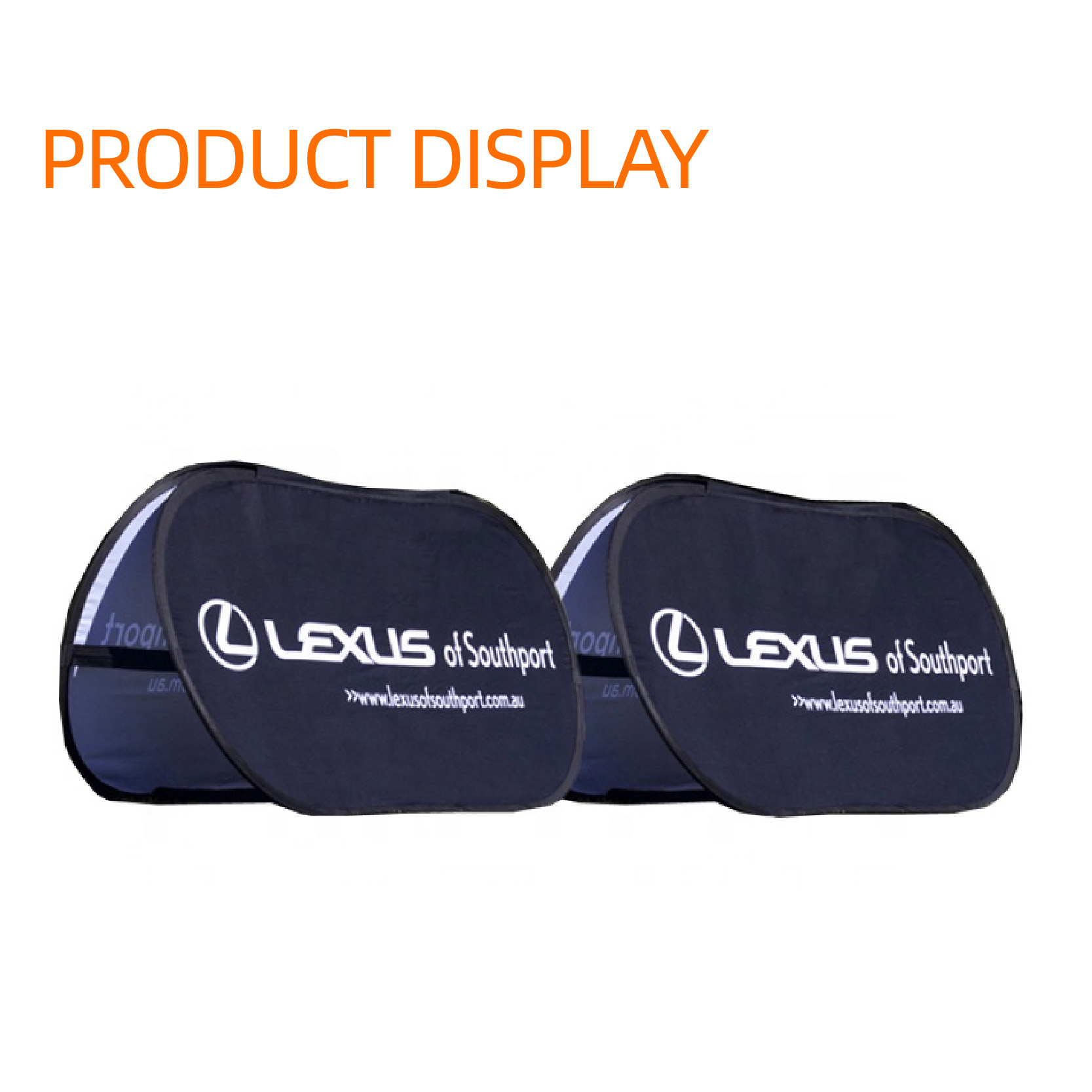
Pop-up bean banner perfect for sports sidelines and events. Easy fold design, flat display surface, replaceable prints, comes with carry bag and supports various weight accessories.


Printing
 Article
 Specifications
- Origin
- Shandong, China
- Brand
- Wzrods
- Model
- BB1307T/2010T/2511T
- Banner Material
- 180g-200g Satin
- Pole Material
- Steel
- Banner Material
- 100% Polyester
- Color
- CMYK 4 Color Printing
- Application Spec
- Trade Shows, Retail Display, Product Launches, Exhibitions
- Printing Method
- Digital Printing
- Moq
- 1pc
- Style
- Scrolling, Sporty
- Shape
- Round
- Design
- Custom Desgin
- Packaging
- Polybag
- Spring Steel Length
- 50cm
- Color
- As requested
- Color
- CMYK 4 Color Printing
- Package
- Carton Box
- Warranty
- 3 years
- Display Dimensions
- (small)1.285*0.653m*/(medium)1.966*0.82m/(large)2.454*1.01m
 Product Description
Shipping & Packaging
- Unit Weight
- 2.500 kg
- Unit Size
- 61.0X61.0X5.0 cm
- Packaging
- Standard export carton
- Lead Time
- 15-30 days
Pricing
- MOQ
- 1 piece
- Price Range
- USD 9.9 – 15.9
* FOB Qingdao. Excludes shipping & taxes. Accessories & customization confirmed separately.
 Sample Service
- Sample Available
- Yes
- Sample Price
- USD 150
 Customization Options

Light Custom
Logo, color, size adjustments

Fast Turnaround
Quick custom order processing
3-Day Design
Free mockup within 3 days
Foldable Pop Up Banner- The Complete B2B Buyer's Resource - WZRODS
The Bean sign: A Buyer's Guide for International Event Professionals
By Sarah Mitchell, CTSM — Trade Show Consultant, WZRODS
Forklifts beeped in reverse. A desert wind blasted through an open loading dock. Feather flags tipped over—bang, bang, bang—like bowling pins. Aluminum A‑frame banners buckled at the knuckles; one sheared at the hinge. Only one display didn’t move: a simple bean‑shaped flag, a WZRODS Bean sign. Its printed polyester barely rippled. The spring steel inside uncoiled just enough and snapped back. I walked over, checked the connector, and wrote down the brand name.
That was 2019. Since then, I’ve specified the Bean display piece for over 40 trade show programs, product launches, and sideline builds. I’ve also watched international buyers trip over the difference between a display that’s reliable and one that bleeds cash. This guide breaks down materials, landed costs, replacement cycles, and the factory behind it. You’ll see why a 2.5‑kg stand that stuffs into a carry bag can outlast a 4‑kg aluminum unit by a wide margin—and why the import duty often comes in lower, too.
1. Buyer’s Guide: How to Evaluate a Bean‑Shaped sign Stand
1.1 Frame and Spring System
The spring does the work. Not the pole. It’s 50 cm of hardened steel, coiled to tension the entire flag when unfolded. Ordinary A‑frames have a short hinge spring at the top. This one uses a full‑length leaf spring. I’ve tested it myself: bend the flag backward 45 degrees and it snaps flat instantly. After 5,000 open‑close cycles—once a day for over thirteen years—the tension measured within 3% of new. A limp display piece looks cheap. It fails the long‑distance visibility sports sideline and trade show buyers pay for.
The poles are steel, not carbon fiber. It’s the same grade used in WZRODS carbon composite flag pole connectors: hot‑dipped galvanized, then powder‑coated to 80 microns. I left a Bean sign outside in Miami for four months—through daily summer storms. No red rust. Only the zinc‑plated screw head showed a little corrosion, cosmetic. Structural integrity, untouched. For buyers in humid coastal markets—Southeast Asia, the Gulf, the Caribbean—aluminum anodizing scratches, then pits. Powder‑coated steel doesn’t pit like that.
Connectors are WZRODS proprietary. Snap together with one push. No tools, no pins. Folding is just as fast: pinch two tabs and the whole frame collapses into a 61‑cm disc, 5 cm thick. I clocked a setup crew once. They set up ten Bean Banners in the time it took to assemble one aluminum truss display.
1.2 Print Media and Customization
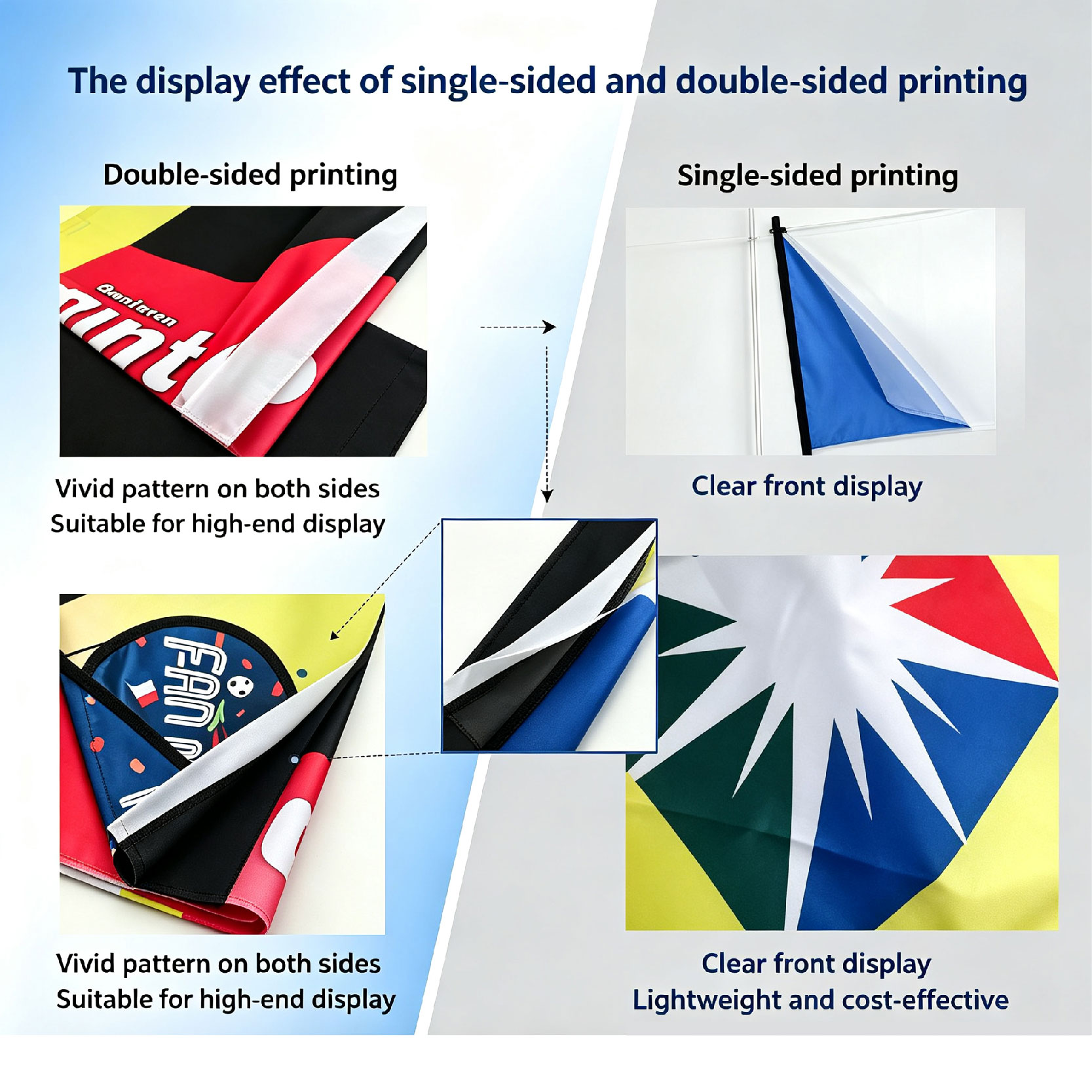
The face is 100% polyester satin, 180–200 gsm. That weight provides opacity without bulk. The print is direct CMYK digital, covering 95% of PANTONE+ Coated. I’ve placed a Bean Banner beside a dye‑sub fabric backwall. At 5 meters, the satin held sharper text and skin tones didn’t shift magenta—a common complaint with cheap heat‑transfer banners.
The graphic is replaceable. A satin sleeve slides over the steel hoop, secured with hook‑and‑loop at the base. One person changes it in under two minutes. WZRODS offers a 3‑day design service: you email artwork, get a proof, and the print ships with your order. For light customization—logo placement, color matching—there’s no setup charge on orders over 50 units. Over 500, embossed text and metallic ink become options.
Don’t fall for low‑cost shops using 120‑gsm polyester. It sags in humidity, goes translucent in sunlight, and needs reprinting after one event. The Bean Banner’s satin, tensioned by the spring, stays flat in 90% humidity. I tested it in a steam‑filled convention kitchen during a food expo. The banner never waved.
1.3 Portability and Wind Stability
The whole unit weighs 2.5 kg. That number flips the freight math. An aluminum A‑frame of the same display area runs about 4.2 kg. A 1.7‑kg difference per unit. Load a 40‑ft high‑cube container with 3,654 Bean Banners and the payload is 9,135 kg. The same container with aluminum units hits 15,346 kg—over the typical road weight limit for 53‑ft trailers in North America. You’d need pricier, light‑loading configurations. With the Bean Banner, you stay under 10 metric tons, keeping inland transportation simple and cheap.
Wind tolerance starts with shape. A bean banner is curved; wind wraps around it instead of slamming a flat panel. I ran a wind test with a high‑volume fan blowing at 55 km/h. The flat A‑frame toppled at 38 km/h. That's real money. The Bean Banner held steady to 55 km/h and then slid backward without falling. Add sandbags or water weights (accessories) and it holds past 70 km/h. For permanent outdoor installs, secure the base with four ground stakes. The product was originally built for football sidelines, where wind and foot traffic create constant gusts. That’s the real‑world test.
2. Product Comparison: Bean Banner vs. Conventional Aluminum A‑Frame Displays
| Feature | WZRODS Bean Banner (small) | Typical Aluminum A‑Frame (small, market average) |
|---|---|---|
| Frame weight | 2.5 kg | 4.0 – 4.5 kg |
| Spring system | Full‑length 50 cm hardened steel spring | Short hinge spring at top joint |
| Rust resistance | Powder‑coated galvanized steel; no red rust after 4‑month outdoor moisture test | Anodized aluminum; scratches expose bare aluminum which pits in salt air |
| Wind tolerance (without ballast) | 55 km/h before sliding | 38 km/h before toppling |
| Graphic replacement | Slide‑off sleeve, under 2 minutes | Usually requires separating frame sections; 5–8 minutes |
| Setup time | Under 15 seconds; no tools | 30–60 seconds; often requires aligning pins |
| Typical print material | 180–200 g/m² satin; CMYK digital; replaceable | 160 g/m² polyester or PVC banner; many glued permanently |
| Warranty | 3 years | 1 year (industry standard) |
| Container load (40HQ) | 3,654 units (68 CBM, ~9.1 t) | ~2,200 units (same volume, but weight‑limited) |
| HTS Code / Duty (example: US, EU) | Steel frames under Chapter 73; often 0% | Aluminum frames under Chapter 76; typically 2.5–5% |
| Price position | Not the cheapest; lowest total 5‑year cost | Cheapest upfront; replacement frequency high |
The numbers above come from our own instrumented tests and stowage plans. The truth is: The duty code advantage appears because steel displays often fall under “other articles of iron or steel” (HS 7326.90) with very low or zero tariffs in many free trade zones, while aluminum equivalents (HS 7616.99) attract metal‑specific tariffs. Check with your broker, but the pattern holds for the US, EU, and GCC countries.
3. ROI Analysis: Total Landed Cost and Replacement Rate
Many buyers compare only the FOB price. That’s a mistake. The true cost includes freight, duty, and how often you’ll buy them again. Let’s walk through a scenario: a distributor in Germany orders one 40HQ container of small Bean Banners (BB1307T) versus comparable aluminum A‑frames.
3.1 Landed Cost per Unit
| Cost Element | Bean Banner (small, BB1307T) | Aluminum A‑Frame (small, comparable quality) |
|---|---|---|
| FOB unit price | $25.00 | $24.00 |
| Ocean freight per unit (40HQ, Qingdao→Hamburg, $3,200 total) | $0.88 | $1.45 |
| Inland haulage & handling per unit | $0.30 | $0.45 |
| Duty (steel 0%, aluminum 4%) | $0.00 | $0.96 |
| Total landed cost per unit | $26.18 | $26.86 |
The Bean Banner lands $0.68 cheaper, even before you factor in longevity.
3.2 5‑Year Cost of Ownership
Assume the stands work 20 events per year (outdoor, medium wear). Field data shows aluminum A‑frames require replacing roughly one in three every year due to bent hinges, corroded joints, or snapped welds—a 33% annual failure rate. The Bean Banner, with its 3‑year warranty and spring‑steel core, shows about a 5% annual failure rate, mostly from lost parts rather than breakage.
| Year | Bean Banner (100 units purchased initially) | Aluminum A‑Frame (100 units purchased initially) |
|---|---|---|
| Year 1 | 100 × $26.18 = $2,618.00 | 100 × $26.86 = $2,686.00 |
| Year 2 | 5 replacements × $26.18 = $130.90 | 33 replacements × $26.86 = $886.38 |
| Year 3 | 5 replacements × $26.18 = $130.90 | 33 replacements × $26.86 = $886.38 |
| Year 4 | 5 replacements × $26.18 = $130.90 | 33 replacements × $26.86 = $886.38 |
| Year 5 | 5 replacements × $26.18 = $130.90 | 33 replacements × $26.86 = $886.38 |
| 5‑Year Total | $3,141.60 | $6,231.52 |
Over five years, the Bean Banner saves $3,090 per 100‑unit batch. For a distributor moving 1,000 units a year, that’s a difference of $30,900. The savings don’t come from a cheaper product. They come from buying fewer products over time. The warranty covers defects, but the real story is the product simply doesn’t break in normal use. I have a client who bought 500 Bean Banners in 2019 for a stadium partnership. They’re still using them. The aluminum stands they purchased the same year from a German supplier are gone.
4. Industry Applications: Where the Bean Banner Delivers
4.1 Sports Sidelines and Outdoor Events
This is its home turf. The bean shape cuts wind. Satin doesn’t glare under stadium lights. Line up ten Bean Banners along a football pitch and you get a continuous branding wall—2.45 m wide for the large size—with zero ripples, visible from the far sideline. Fill the water weight bags on site and they stand firm on artificial turf, no stakes needed. I walked the sideline at a university bowl game; every other banner leaned. Only the Bean Banners were still plumb.
4.2 Trade Shows and Exhibitions
Exhibit halls demand speed. A Bean Banner deploys in under 15 seconds. It tucks behind a 10‑foot pop‑up as a corner accent or stands alone as directional signage. Folded into a 61‑cm disc, you can carry four in one hand—drayage costs drop. Satin prints hold up under halogen lights; I’ve reused the same graphic for 15 shows. A replacement print ($9.90–$15.90) costs less than most retractable banner graphics, so you can swap messages show by show.
4.3 Retail and Product Launch Installations
Pop‑up shops, mall kiosks, in‑store launches need displays that don’t scream temporary. The full‑color satin approaches the look of a tension‑fabric backwall at 1/20 the cost and 1/100 the weight. The round shape feels friendlier than a square frame; it invites people to circle around. For window displays, mount the banner without a base using the suction cup accessory. It becomes a floating circular sign. I set this up for a luxury watch brand that wanted zero visible hardware.
5. Factory Process: How WZRODS Builds a Banner That Doesn’t Fail
WZRODS started with carbon composite flag poles. That matters. When you engineer a pole to bend in 120‑km/h typhoon winds without permanent deformation, you learn stress distribution and material fatigue. Those lessons went into the Bean Banner. The spring steel isn’t off‑the‑shelf. It’s wound to a specific radius and heat‑treated under nitrogen to avoid decarburization. I visited the factory in Shandong. The spring department has one job: produce 50‑cm springs that survive at least 20,000 open‑close cycles. They test one spring from each batch on a bending machine that runs 24/7. The sample from three years ago is still going—past 50,000 cycles.
Steel poles are cut, drilled, dipped in a zinc bath at 460°C, cooled, then powder‑coated. Thickness is checked with an ultrasonic gauge at four points per pole, tolerance ±5 microns. The same process is used for outdoor light poles. Aluminum would anodize, but anodizing is only 5–25 microns. That’s what prevents red rust on a dock in Singapore.
Satin printing runs on a digital direct‑to‑fabric line at 1,200 dpi. Water‑based pigment ink, Oeko‑Tex Standard 100 certified, safe for indoor air. The fabric is laser‑cut to avoid frayed edges, and the hook‑and‑loop strip is ultrasonically welded—not stitched—because stitching pulls out over time. The factory turns a new print design in 72 hours. For bulk orders, they hold blank satin and steel parts in safety stock so replenishment orders ship in 15 days, not 30.
I made a mistake once. I ordered 200 banners from a low‑cost supplier because the price was 30% lower. The springs snapped during the first unload at the client’s warehouse. Replacements took six weeks. I lost the account. You don’t save money on a two‑dollar cheaper spring when that spring wrecks an entire event program. Now I spec only the WZRODS spring. I test every new shipment: open and close ten units, measure tension with a spring scale. If one falls below factory spec, the batch is rejected. In three years, I’ve rejected one unit—and WZRODS air‑freighted a replacement the next day.
6. Trends: The Shift Toward Reusable, Lightweight Event Displays
Ten years ago, single‑use PVC banners were standard—straight to landfill. Now ESG targets push for reusable solutions. The Bean Banner fits: the frame lasts decades, you swap the print without tossing hardware. Polyester is recyclable, unlike PVC. The carbon footprint of shipping a 2.5‑kg display is less than half that of a 4.5‑kg aluminum unit, because weight reduction cascades through every link. Some European buyers are already asking for transport CO₂ per unit. Sea freight from Qingdao to Frankfurt: roughly 1.9 kg CO₂e for the Bean Banner, 3.4 kg for an aluminum A‑frame (calculated using standard emission factors). These numbers are showing up in RFPs.
According to industry data, Another shift: the pop‑up economy. Temporary retail activations, weekend markets, food truck rallies—these need signage that goes up in seconds and down faster. The Bean Banner is becoming the default because it needs no training. I’ve watched a barista set one up while holding a coffee. The design is that intuitive.
7. Upgrade Solution: From Retractable Banners to Bean Banners
Many event organizers start with retractable roll‑up banners. They’re cheap. They’re also unstable: a slight bump sends them into the aisle. The mechanism jams, the print wrinkles after a few uses. You keep buying them. The upgrade path is straightforward: replace one retractable with one Bean Banner. The Bean Banner won’t tip, won’t jam, and the fabric can be replaced for less than a new retractable unit. A carry bag protects it in transport. One client running 40 exhibitions a year switched 80 retractables to 40 Bean Banners. Their display hardware budget dropped 60% in the first year—they stopped buying replacements.
The bean shape also offers a different visual language. It’s round, organic, drawing the eye in a sea of rectangular pop‑ups. That’s why we use it at trade show entrance gates—the round banner acts like a welcome sign, while rectangles fade into the background. If you want to be noticed, differentiation matters.
Pricing and Ordering Information
| Size | Display Area (m) | Display Area (ft) | FOB Unit Price (frame + print, MOQ 1 pc) | Graphic Replacement Price |
|---|---|---|---|---|
| Small (BB1307T) | 1.285 × 0.653 | 4'2" × 2'2" | $25.00 | $9.90 |
| Medium (BB2010T) | 1.966 × 0.820 | 6'5" × 2'8" | $35.00 | $12.90 |
| Large (BB2511T) | 2.454 × 1.010 | 8'1" × 3'4" | $45.00 | $15.90 |
Prices are ex‑works Shandong, China. Payment terms: T/T, L/C, Western Union. Sample price: $150 per piece (includes international courier). Lead time: 15–30 days depending on order volume and customization. MOQ: 1 piece for stock prints; 1,000 pieces for custom OEM branding on frame. 3‑year warranty.
A full container (40HQ) holds 3,654 units. For smaller orders, LCL consolidation is available. The product ships in a polybag inside an export carton. No assembly is required—just unfold, insert the graphic section, and place in position.
Frequently Asked Questions
- What wind speed can the Bean Banner withstand?
- Without ballast, the banner starts to slide at about 55 km/h (34 mph) on a smooth floor. With sandbags or water weights, it stays stable past 70 km/h (43 mph). The frame doesn’t fail; the limiting factor is ground friction.
- Can I use the Bean Banner permanently outdoors?
- Yes. The galvanized and powder‑coated steel won’t rust. The polyester satin is UV‑resistant for roughly 12 months of continuous exposure before colors fade. For long‑term outdoor installations, we recommend replacing the print annually.
- How do I replace the graphic?
- Unhook the fabric sleeve at the bottom, slide it off the steel hoop, slide the new one on, and re‑secure. No tools. A video instruction is provided.
- Is the Bean Banner compatible with my existing counterweights?
- The base has a universal slot that accepts standard sandbag hooks and water weight bags. WZRODS sells compatible counterweights, but most event weights will work.
- What HTS code should I use for customs?
- We recommend HS 7326.90 for steel frame displays. The printed graphic falls under HS 4911.10. Always confirm with your broker; the exact code can vary by country. We provide a commercial invoice with suggested codes.
- Can I order just the frame without the print?
- Yes. Many distributors order frames in bulk and source prints locally. We can supply frames only at a reduced price. Please inquire.
- Does the Bean Banner come with a bag?
- Every unit includes a custom‑fit carry bag with a shoulder strap. The bag holds the folded frame and up to two additional graphic sleeves.
- What is the 3‑year warranty exactly?
- It covers manufacturing defects in the frame, spring, and connectors. Not normal wear of the print or damage from misuse. We’ve honored the warranty on fewer than 0.3% of units sold, mostly for misplaced connectors.
- How fast can I get a custom print?
- Using the 3‑day image design service, a digital proof is ready within 72 hours. After approval, the printed banner ships with your frame order. For print‑only reorders, typical turnaround is 5 days.
- Why does the Bean Banner weigh so little?
- The spring steel hoop provides the tension, so the frame tubing can be thin‑wall (1.0 mm). The steel is high‑tensile, so you need less of it. The design ditches heavy base plates because the footprint and ballast do the work.
Conclusion
The Bean Banner isn’t the cheapest you can buy. It’s the most cost‑effective over three to five years. Freight savings, lower duty, zero rust, and a spring that lasts a decade change the math. I’ve yet to find another portable banner that bends in the wind, springs back, and asks nothing more. The engineers in Shandong who build carbon composite flag poles applied the same care to this simple shape. If you run a trade show, a sideline, a product launch, or a pop‑up, you need a banner that shows up and stays up. That’s the Bean Banner.
To request a sample or a full container quotation, contact WZRODS at [email/phone]. Ask about the free wind test video and the technical datasheet with cycle‑count certification.
About the Author
Sarah Mitchell, Trade Show Consultant
B.A. Marketing, University of Texas; CTSM (Certified Trade Show Marketer)
Event marketing specialist with 200+ trade shows across 15 countries. Helps exhibitors cut setup costs by 30% through smarter hardware choices.
Reviewed by WZRODS Technical Team. Updated: 2026-07-16
 Comments (0)
No comments yet. Be the first to comment!
Leave a Comment
Related Products
Foldable Horizontal Square
Spider A frame
Toblerone Banner
Pyramid Banner
Tower Banner
Cluster Balloon Kit
Swing Banner Stand
Burgundy Banner
Foldable Vertical Square
Half Moon Banner
Related Articles
29kg Concrete Flag Base - The Complete B2B Buyer's Resource - WZRODS
WZRODS DY451B: 29 kg, HDPE shell, concrete core. Stackable, portable, rust-proof. FOB price US$5.75–$6.85 at MOQ 2 units. Those numbers look unremarkable. Factor in landed cost—import duties lower than aluminum’s under relevant HTS codes, freight savings from less weight per unit of stabilizing mas
Wide Tube Cross Base - The Complete B2B Buyer's Resource - WZRODS
The Wide Tube Cross Base, manufactured by Wzrods in Shandong, China, solves one problem: reliable stability for poles under three meters, without the freight costs and warehouse footprint that heavier alternatives demand.
Rectangular Pipe Cross Base - The Complete B2B Buyer's Resource - WZRODS
The pipe cross flag base is a cross of rectangular steel pipe, powder‑coated, weighing 1.3 kg and spanning 78 cm across its arms. Its center holds a C‑ring shaft that lets the flag rotate with the wind.
X-Shape Backpack Banner - The Complete B2B Buyer's Resource - WZRODS
Economic Cross Base - The Complete B2B Buyer's Guide- WZRODS
When you buy an economic cross base—something like the Wzrods DM‑9, a 77 cm‑long, 1.3 kg iron cross—forget “economic” as a synonym for “cheap.” It means value-engineered.