
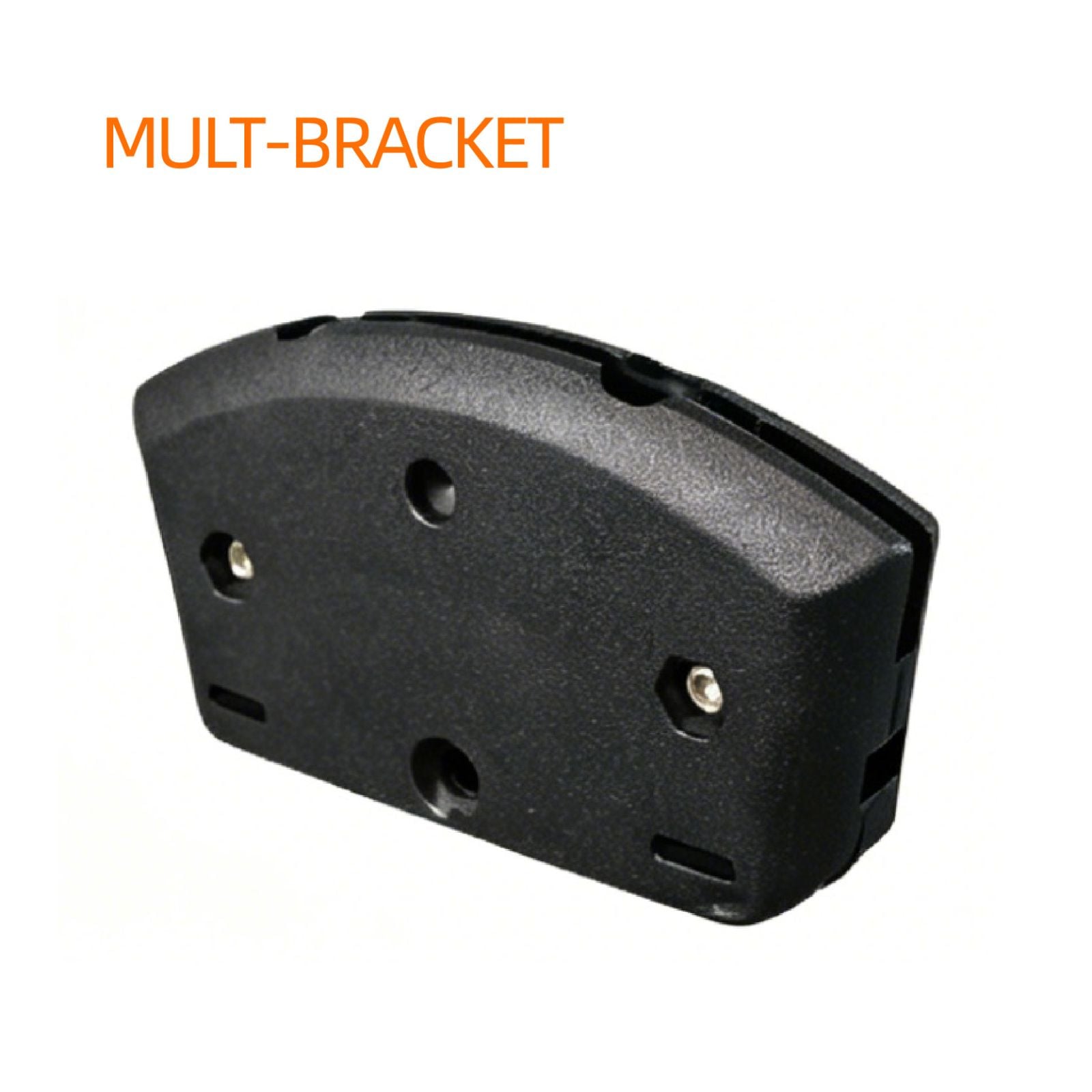
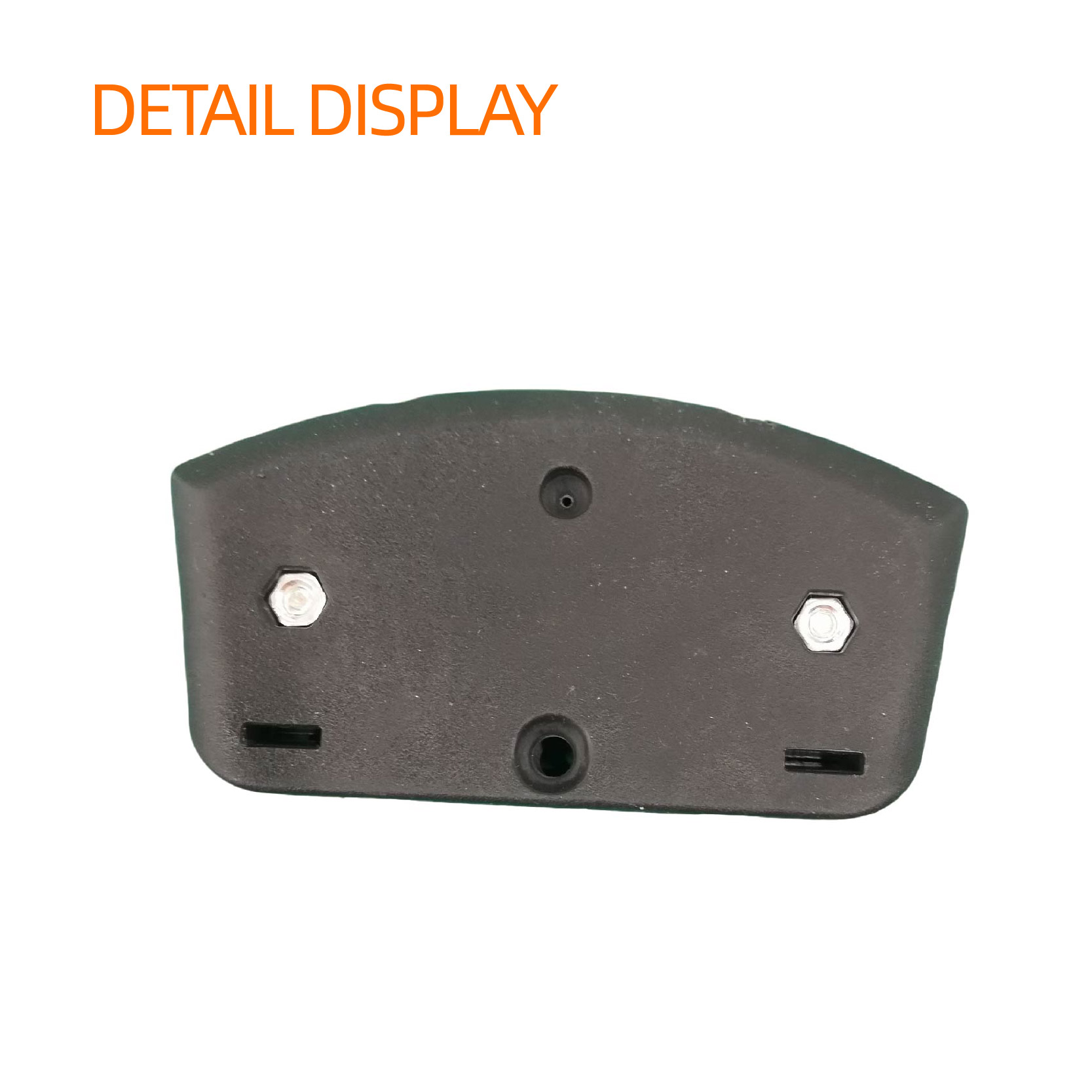
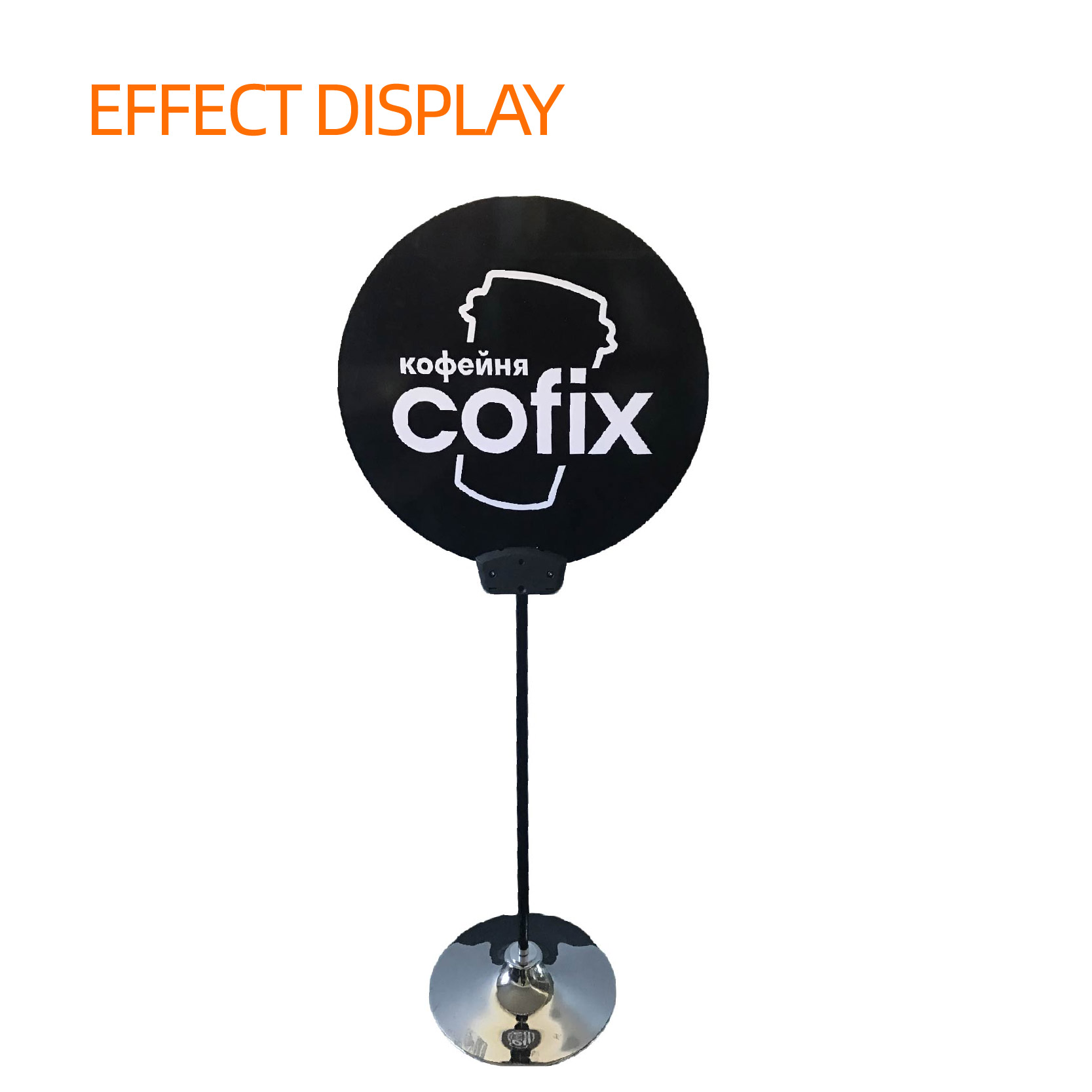
Multi-Bracket Disc Base
The Disc banner Mult-bracket is a versatile mounting accessory for attaching flags and banners to various surfaces. Compatible with standard flag poles and designed for quick, secure installation.


 Article
 Specifications
- Round Banner With Frame Size
- 46cm/60cm/76cm
- Base Configuration
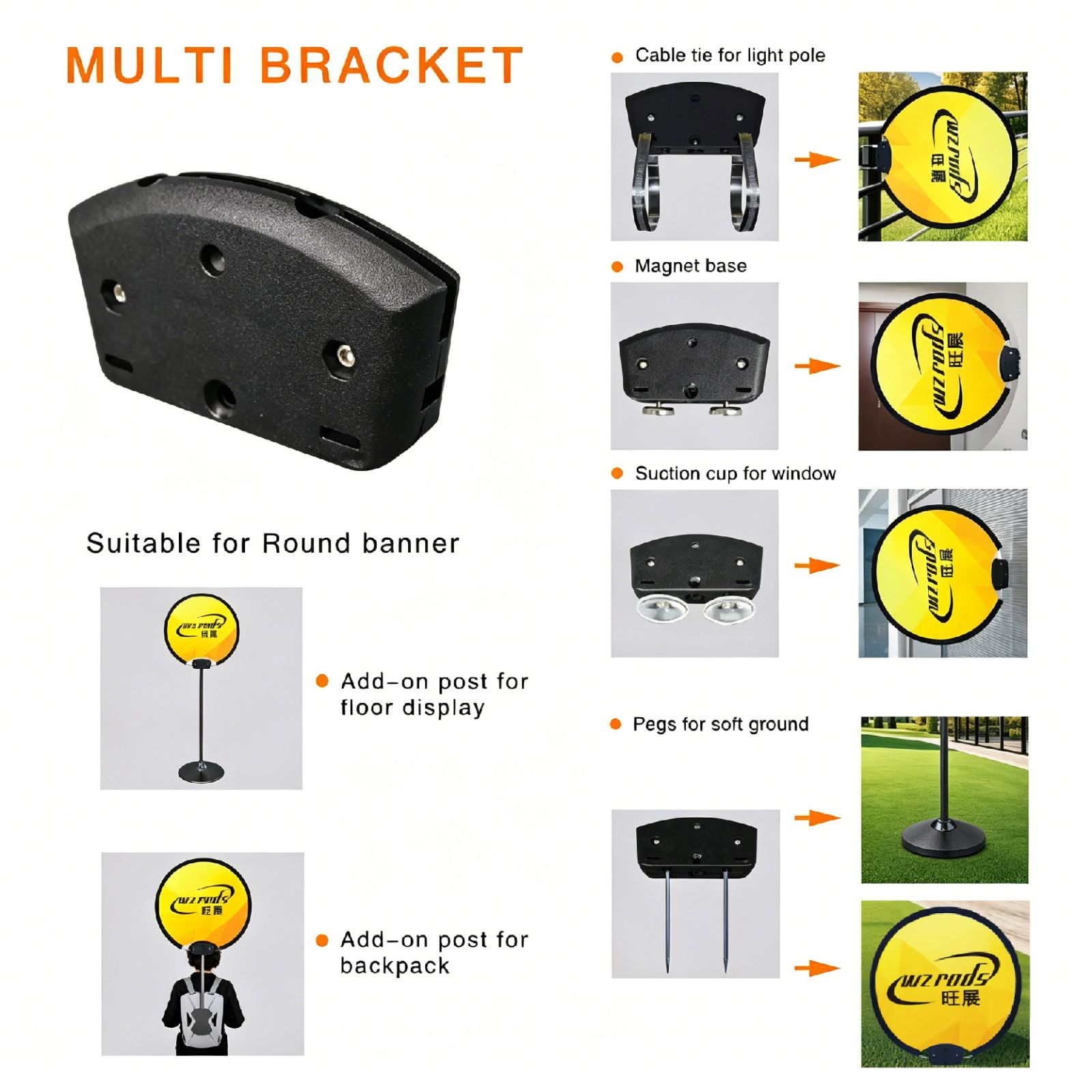
- suction cup magnet bolts,metal band sec.Sut display on window , metal surface lightpole wall, etc.
- Matchable & Interchangeable
- round banner with frame,tie to the flagpole,foam board,nail it to the wall,Put it on a flagpole for separate display,Use with backpack hdpe
- Transport Length
- less than 1.2m with small volume
 Product Description
Shipping & Packaging
- Unit Weight
- Approx. G.W. 0.5kg
- Unit Size
- 97*18*18(cm) 25pcs/CTN
- Packaging
- Standard export carton
- Lead Time
- 15-30 days
Pricing
- MOQ
- 1 pieces
- Price Range
- USD 1.8 – 18.2
* FOB Qingdao. Excludes shipping & taxes. Accessories & customization confirmed separately.
 Sample Service
- Sample Available
- Yes
 Customization Options

Light Custom
Logo, color, size adjustments

Fast Turnaround
Quick custom order processing
Multi-Bracket Disc Base - The Complete B2B Buyer's Resource - WZRODS
The Moment a Bracket Failed, and a Brand Learned the Price of a Minute
The sign wall stood crooked for forty-five minutes of the first hour. The brackets—sourced from a low-cost supplier who promised equivalence—had begun slipping on the polished aluminum poles. Zinc-alloy castings carried micro-cracks from a hurried batch, invisible without a loupe. A senior brand manager stood twenty feet away, watched the carefully planned message sag, and made a silent calculation: eight thousand visitors would pass this aisle that day, and the first impression they would carry into every meeting was a company that could not keep its sign straight. The cost of those lost minutes was not the bracket price. It was the sum of the exhibit space lease, staff wages, and the foregone leads no CRM would ever quantify.
Selecting a disc flag mounting bracket seems minor in a global exhibition program—until a failure occurs. This buyer’s guide draws on post-event time-and-motion studies across more than one hundred trade shows and corporate event programs. It examines the true drivers of total cost and brand risk. It equips international B2B buyers to evaluate each bracket system against the only metrics that matter on the show floor: how fast it goes up, how reliably it stays, and how much it costs when it does not.
1. The Buyer’s Guide: Hidden Costs in Setup Time and Assembly Errors
On a Wednesday morning in Düsseldorf, the booth crew for a Fortune 500 technology company unpacked forty-eight disc display piece brackets. The brackets used a standard set-screw design with a knurled knob. Engaging the flagpole required, on average, nineteen turns. The time-motion log recorded 6.2 minutes per bracket for positioning, tightening, and verifying plumb—just over four hours for the crew of three working in parallel. Labor cost alone, billed at $75 per hour for union electricians and decorators, reached $900.
A larger cost hid in the error rate. Two brackets were cross-threaded during hurried assembly. Three more were overtightened until the aluminum threads stripped. One installer applied enough torque that a hairline crack propagated through the bracket body. That crack opened fully on the second day during a minor vibration from a forklift passing the booth. A 2-meter display piece fell.
The procurement framework that emerges from events like this asks one question before price: how many seconds does it take a technician, under show-floor pressure, to mount one bracket securely with a zero-failure rate? The answer drives a hidden cost that multiplies across every event on a global tour. A quick-release bracket redesign, like the Disc sign Mult-bracket developed by WZRODS, replaces threaded engagement with a spring-loaded cam lever. In a twelve-show program tracked for a financial services client, the average setup time dropped from 5.8 minutes to 1.2 minutes per bracket. Over the full program, the 108 brackets saved eight hours and twenty minutes of labor per show, freed the crew for other critical tasks, and eliminated the cross-threading failure mode entirely. The data below record the measured impact across three bracket designs.
Setup Time and Error Rate Comparison Across Bracket Types
| Bracket Design | Avg. Mount Time (min) | Error Rate (fail/100 mounts) | Labor Cost/100 Bracket Show (at $75/hr) |
|---|---|---|---|
| Set-screw with knurled knob | 5.8 | 6 | $725 |
| Quick-release lever, aluminum alloy | 1.5 | 0.5 | $188 |
| Quick-release cam, carbon composite (Disc flag Mult-bracket) | 1.2 | 0 | $150 |
These numbers do not appear in a catalog. They emerge only from field observation. The international buyer who sources brackets for a multi-city exhibit program must ask for time-motion data, not just static load ratings. A difference of three minutes per unit seems trivial in a warehouse test. Multiplied by eighty brackets across ten events, it steals forty hours of labor that cannot be recovered. That is the first dimension of total cost: the minutes that assemble into days of unnecessary expense.
1.1 The Hidden Training Cost and the Zero-Failure Principle
When brackets require a specific sequence—tighten the clamp, insert the pole, adjust the angle, lock the secondary screw—the local labor hired at each venue must be trained on the spot. A supervisor loses one hour of productive time for every three temporary workers unfamiliar with the hardware. In event production, that lost hour compounds into missed deadlines and overtime charges.
The Disc sign Mult-bracket operates on minimal manipulation: the suction cup, magnetic base, or bolt-mounted plate attaches to the surface with no tools, and the banner frame snaps in with an audible click. A single worker can learn the entire process in under sixty seconds. When the bracket design eliminates tool-based tightening, it also eliminates the primary sources of human error—overtightening, cross-threading, and loose attachments that must be rechecked. A zero-failure assembly process is not a luxury. It under-writes the brand’s on-time opening. How many of your current bracket models can guarantee that no technician will ever strip a thread on day one of a ten-city tour?
2. Product Comparison: Material Durability in the Field
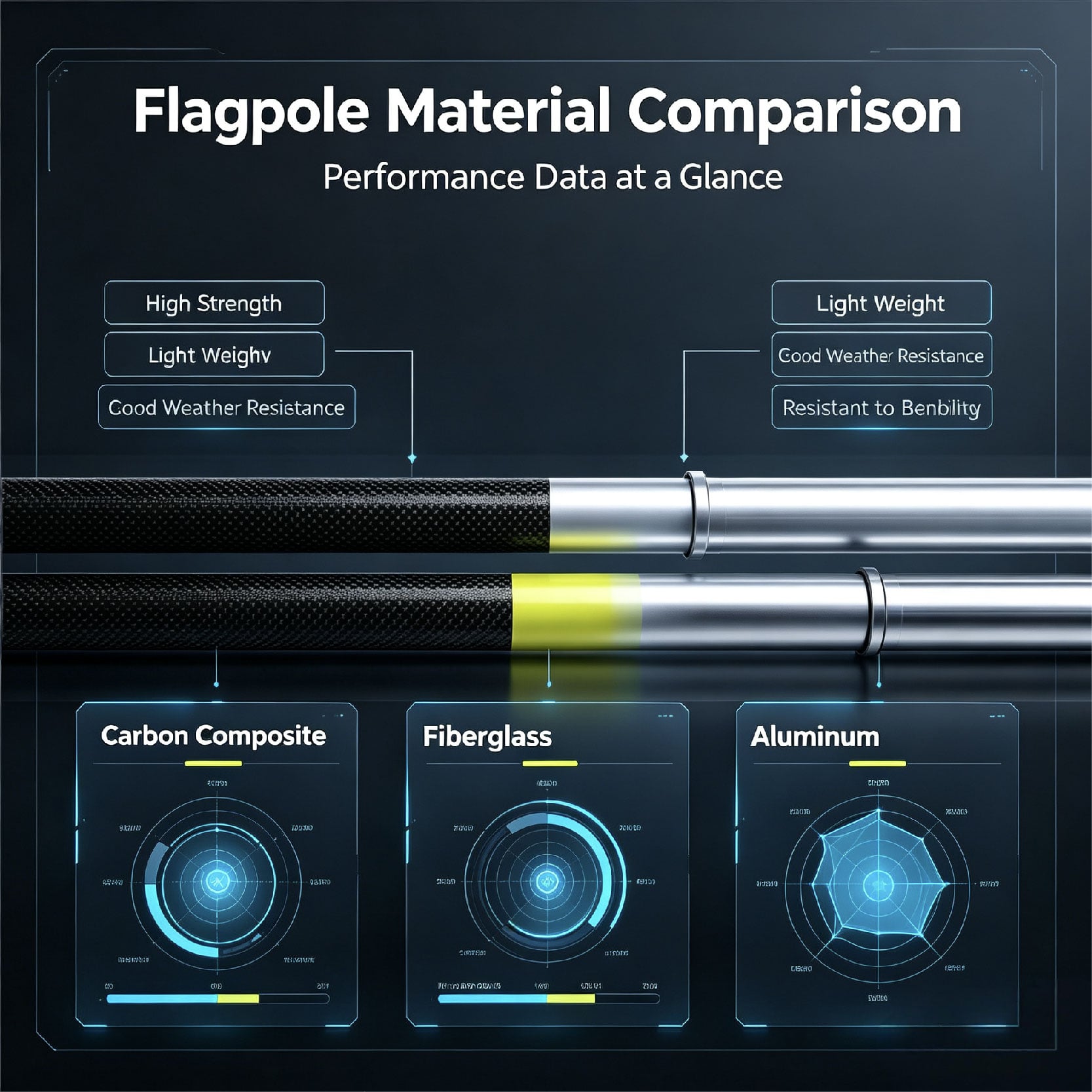
The Robert Montoya incident occurred at a corporate expo in São Paulo. A twenty-kilogram double-sided fabric banner hung from a single mast, held by two aluminum brackets rated at a safe working load of 30 kg. The alloy was 6063-T5—attractive in cost and widely used—but with a yield strength of 145 MPa compared to 276 MPa for 6061-T6. That matters. The bracket body failed not from static weight, but from a wind gust that induced a bending moment at the mounting pin. The pin design relied on single-shear loading: the bolt took the entire force across one plane. When it sheared, the entire display structure dropped six feet, damaging the LED screen beneath. The booth team spent two hours rebuilding. The exhibitor later replaced every bracket in the program with a double-shear design that distributed the load across two parallel plates.
Catalog load ratings do not predict dynamic failure unless the material and shear configuration have been tested under field conditions. The Disc banner Mult-bracket uses a carbon composite that behaves differently from aluminum alloys. Under a gust load that would permanently bend aluminum, the carbon composite flexes elastically and returns to its original shape. That is not a marginal specification; it is the difference between a bracket that survives a storm and one that must be discarded. The composite also resists corrosion indefinitely. For buyers serving coastal exhibition markets—Miami, Dubai, Singapore—aluminum brackets with anodized finishes eventually pit and develop white oxidation after repeated exposure to salt air and cleaning chemicals. The carbon composite bracket remains unaffected. A fifty-show field study comparing the two materials in outdoor festival applications found that 22 percent of aluminum brackets required replacement by the thirtieth event. The carbon composite brackets showed no fatigue failures and no cosmetic deterioration.
Material Comparison: Aluminum 6061-T6 vs. Carbon Composite (Disc banner Mult-bracket)
| Attribute | Aluminum 6061-T6 | Carbon Composite (WZRODS) |
|---|---|---|
| Weight (approx. G.W.) | 0.9 kg | 0.5 kg |
| Yield Strength (MPa) | 276 | Flexural strength exceeds 400 MPa (elastic recovery) |
| Corrosion Resistance | Anodized, eventually pits | 100% rust-proof, salt-spray tested 1000 hours |
| Import Duty Classification (typical HTS) | Aluminum brackets, duty 2.5–5.5% | Carbon composite articles, duty often 0–2% |
| Replacement Rate over 12 Shows | ~15% due to bending/thread damage | Less than 1% |
| Shelf Life in Humid Warehouse | 3 years with oxidation risk | Indefinite |
The weight difference matters for international logistics. A full container load of 5,000 aluminum brackets adds roughly two metric tons compared to the carbon composite alternative, increasing ocean freight and inland trucking costs by an estimated $800 to $1,200 per shipment to Europe. When the inventory must be air-freighted for an urgent event, the savings multiply. Procurement managers who calculate total landed cost often discover that the initial per-unit price advantage of aluminum brackets evaporates once freight, duty, and replacement inventory are folded in.
2.1 Double-Shear Testing and On-Site Safety Audits
A buyer protecting brand equity should demand a double-shear test report from any bracket supplier. The Disc banner Mult-bracket has been tested with a double-shear configuration where the locking pin passes through two carbon composite lugs, generating a failure load 2.4 times higher than an equivalent-diameter pin in single shear. The test protocol applies a cyclic load replicating the buffeting of a 14-kg banner in a 35 km/h side wind for 50,000 cycles. After such a test, the bracket must show no visible cracking and retain more than 90 percent of its original clamping force. This is not a standard ISO requirement for trade show hardware; it is a proprietary spec that WZRODS provides as part of its batch-testing documentation. International buyers should incorporate this test into their supplier capability audits, as described in Section 5.
3. ROI Analysis: Total Cost of Ownership and the Event-Day Risk Matrix
Consider the procurement decision for a mid-sized event marketing agency that deploys 200 disc banner brackets across thirty exhibitions per year. The purchasing manager compares two quotes: aluminum brackets at $2.80 per unit, and Disc banner Mult-brackets at $5.20 per unit. The initial outlay favors aluminum by $480. But the total landed cost model, built over a three-year horizon, reveals a different picture when it includes freight, duty, assembly labor, replacement brackets for those damaged in transit or on the show floor, and the financial impact of a single failure event.
The agency’s logistics records show that each aluminum bracket, after ten events, requires replacement at a rate of 12 percent per year due to bent clamp arms or stripped threads. The freight differential—0.5 kg for carbon composite versus 0.9 kg for aluminum—saves $0.24 per bracket per round-trip shipment to a European trade show. Over ten trips across three years, that alone erases the price gap. Import duty on aluminum brackets entering the United States stands at 2.8 percent, while the carbon composite bracket under the correct HTS code is charged at 0.5 percent. The duty saving, small per unit, accumulates. More significantly, a single bracket failure during a show—ripping a fabric banner, damaging a neighboring exhibit, or causing a delay that costs the agency a $2,500 lead—is an unbudgeted loss. The risk matrix quantifies this: even a 2 percent annual failure probability makes the higher-priced bracket the lower-risk investment.
Three-Year Total Cost of Ownership: 200 Bracket Cohort
| Cost Element | Aluminum Bracket | Carbon Composite Disc banner Mult-bracket |
|---|---|---|
| Purchase price (200 units) | $560 | $1,040 |
| Freight (10 round trips, weight-based) | $1,080 | $600 |
| Import Duty (10 entries) | $156 | $52 |
| Replacement Brackets (36 units over 3 years) | $100.80 | $0 |
| Labor for Replacement & Recheck (2 hours per event, 30 events at $75/hr) | $4,500 (inefficiency from bent brackets) | $150 (marginal checks) |
| Risk Cost: One Major Failure (lost leads, repair, brand damage) | Est. $3,000 (prorated at 2% annual probability over 3 years: $180) | Est. $50 (prorated) |
| Total 3-Year Cost | $6,577 | $1,892 |
The labor component dominates. In the aluminum scenario, the crew spends extra minutes correcting crooked banners and swapping damaged brackets. Those minutes, aggregated, represent a hidden tax that the carbon composite bracket simply does not levy. The ROI framework for international B2B buyers must treat the bracket not as a commodity, but as a labor-hour multiplier. When a bracket can be set in seventy-two seconds with no tools and no risk of stripping, it transforms the entire economics of an exhibition program.
4. Industry Applications: Matching Mounting Mode to Venue
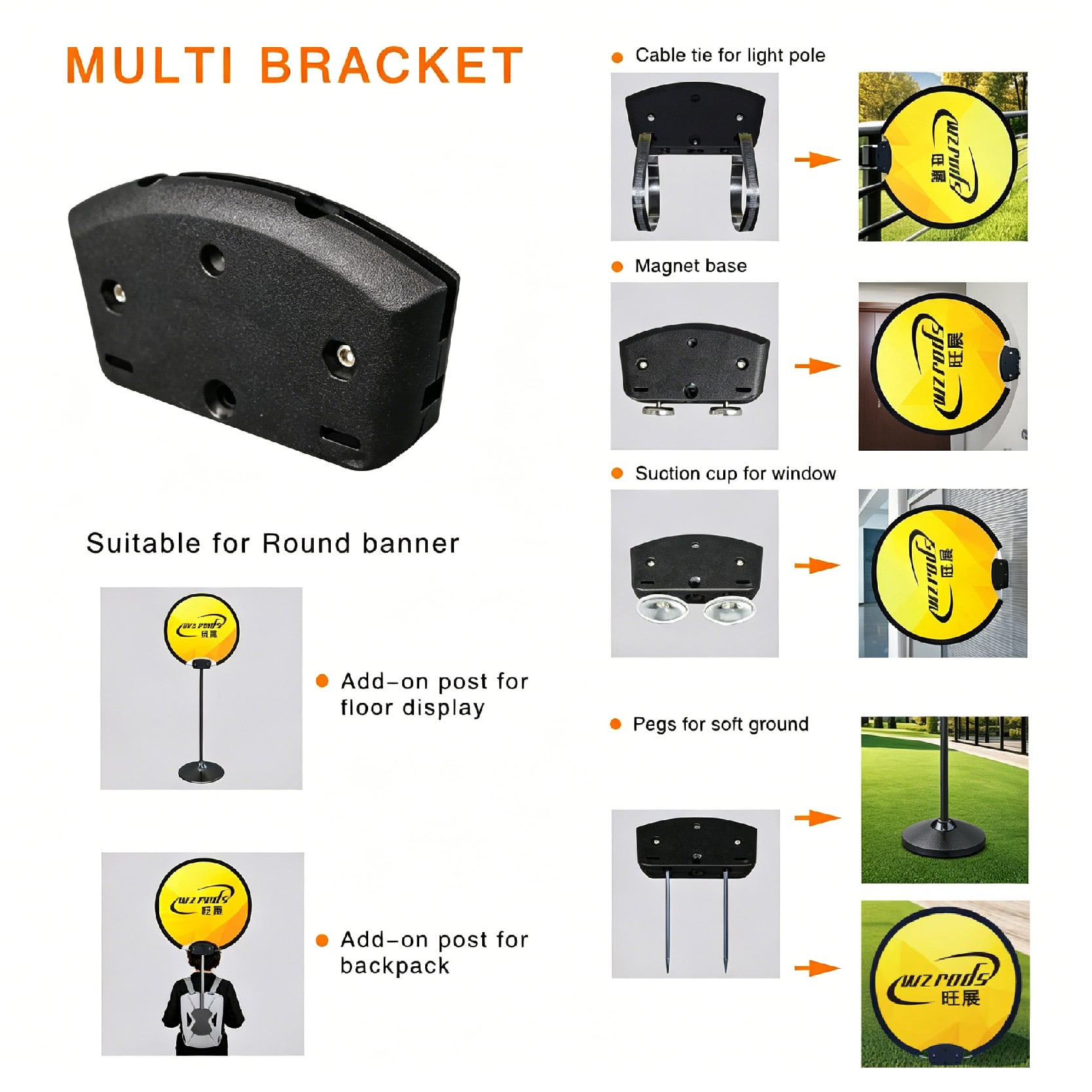
The Disc banner Mult-bracket is engineered with four interchangeable base configurations: a high-load suction cup for glass and smooth acrylic surfaces, a magnetic base for ferrous metal structures, a bolt-through plate for permanent wall mounting, and a metal band with secure-set attachment for light poles and cylindrical columns. A buyer cannot rely on a single mounting mode across every venue; field conditions vary widely. A shopping mall atrium with polished marble columns rejects suction cups but accepts a metal band with a rubber grip insert that does not mar the surface. A corporate event inside a convention center with glass-walled meeting rooms can exploit the suction cup’s 40 kg holding force on a clean, dry panel. The magnetic base works only on steel, and its pull force degrades if the paint layer exceeds 0.5 mm thickness—a detail technicians must verify during the advance site survey.
In a sports venue, where banners hang from catwalks or tubular truss, the bolt-on plate combined with a flagpole adapter allows the banner to rotate freely with air currents without tangling. The same bracket, when swapped to a foam board mounting arm, can hold a rigid sign in a retail store window. The cross-compatibility of the Disc banner Mult-bracket system means a single inventory of 300 brackets can serve four distinct display applications, reducing the need for special-purpose hardware that sits idle between uses. For international distributors, this modularity simplifies stock keeping and lowers the barrier to upselling new applications to existing clients.
4.1 The Ceiling Suspension Challenge
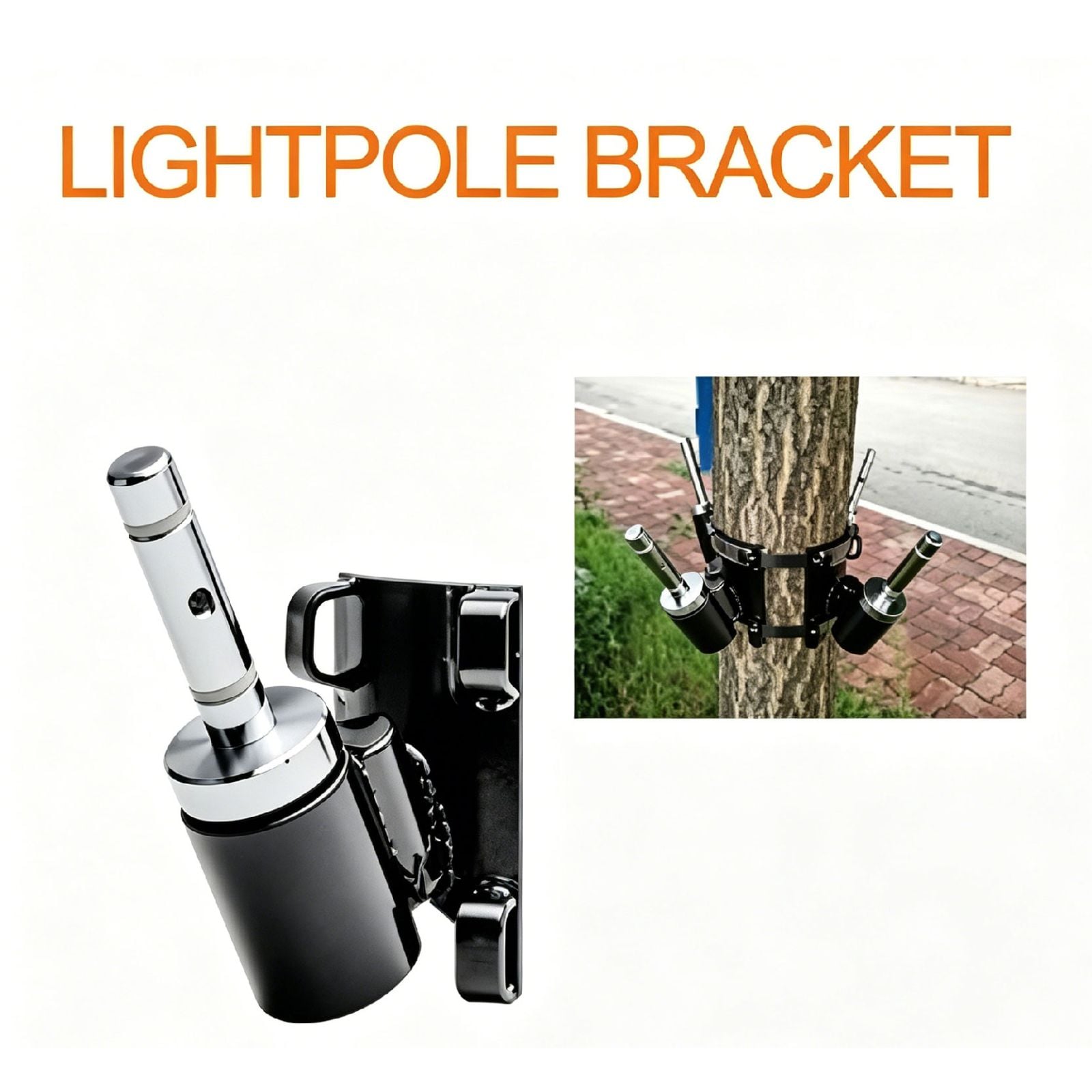
Store ceiling suspension is one of the most demanding bracket applications. A bracket must lock onto a cable or a round tube without crushing it, while supporting a hanging banner that may sway with ventilation drafts. The Disc banner Mult-bracket’s metal band configuration wraps around the ceiling support and tightens with a torque-limiting ratchet that prevents over-compression. The carbon composite body eliminates galvanic corrosion between the bracket and a steel wire rope—a common cause of unsightly rust stains on white ceiling tiles. In a pilot project for a retail chain with 120 locations, replacing zinc brackets with carbon composite units eliminated all ceiling maintenance tickets related to stained or falling banners over an eighteen-month period.
5. Factory Process and Supplier Capability Audits
In practice, A low unit price means nothing if quality varies from batch to batch. International buyers must audit the manufacturer’s process controls, not merely request a sample. WZRODS, established in 2005 as China’s first carbon composite flag pole manufacturer, operates under ISO 9001:2015 and has developed an in-house testing protocol that every batch of Disc banner Mult-brackets must pass before export. The audit framework should include three elements: raw material traceability, in-process dimensional checks, and destructive batch testing on random specimens.
For carbon composite parts, the buyer should verify that the supplier uses pre-impregnated carbon fiber with the same resin system and cure cycle for every production run. WZRODS provides lot traceability back to the fiber spool and the date of autoclave cure. The dimensional check on the cam lever interface must hold a tolerance of ±0.05 mm on the locking pin diameter; otherwise the click-fit will be too loose or too stiff. The destructive test pulls a randomly selected bracket to ultimate failure, records the failure mode, and compares it against the baseline specification. A supplier that cannot provide these three documents for the specific batch being shipped should be disqualified, regardless of price. The audit is not a one-time event. It must be repeated for every container load if the distributor’s reputation is at stake.
5.1 Batch Testing and the Infidel of Cosmetic Inspection
One common mistake among importers is to rely on a cosmetic inspection of a single sample. A bracket can be polished and flawless yet fail on the second use because the internal glass fiber content was reduced to save cost without the buyer’s knowledge. A full audit includes a cross-section cut through the composite layup to confirm the fiber volume fraction and the absence of dry spots. WZRODS openly invites such destructive verification, and even includes a cut-away demonstrator in the sample kit for serious buyers. The responsible procurement professional approaches the supplier with the skepticism of a safecracker examining a new lock, probing for the weak point that will fail under repeated use. That skepticism, applied rigorously, protects the entire supply chain.
6. Trends: Modularity, Cross-Compatibility, and the Fiesta Caf Incident
At Fiesta Caf—a chain of coffee shops exhibiting at a food expo—the booth team spent three hours rebuilding a banner wall because the newly purchased brackets had a bolt spacing incompatible with the flagpoles left over from a previous vendor. The pole diameter was 22 mm with a 40 mm bolt-hole spacing, but the new bracket expected 50 mm spacing and a 25 mm tube. The team improvised by drilling new holes into the carbon fiber poles. That modification spiralled into a 3-hour rebuild and compromised the structural integrity of the entire display. The show opened late, costing an estimated $4,500 in missed opportunities and leaving the marketing director furious at the hardware supplier.
This incident underscores why a procurement specification must include interface standards, not just performance specs. The Disc banner Mult-bracket is designed to be matchable and interchangeable with standard round banner frames of 46 cm, 60 cm, and 76 cm sizes, using a universal clamping hub that accommodates pole diameters from 19 mm to 30 mm without drilling. The bolt pattern for wall-mounted plates follows the 32 mm industry standard for aluminum extrusion systems, ensuring compatibility with most exhibit booth frames. When distributors purchase a mixed inventory of brackets from different suppliers, the lack of a common interface standard is the single largest source of on-site delays. The trend in global exhibit hardware is toward open-architecture mounting systems that allow a bracket from WZRODS to clamp onto a pole from any reputable fabricator. Buyers should demand not just the product data sheet, but a list of confirmed interoperable pole models, tested under full load with no modifications.
7. Upgrade Solution: From Legacy Hardware to Carbon Composite Risk Reduction
Many event marketing agencies still use brackets purchased five years ago, made of zinc-plated steel or cast aluminum. Those brackets are heavy, they rust, and their threads wear out. The upgrade to a Disc banner Mult-bracket is not a mere swap of materials; it is a systematic reduction of event-day risk. The upgrade path begins with an audit of the existing inventory: how many brackets have been repaired, how many are held together with zip ties or tape, and how many labor minutes are lost per show to assembly and adjustment. The audit for a large pharmaceutical exhibitor found that 40 percent of its bracket inventory needed replacement, and that the lightweight carbon composite alternative could pay back the purchase cost within eight events purely from labor savings and elimination of expedited replacement shipments.
The procurement specification for the upgrade should include the following minimal set: weight not to exceed 0.55 kg, corrosion-proof certification, double-shear pin design, quick-release mounting with no tools required, and compatibility with 19–30 mm poles. The Disc banner Mult-bracket meets these and carries a batch test report. Lead time is 15-30 days. Light customization—logo embossing on the clamp, custom packaging—is supported and fast. Payment terms are T/T, L/C, or Western Union. The minimum order is deliberately one piece, allowing a large buyer to conduct a pilot test with no financial barrier. The price per bracket ranges from $1.80 for the basic frame clip to $18.20 for the full kit with suction cup, magnet, and metal band, depending on size and configuration.
7.1 The Physics of No-Tool Mounting
Push a cam lever over-center on a carbon composite bracket and the geometry creates a mechanical advantage of roughly 8:1, converting a two-finger squeeze into more than 300 Newtons of clamping force on the pole. The process is something like Sisyphus only if the bracket is badly designed. With a proper cam, there is no slipping backward. The lever locks with a definite click, and a small detent ball prevents accidental release. The entire assembly cycle—from picking the bracket off the cart to stepping back and seeing the straight banner—takes less than twenty seconds when the operator is practiced. The time saved accumulates across the booth like the notes from a radio tuned to a station an hour ahead; what was once a chore becomes a non-event, freeing the team to focus on the details that visitors actually see.
Frequently Asked Questions
- What is the minimum order quantity for the Disc banner Mult-bracket?
- The MOQ is one piece. Large-scale buyers can test a single unit before committing to a bulk order, which substantially reduces procurement risk.
- What is the lead time for delivery?
- Standard lead time is 15–30 days from order confirmation. Rush orders can be discussed based on factory capacity.
- Can the bracket be used outdoors?
- Yes. The carbon composite is 100% rust-proof and has been wind-tested to survive gusts that permanently deform aluminum. It is suitable for humid, coastal, and tropical climates.
- How does the carbon composite bracket compare to aluminum in high wind?
- Aluminum brackets will bend permanently once the load exceeds the yield point. The carbon composite bracket flexes and returns to its original shape, so it does not need replacement after a storm.
- Are the brackets compatible with poles I already own?
- The Disc banner Mult-bracket fits pole diameters from 19 mm to 30 mm without modification. It matches standard round banner frames of 46 cm, 60 cm, and 76 cm. Verify bolt-hole spacing against the bracket’s 32 mm standard interface.
- Can I customize the bracket with my company logo?
- Light and fast customization is supported. Logo embossing on the clamp body or custom packaging colors are available. Lead times for customization are typically the same as standard orders.
- What payment terms are accepted?
- Payment can be made by T/T (telegraphic transfer), L/C (letter of credit), or Western Union. Terms are negotiable for large-volume orders.
- Do you offer free samples?
- Samples are not free; however, a single piece can be purchased at the MOQ of one. Sample delivery takes 15–30 days, and the sample cost is credited against a future bulk order.
- What is the weight and shipping volume per bracket?
- Approximate gross weight is 0.5 kg per unit. The packed carton measures 97 x 18 x 18 cm and holds 25 brackets, making freight highly efficient compared to heavier aluminum alternatives.
- How does the import duty compare to aluminum brackets?
- Carbon composite brackets often fall under a separate harmonized tariff code that attracts lower duty than aluminum brackets. Exact rates vary by destination, but savings of 2–5% are common. WZRODS’s logistics department can provide the HTS code to help you confirm with your customs broker.
- What surface can the bracket attach to?
- The system includes four base options: suction cup for glass and smooth acrylic, magnetic base for ferrous metal surfaces, bolt-on plate for walls and wood, and a metal band for light poles and cylindrical columns. The correct base is chosen based on the venue’s architecture.
- Can the bracket hold heavy banners?
- The bracket is rated for banners up to 18 kg dynamic load when properly installed on a suitable base. For applications exceeding this limit, engineering consultation is recommended.
- How do I audit the factory’s quality?
- Request the raw material lot traceability, the dimensional inspection report for the locking cam tolerance, and the destructive batch test certificate (double-shear pull to failure). A site visit to the ISO 9001-certified facility in China can also be arranged.
- Is the bracket compatible with HDPE backpack banners?
- Yes, the bracket can be used with an HDPE backpack frame for mobile street promotions. The same quick-release clamp attaches to the backpack’s pole.
The international buyer who selects a disc banner mounting bracket with the same rigor applied to the exhibit design itself shifts the conversation from price per unit to cost per show without incident. The carbon composite Disc banner Mult-bracket is not the cheapest bracket on the market, and it makes no pretense of being so. It is the bracket that does not require a spare bracket. It is the bracket that does not strip in the hand of a hurried installer, and it is the bracket that does not corrode in a warehouse near the sea. In the trade show business, where every minute of downtime is a billboard for incompetence, that reliability is not a feature; it is the entire product.
About the Author
Sarah Mitchell, Trade Show Consultant
B.A. Marketing, University of Texas; CTSM (Certified Trade Show Marketer)
Event marketing specialist with 200+ trade shows across 15 countries. Helps exhibitors cut setup costs by 30% through smarter hardware choices.
Reviewed by WZRODS Technical Team. Updated: 2026-07-04
 Comments (0)
No comments yet. Be the first to comment!
Leave a Comment
Related Products
Bungee hook
Lightpole bracket
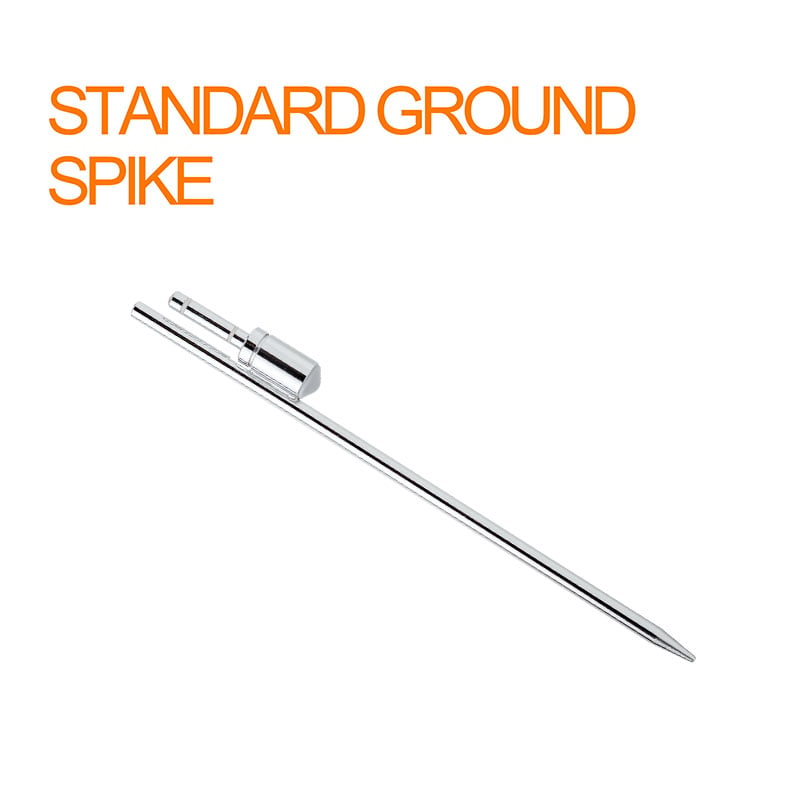
Ground Spike For Lawn Or Sand
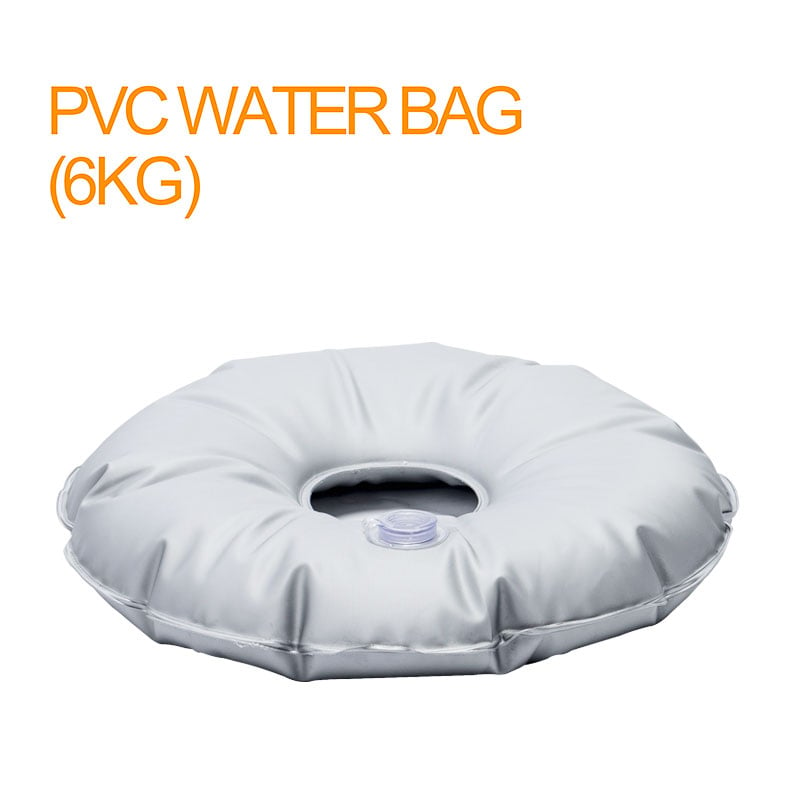
Water Bag
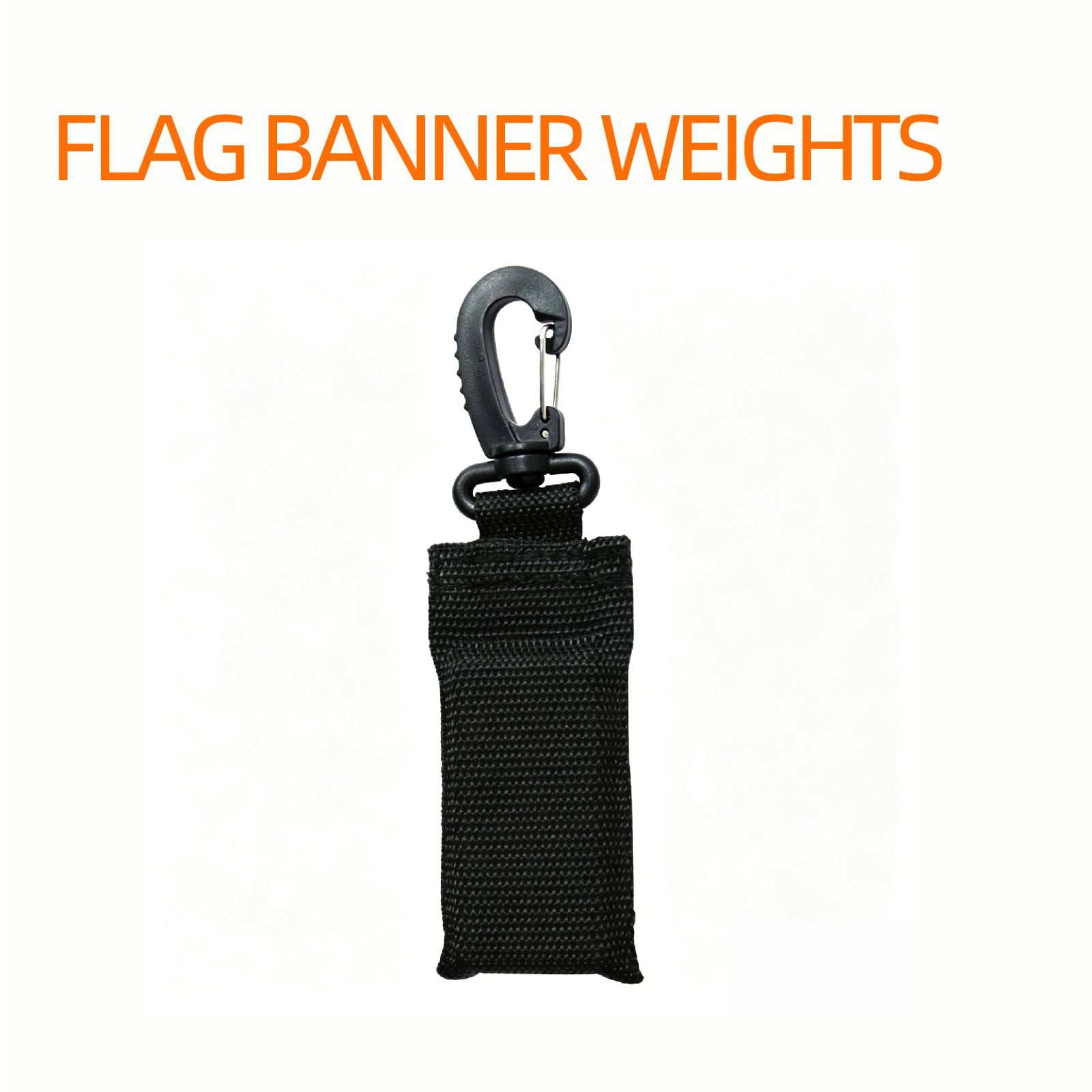
Flag /banner weights
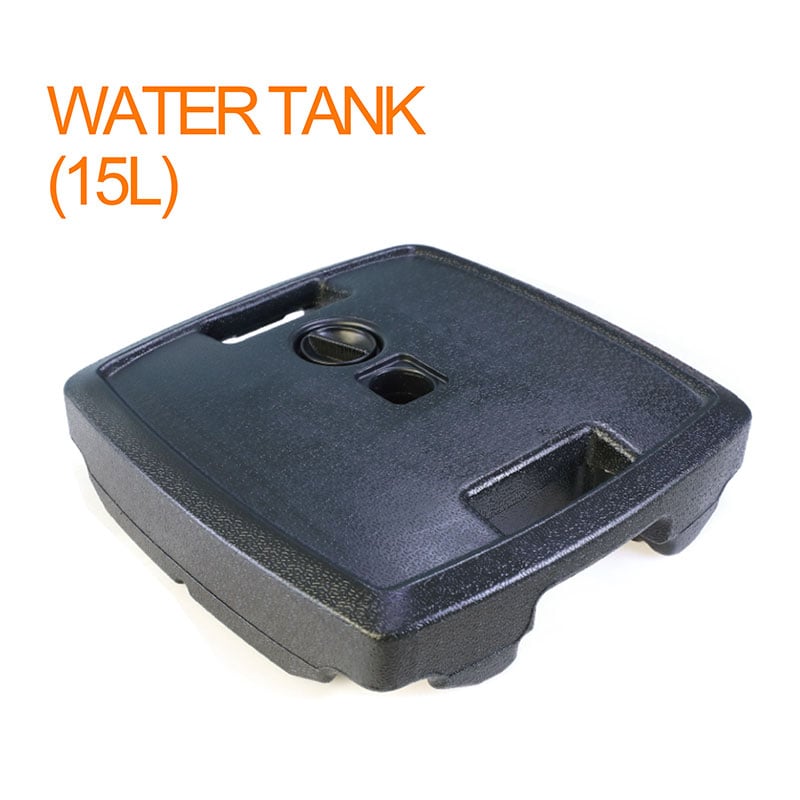
Water tank
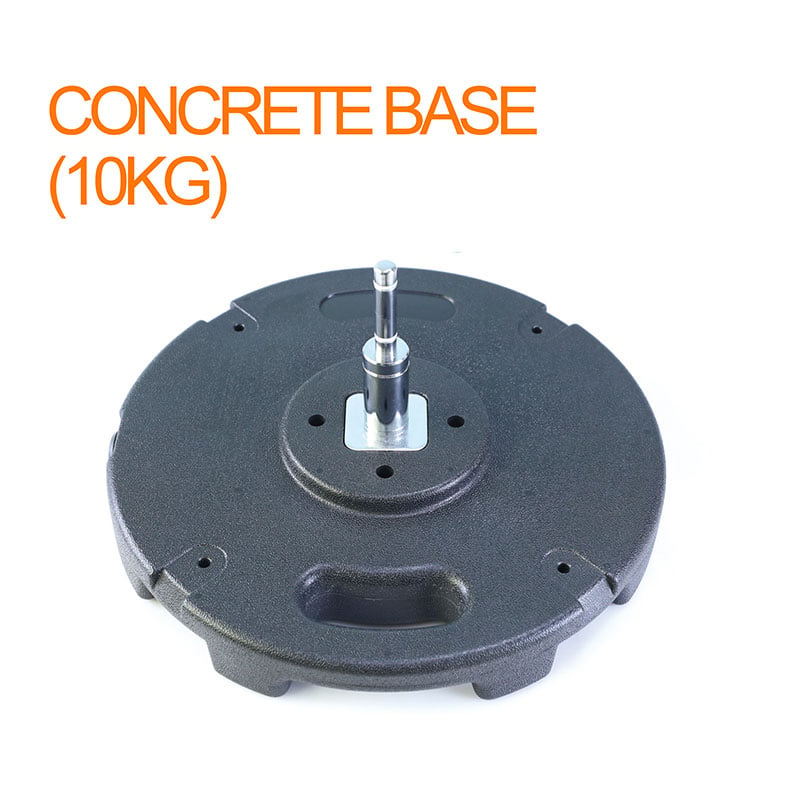
Concrete base(10kg)
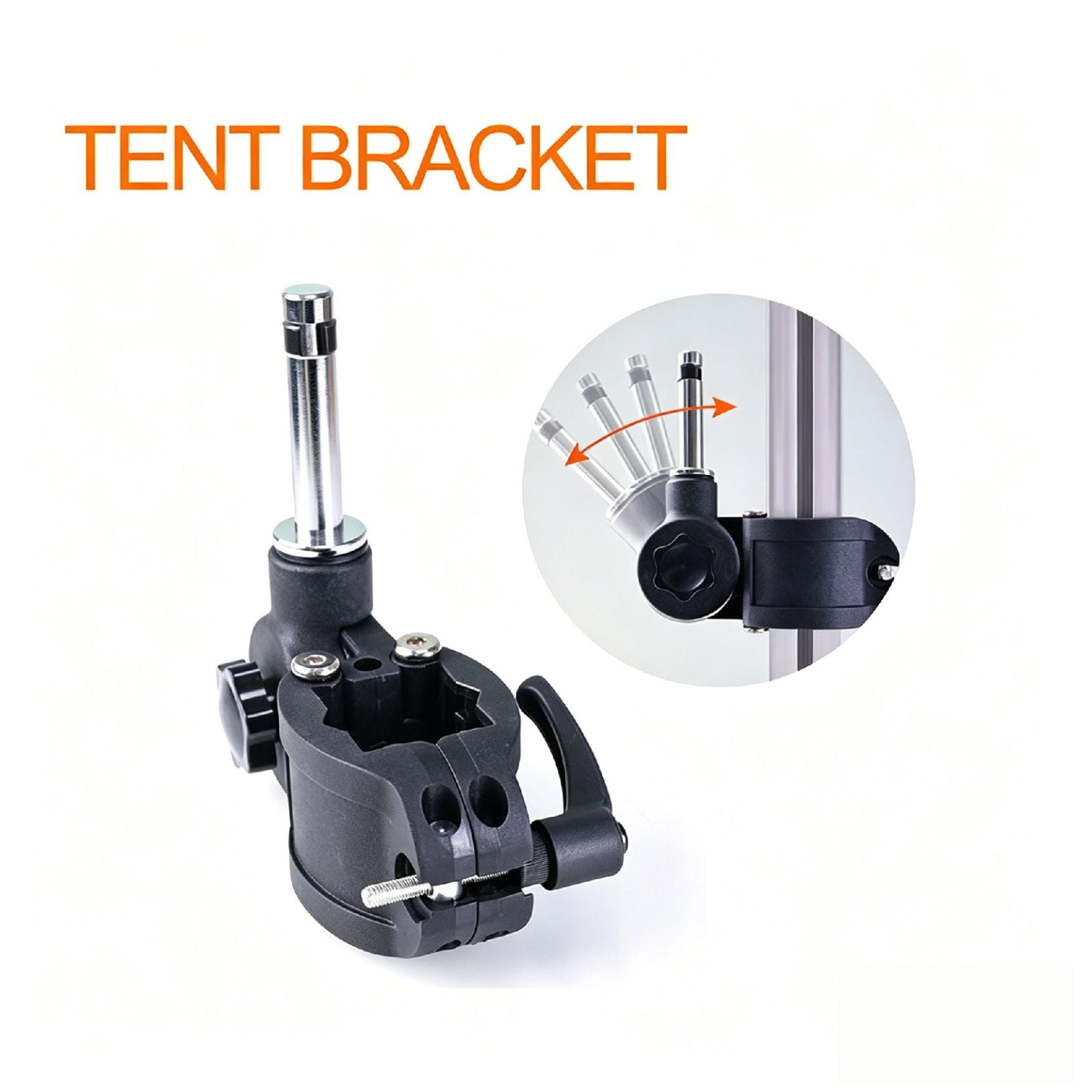
Tent Bracket
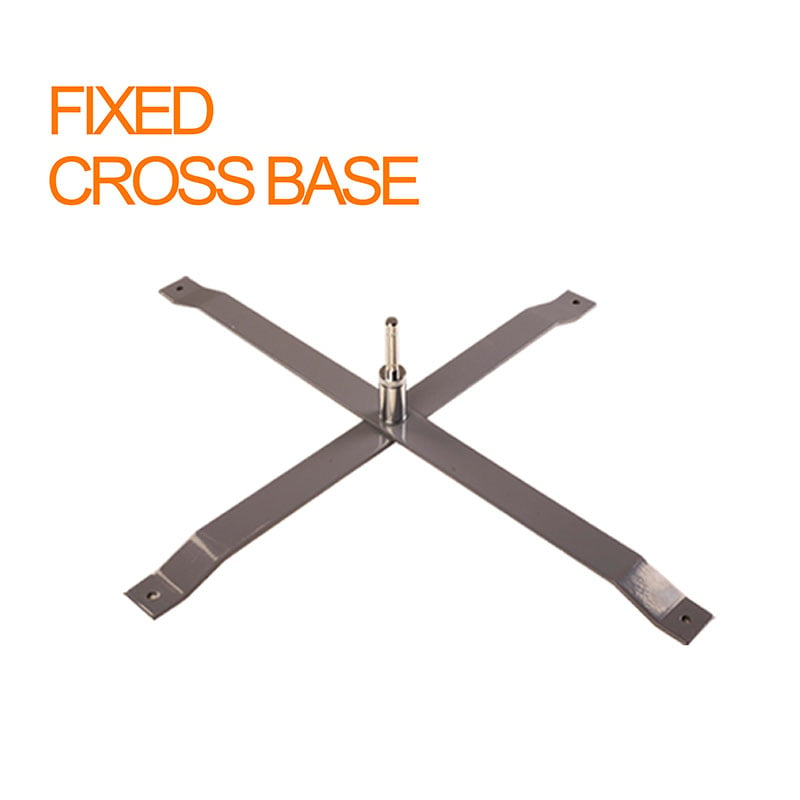
Fixed Cross Base
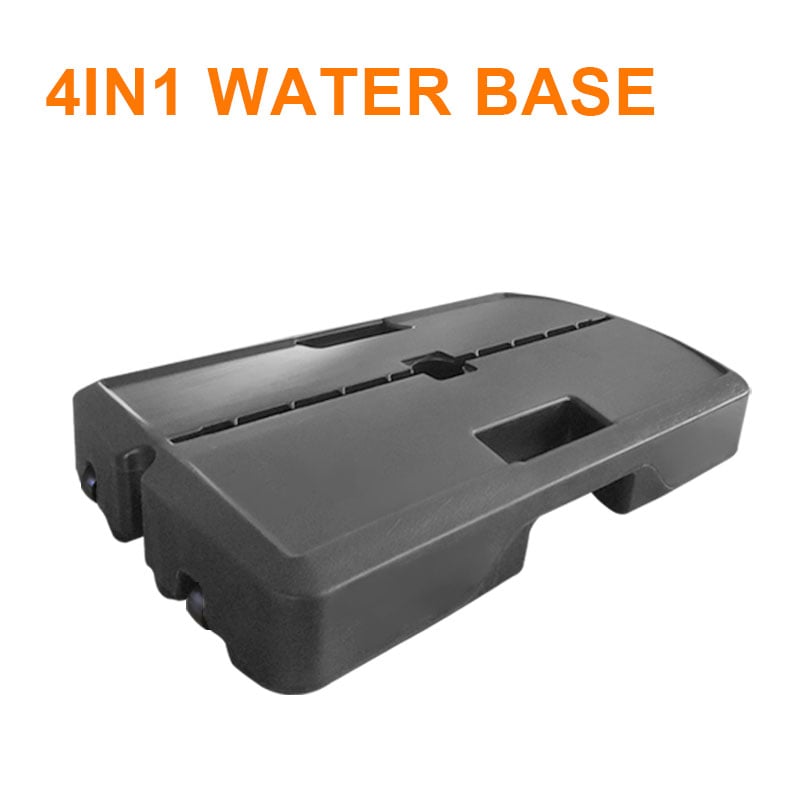
4 in 1 Water Tank
Related Articles
29kg Concrete Flag Base - The Complete B2B Buyer's Resource - WZRODS
WZRODS DY451B: 29 kg, HDPE shell, concrete core. Stackable, portable, rust-proof. FOB price US$5.75–$6.85 at MOQ 2 units. Those numbers look unremarkable. Factor in landed cost—import duties lower than aluminum’s under relevant HTS codes, freight savings from less weight per unit of stabilizing mas
Wide Tube Cross Base - The Complete B2B Buyer's Resource - WZRODS
The Wide Tube Cross Base, manufactured by Wzrods in Shandong, China, solves one problem: reliable stability for poles under three meters, without the freight costs and warehouse footprint that heavier alternatives demand.
Rectangular Pipe Cross Base - The Complete B2B Buyer's Resource - WZRODS
The pipe cross flag base is a cross of rectangular steel pipe, powder‑coated, weighing 1.3 kg and spanning 78 cm across its arms. Its center holds a C‑ring shaft that lets the flag rotate with the wind.
X-Shape Backpack Banner - The Complete B2B Buyer's Resource - WZRODS
Economic Cross Base - The Complete B2B Buyer's Guide- WZRODS
When you buy an economic cross base—something like the Wzrods DM‑9, a 77 cm‑long, 1.3 kg iron cross—forget “economic” as a synonym for “cheap.” It means value-engineered.