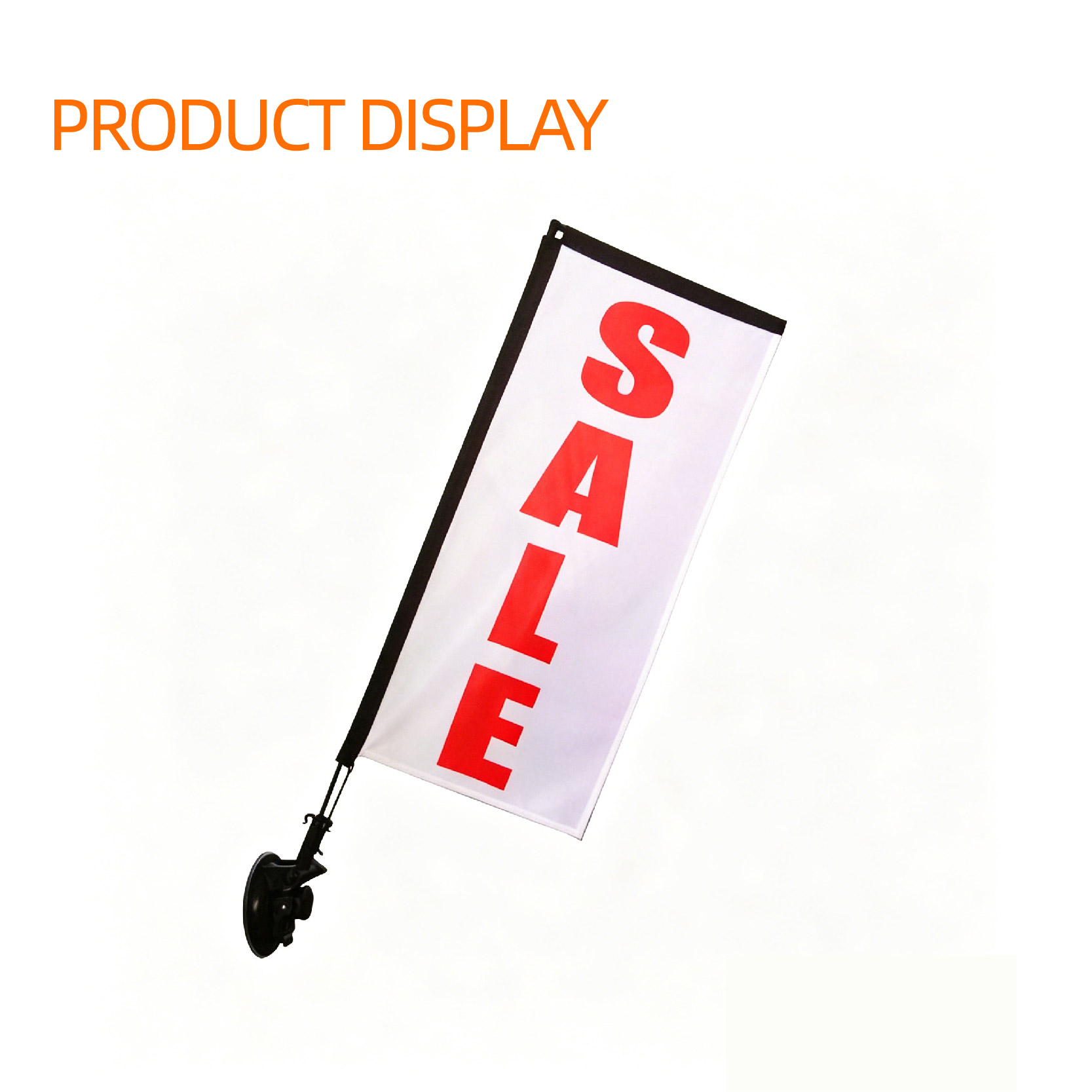
Window Display Flag
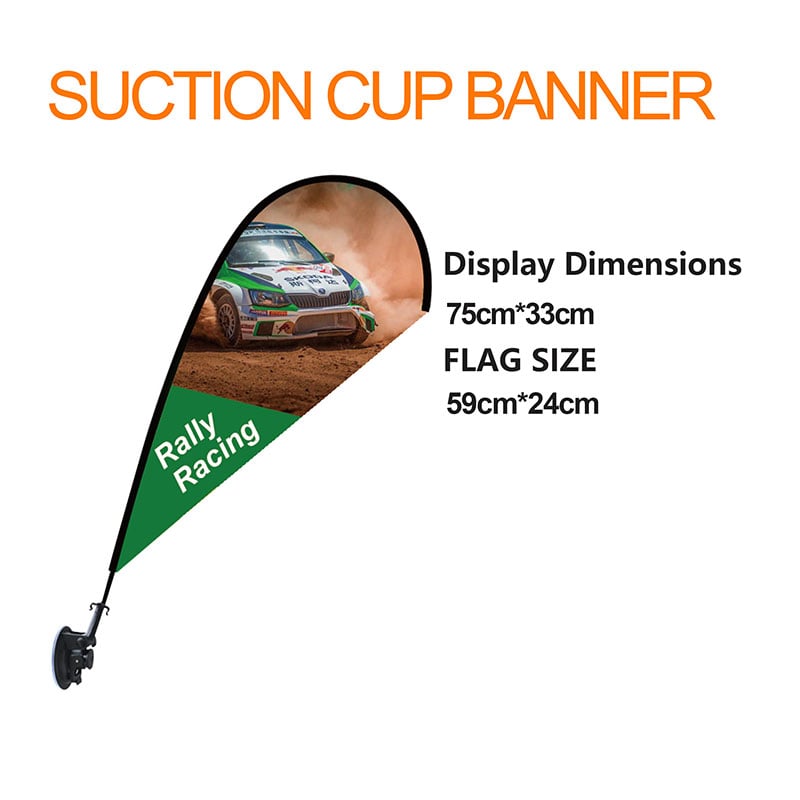
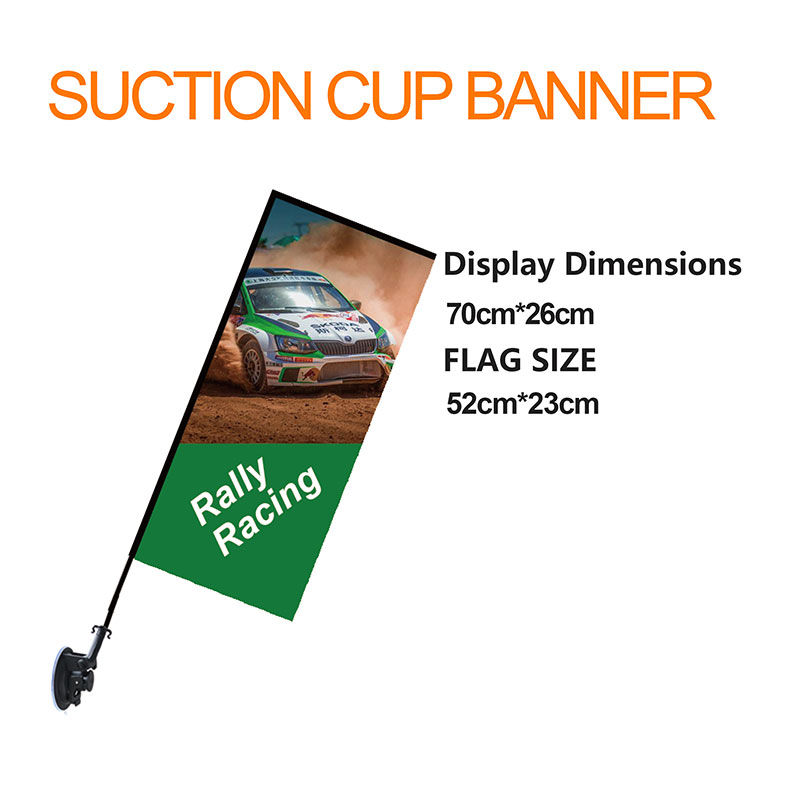
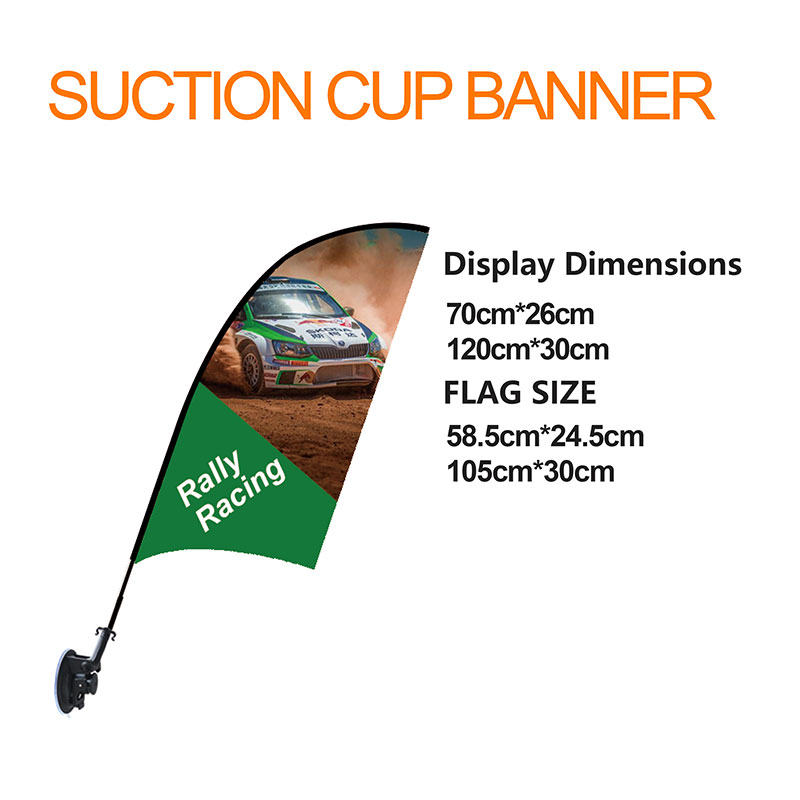
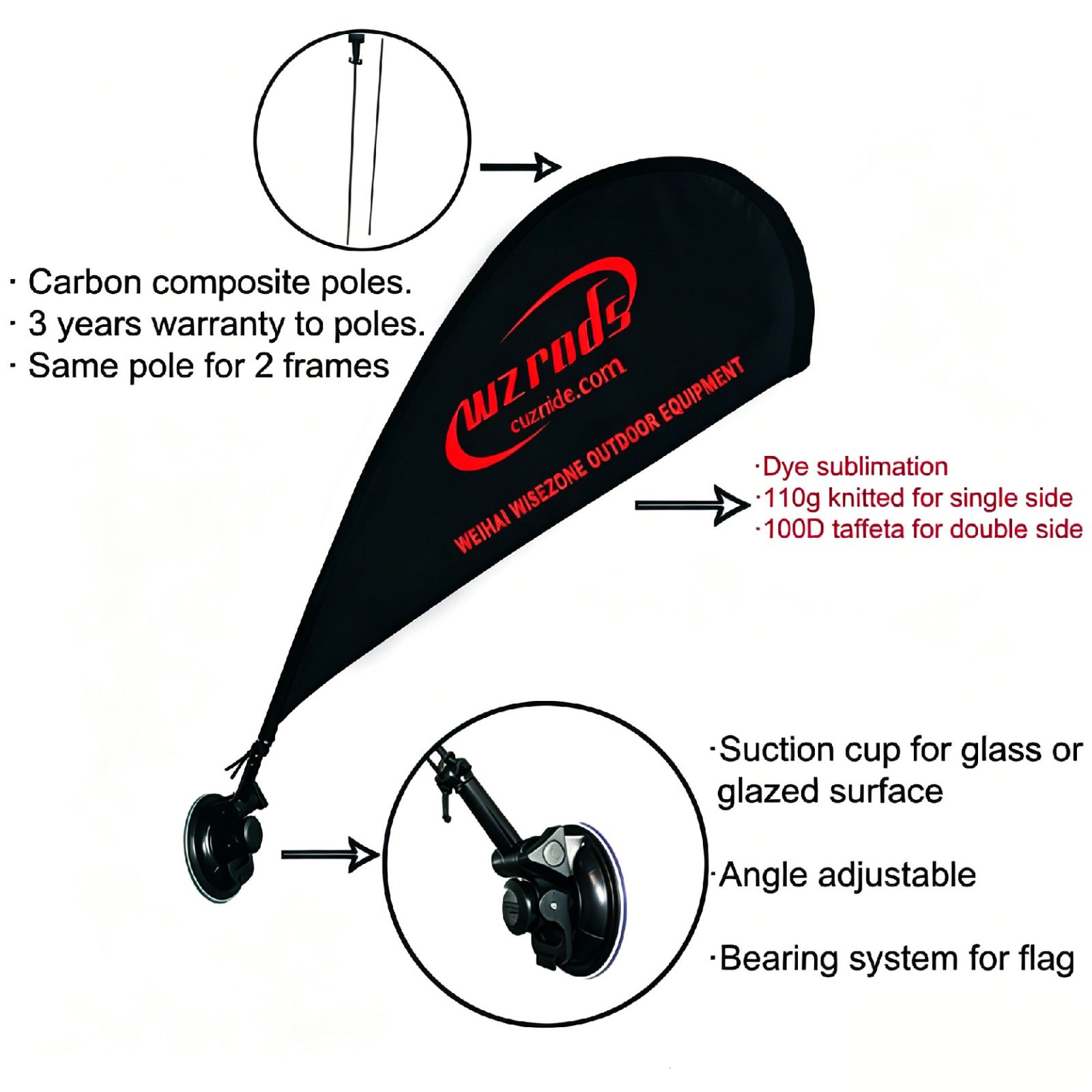
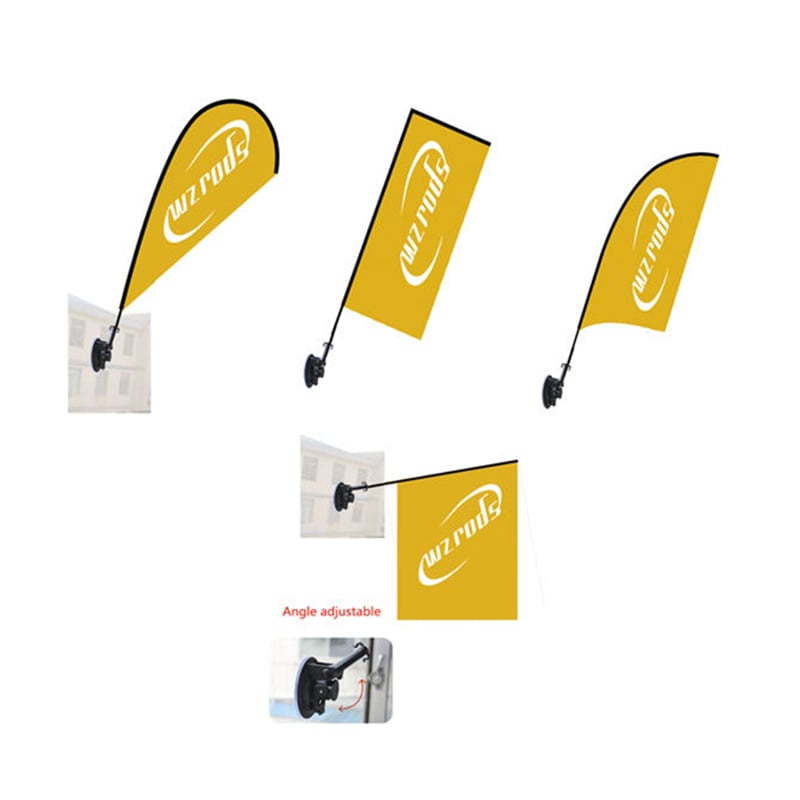
WZRODS suction cup flag adheres to smooth glass, tile, and metal surfaces. Offered in 3 shapes with a 2-in-1 pole design, it features 360° rotation and angle adjustment.


 Article
 Specifications
- Origin
- Shandong, China
- Brand
- Wzrods
- Item Code
- SCTF-132/SCTH-652/SCTF-132/SCTS-120-880#
- Pole Material
- Carbon Composite
- Banner Material
- Nylon
- Color
- CMYK 4 Color Printing
- Usage
- Advertising
- Application Spec
- Point of Sale, Indoor Display, Promotional Counters, Retail
- Printing Method
- Heat Transfer Printing
- Product Type
- promotional products
- Warranty
- 3 Years
- Pole Color
- Black or Silver
- Feather Banner Diaplay Dimensions
- 67.5*28.5cm
- Teardrop Banner Display Dimensions
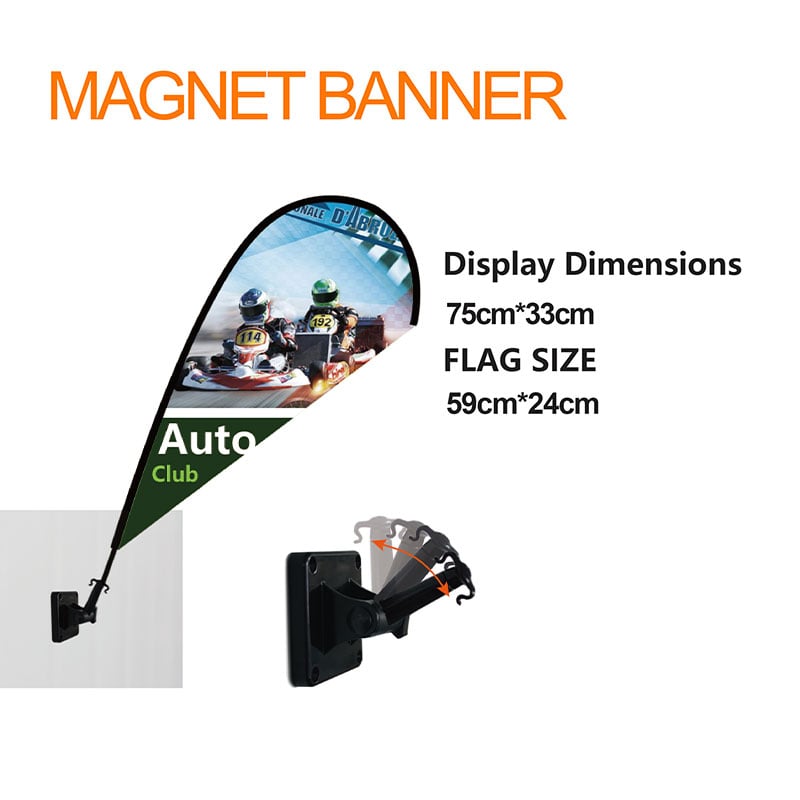
- 59*24cm
 Product Description
Shipping & Packaging
- Unit Weight
- 0.200 kg
- Unit Size
- 14X5X5CM
- Packaging
- Standard export carton
- Lead Time
- 15-30 days
Pricing
- MOQ
- 2 piece
- Price Range
- USD 2.8 – 3.3
* FOB Qingdao. Excludes shipping & taxes. Accessories & customization confirmed separately.
 Sample Service
- Sample Available
- Yes
- Sample Price
- piece 25
- Max Sample Qty
- 1
 Customization Options

Light Custom
Logo, color, size adjustments

Fast Turnaround
Quick custom order processing
Suction window flags - The Complete B2B Buyer's Resource - WZRODS
When a procurement manager evaluates display hardware for retail windows, trade show counters, or auto dealership showrooms, the conversation usually starts with aluminum. It is the default. Familiar. But familiar is not the same as economical, and it is certainly not the same as durable. A lightweight, rust-proof suction cup banner built around a carbon composite pole has reshaped the arithmetic of international sourcing. No one needs to rip out an existing supply chain overnight. Worth noting. But for buyers who run the numbers, the move from aluminum to carbon composite is not a gamble. It is lower landed cost and longer service life, line by line.
WZRODS has manufactured these products since 2005. Carbon composite applied to mini flag poles started here. So did the 2-shapes-in-1-pole design that lets a distributor stock one pole and three flag skins, cutting inventory in half. This article lays out a full sourcing framework—material selection, print technology, logistics, compliance, real-world ROI. It is drawn from managing $4.2 million in display hardware procurement annually. No fluff. Just what the numbers say.
1. Buyer's Guide: Sourcing Suction Cup Banners Across Borders
1.1 The Product, Plainly Described
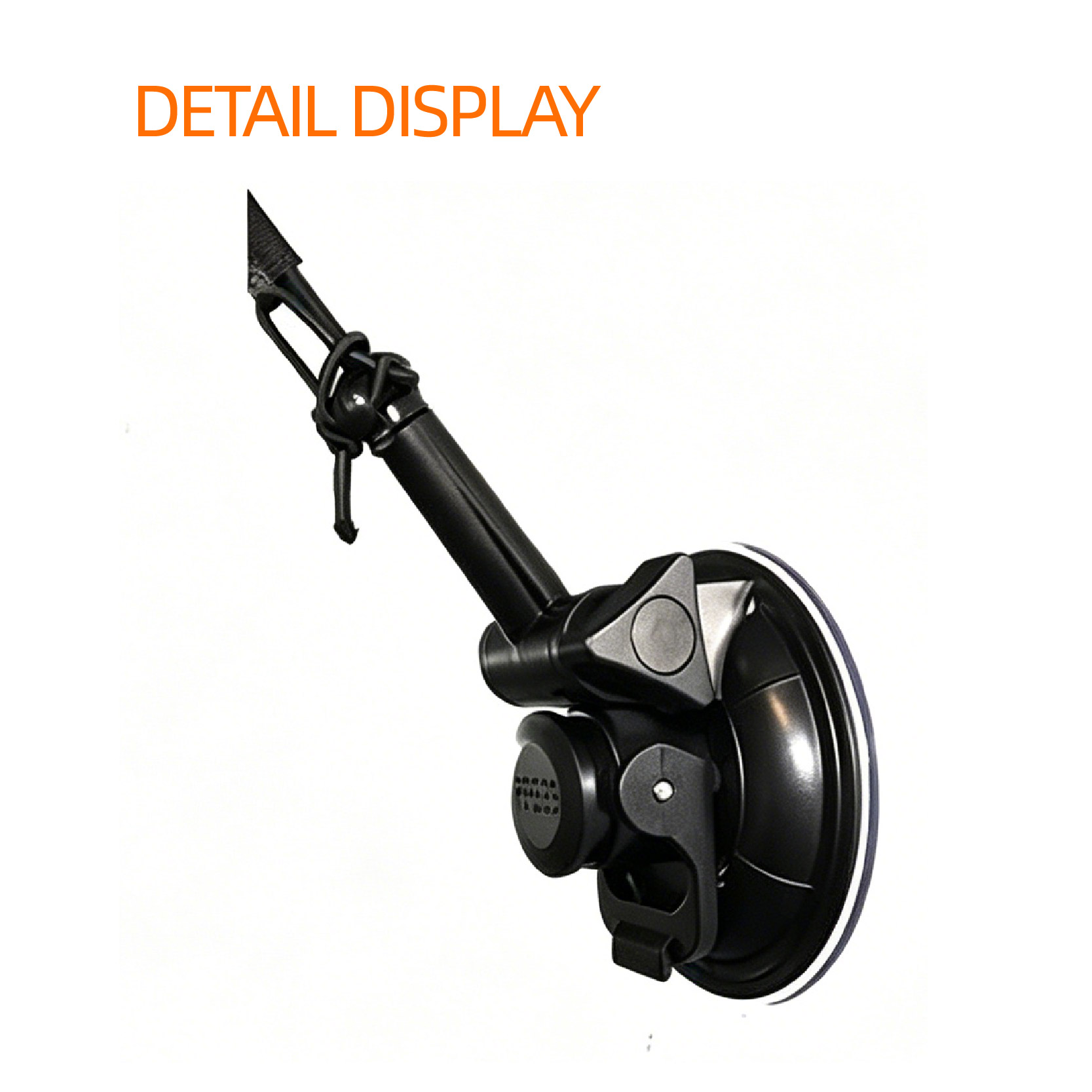
A suction cup banner has three parts: a high-grip suction cup, a lightweight pole, and a printed flag. The cup adheres to any smooth, non-porous surface—glass, polished tile, enameled metal. No adhesive. No tools. The pole is a carbon composite shaft, black or silver. The flag is nylon, printed via heat transfer in four-color CMYK. Three shapes are stocked: feather (SCTF-132), teardrop (SCTH-652), and rectangle (SCTS-120-880#). A 360-degree rotating joint and an adjustable-angle mechanism let the banner face the right direction in any indoor or sheltered outdoor setting.
For a B2B buyer, the commercial logic is straightforward. One pole works with all three banner shapes. Stock one set of poles, order multiple flag skins, and storage volume drops by half. Reordering gets simpler. The suction cup uses a high-grade rubber compound that holds its grip for years with occasional cleaning. No wind is needed to unfurl the message—the flag is sewn with a rigid tension pocket. The entire assembly weighs 200 grams.
1.2 Key Specifications a Buyer Must Verify
Not all suction cup displays are built for commercial use. These specifications separate durable tools from short-lived novelties:
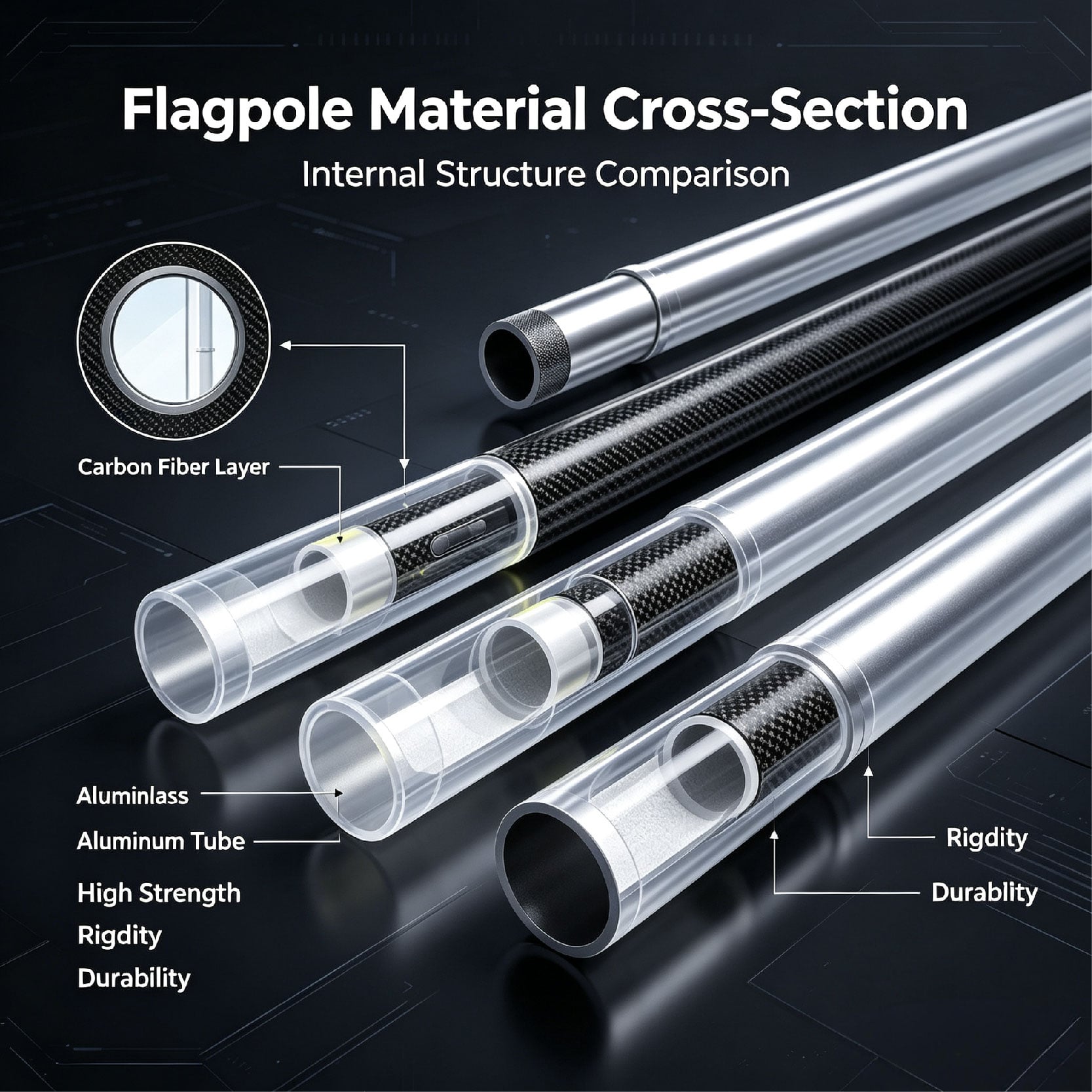
- Pole material. Carbon composite, aluminum, or fiberglass. Carbon composite has the highest strength-to-weight ratio and complete corrosion immunity. Aluminum bends permanently under repeated flexing. Carbon composite snaps back.
- Banner fabric. Nylon of at least 120 GSM. Resists fraying and color fading under indoor light for years. Cheaper polyester blends stretch and lose vividness within months.
- Printing method. Heat transfer embeds ink into the fabric at the molecular level. Screen-printed flags crack. Dye-sublimation works only if the fabric is polyester and the process is tightly controlled.
- Suction cup rating. Minimum 55 mm diameter, 15 mm concave depth. This holds a 200-gram pole-plus-flag combination on vertical glass for extended periods without slipping.
- Rotation mechanism. A bearing with a low coefficient of friction. The banner must rotate smoothly in moving air without tangling.
1.3 Vetting a Supplier
A supplier's sample policy reveals a lot. WZRODS charges $25 per sample—maximum one piece, delivery in 15 to 30 days. That is a reasonable investment before committing to a container order. Request the sample in the exact shape and print design planned for the market. Test it on glass at different temperatures. Watch it over a week. Does the suction cup release? Does the pole flex and recover? Is the print sharp under store lighting? If the sample fails these tests, the container load will not be any better.
Payment terms signal financial stability. Standard terms are T/T, L/C at sight, or Western Union. A manufacturer demanding full advance payment without a track record of on-time shipments warrants caution. WZRODS typically requires a 30% deposit with the balance against the bill of lading for new accounts. After a year of consistent trade, established buyers can move to open account.
1.4 Minimum Order Quantity and Unit Economics
The advertised minimum order quantity is two pieces. That is a sample or trial quantity, not a bulk-buy MOQ. For container-load orders, the practical MOQ is roughly 5,000 units to bring freight cost per unit into reasonable territory. Unit pricing runs $2.80 to $3.30, FOB Qingdao, depending on shape and volume. At two pieces, the base price applies—but per-unit shipping cost will be disproportionately high. Buyers reselling into retail chains or subscription box services should calculate landed cost based on a 20-foot or 40-foot high-cube container. A 40-foot high-cube holds approximately 194,000 units. At that density, ocean freight from Qingdao to Rotterdam adds roughly two to three cents per unit. The total landed cost is sharply competitive against locally sourced alternatives.
2. Product Comparison: Carbon Composite vs. Aluminum and Other Pole Materials
2.1 The Mechanics of Failure
Aluminum has its uses. A flag pole that sways in shifting air currents is not among the best of them. Aluminum has a well-defined yield point. When a gust pushes an aluminum pole past its elastic limit, the metal takes a permanent set—it bends and stays bent. Carbon composite behaves like a spring. It stores deflection energy and snaps back. Over the life of a banner in a busy restaurant window or an auto dealership, that resilience keeps the pole straight, the flag hanging correctly, and the brand image sharp. Not shabby.
2.2 Weight and Freight
A single WZRODS suction cup banner—pole, cup, flag—weighs 0.200 kg. The real talk: An equivalent aluminum pole assembly weighs roughly 0.280 kg. Across a container of 194,000 units, that 0.080 kg difference saves over 15,000 kg. Not even close. Ocean freight is charged by weight or measure, whichever is greater. Carton dimensions being equal, lighter cargo converts directly into lower freight cost. For air freight shipments of urgent promotional kits, the savings are even sharper.
2.3 Corrosion in Coastal and Humid Climates
Aluminum does not rust like steel, but it corrodes. Salt-laden air produces a white, powdery oxidation. The surface pits. The anodized finish degrades. Carbon composite is inert. It does not react with moisture, salt, or most cleaning chemicals. In Southeast Asia, the Gulf states, or the Caribbean, a carbon composite pole will outlast several aluminum equivalents. Fewer warranty claims. Fewer end-user complaints. Both quietly eat a distributor's margin.
2.4 Import Duty Classification
An advantage that is easy to overlook: carbon composite poles typically fall under HTS subheadings for articles of plastics and composite materials. Aluminum poles fall under aluminum articles. In many jurisdictions, the composite rate is lower. The exact rate depends on the importing country, but a two-percentage-point spread is common—roughly 3% for carbon composite versus 5% for aluminum. On a container of 194,000 units at $3.00 FOB each—a shipment value near $582,000—a two-point duty difference amounts to $11,640. That is retained profit or a sharper price for the customer. Either way, it tilts the arithmetic.
Carbon Composite vs. Aluminum Suction Cup Pole: At a Glance
| Attribute | Carbon Composite (WZRODS) | Aluminum (Typical) |
|---|---|---|
| Unit pole weight | 0.200 kg | 0.280 kg |
| Corrosion resistance | 100% rust-proof, inert | Pitting and oxidation in salt air |
| Flex recovery | Full elastic return | Permanent bend beyond yield point |
| Duty rate (typical EU) | ~3% | ~5% |
| Weight savings per 40HQ container | — | ~15,500 kg heavier |
| Service life in coastal tropics | 3+ years | 1–2 years |
3. ROI Analysis: Total Cost of Ownership for Bulk Buyers
3.1 The Real Cost of a Broken Display
A bent pole is not just a replacement cost. It is a failed advertising day. Consider a chain of 50 retail stores, each with three suction cup banners in the window—150 display positions. Aluminum poles in a moderate climate average 18 months before they bend beyond use. Carbon composite poles last three years minimum. Over a 36-month cycle, aluminum requires two full replacements: 450 units purchased versus 150. At a landed cost of $3.07 per aluminum unit, the total is $1,381. At $3.11 for carbon composite, the total is $467. The direct saving exceeds $900. Factor in the labor of reinstallation and the brand cost of a drooping flag, and the gap widens further. In coastal or high-humidity locations, where aluminum may need replacement annually, the numbers tilt harder.
3.2 Freight and Duty as Hidden Multipliers
An importer in the Netherlands placed a trial order of 10,000 aluminum-pole suction flags. The FOB price looked attractive. When the container arrived and the customs broker calculated duty on aluminum articles, the importer absorbed a rate nearly double what a composite classification would have carried. He reworked the landed cost model, substituted carbon composite poles, and the per-unit cost dropped by eleven euro cents. Over a year of ordering 70,000 units, that difference funded a new warehouse loading system. The pattern repeats wherever buyers tally every cost line rather than stopping at the invoice price.
3.3 Running Your Own Numbers
The formula is simple:
Landed Cost = (FOB Unit Price × Quantity + Ocean Freight + Insurance) × (1 + Duty Rate) + Inland Transportation
But unit landed cost is only the starting point. The metric that matters is total cost of ownership over the service period. Take a retail chain needing 5,000 display positions on a three-year refresh cycle. Carbon composite: 5,000 units purchased once. Landed at $3.11 each, that is $15,550. Aluminum: 5,000 units purchased three times—initial plus two replacements—at $3.07 each landed. Total: $46,050. The invoice price on the initial aluminum order was lower. The total cost over three years was three times higher. Procurement teams that stop at the first number on the quote sheet get this wrong every time. The arithmetic does not care about opinion.
4. Industry Applications: Where the Suction Cup Banner Outperforms All Others
4.1 Retail Window Displays
The classic use case. Suction cups allow instant placement—no drilling into frames, no adhesive residue. A national chain can equip every store with identical branding in a single night. The flag rotates 360 degrees. A pedestrian sees a dynamic, fluttering message that catches the eye. The nylon flag, printed via heat transfer, withstands direct sunlight behind window glass for months without significant fading.
4.2 Auto Dealerships
Glass partitions in showrooms and service bays make ideal mounting surfaces. Sales events change monthly. The 2-in-1 pole system lets a dealership keep a core set of poles and swap only the flag skins. The carbon composite pole holds up against vacuum cleaner bumps and the vibration of closing doors. It does not scratch the glass during repositioning.
4.3 Trade Show and Pop-Up Event Booths
Exhibitors care about weight and packability. A single suction cup banner disassembles into a 14×5×5 cm package. A sales representative can carry a dozen in a backpack. Setup takes five seconds. The cup adheres to any smooth booth wall, countertop, or metal pillar. No heavy floor stands. Lower drayage costs.
4.4 Restaurants and Point-of-Purchase Counters
Countertop menus, daily specials, app download QR codes—all benefit from the banner's small footprint. The adjustable angle lets the flag face customers at reading height. The pole material is food-safe and washable. After a week of splatters, a damp cloth returns it to a clean, professional finish.
5. Behind the Scenes: Factory Process and Quality Control at WZRODS
5.1 Carbon Composite Pole Production
The carbon composite tube is pultruded in a Shandong facility from continuous carbon fiber tows saturated with weather-resistant epoxy resin. The die sets a precise outer diameter and wall thickness. Consistent dimensions produce consistent flex characteristics. Each batch undergoes deflection testing: a standard weight is hung at a fixed distance, and the deflection is measured. Tubes outside tolerance are reground and re-pultruded.
5.2 Heat Transfer Printing
Nylon flags are laser-cut, then placed on a heat transfer press. A CMYK-printed transfer paper aligns with the fabric under controlled tension. Heat and pressure sublimate the ink into the nylon fibers. That's the gap. The result is a flag that can be washed and ironed without image degradation. Each flag is inspected under a D50 light booth for color accuracy against a Pantone reference. Because the 2-in-1 pole assembly is identical across feather, teardrop, and rectangle flags, a worker simply attaches the appropriate flag to the tension pocket. The unit is ready for packaging.
5.3 Packaging for Export
Each banner is bagged individually in a poly sleeve with a silica gel desiccant. Twenty-five units go into a white inner box. Four inner boxes make a master carton of 100 units. The carton is strapped and wrapped with moisture-barrier film. Carton dimensions cube out a container with minimal wasted space—hence the 194,000-unit capacity in a 40-foot high-cube. Each pallet carries an RFID-enabled label with batch number, production date, and destination. Receiving discrepancies for European distributors have dropped to near zero since this system was implemented.
6. Trends: How the Industry Is Moving Toward Lightweight, Sustainable Display Solutions
6.1 Sustainability and Carbon Footprint
Retailers and event organizers face growing pressure to report the carbon footprint of promotional materials. A carbon composite pole is lighter, requires less energy to transport, and generates fewer emissions per unit than an aluminum equivalent. The material is also recyclable. The Shandong facility runs a take-back program that grinds end-of-life poles into filler for new composite products. Buyers marketing to eco-conscious clients can present a verifiable sustainability story. In some European tenders, that story is the deciding factor.
6.2 The End of Single-Use Displays
Retail is moving toward durable, reconfigurable display systems. The 2-in-1 pole design fits this shift precisely. A brand runs a seasonal sale, changes the flag, and uses the same pole for the next promotion—indefinitely. This move away from single-use corrugate and cheap plastic stands is driven by cost and regulation. Many municipalities now tax disposable display materials. A suction cup banner is a reusable asset that depreciates over multiple tax cycles. Finance directors notice.
6.3 Customization at Scale
Digital heat transfer presses now make runs as small as 100 customized flags economical. WZRODS supports both light and fast customization. A buyer uploads artwork as an Adobe Illustrator file, approves a digital proof within 48 hours, and receives sample flags in 30 days. Event planners can create hyper-localized messaging—different flags for each store in different neighborhoods—without breaking the per-unit cost model.
7. Upgrade Solution: Making the Switch from Traditional Banner Stands
7.1 Why Floor Stands Are Losing Ground
Retractable banner stands and X-stands occupy floor space, require assembly, and tip over easily. They are heavy to ship. Their aluminum extrusions often arrive bent. A suction cup banner eliminates all of this. It uses vertical space—windows, glass partitions, columns—that otherwise goes unused. No floor footprint matters in cramped trade show aisles and narrow store entrances. Shipping volume per unit is a fraction of a floor stand's.
7.2 The 2-in-1 Pole as an Inventory Simplifier
A distributor stocking ten shapes of traditional banner poles warehouses ten SKUs. With the WZRODS system, one pole SKU covers three flag shapes. Inventory shrinks. Picking errors drop. Cash tied up in slow-moving shapes gets freed. The upgrade is not just a product change. It is a supply chain redesign with immediate working capital benefits.
7.3 Implementation Steps
A buyer can take a stepped approach. Order one sample. Test it in the highest-humidity store location. Measure customer response. If positive, place a 1,000-unit air freight order to prove the market. Then roll out with a container order. Transition costs are minimal. The suction cup banner costs less than most floor stands at the FOB level and requires no new fixtures at the point of sale. Staff learn to attach and remove a banner in minutes.
Frequently Asked Questions
What surfaces will the suction cup adhere to? Any smooth, non-porous, clean surface: glass, polished tile, smooth metal, acrylic panels, laminated countertops. It will not hold on textured walls, brick, or unpainted wood.
How long does the suction cup hold? Applied to a clean surface with a drop of water or a light alcohol wipe, the cup can hold for months without slipping. Temperature extremes from -10°C to 50°C do not affect performance. Below freezing, the rubber stiffens slightly. Re-moistening before application resolves this.
Can the suction cup banner be used outdoors?
It is designed for indoor and sheltered outdoor use. Direct rain will not damage the pole or flag, but the suction cup may lose grip if water intrudes between the cup and the surface. For permanent outdoor locations, a secondary mechanical tether is advisable.
What is the warranty?
Three years against manufacturing defects in materials and workmanship. Covers pole breakage under normal use, fading beyond industry standards, and suction cup failure. Excludes damage from reckless handling or use on inappropriate surfaces.
How are graphics customized?
Artwork is supplied as a vector file. A digital proof arrives within 48 hours. Once approved, a heat transfer print run produces the flags. Lead time for customized orders is 15 to 30 days, depending on volume.
What is the minimum order quantity?
Two pieces for sample or trial orders. For bulk pricing and container shipping, 5,000 units is the typical starting point. Mixed-shape orders are accepted.
How are the banners packaged for international shipping?
Each banner is poly-bagged and desiccated, packed 100 units per master carton. Cartons are palletized, stretch-wrapped, and labeled with full shipping marks. No fumigation required—carbon composite and nylon are non-organic.
Which payment terms are accepted?
T/T (30% deposit, 70% before shipment or against B/L copy), L/C at sight, and Western Union for sample orders. Open account terms are available after one year of trading history and satisfactory credit reference.
How many units fit in a container?
Approximately 194,000 units in a 40-foot high-cube container.
Is there a sample available, and how much does it cost?
Samples are $25 per unit, maximum one per buyer. Includes the pole, suction cup, and one flag of the buyer's choice. Delivery takes 15 to 30 days. Shipping cost is the buyer's responsibility.
How should I care for the suction cup banner to maximize its life?
Wipe the suction cup with a damp cloth before each application. Hand-wash the nylon flag in cold water if soiled; do not machine dry. Clean the carbon composite pole with mild detergent. Store disassembled in a dry place.
For buyers managing promotional display fleets across multiple countries, the arithmetic points in one direction: lighter, rust-proof, longer-lasting hardware. The carbon composite suction cup banner is not a revolution. It corrects the weaknesses aluminum has forced us to tolerate for too long. A sample is the first step. The numbers do the rest.
About the Author
Wei Chen, Senior Product Specialist
B.S. Supply Chain Management, Michigan State University; Certified Professional in Supply Management (CPSM)
12 years in B2B display hardware sourcing. Former procurement manager for a top 20 US promotional products distributor. Specializes in aluminum pole systems and import compliance.
Reviewed by WZRODS Technical Team. Updated: 2026-07-04
 Comments (0)
No comments yet. Be the first to comment!
Leave a Comment
Related Products
Related Articles
29kg Concrete Flag Base - The Complete B2B Buyer's Resource - WZRODS
WZRODS DY451B: 29 kg, HDPE shell, concrete core. Stackable, portable, rust-proof. FOB price US$5.75–$6.85 at MOQ 2 units. Those numbers look unremarkable. Factor in landed cost—import duties lower than aluminum’s under relevant HTS codes, freight savings from less weight per unit of stabilizing mas
Wide Tube Cross Base - The Complete B2B Buyer's Resource - WZRODS
The Wide Tube Cross Base, manufactured by Wzrods in Shandong, China, solves one problem: reliable stability for poles under three meters, without the freight costs and warehouse footprint that heavier alternatives demand.
Rectangular Pipe Cross Base - The Complete B2B Buyer's Resource - WZRODS
The pipe cross flag base is a cross of rectangular steel pipe, powder‑coated, weighing 1.3 kg and spanning 78 cm across its arms. Its center holds a C‑ring shaft that lets the flag rotate with the wind.
X-Shape Backpack Banner - The Complete B2B Buyer's Resource - WZRODS
Economic Cross Base - The Complete B2B Buyer's Guide- WZRODS
When you buy an economic cross base—something like the Wzrods DM‑9, a 77 cm‑long, 1.3 kg iron cross—forget “economic” as a synonym for “cheap.” It means value-engineered.
Car Window Flag - The Complete B2B Buyer's Resource - WZRODS
In fall 2019, a seasoned promotional-products distributor rushed 2,000 aluminum window flags to a large dealership group for a nationwide weekend sale. By noon
Suction Cup Banner - The Complete B2B Buyer's Resource - WZRODS
The core suction cup sign design principle requires strong adhesion against wind and impacts while detaching residue-free. Creating durable specs for multi-city US trade shows relies on material research, logistics calculation and venue compliance. A buyer’s costly experience proves carbon composite