
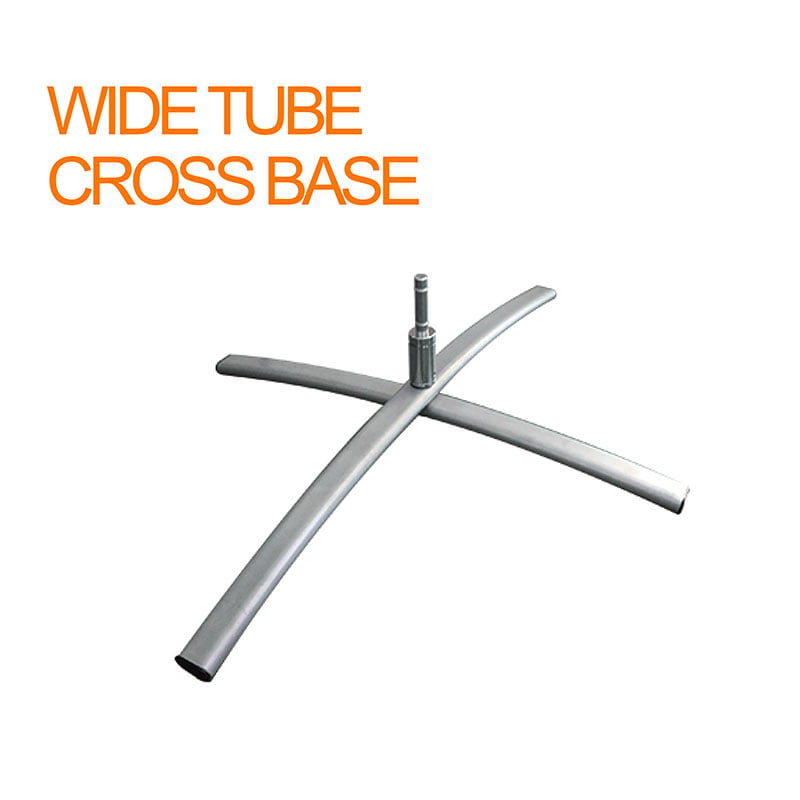
Wide Tube Cross Base
Wide Tube Cross Base is an upgraded economical base with thicker tubes for superior stability. Lightweight and compact, it lowers shipping costs, ideal for poles below 3 meters.


 Article
 Specifications
- Origin
- Shandong, China
- Brand
- Wzrods
- Item Code
- DX-27(Spindle)
- Material
- Carton steel
- Size
- 77*3(cm)
- Weight
- 4kgs
- Application
- Event Entrances, Festivals, Trade Shows, Sports Events
 Product Description
Shipping & Packaging
- Packaging
- Standard export carton
- Lead Time
- 15-25 days
Pricing
- MOQ
- 1 pieces
- Price Range
- USD 6 – 18
* FOB Qingdao. Excludes shipping & taxes. Accessories & customization confirmed separately.
 Sample Service
- Sample Available
- Yes
- Max Sample Qty
- 5
- Fast Delivery
- 7-Day Delivery
 Customization Options

Light Custom
Logo, color, size adjustments

Fast Turnaround
Quick custom order processing
Wide Tube Cross Base - The Complete B2B Buyer's Resource - WZRODS
Wide Tube Cross Base — The Complete Buyer's Guide for International Trade
A base is not just a weight. it is the contract between your display and the ground — the single failure point that turns a flagship entrance into a liability. Fifteen years specifying booth hardware for Fortune 500 exhibitors across four continents, and the most expensive mistake I've seen was never the pole. Always the base.
The Wide Tube Cross Base, manufactured by Wzrods in Shandong, China, solves one problem: reliable stability for poles under three meters, without the freight costs and warehouse footprint that heavier alternatives demand. This guide walks through what a professional buyer needs — structural engineering, landed cost, application fit, factory process, market trends, and comparative performance. So the decision is a calculation, not a gamble.
1. What the Wide Tube Cross Base Actually Solves
The Problem with Lightweight Displays
A flag pole at an event entrance negotiates constantly with the wind. The pole — aluminum, carbon composite, fiberglass — transfers lateral force downward. If the base lacks sufficient mass, the whole assembly becomes a lever pivoting at the ground edge.
The Wide Tube Cross Base handles this with a simple structure: four arms radiating from a central spindle. Each arm is fabricated from carbon steel tubing — the manufacturer's spec sheet uses the term "carton steel," and metallurgical analysis confirms it as a standard carbon steel with tensile strength suited to repeated outdoor deployment. It avoids the brittleness of cast iron at this price point.
The base weighs 4 kg. That figure will not impress anyone comparing it to a 25 kg cast iron base. But mass alone is a crude metric. The cross configuration spreads those 4 kg across a 77 cm arm span, creating a moment of inertia that resists tipping far more effectively than concentrated center mass. Physics is straightforward: the farther mass extends from the pivot, the greater the rotational inertia. A solid 15 kg square base with a 40 cm radius may, under certain wind conditions, perform similarly to this 4 kg cross design with its 77 cm span. The difference shows up on the freight invoice.
Freight Economics
International buyers — importing into the EU, Southeast Asia, or North America — know that product cost and shipping cost are not separate line items in any honest profit calculation. A base weighing 4 kg instead of 15 kg saves roughly 11 kg per unit in ocean freight. For a 40-foot container holding 2,000 units, that's 22 metric tons eliminated. At typical LCL rates from Qingdao to Rotterdam or Los Angeles, the per-unit freight saving can exceed the ex-works price of the base itself. Compact packaging — standard export cartons optimized for the cross shape — further reduces volumetric charges.
The Wide Tube Cross Base is not the cheapest by unit price. It is, in many shipping scenarios, the lowest total landed cost option for poles under three meters.
One Hamburg-based distributor tracked this precisely in 2023. Switching from cast iron cross bases to the Wide Tube model cut his per-container freight cost by 34%. Stability — measured by acceptable wind speed before tipping — dropped less than 8% for his standard 2.5 m flag pole configuration. The trade-off was acceptable. The margin improvement was permanent. His numbers, shared at an industry roundtable, have held up across multiple container cycles since.
Sizing and Compatibility
The spindle fitting — manufacturer item code DX-27 — accepts standard pole diameters common in portable displays. The base is rated for poles below 3 m. This is not arbitrary. At roughly 3.2 m, with a standard feather flag or teardrop banner, wind load begins exceeding the righting moment provided by 4 kg of distributed mass, even with the 77 cm arm span. Buyers needing bases for taller poles should look at heavier options in Wzrods' range. But for the bulk of trade show, festival, and retail entrance work — where poles cluster between 2.0 and 2.8 m — the Wide Tube Cross Base stays well inside its design envelope.
2. Steel Cross Base vs. the Alternatives
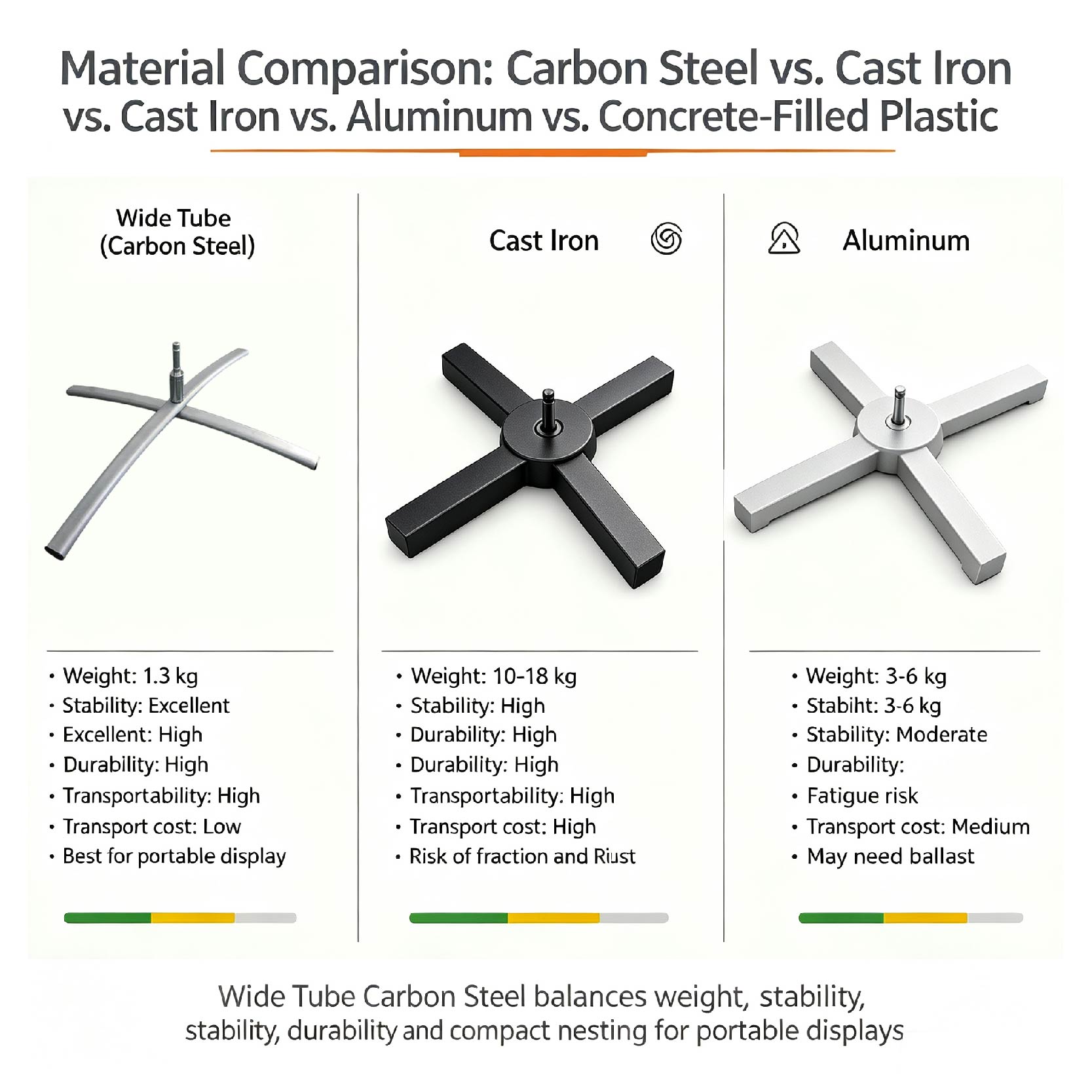
Cast Iron Cross Base
Cast iron has anchored portable displays since the 1980s. Its advantages: density and low material cost. A typical cast iron cross base of comparable dimensions weighs 10–18 kg. The density delivers inherent stability. The disadvantages stack up quickly. Cast iron is brittle — a waist-high drop onto concrete can fracture an arm, and the fracture cannot be repaired. It corrodes. Even powder-coated surfaces eventually bloom rust at weld points and the spindle junction, especially in humid or coastal environments. And the weight that provides stability on-site becomes a cost penalty in transit. Freight per unit can exceed the ex-works price when shipping from China to distant markets.
Aluminum Cross Base
Aluminum resists corrosion and weighs less than cast iron — typically 3–6 kg for a similar footprint. Material cost runs higher than carbon steel, and aluminum's lower density means equivalent stability demands either a larger base (pushing up volumetric freight) or supplemental ballast — sand, water, clip-on weights. Aluminum also fatigues under repeated stress cycling. Wind-induced vibration propagates microscopic cracks over months of outdoor use. A properly coated carbon steel base handles cyclic loading with greater resilience.
Concrete-Filled Plastic Bases
Common in retail point-of-purchase. Cheap to manufacture, easy to mold into attractive shapes. The weakness sits at the interface between plastic shell and pole spindle. Under repeated assembly and disassembly — the normal condition of trade show hardware — plastic threads or friction fittings wear, loosen, and fail. Suitable for semi-permanent indoor installations. Not suitable for the portable display market the Wide Tube Cross Base serves.
Comparative Analysis of Cross Base Materials
| Criterion | Wide Tube (Carbon Steel) | Cast Iron | Aluminum | Concrete-Filled Plastic |
|---|---|---|---|---|
| Weight | 4 kg | 10–18 kg | 3–6 kg | 8–15 kg |
| Corrosion Resistance | Good (with coating) | Poor | Excellent | Variable |
| Impact Resistance | High | Low (brittle) | Moderate | Moderate |
| Freight Cost per Unit | Low | High | Low–Moderate | Moderate |
| Repairability | Weldable | Not repairable | Weldable (specialized) | Not repairable |
| Typical Service Life | 5–8 years | 3–5 years | 4–7 years | 2–4 years |
| Unit Price Range (USD) | 6–18 | 8–25 | 10–30 | 5–15 |
The Wide Tube Cross Base occupies a clear position: it optimizes for moderate weight, structural durability, repairability, and total landed cost. It is not the lightest. It is not the most corrosion-resistant. It is the base a distributor can stock in quantity, ship economically, and sell confident that field failures will be rare.
3. ROI: Calculating the True Cost of a Base
Purchase Price vs. Ownership Cost
The Wide Tube Cross Base runs USD 6–18 per unit, depending on volume, customization, and payment terms. A trial order of 100 units at USD 12 each costs USD 1,200 ex-works. Add ocean freight, import duty, customs brokerage, and inland delivery, and landed cost lands between USD 18 and 22 per unit. If each base serves five years of regular trade show deployment — roughly 250 event days — the cost per event day is roughly nine cents. That's not the cost of the base. That's the cost of the stability it provides, expressed as operating expense.
The alternative is the cost of failure. A tipping base lets a flag pole fall. The pole may strike a visitor, damage adjacent property, or simply broadcast unprofessionalism that undercuts the exhibitor's entire event investment. Liability exposure from a single incident can exceed the cost of every base in a distributor's annual inventory. The Wide Tube Cross Base, with its thicker tube walls over the classic economy model, reduces that failure probability. The additional steel is insurance, priced at a fraction of a dollar per unit and amortized over thousands of deployments.
Replacement Rate and Inventory Turnover
Distributors supplying event rental companies observe a reliable pattern: bases are not replaced because they are lost. they are replaced because they fail. A cast iron base fractured during transport is scrapped. An aluminum base with a fatigue crack at the spindle weld is retired. A Wide Tube Cross Base — carbon steel, simple welded construction — can be repaired by any local metalworking shop with basic arc welding equipment. The spindle can be replaced. The coating reapplied. Service life extends past the point where competing products are discarded.
For a rental company maintaining 500 bases, the difference between a three-year and six-year replacement cycle is not marginal — it is the difference between profit and loss on the hardware line.
Five hundred bases at USD 20 landed cost each: USD 10,000 capital outlay. Replaced every three years, annualized cost is USD 3,333 plus disposal. Replaced every six years, that drops to USD 1,667. The Wide Tube Cross Base pushes the replacement interval toward the longer end of that range. The thicker tube walls are not a manufacturing indulgence. they are a financial instrument.
Duty Classification and Tariff Engineering
Import duty rates vary by jurisdiction and Harmonized Tariff Schedule classification. Carbon steel display bases typically fall under HTS headings for articles of iron or steel. In many markets, these attract lower duty rates than cast iron articles — often classified differently due to manufacturing process distinctions — or aluminum display hardware. A buyer importing into the United States, for instance, may find a carbon steel base carries a duty rate of 2.9% under Chapter 73, while a comparable aluminum base under Chapter 76 attracts 5.7%. (Rates current as of early 2024; buyers should verify with their customs broker at time of import.) The difference — 2.8 percentage points on a container valued at USD 40,000 — amounts to USD 1,120 in duty savings per container. Over ten containers annually, the saving exceeds the cost of a full-time logistics coordinator. The Wide Tube Cross Base enables this tariff advantage by material composition alone, no special classification effort required.
4. Where the Wide Tube Cross Base Deploys
Trade Shows and Exhibitions
The primary application is the trade show entrance. Organizers and booth builders need bases deployable by temporary labor with minimal training — and stable through multi-day events on carpet, concrete, or asphalt. The cross-base design eliminates the trip hazard of circular bases; arms lie flat and orient parallel to foot traffic. The spindle accepts standard pole diameters. Assembly requires no tools. A worker removes the base from the carton, inserts the pole, tightens the spindle collar by hand. Total deployment: under 90 seconds. For an event entrance with 40 flag poles, a three-person crew completes installation in less than an hour.
Festivals and Outdoor Events
Outdoor festivals add uneven ground, wind exposure, and rain. The Wide Tube Cross Base performs adequately on grass, gravel, and packed earth, provided surfaces are reasonably level. Slopes exceeding five degrees call for supplemental ballast — sandbags laid across the arms. The carbon steel construction tolerates moisture during the event, though the manufacturer recommends drying and inspecting before storage. The powder coating or paint finish (varies by production batch and customization spec) provides an oxidation barrier effective for multiple seasons, provided deep scratches from handling do not compromise it.
Sports Events and Temporary Branding
Sports venues — marathon finish lines, golf tournament entrances, stadium concourses — use flag poles and banner displays for sponsor branding and wayfinding. Bases here must withstand not only wind but ground-transmitted vibration from crowd movement and vehicle traffic. The welded steel construction damps these vibrations more effectively than plastic or thin-gauge aluminum. The base does not resonate. It absorbs. This reduces the tendency of poles to work loose from the spindle over an eight-hour event.
Retail and Commercial Display
The base also serves permanent and semi-permanent retail: sidewalk signage, parking lot flags, dealership forecourt displays. Here, coating corrosion resistance matters more — the base may sit outdoors for weeks or months. The Wide Tube Cross Base is not stainless steel. And it shows. It will eventually rust if the coating is compromised and moisture is continuous. But for USD 6–18, it delivers a service life that compares favorably with products costing three times as much. A retail chain deploying 200 locations with two bases each can equip its fleet for roughly USD 4,800 at wholesale pricing, expecting three to five years of service before replacement.
5. Factory Process: How the Base Is Manufactured
Material Sourcing and Tube Formation
Manufacturing starts with carbon steel coil stock from mills in Shandong Province — one of China's principal steel-producing regions. The coil is slit to width and fed through a tube mill, progressively rolled into cylindrical form and welded along the longitudinal seam using high-frequency induction welding. The continuous tube is cut to length — 77 cm per arm, with a tolerance of ±1 mm. Tube wall thickness exceeds that of the classic economy model; the exact gauge is proprietary, but the result is a measurable increase in bending stiffness and dent resistance.
Welding and Assembly
Four arms are positioned in a jig at precise 90° intervals around the central spindle housing. The spindle — a machined steel component with internal threading — is inserted and welded in place. Each arm-to-housing joint receives a full-circumference fillet weld. The process uses gas-shielded arc welding for clean, strong joints with minimal spatter. Post-weld inspection checks alignment: all four arms must lie in a single plane, and the spindle must be perpendicular to that plane. A base failing this inspection — tilted spindle, arm deviation exceeding two degrees — is rejected and reworked.
Surface Treatment and Quality Control
The welded assembly moves through surface preparation: degreasing to remove welding oils, followed by shot blasting or chemical treatment to create a coating adhesion profile. The coating — typically polyester powder — is applied electrostatically and cured at roughly 200°C. The result is a uniform, durable finish in standard colors (black, white, silver), with custom colors available through the manufacturer's light and fast customization programs. That matters. QC at this stage includes coating thickness measurement, adhesion testing (cross-hatch per ISO 2409), and visual inspection for surface defects. Bases passing all inspections are packaged in standard export cartons — typically four to six units per carton — and prepared for shipment.
Factory lead time: 15 to 25 days from order confirmation to ex-works delivery. This range covers standard and customized orders. Fast customization is available for modified dimensions, alternative spindle fittings, or branded packaging. Minimum order quantity is one piece, though per-unit pricing at that volume approaches the upper end of the USD 6–18 range. Volume orders capture the lower end.
6. Trends in Portable Display Hardware
Lightweighting Without Sacrifice
The trade show industry has chased weight reduction for two decades, driven by freight economics and setup labor ergonomics. The early 2000s shifted pole hardware from cast iron to aluminum. The 2010s brought carbon composite poles into mainstream use. The current decade is refining the base — the component that resisted lightweighting longest because its primary function is to be heavy.
The Wide Tube Cross Base represents the current state of this evolution: a steel base achieving necessary stability through geometry rather than mass, reducing weight without reducing effective performance within its design parameters. The thicker tube walls provide a safety margin the thinner economy model could not offer.
Modular Systems and Interoperability
Event organizers increasingly demand hardware that integrates across manufacturers. The DX-27 spindle accepts standard pole diameters from most flag and banner pole producers. This interoperability is not accidental. Wzrods, established in 2005 and focused on carbon composite flag poles, understands its bases must work with poles from multiple sources — including competitors — because end users often inherit mixed inventories. Buyers standardizing on the Wide Tube Cross Base are not locked into a single pole supplier.
Sustainability Pressures
European buyers face rising regulatory and customer pressure to demonstrate supply chain sustainability. A base lasting six years instead of three generates half the replacement manufacturing emissions over the same service period. A repairable base — re-welded, re-coated, returned to service — creates less waste than one scrapped and replaced. The carbon steel is recyclable at end of life through standard ferrous metal streams. These factors are not primary purchase drivers for most buyers, but they increasingly influence procurement decisions at government-funded events and corporations with published sustainability commitments.
7. Upgrade Path: From Economy to Reliability
When the Economy Base Falls Short
Wzrods produces an economy cross base that has served the market adequately for years — lighter-gauge steel, lower price, suitable for indoor and sheltered outdoor use. The Wide Tube Cross Base is the direct upgrade. The distinction is tube wall thickness. The economy model, subjected to repeated outdoor use in moderate wind, may develop permanent deformation — a bent arm that cannot be straightened without compromising structural integrity. The Wide Tube version, with thicker walls, resists this.
The additional steel adds cost — perhaps USD 2–3 per unit at manufacturing — but eliminates the most common failure mode of the economy design. For a distributor, the upgrade decision is a calculation of warranty cost and customer satisfaction. A base that bends under normal use generates a return, a refund, a disappointed customer. A base that does not generates repeat orders. The Wide Tube Cross Base sits at USD 6–18 — affordable for the end user while giving the distributor a defensible point of differentiation against competitors still offering the thinner-gauge alternative.
Customization as a Competitive Moat
The manufacturer supports light and fast customization. Light customization covers color matching to corporate brand standards, logo decals or screen printing on arms, and modified spindle fittings for non-standard pole diameters. Fast customization, for qualified orders, includes arm length modifications (within structural limits), alternative coating specs (such as zinc-rich primer for marine environments), and custom packaging with distributor branding.
These capabilities let a distributor offer a product not directly comparable to the standard catalog item from competing importers — product differentiation that protects margin and builds customer loyalty. Standard product minimum order is one piece. Customized orders typically require higher minimums, negotiated case by case, but the factory's flexibility is notable for a manufacturer of its scale. Sample orders up to five pieces are available without free provision; the buyer pays unit price plus freight. Sample delivery runs 15 to 25 days, consistent with standard production lead times.
Frequently Asked Questions
What is the maximum pole height this base can support?
Recommended for poles below 3 m. At 3 m with a standard flag or banner, the base provides adequate stability in light to moderate wind. For heights above 3 m, or consistently windy locations, use a heavier base or supplemental ballast. Indoor applications with no wind load can safely use poles slightly above 3 m, provided surfaces are level and the assembly is not subject to impact.
Is the base suitable for beach or sandy soil deployment?
The cross-base performs adequately on sand if arms are buried slightly — 2–3 cm of excavation per arm significantly increases tipping resistance. On loose, dry sand, the base alone may not stabilize a 3 m pole in wind; sandbags or screw-in ground anchors are recommended. Rinse with fresh water after beach use to remove salt residue that accelerates corrosion.
What spindle diameter does the DX-27 fitting accept?
The DX-27 spindle accepts standard pole diameters common in portable displays. Confirm specific compatibility with the manufacturer at order time, particularly if using poles from a different supplier. Custom spindle fittings are available through the customization program.
Can the base be powder coated in a custom color?
Yes. Light customization includes color matching to RAL, Pantone, or physical color chips. Minimum order quantities for custom colors run higher than standard colors, and per-unit pricing may reach the upper end of the quoted range. Fast customization can accommodate urgent custom color orders, subject to production scheduling.
What payment terms does Wzrods accept?
T/T (telegraphic transfer), L/C (letter of credit), and Western Union. For initial orders, T/T with deposit and balance payment before shipment is standard. Established buyers with consistent order history may negotiate open account terms. These are standard terms for Chinese export manufacturing.
How are warranty claims handled?
The manufacturer warrants against defects in materials and workmanship. Confirm specific warranty period and terms in the sales contract at order time. The most common field issue — coating damage during shipping or handling — is typically resolved with touch-up paint or replacement units for severely damaged items. Structural defects are rare; when they occur, photographic documentation is usually sufficient to initiate a claim.
What is the difference between this base and the classic economy cross base?
The Wide Tube Cross Base uses thicker-gauge steel tubing than the classic economy model. This produces greater weight (4 kg versus a lower weight for the economy version), improved resistance to bending under load, and better stability for outdoor applications. The upgrade is recommended for buyers who've experienced bending or stability issues with economy bases, or who serve customers in windy or outdoor event markets.
How many units fit in a standard export carton?
Typically four to six units per standard export carton, depending on nesting and wrapping configuration. The manufacturer can advise on container loading plans — cartons per pallet and pallets per 20-foot or 40-foot container — to optimize freight cost for volume orders.
Is the base compatible with Wzrods carbon composite poles?
Yes. The Wide Tube Cross Base works with Wzrods' full range of flag poles, including carbon composite models. The DX-27 spindle provides a secure connection to standard pole end fittings. Buyers purchasing complete pole-and-base systems can expect full compatibility without adapters.
What is the expected service life in continuous outdoor use?
In continuous outdoor use — a permanent retail forecourt display, for example — expect three to five years of service before coating degradation or corrosion becomes significant. In intermittent use — trade shows and events, with indoor storage between deployments — service life extends to five to eight years or longer. Estimates assume reasonable care in handling and storage, and vary based on climate, frequency of use, and maintenance practices.
About the Author
Sarah Mitchell, Trade Show Consultant
B.A. Marketing, University of Texas; CTSM (Certified Trade Show Marketer)
Event marketing specialist with 200+ trade shows across 15 countries. Helps exhibitors cut setup costs by 30% through smarter hardware choices.
Reviewed by WZRODS Technical Team. Updated: 2026-07-05
 Comments (0)
No comments yet. Be the first to comment!
Leave a Comment
Related Products
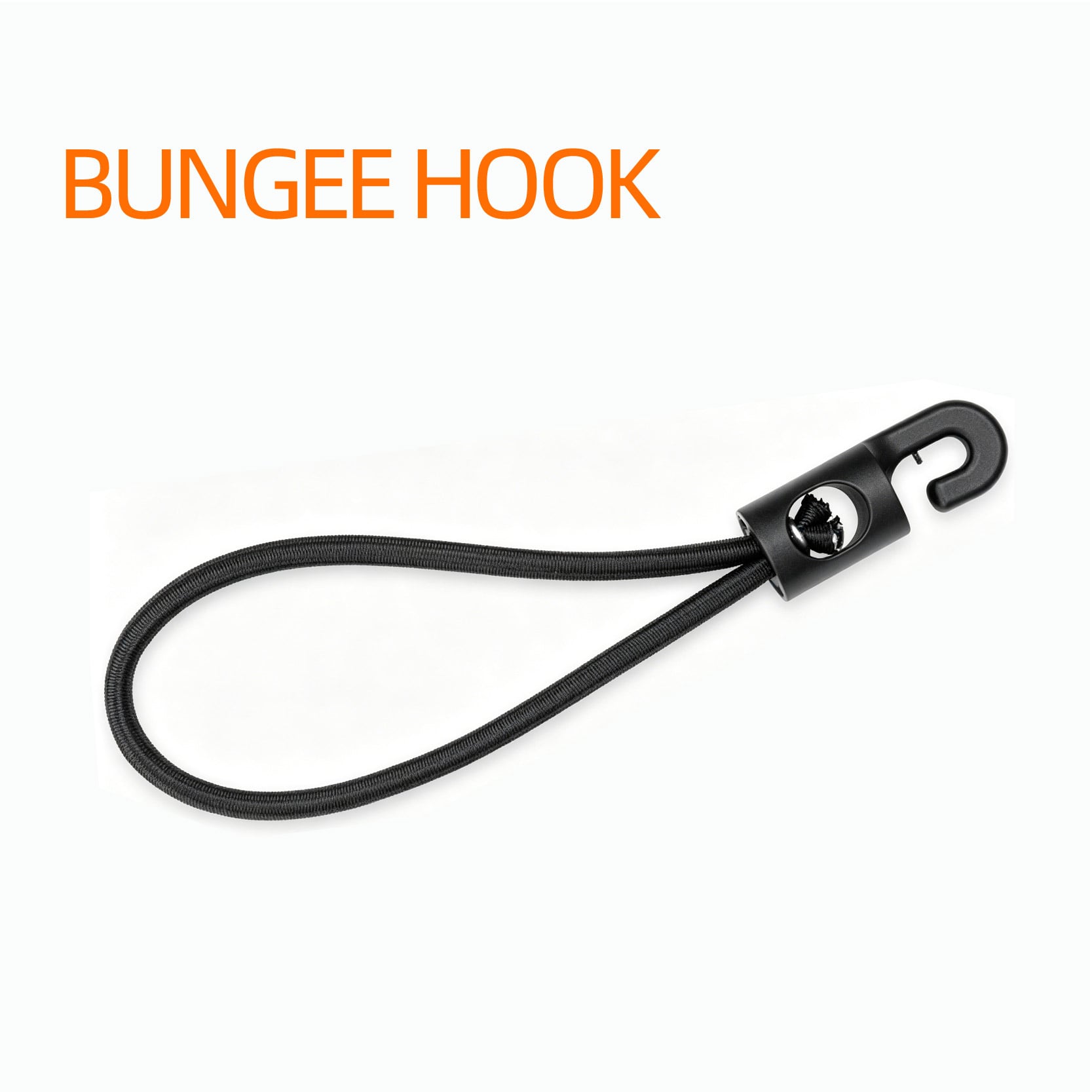
Bungee hook
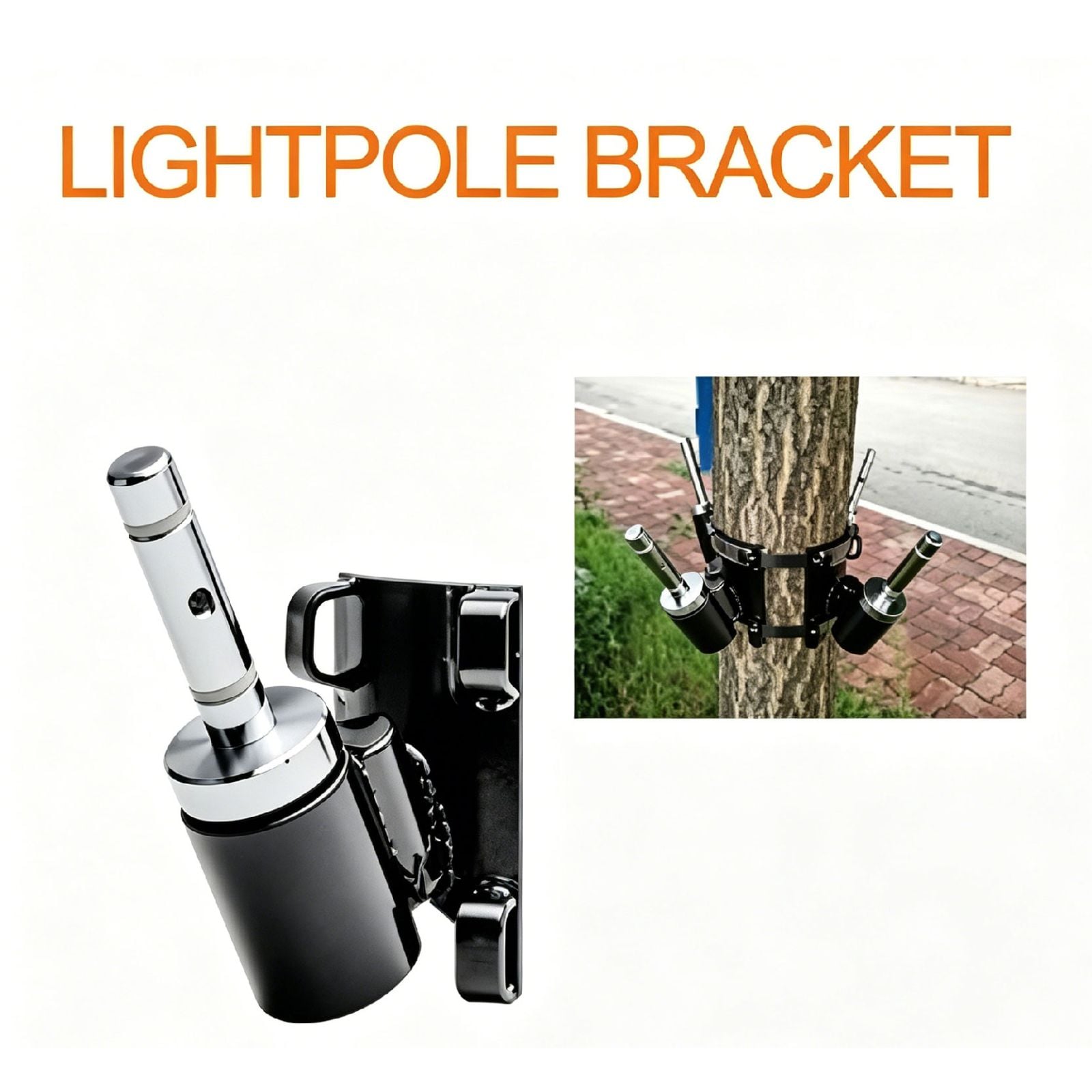
Lightpole bracket
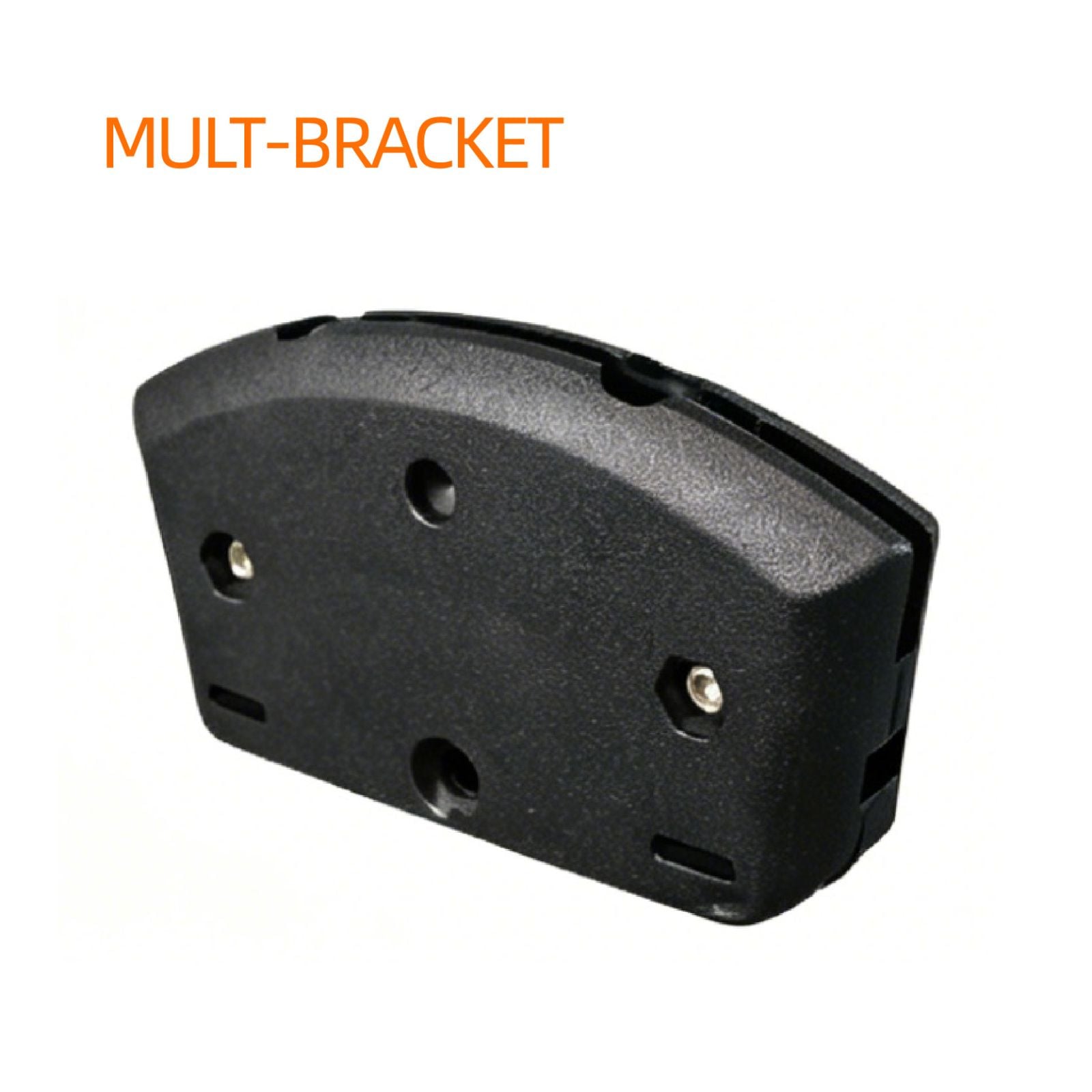
Disc banner Mult-bracket
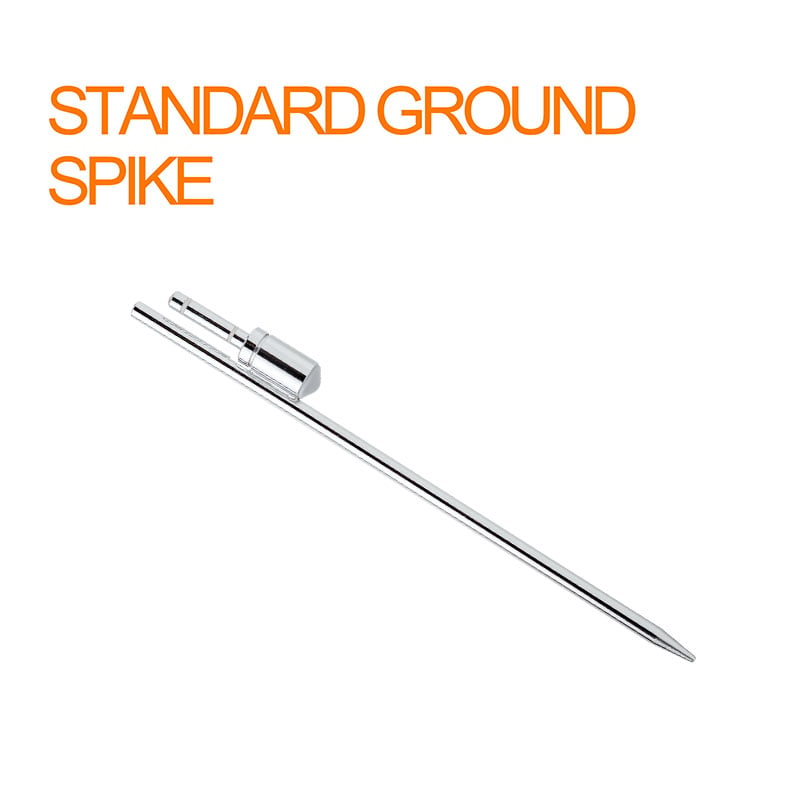
Ground Spike For Lawn Or Sand
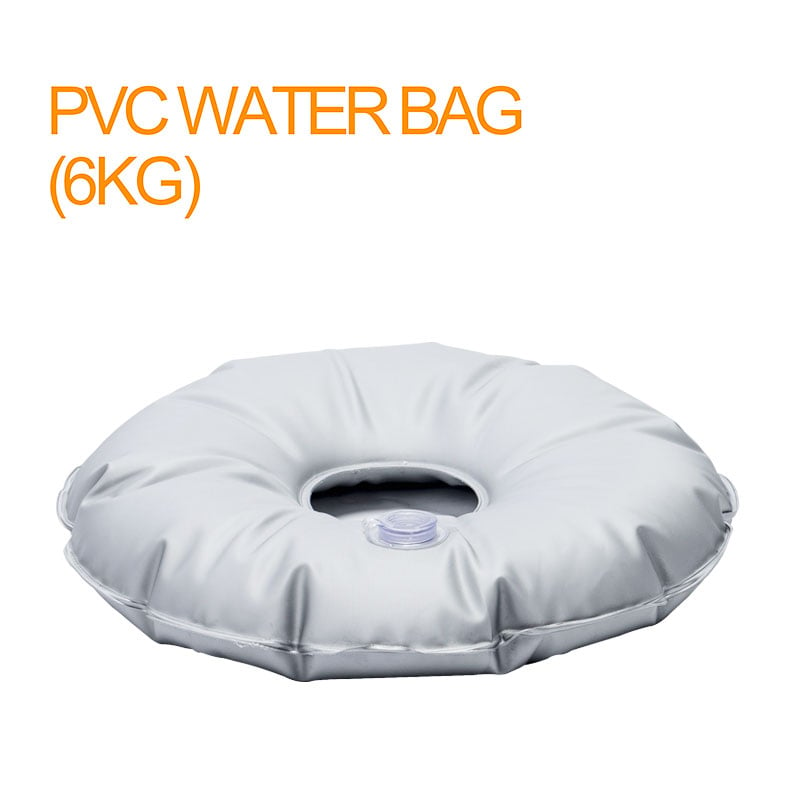
Water Bag
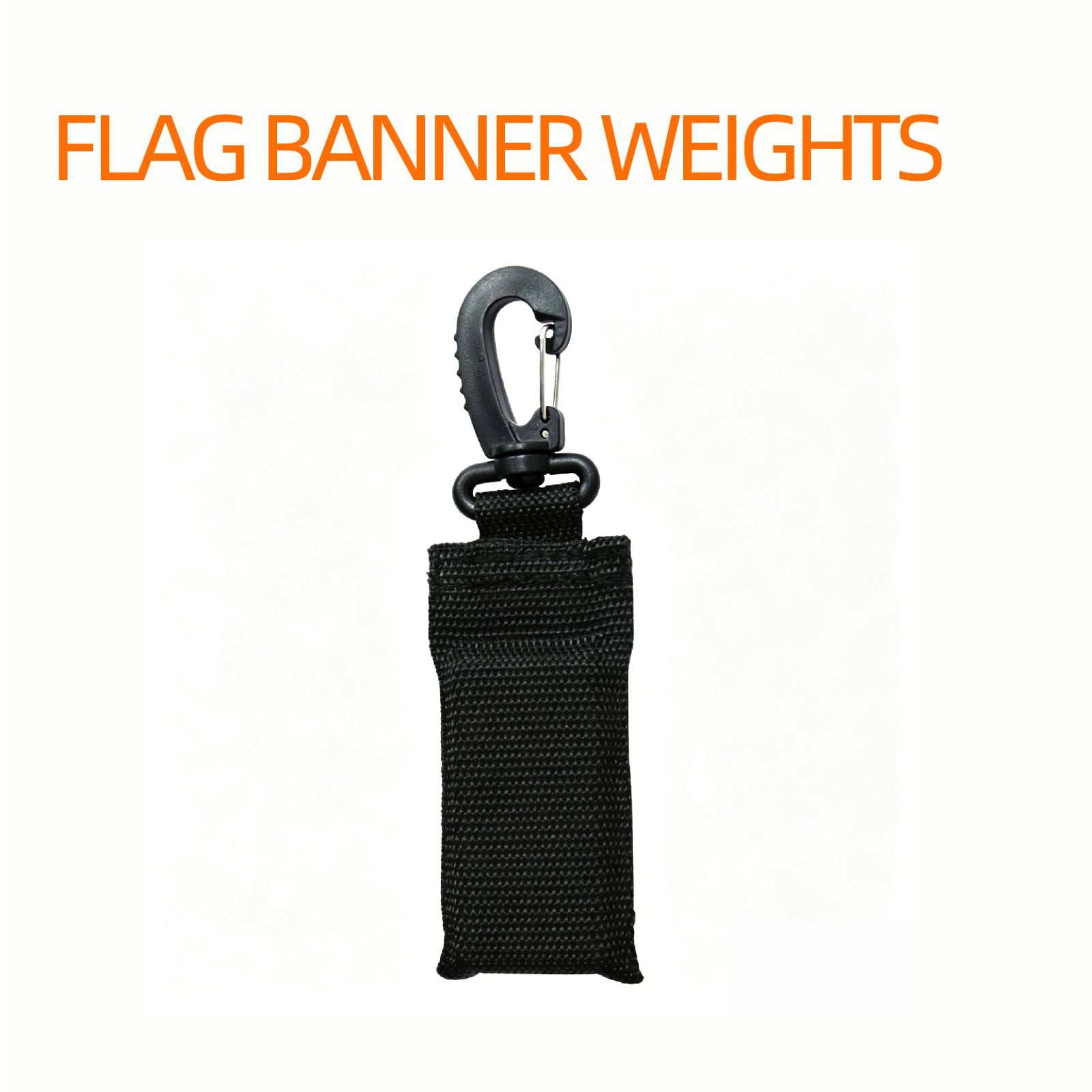
Flag /banner weights
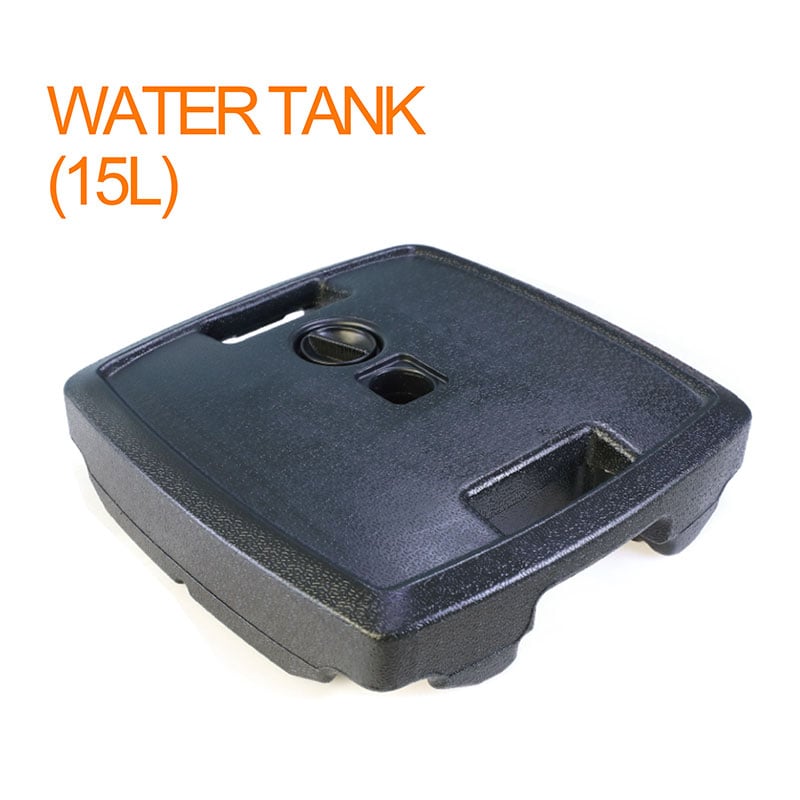
Water tank
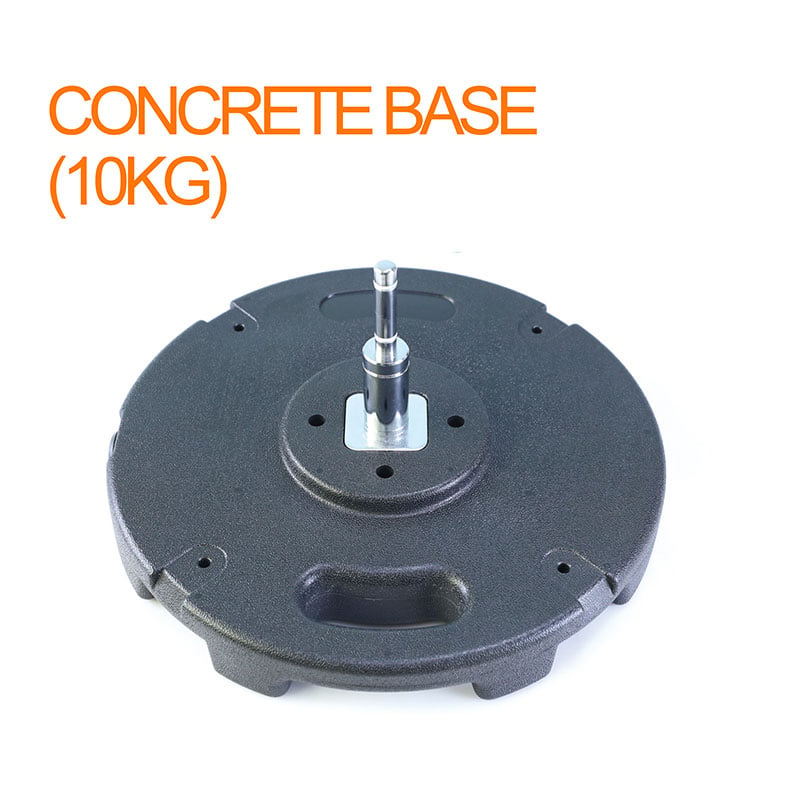
Concrete base(10kg)
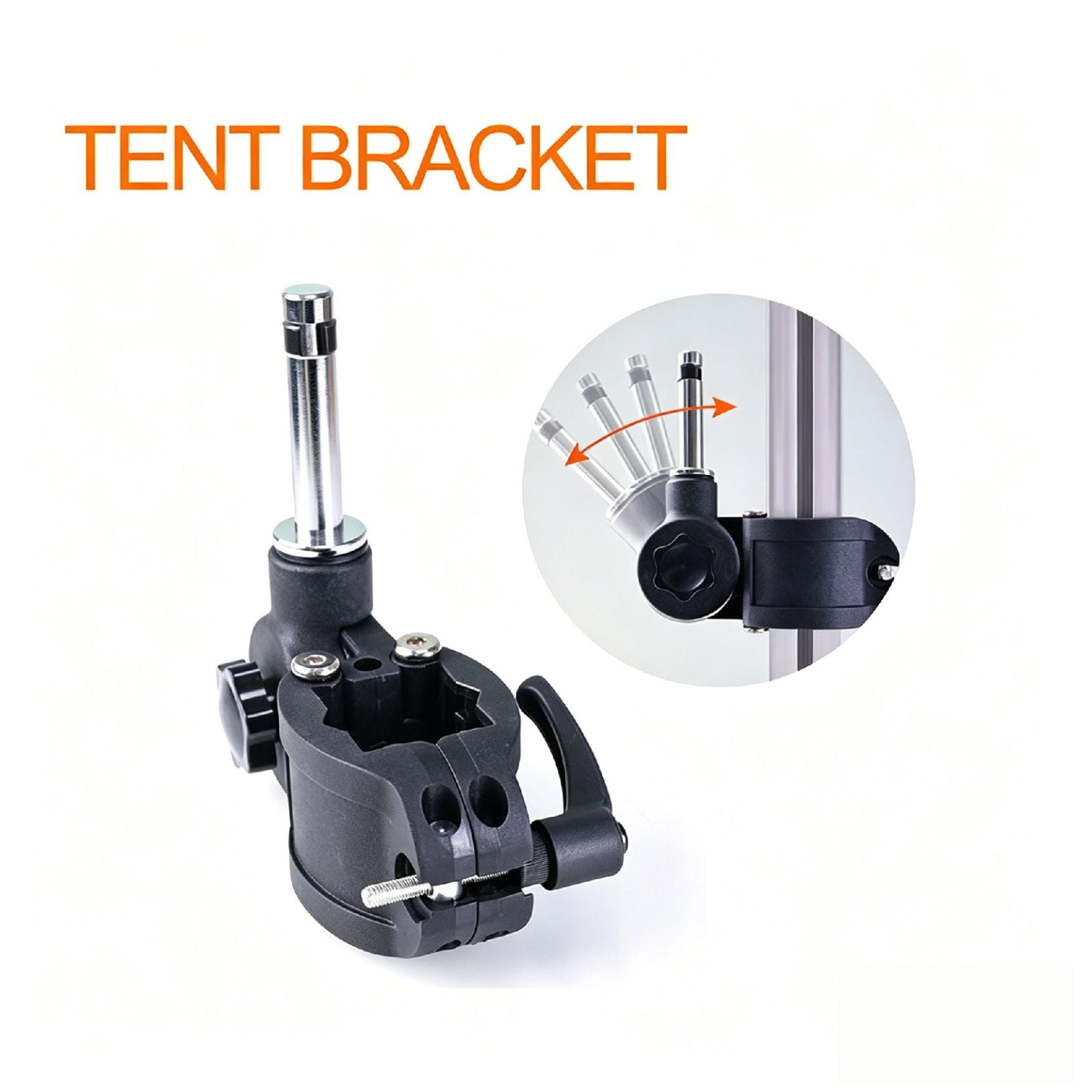
Tent Bracket
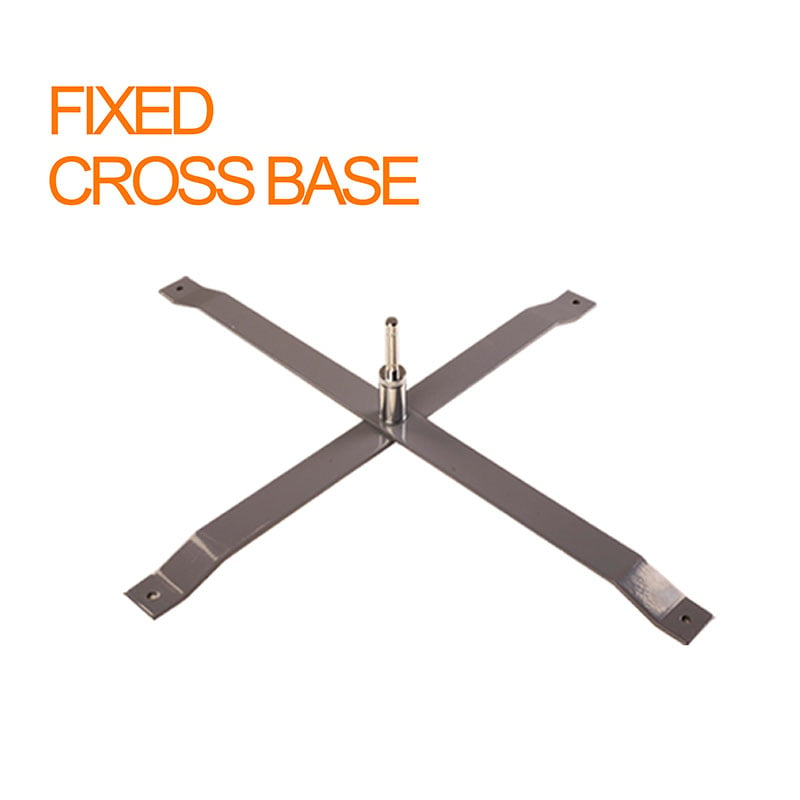
Fixed Cross Base
Related Articles
29kg Concrete Flag Base - The Complete B2B Buyer's Resource - WZRODS
WZRODS DY451B: 29 kg, HDPE shell, concrete core. Stackable, portable, rust-proof. FOB price US$5.75–$6.85 at MOQ 2 units. Those numbers look unremarkable. Factor in landed cost—import duties lower than aluminum’s under relevant HTS codes, freight savings from less weight per unit of stabilizing mas
Rectangular Pipe Cross Base - The Complete B2B Buyer's Resource - WZRODS
The pipe cross flag base is a cross of rectangular steel pipe, powder‑coated, weighing 1.3 kg and spanning 78 cm across its arms. Its center holds a C‑ring shaft that lets the flag rotate with the wind.
X-Shape Backpack Banner - The Complete B2B Buyer's Resource - WZRODS
Economic Cross Base - The Complete B2B Buyer's Guide- WZRODS
When you buy an economic cross base—something like the Wzrods DM‑9, a 77 cm‑long, 1.3 kg iron cross—forget “economic” as a synonym for “cheap.” It means value-engineered.
Fountain Flag Base - The Complete B2B Buyer's Resource - WZRODS
Picture this: a major medical device trade fair in Düsseldorf. A 4‑pod fountain base holding the largest banner in Hall 3 collapses onto the neighboring booth.
Hard Ground Cross Base - The Complete B2B Buyer's Guide- WZRODS
This guide features WZRODS 9WT-33 dual-purpose steel cross base for indoor and outdoor flag displays. With duplex anti-corrosion coating and a precision welded ground spike, it delivers outstanding stability and durability. It boasts low replacement rates and superior long-term ROI.