
Triangle Display
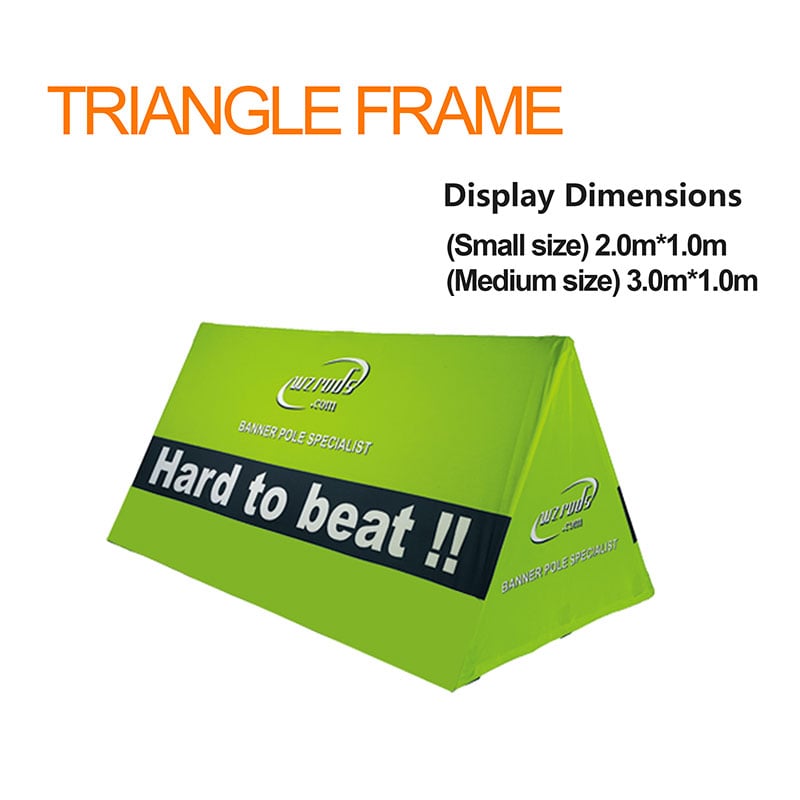
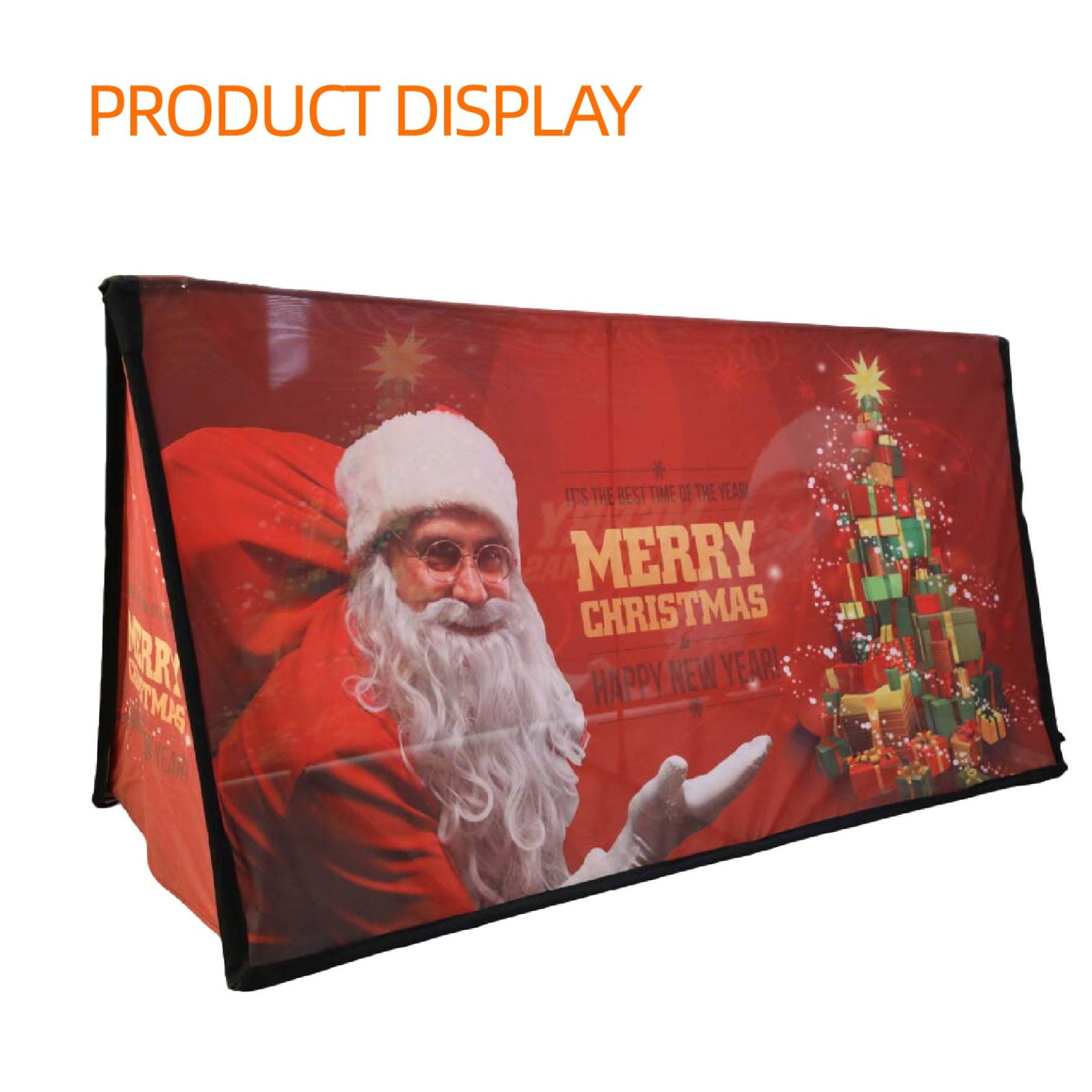
The triangle frame uses a splicing type flagpole. It has a compact packaging design that can be expanded through connectors, and an optional side banner is available for outdoor display arrangements.I…


 Article
 Specifications
- Item Code
- TF2000/TF3000
- Display Size(Small)
- 2.0m*1.0m
- Display Size(Mmall)
- 3.0m*1.0m
- Origin
- Shandong, China
- Brand
- Wzrods
- Pole Material
- Carbon Composite
- Color
- CMYK 4 Color Printing
- Feature
- Eco-Friendly, Waterproof
- Style
- Scrolling, Sporty
- Packaging
- Polybag
- Customized Logo
- 2 sets
- Graphic Customization
- 2 sets
 Product Description
Shipping & Packaging
- Unit Weight
- TF2000 2M: 3.7kg; TF2000 3M: 4.7kg
- Unit Size
- TF2000 2M:104*20*20cm; TF2000 3M:104*25*25cm
- Packaging
- Standard export carton
- Lead Time
- 15-30 days
Pricing
- MOQ
- 1 pieces
- Price Range
- USD 5 – 50
* FOB Qingdao. Excludes shipping & taxes. Accessories & customization confirmed separately.
 Sample Service
- Sample Available
- Yes
 Customization Options

Light Custom
Logo, color, size adjustments

Fast Turnaround
Quick custom order processing
Triangle Display - The Complete B2B Buyer's Resource - WZRODS
In practice, I got a call from a distributor in Singapore. His client had staged a brand activation at Marina Bay. A squall hit. Eight aluminum feather‑flag poles bent like straws. Banners shredded. The event manager was livid.
“Aluminum does that,” I told him. “It yields. You need something that bends without taking a set.”
He asked if I meant fiberglass.
“Better. Carbon composite. Same stuff in high‑end fishing rods and drone frames. It flexes, returns to true. Half the weight.”
That call pushed me to spec carbon‑composite poles for booths, festival gates, and coastal activations. The triangle frame from Wzrods is now my default recommendation for anyone tired of replacing bent hardware and eating oversize freight on metal.
What follows draws on field data, freight invoices, and conversations with event crews across four continents.
1. Buyer’s Guide: What to Look for in a Portable Flag Display
You’re buying three things: a shipping bill, a reliability promise, and a branding surface. The triangle frame delivers all three—provided you know what’s under the paint.
The Splicing Logic
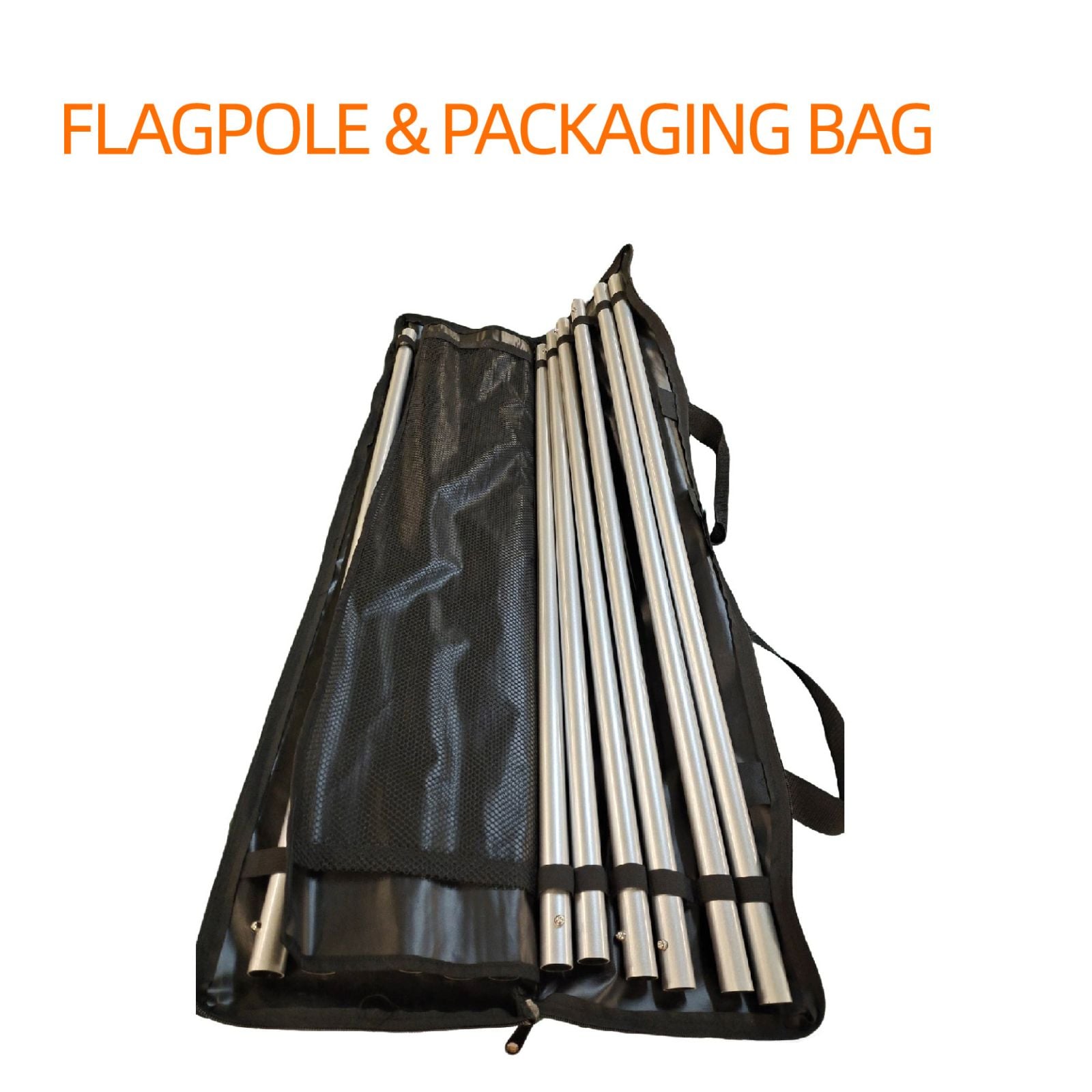
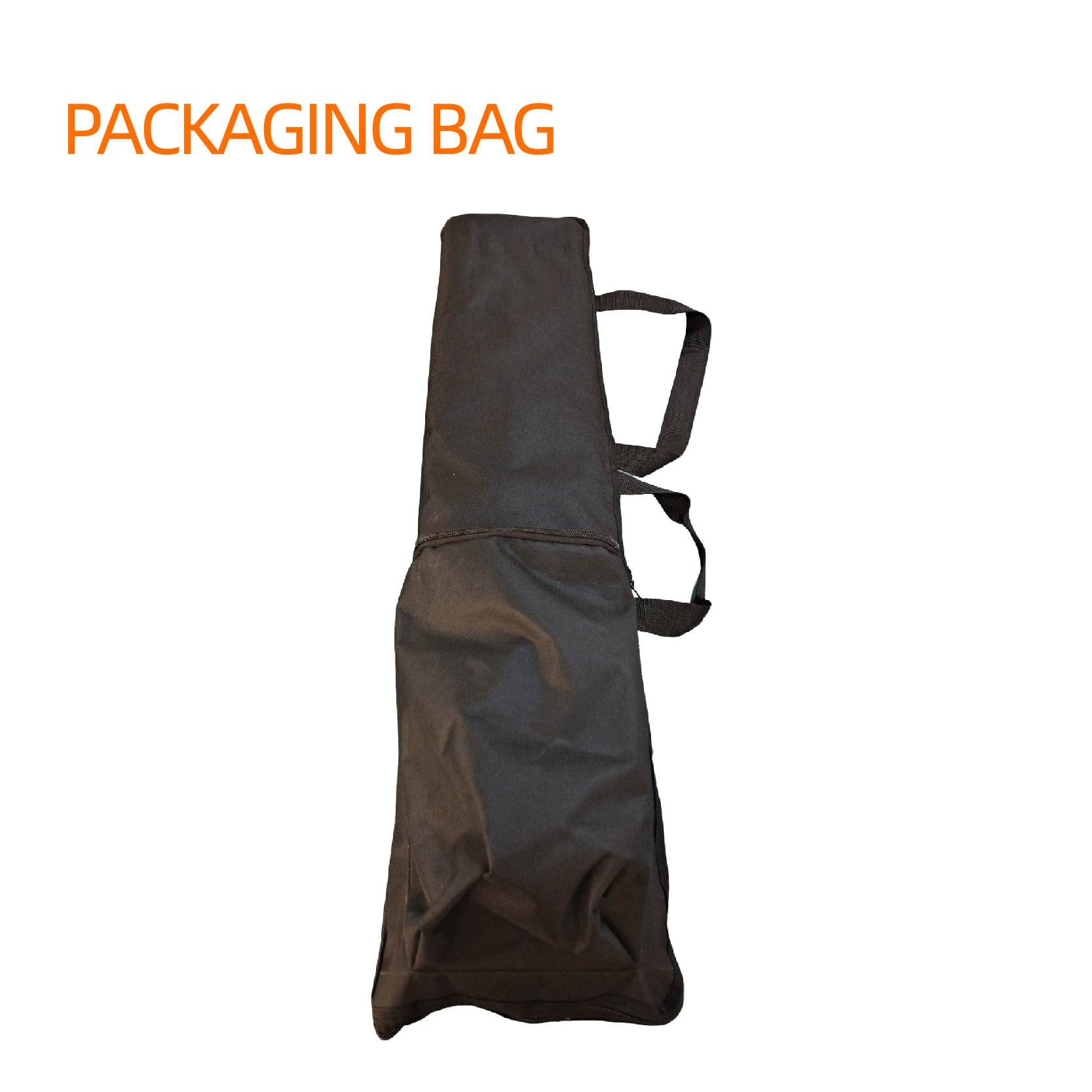
The frame breaks into short, splice‑together tubes. One carton: 104 cm long, under 25 cm square. That holds whether you order the 2 m or 3 m version. Inside, carbon‑composite tubes lock via internal ferrules. No question. Joints stiffen enough to hold a banner. The pole still bends under wind instead of cracking.
Now compare a one‑piece aluminum pole. The box runs the full erected height—roughly 300 cm for a 3 m pole. Carriers bill dimensional weight. That tube lands in oversize freight territory. Splice into 104 cm sections and you shed roughly 65% of the volumetric charge. Most of the savings start right there.
Material Integrity
Carbon composite isn't one substance. It's carbon‑fiber sheets in an epoxy matrix. Wzrods poles are filament‑wound: fibers align along the tube axis and at bias angles to resist twist. Under load, the pole arcs. It doesn't kink at a weak spot.
Aluminum work‑hardens. Every gust micro‑stresses the metal until a crease forms. The pole leans. At beachside venues, this can happen inside six months. A Bali surf competition ran a full season on these carbon poles—zero replacements, according to the event's logistics lead.
Another property buyers miss: carbon composite won't rust. Salt air does nothing. Cheap 6061 aluminum pits wherever the anodizing scratches. Then the banner stains.
Wind‑Handling and Footprint
The tripod base gives the frame its name: three legs splay at 120°. Clip a side banner to one or two legs, and you've got a 3D corner display. The pole is engineered to flex, not fight. A gust hits—the pole leans, spills the wind load, and stress stays transient. Wzrods' internal wind‑tunnel tests show a fully bannered carbon pole withstands gusts to 65 km/h with proper base weighting. I've watched units hold at 50 km/h on a beachfront. Beyond that, mass matters more than pole strength.
2. Product Comparison: Carbon Composite vs. Aluminum Flag Systems
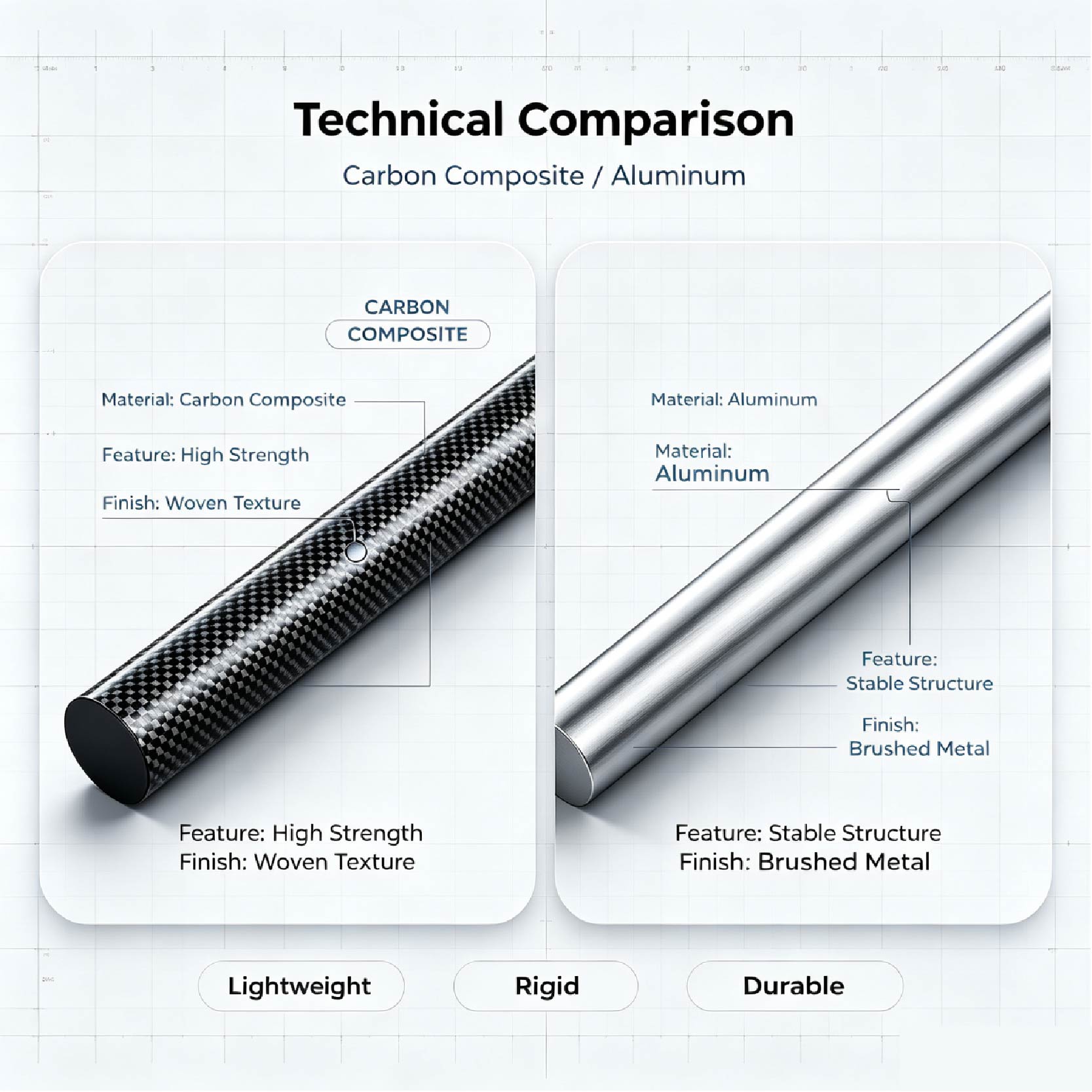
A buyer at a German trade‑show service company told me, “We buy aluminum because it's familiar.” I asked him to run the numbers across a two‑year, 12‑event program. He switched. Here's the comparison.
| Factor | Aluminum (3 m, one‑piece) | Carbon Composite (TF3000 3M) |
|---|---|---|
| Unit weight | 8–9 kg | 4.7 kg |
| Shipping carton size | ~300 × 20 × 20 cm | 104 × 25 × 25 cm |
| Freight class | Oversize | Small‑package threshold |
| Import duty (EU example) | Aluminum poles: ~6% under typical HTS codes | Carbon composite articles: varies; often 3.5% under sports equipment or plastic articles codes—verify with your broker |
| Corrosion resistance | Low; anodizing wears, salt air pits the metal | Inherently rust‑proof |
| Wind recovery | Permanent bend after overload | Elastic return; no permanent deformation |
| Typical lifespan at 30 events/year | 1–2 years; frequent replacement of bent sections | 3–5 years |
| Repairability | Bent section must be scrapped | Splices replaceable; pole breakage extremely rare |
Landed cost flips fast once freight enters the picture. A container of aluminum flagpoles is mostly dead weight. Air freight? Worse. On an order of 500 units, the freight differential alone can erase carbon composite's higher unit price. Then there's duty. Clients in Australia and Canada saw customs classify carbon poles at 3.5% versus 6% for aluminum—code‑dependent, so ask your broker.
Standard orders include two printed banners per frame: CMYK on waterproof fabric. That gives you a backup graphic straight out of the box, not after the first event.
3. ROI: A Real Distributor’s Numbers
A Rotterdam distributor imported 200 TF3000 units and tracked the two‑year picture against a typical aluminum set. His cost build‑up:
| Cost Element | Carbon Composite (per unit) | Aluminum (per unit, est.) |
|---|---|---|
| FOB unit price (sample range) | USD 20–50 | USD 15–35 |
| Ocean freight (LCL, per unit, 200‑unit basis) | USD 4.20 | USD 8.50 |
| Import duty (3.5% / 6%) | USD 0.70–1.75 | USD 0.90–2.10 |
| Est. replacement rate over 2 years | 10% | 40% |
| Avg replacement cost per unit per year* | USD 2–5 | USD 6–14 |
*Replacement covers reorder hardware, handling, and proportional freight.
Use the midpoints. Carbon composite lands around USD 41 (unit + freight + duty). At a 10% fail rate over two years, replacements add roughly USD 7 per unit. Total: about USD 48. Aluminum lands near USD 36. But the 40% fail rate pushes replacements close to USD 20 per unit—two‑year cost roughly USD 56. The gap: USD 8 per unit. On 200 units, that's USD 1,600 staying in your pocket. Before you count the time saved on customer service calls about bent poles.
4. Where the Triangle Frame Excels
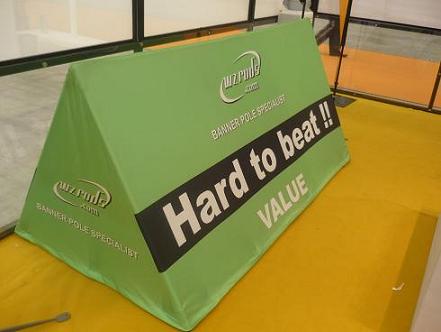
Trade‑Show Booths and Exhibition Entrances
Place two 3 m triangle frames at the edges of a 40‑ft inline exhibit. Full‑cover banners frame the entrance without clogging the aisle. The black carbon weave reads as intentional—a design choice, not an afterthought. Automotive and tech exhibitors frequently spec the medium size with side banners to build a towering 3D brand mark.
Outdoor Festivals and Sports Events
I specified 200 poles for a beachfront music festival in Thailand. Salt and humidity had destroyed their aluminum stock in weeks. A crew of four assembled the carbon poles in 90 minutes. After ten days, we wiped them down, packed them into the original cartons, and not one pole had bent. The organizer pegged the savings at USD 8,000 versus the prior year's aluminum replacements.
Event Gates and Wayfinding
Strip the banner and the frame functions as a lightweight structural pole. Connect six TF3000s end‑to‑end to hang a fabric tunnel. I watched a crew build an event entrance that way—the whole thing weighed under 30 kg and shipped in six cartons. That kind of modularity matters for rental companies running tight turnarounds.
5. Factory Tour: How the Triangle Frame Gets Made
Wzrods operates a carbon‑composite facility in Shandong. What nobody tells you: They switched from aluminum flagpoles to carbon fiber in 2005. The floor runs filament winding and pultrusion lines. Carbon tows pass through a resin bath, wind onto mandrels, cure, then get cut to splice lengths. Connectors bond in with structural adhesive. QC pulls 5% of each batch for flexural and burst testing.
The splice system is simple: each section has a spring‑loaded button lock. Push until it clicks. No tools.
Banners print in‑house—solvent‑based eco‑friendly inks on waterproof fabric. UV lamination buys roughly 12 months of outdoor life, less under harsh desert sun. Packaging: polybag inside an export carton. MOQ is one unit for samples. Volume pricing kicks in at larger quantities. Lead time runs 15–30 days for standard custom, slightly longer for unique sizes.
6. Trends: Lighter, Rust‑Proof, No‑Tool Hardware
Trade‑show hardware is shifting toward materials that slash freight and reduce landfill. Carbon composite lasts two to three times longer than aluminum in event service, so the waste stream shrinks. In Europe, carbon‑fiber tripods and tension‑fabric backwalls are becoming standard spec.
Pop‑up activations keep multiplying. Cities issue more permits, so crews set up and tear down more often. A flagpole that splits into a short case, weighs 4.7 kg, and goes up tool‑free in two minutes fits that rhythm. I've seen RFPs that now specify “portable flag display, max weight 5 kg, rust‑proof.” The triangle frame checks those boxes.
7. Upgrade Path: From Single Pole to Full Display System
Step 1: Stock the two sizes. TF2000 (2 m display area) for tabletops and registration counters; TF3000 (3 m) for entrance arches and aisle markers.
Step 2: Add the side banner. Attach to one tripod leg. Now you've got a 3D corner display pulling cross‑aisle attention.
Step 3: Full‑cover banners. Wrap the entire frame—legs and center pole—for a smooth branded monolith.
Step 4: Connectors for infinite length. The same splicing system links multiple poles. Need a 6‑meter arch? Couple two TF3000s. A 12‑meter horizontal span? Four poles. Same connectors throughout.
Customization stays fast. The factory ships two printed banners per unit, and lead time holds at 15–30 days even on small runs.
Frequently Asked Questions
Q: Is the triangle frame difficult to assemble?
A: No. One person, two minutes. Slide sections together until the button clicks. Spread the three legs. Attach the banner via Velcro or sleeve. No tools.
Q: Can the carbon composite pole break?
A: Under extreme impact—a truck hitting it—yes, it can fracture. In normal wind and handling, it's far tougher than aluminum. Factory data shows less than 0.5% breakage in shipping.
Q: What's the warranty?
A: One year against manufacturing defects. Wind wear isn't covered. Because the pole doesn't fatigue like metal, claims are rare.
Q: Do I need a base weight?
A: Outdoors, yes. Add sandbags or water weights on the feet. The pole flexes; the mass keeps it upright.
Q: How do I clean the banner?
A: Wipe with a damp cloth. The waterproof coating resists dirt and mild mold. For heavy soil, use mild soap. Do not machine wash.
Q: Can I get a sample before ordering in volume?
A: Yes. Samples aren't free—you purchase one at the sample rate. I tell new distributors to order one TF3000, toss it in the back of a truck for a week, then inspect it. You'll understand the value immediately.
Q: What's the MOQ for custom logos?
A: One piece for the frame; one piece for custom graphics. That makes small batches feasible for event companies ordering per client.
Q: How do I ship the units? Do you dropship?
A: Standard export cartons work with any courier or forwarder. Wzrods doesn't yet offer direct dropshipping to end consumers, but they'll ship to a warehouse or event site. Payment terms: T/T, L/C, or Western Union.
Q: Is the carbon composite environmentally friendly?
A: It's a durable composite, not biodegradable. But its longer service life cuts waste. The factory is researching carbon‑fiber recycling; it's not available at scale yet.
That call from Singapore taught me something: change one material, and the whole equation shifts. Freight bills drop. Replacement cycles stretch. Service calls dwindle. The triangle frame isn't a revolution—it's just a smarter pole. For distributors tired of shipping complaints, or event planners tired of crooked flags on show morning, this piece of kit pays for itself inside one season.
About the Author
Sarah Mitchell, Trade Show Consultant
B.A. Marketing, University of Texas; CTSM (Certified Trade Show Marketer)
Event marketing specialist with 200+ trade shows across 15 countries. Helps exhibitors cut setup costs by 30% through smarter hardware choices.
Reviewed by WZRODS Technical Team. Updated: 2026-07-29
 Comments (0)
No comments yet. Be the first to comment!
Leave a Comment
Related Products
Foldable Horizontal Square
Spider A frame
Toblerone Banner
Pyramid Banner
Tower Banner
Bean Banner
Cluster Balloon Kit
Swing Banner Stand
Burgundy Banner
Foldable Vertical Square
Related Articles
29kg Concrete Flag Base - The Complete B2B Buyer's Resource - WZRODS
WZRODS DY451B: 29 kg, HDPE shell, concrete core. Stackable, portable, rust-proof. FOB price US$5.75–$6.85 at MOQ 2 units. Those numbers look unremarkable. Factor in landed cost—import duties lower than aluminum’s under relevant HTS codes, freight savings from less weight per unit of stabilizing mas
Wide Tube Cross Base - The Complete B2B Buyer's Resource - WZRODS
The Wide Tube Cross Base, manufactured by Wzrods in Shandong, China, solves one problem: reliable stability for poles under three meters, without the freight costs and warehouse footprint that heavier alternatives demand.
Rectangular Pipe Cross Base - The Complete B2B Buyer's Resource - WZRODS
The pipe cross flag base is a cross of rectangular steel pipe, powder‑coated, weighing 1.3 kg and spanning 78 cm across its arms. Its center holds a C‑ring shaft that lets the flag rotate with the wind.
X-Shape Backpack Banner - The Complete B2B Buyer's Resource - WZRODS
Economic Cross Base - The Complete B2B Buyer's Guide- WZRODS
When you buy an economic cross base—something like the Wzrods DM‑9, a 77 cm‑long, 1.3 kg iron cross—forget “economic” as a synonym for “cheap.” It means value-engineered.