
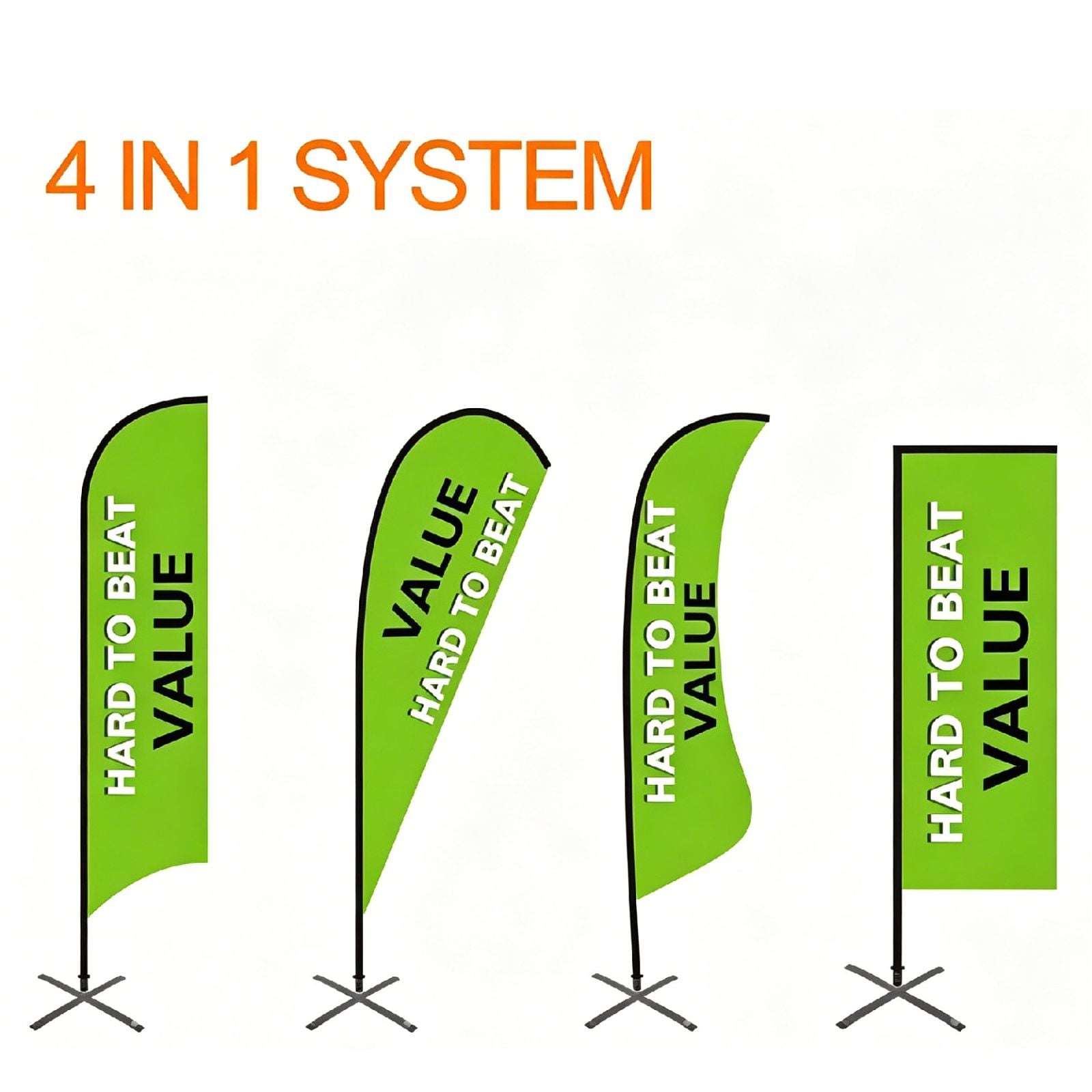
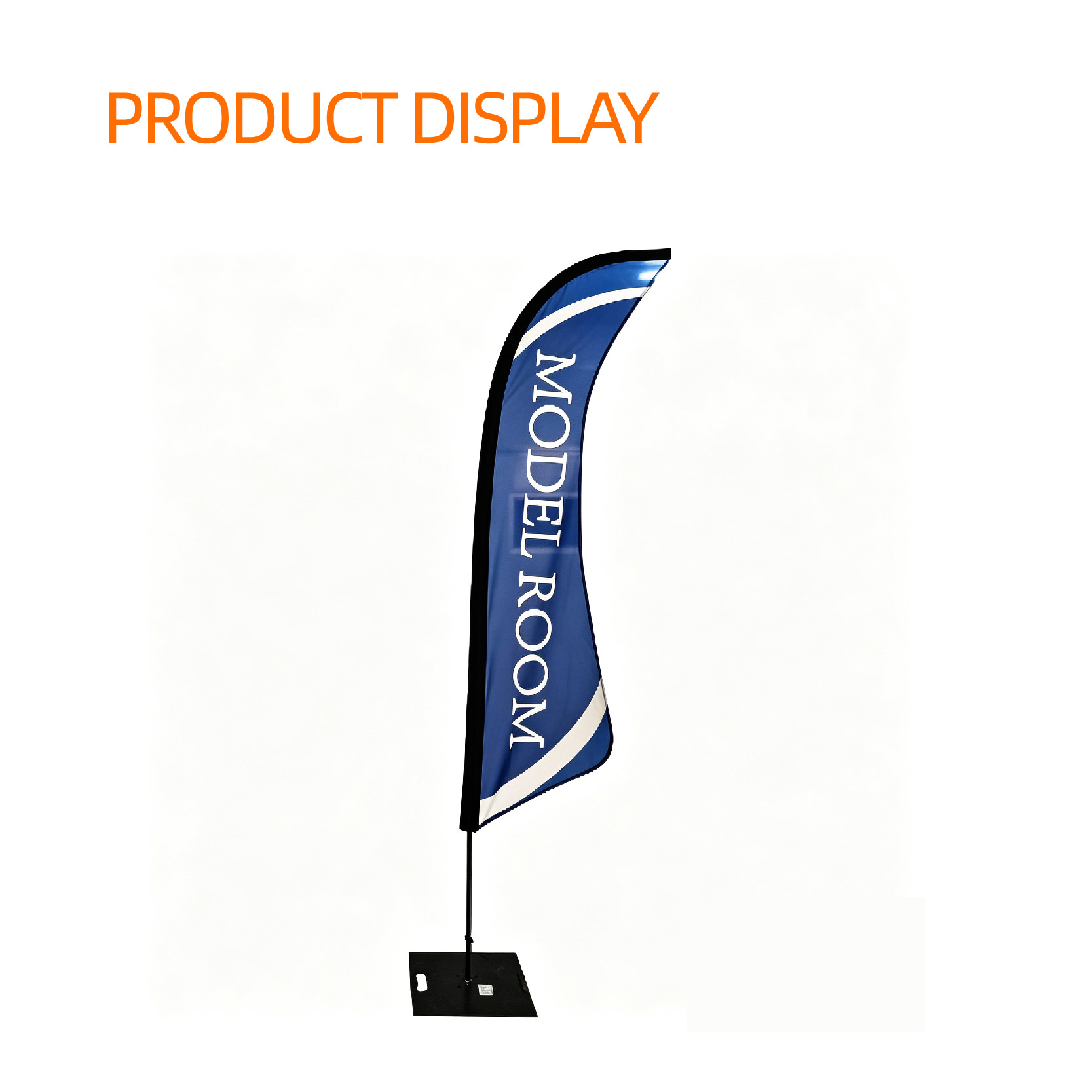
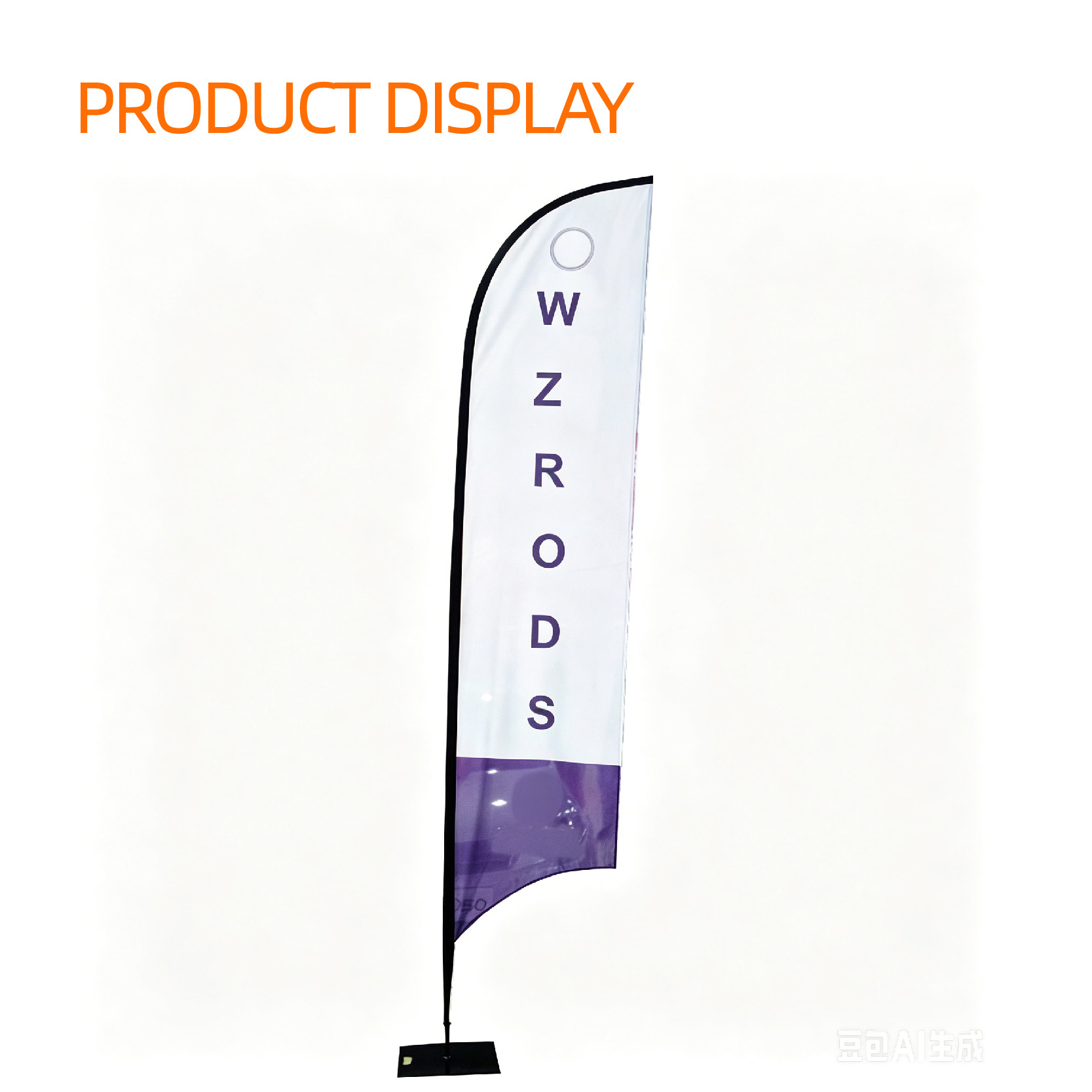
4-in-1 Flag Pole System
We supply 4-in-1 flag pole system fitting four flag styles. High-toughness carbon composite poles are lightweight. Quick shape switching cuts cost and stock space, with carry bag and bases.


Packaging
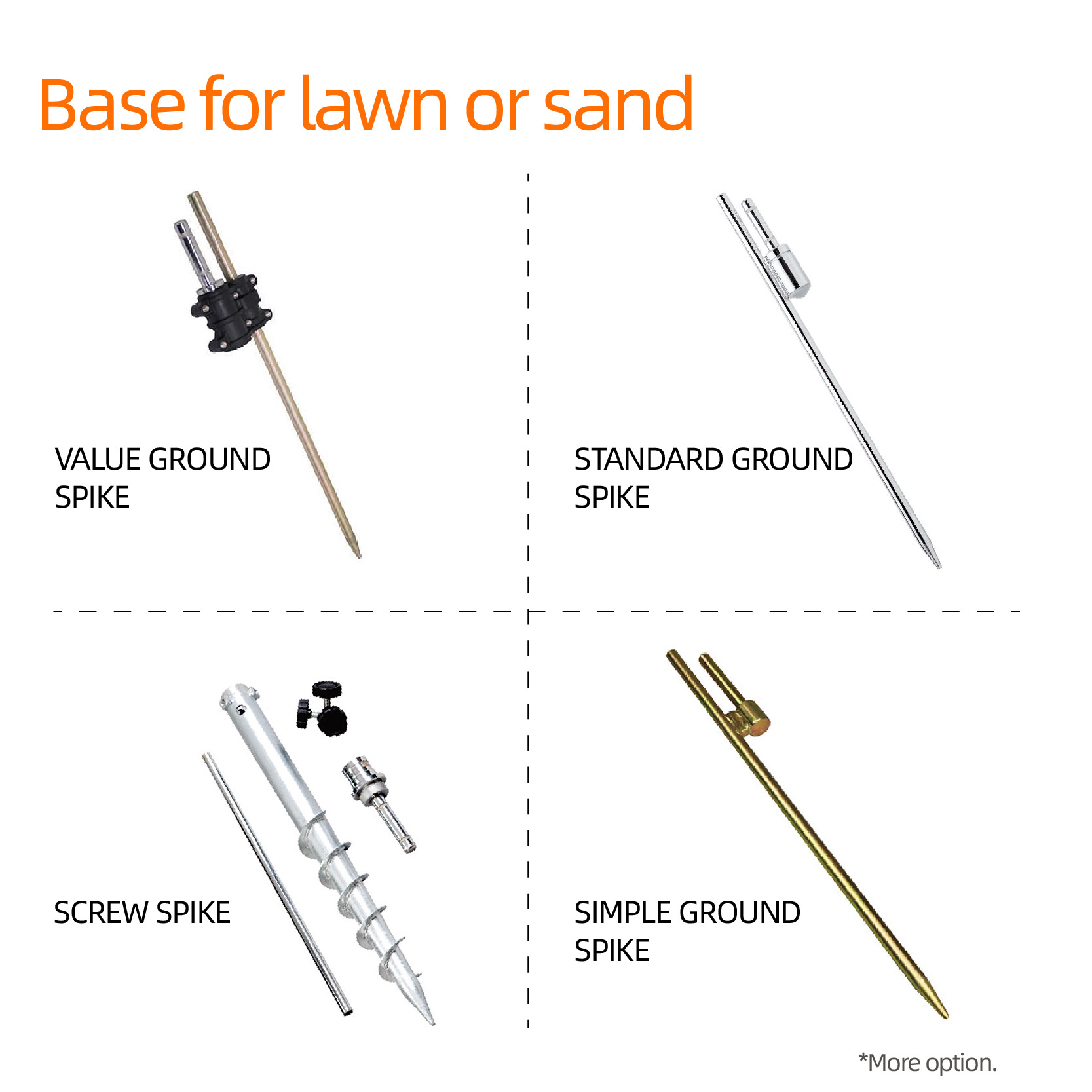
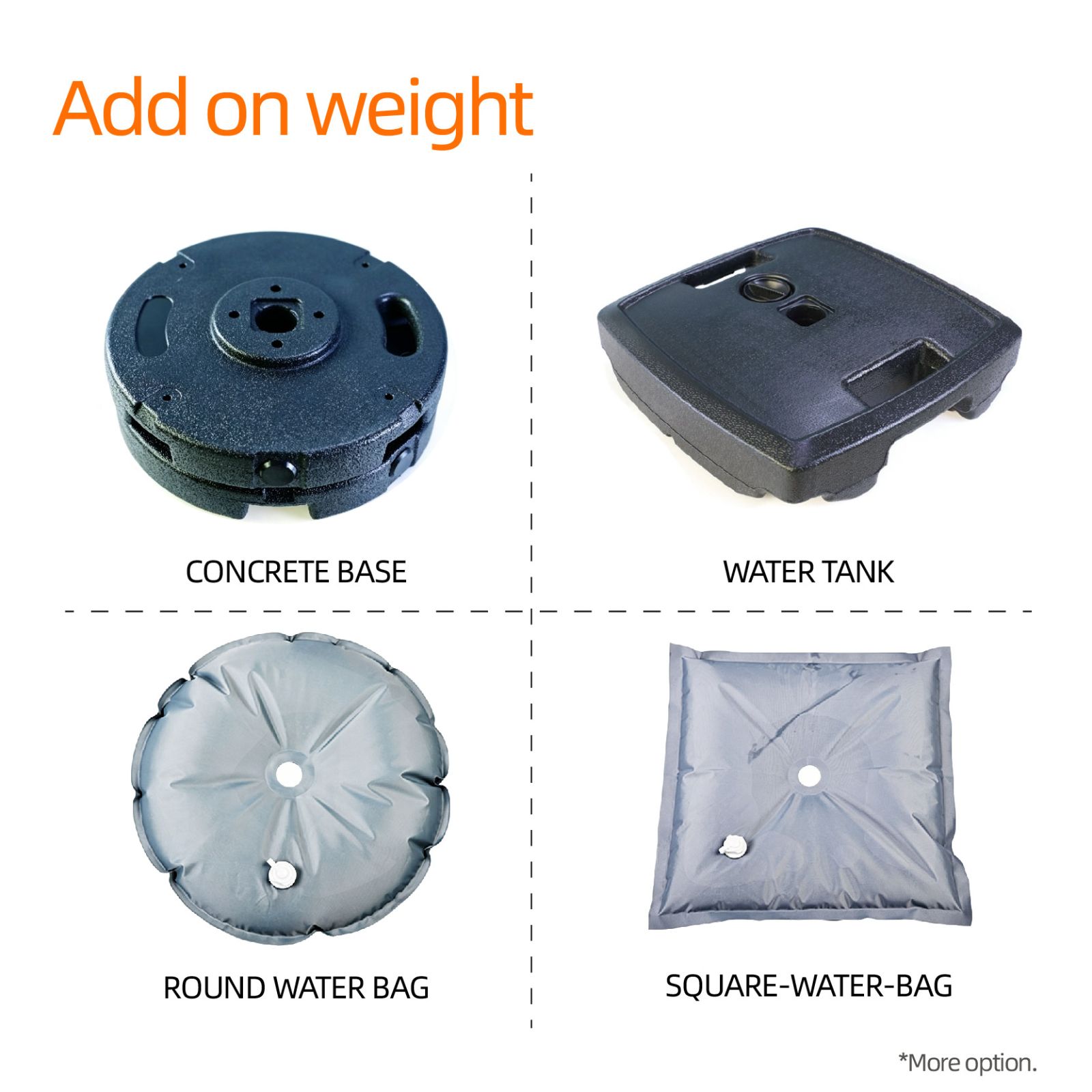
base
printing
 Article
 Specifications
- Origin
- Shandong, China
- Brand
- Wzrods
- Item Code
- FOS-Z/FOM-Z/FOL-Z
- Pole Material
- Carbon Composite
- Banner Material
- 100% Polyester
- Application Spec
- Trade Shows, Outdoor Events, Corporate Events
- Printing Method
- Digital Printing, Dye Sublimation Printing
- Print Color
- 4 color
- Artwork Format
- Ai. Jpg. Pdf. Eps. PSD
- Moq
- 1pc
- Logo Service
- Customized Artwork Printed
- Warranty
- 3 years
- Target User
- Insurance, Hotel and Resort, Real Estate/Construction, Travel Agency
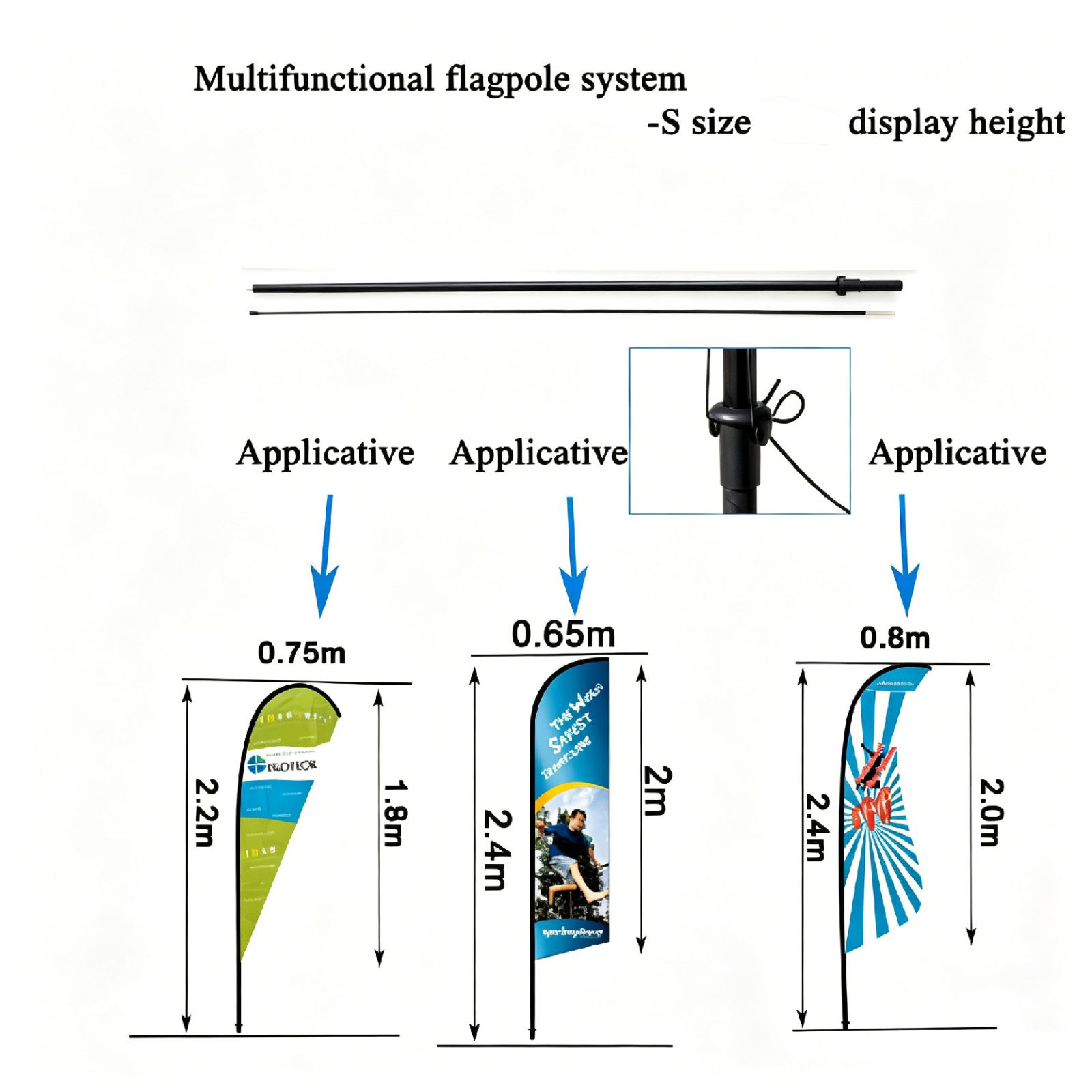
- Feather S (2.7M)/M (3.8M)/L (5.2M)Size
- 2.2*0.65m/3.2*0.7m/4.2*0.7m
- Teardrop S(2.5M)M(3.6M)/ L(5.2M)Size
- 1.92*0.7m/3.2*0.92m/3.68*1.07m
- Sharkin S(2.5M)M(3.6M)L(5.0M)Size
- 2.2*0.59m/3.0*0.885m/4.0*1.18m
- Rectangles(2.5M)M(3.6M)L(5.0M)Size
- 1.55*0.69m/2.5*0.73m/3.3*0.73m
 Product Description
Shipping & Packaging
- Unit Weight
- 1.500
- Unit Size
- 155X10X5
- Packaging
- Standard export carton
- Lead Time
- 15-30 days
Pricing
- MOQ
- 1 piece
- Price Range
- USD 11 – 17.5
* FOB Qingdao. Excludes shipping & taxes. Accessories & customization confirmed separately.
 Sample Service
- Sample Available
- Yes
- Sample Price
- piece 407.89
- Max Sample Qty
- 1
 Customization Options

Light Custom
Logo, color, size adjustments
4-in-1 Flag Pole System - The Complete B2B Buyer's Resource - WZRODS
Managing a $4.2 million display‑hardware budget taught me one thing fast: hardware failure almost always starts in the purchase order, not on the show floor. In a Singapore warehouse a few years ago, I stood next to a pile of twisted aluminum flag poles returned from an insurance‑industry expo. Salt air had turned their joints white with filiform corrosion. A few gusts beyond the designer’s soft assumptions had bent the shafts into permanent curves. That inventory occupied an entire pallet position and turned over about twice a year. I started hunting for a better answer. That search led to a carbon‑composite 4‑in‑1 flag setup — one pole that delivers four flag shapes, no corrosion, and zero structural failures across three seasons of field use. Here’s what I’ve learned since.
1. The Buyer’s Guide: Selecting a Flag arrangement for Global Trade
1.1 Material Foundation
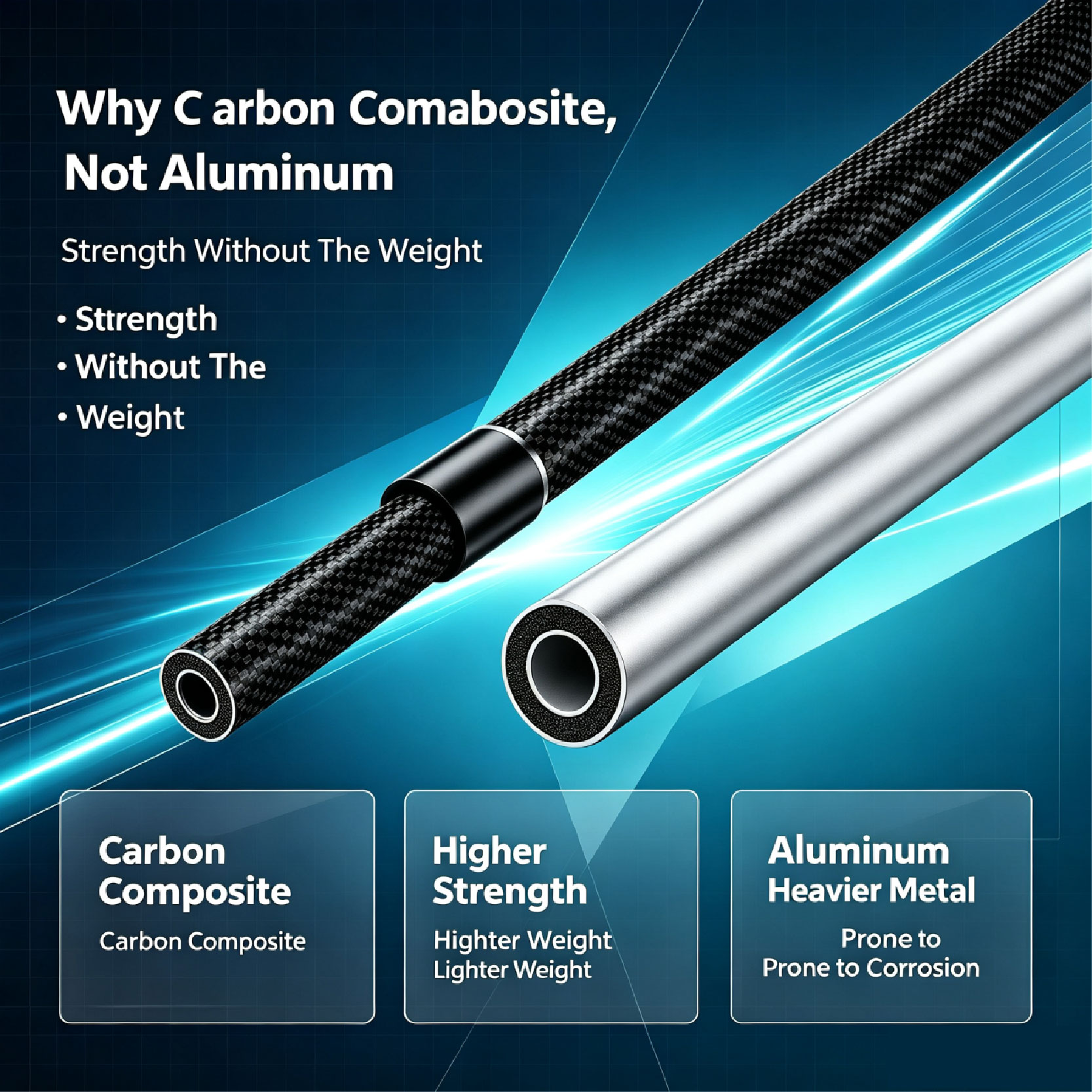
Start with the pole material. It governs corrosion rate, wind tolerance, freight class, and duty bracket. Aluminum 6061‑T6 has been the default for years because its price per kilo looks low. But in a coastal venue or tropical convention hall, that anodized surface pits. The white powder at the joints isn’t cosmetic — it increases assembly friction and thins the wall until the pole buckles.
Fiberglass resists chemical attack but turns brittle. Over‑flex it and it splinters without warning.
The carbon‑composite pole inside the WZRODS kit combines the corrosion immunity of a non‑metallic matrix with tensile strength above 1,200 MPa and a fatigue behavior that lets it arc under wind load and return to within a degree of true. Get the material right and you’ve already eliminated the biggest field‑failure trigger.
1.2 kit Versatility
A traditional flag catalog multiplies SKUs fast: one pole for a feather banner, another for a teardrop, a shark‑fin, and a rectangle — each with its own diameter, base fitting, and storage bag. Stock all four shapes in three sizes and you carry twelve line items. The working capital tied up in safety stock and warehouse cube adds up.
The 4‑in‑1 system collapses that to one pole. A top‑cap adapter and interchangeable fabric sleeves let you swap the printed banner and end‑piece while the pole doesn’t change. For a buyer, the purchase order lists one core item. Container loading becomes simple multiplication. After‑sales is simpler too: a replacement part works regardless of which flag shape was originally ordered.
1.3 Logistics and Compliance
Landed cost isn’t just unit price. Weight and tariff classification matter.
A complete 4‑in‑1 carbon‑composite system weighs about 1.5 kg; an equivalent aluminum set runs 2.65 kg. In a 40‑foot high‑cube container, the manufacturer’s plan loads 8,774 carbon units, against roughly 7,200 aluminum units. The weight saving across a full container comes close to 8.7 metric tonnes — enough to reduce ocean freight by a meaningful margin.
Then there’s duty. Aluminum poles usually classify under HTS 7616.99, attracting 5‑8% in many jurisdictions. Carbon‑composite poles, per conversations with our customs brokers, often fall under HTS 6815.10 (articles of carbon fibre) with rates of 2‑4%, depending on trade agreements with China. Request the exact HTS code from your supplier and verify the rate with your broker before signing the proforma. That step alone can shrink your landed cost by two to four percentage points before the first flag is hoisted.
2. Product Comparison: Materials and Mechanics
2.1 Laboratory and Field Performance
I ran a side‑by‑side wind test on a concrete plaza with an industrial fan that ramped from 30 km/h to 70 km/h in 5‑km/h increments. We tested three identical teardrop poles: carbon composite, 6061‑T6 aluminum, and E‑glass fiberglass.
The aluminum pole started yielding at 42 km/h, taking a permanent 8‑degree set. By 55 km/h it folded into an obtuse angle and would not recover. The fiberglass pole held its shape until 52 km/h, then shattered 15 cm above the ground sleeve. The carbon‑composite pole bent into a smooth arc, the tip tracing a circle of about 90 cm at 70 km/h — the fan’s limit. When the wind stopped, the pole straightened to within 1 degree of original. After 50 cycles, we saw no matrix cracking or delamination. That’s the gap between a material that yields and one that accommodates.
2.2 Comparative Specification Table
| Property | Carbon Composite (WZRODS) | Aluminum 6061‑T6 | Fiberglass (E‑glass) |
|---|---|---|---|
| Tensile Strength (MPa) | 1,200–1,600 | 310 | 3,450 (fibre; resin‑matrix limits practical strength) |
| Density (g/cm³) | 1.55 | 2.70 | 2.55 |
| Corrosion Resistance | Immune to salt spray; no galvanic reaction | Anodized surface eventually pits in salt | Resistant; resin may hydrolyze over time |
| Fatigue Behaviour | Elastic recovery to ±1° after repeated 60 km/h gusts | Permanent deformation after a single 42 km/h gust | Brittle fracture at 52 km/h |
| Weight per 3.8m System (kg) | 1.50 | 2.65 | 2.40 |
| Typical Duty Rate (USA/EU) | 2–4% (HTS 6815.10) | 5–8% (HTS 7616.99) | Variable, often 5% |
| Service Life in Tropical Climate | 8+ years | 2–3 years before joint failure | 3–5 years before splintering |
3. Return on Investment: A Procurement‑Budget Perspective
3.1 Total Cost of Ownership
Comparing ex‑works prices and stopping there misses the full picture. What matters is landed cost per pole per year of reliable service. Into that denominator go freight, duty, on‑site replacements, labor spent wrestling seized joints, and the lost opportunity of an empty flag stand while a bent pole ships back.
Below is a three‑year model for a distributor importing 1,000 medium‑sized teardrop systems annually into Hamburg. Replacement data draws from purchase histories of five distributors over two years.
3.2 Three‑Year Cost Model (1,000 units per annum, delivered Hamburg)
| Cost Element | Aluminum System | Carbon Composite System |
|---|---|---|
| Ex‑works unit price (USD) | 8.50 | 14.50 |
| Ocean freight per unit (based on 40HQ, 7,200 units for aluminum, 8,774 for carbon) | 2.20 | 1.85 |
| Import duty (5% aluminum, 3% carbon on CIF value) | 0.54 | 0.49 |
| Total landed cost per unit (Year 0) | 11.24 | 16.84 |
| Annual replacement rate (field data) | 40% after Year 1, cumulative 70% by Year 3 | 0% (no structural failures observed) |
| Replacement purchases over 3 years | 700 units | 0 units |
| Cumulative landed cost (1,000 original + replacements) | 1,000 × $11.24 + 700 × $11.24 = $19,108 | 1,000 × $16.84 = $16,840 |
| Three‑year cost per functional pole | $19.11 | $16.84 |
The model shows that despite an ex‑works price roughly 71% higher, the carbon‑composite system delivers a lower total spend over three years. That’s before counting the warranty claims you don’t handle and the reputation you keep when a hotel chain never sees a corroded pole. No spreadsheet line easily captures that, but any sales manager who has lost a client over hardware failure can tell you what it’s worth.
4. Industry Applications
4.1 Trade Shows and Outdoor Expositions
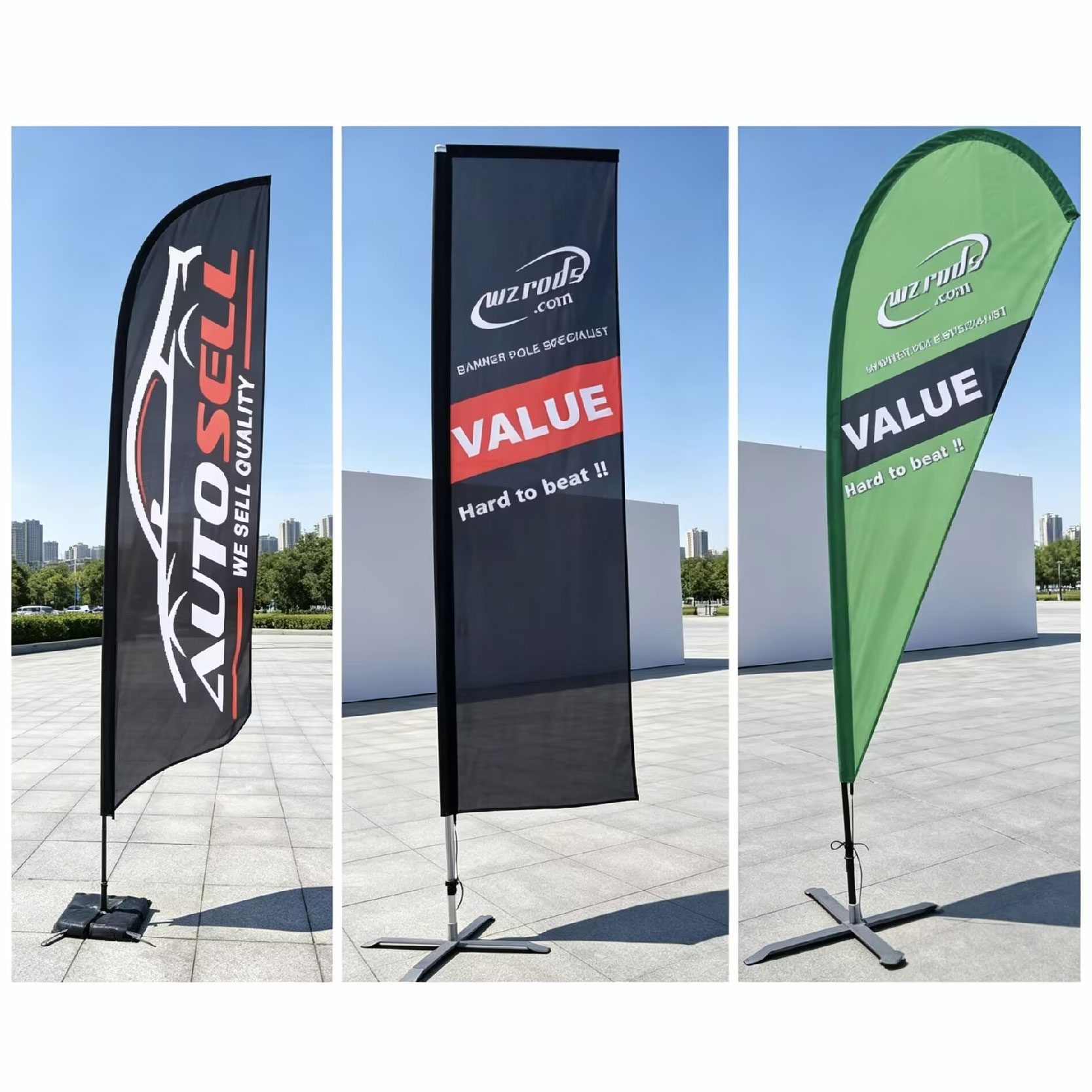
Exhibition halls punish gear. Concrete floors don’t forgive toppled poles, and heavy foot traffic turns a fallen flag into a trip hazard and an organizer complaint. Insurers who erect brand flags at multi‑day outdoor festivals often standardize on the 4‑in‑one system because crews can reconfigure it in seconds — tall teardrop for wide‑visibility approaches, compact rectangle for the registration desk — using the same base and with no technical training. A distributor in Dubai supplied a travel agency that changed flag shapes every evening of a week‑long event; the quick‑change capability eliminated a second setup crew, saving about $1,200 in labor that week.
4.2 Real Estate, Hospitality, and Construction
A developer doing weekend open‑house tours needs signage that fits in a sedan and goes up in five minutes on a windy hillside. The carbon pole weighs 1.5 kg and the carry bag holds all four flag shapes. Beachfront hotels, where salt spray eats metal fixtures in months, get a system that stays like‑new season after season — no peeling anodizing, no rust bleeding from a steel base screw. One inventory item gives the resort’s marketing manager a feather flag for the roadside, a teardrop by the pool, a shark‑fin at the conference entrance, and a rectangle at reception.
5. Manufacturing Process: From Raw Carbon to Finished System
5.1 Material Preparation and Pole Forming
Production starts with carbon fibre tow pulled through a resin bath and wound onto a mandrel in a multi‑axial layup that boosts hoop strength and longitudinal stiffness. The wound mandrel cures under controlled temperature and pressure. Unlike simple pultruded tube, this filament‑winding process lets us tune the wall: stiff at the base where bending moment peaks, a little more compliant in the upper third where wind loads are lower and the visual “flag wave” is actually wanted.
After demolding, each end gets a machined‑aluminum insert bonded with structural adhesive (lap shear >20 MPa). The bond is stronger than the composite’s interlaminar shear, so any overload would deform the metal insert before the pole body fails.
5.2 Banner Printing and Quality Control
Polyester banners are dye‑sublimated for four‑color process accuracy, with double‑stitched hems at the pole sleeve. Every production batch undergoes a wind‑tunnel cycle: the assembled system is mounted on a rotary platform and hit with a 65 km/h airstream for 30 minutes while cameras track tip deflection. Units exceeding an instantaneous 15° deflection are rejected and the pole is sonically scanned for internal voids. I’ve watched this test on the factory floor in Shandong. It replicates a seaside promenade gust pattern and gives a quantitative assurance that visual inspection can’t match.
6. Market Trends
6.1 SKU Consolidation
Large trade‑show general contractors now demand that all flag‑type signage fit a single pole standard. Maintaining separate inventories of feather, teardrop, and blade‑flag poles creates confusion during setup and teardown. This shift began in Germany’s exhibition sector and has spread to North America and the Middle East. The 4‑in‑one system is built for that spec. A buyer who positions for it early offers a catalog that speaks directly to the professional organizer who values speed over a marginal price difference.
6.2 Sustainability and Carbon Footprint
Carbon composite isn’t biodegradable, but its environmental case rests on longer service life and lower transport emissions. A single container of carbon poles that replaces two containers of aluminum poles eliminates an entire ocean voyage’s fuel burn. Event organizers increasingly ask for product carbon‑footprint data for their own ESG reports. A lighter system that lasts eight years gives a defensible number; a heavy, frequently replaced aluminum system doesn’t.
7. Upgrade Path: Transitioning Your Inventory to a Single SKU
7.1 The Distributor’s Dilemma
A distributor carrying four flag‑pole lines in three sizes manages twelve SKUs. The slowest movers tie up cash and warehouse space. The 4‑in‑one path is straightforward: replace twelve SKUs with three (small, medium, large), each delivering all four shapes.
I’ve seen a Netherlands‑based distributor phase in the medium size as an “upgrade” while selling through existing aluminum stock. After customer feedback confirmed demand, they rolled out the small and large sizes. Flag‑pole inventory footprint shrank 68%. Total margin dollars rose 22% in the first year. The simplified range let the sales team sell with confidence, and reduced reorder complexity attracted new accounts who valued quick availability.
7.2 Implementation Timeline
Start with a sample. WZRODS ships one complete system for $407.89 (pole, all four flag shapes, universal base, carry bag) in 15–30 days. Have your team evaluate it hands‑on. Next, run a pilot of 50 units alongside a regular container. The pilot fills fast and generates word‑of‑mouth. Finally, convert the entire flag‑pole category to the 4‑in‑one system during your seasonal procurement cycle, when warehouse space is most precious. The disruption is minimal.
8. Pricing and Logistics
8.1 Unit Prices (Ex‑works, Shandong)
| Size | Pole Height (m) | Unit Price (USD, FOB) |
|---|---|---|
| Small (S) | 2.5 – 2.7 | 11.00 |
| Medium (M) | 3.6 – 3.8 | 14.50 |
| Large (L) | 5.0 – 5.2 | 17.50 |
Prices cover the complete 4‑in‑one kit: one carbon‑composite pole, four interchangeable flag shapes (feather, teardrop, shark‑fin, rectangle), universal ground base, and Oxford‑fabric carry bag. Minimum order quantity is one piece for sampling. Bulk orders qualify for tiered pricing. The sample unit ships at $407.89 (air‑freight documentation and priority handling included) with delivery in 15–30 days. Payment via T/T, Western Union, or PayPal. Each system packs into a standard export carton of 155 × 10 × 5 cm.
8.2 Container Loading and Lead Time
A 40‑foot high‑cube container stows about 8,774 units under the supplier’s optimized pallet plan (single size). Mixed‑size loads will be calculated accordingly. Bulk production lead time is 15–30 days, depending on volume and custom printing. Artwork files (AI, JPG, PDF, EPS, PSD) work directly with the digital sublimation process — no tooling charge. Single‑sided and double‑sided printing are available. Optional accessories: drawstring bags, non‑woven bags, extra bases, and spare end‑caps can be ordered as separate line items.
9. Frequently Asked Questions
What is included in the 4‑in‑one system? One carbon‑composite pole with interchangeable end‑caps, four printed polyester banners (feather, teardrop, shark‑fin, rectangle), a universal ground base, and a carry bag. Pick a shape, slide the pole into the sleeve, attach the matching end‑cap.
Can I order a single test unit? Yes. Sample price is $407.89, delivered within 15–30 days.
What’s the duty advantage of carbon composite over aluminum? Carbon‑composite poles often classify under HTS 6815.10, with duty rates of 2–4%. Aluminum poles typically fall under HTS 7616.99 at 5–8%. Confirm with your broker, but the difference reliably lowers your landed cost.
How does wind resistance compare? In our tests, the carbon‑composite pole handled repeated 65–70 km/h gusts without permanent deformation. Aluminum deformed at 42 km/h and needed replacement. The carbon pole bends elastically and returns to true.
Is the system truly rust‑proof? Yes. The pole body has no metal, so there’s no electro‑chemical corrosion path. The anodized aluminum base insert is bonded and isolated from the carbon fibre; galvanic corrosion doesn’t occur. Safe for continuous salt‑air use.
Warranty? Three years against defects in materials and workmanship. Poles that fail under normal use are replaced at no charge.
Can I mix sizes in a container? Yes. The factory prepares a pallet plan for the mix of small, medium, and large units. The 8,774‑unit figure is for a single size.
Is printing included? Unit prices include standard single‑sided sublimation printing of your artwork on all four flags. Double‑sided printing quoted on request.
What accessories are available? Extra bases, replacement banners, carry bags in different materials, and spare end‑caps can all be ordered separately.
How does the system cut storage space? One pole and one flag set replaces four dedicated systems, reducing physical volume to about a quarter. If you pay warehouse rent per cubic metre, the overhead drops directly.
Can I inspect the pole before bulk order? The $407.89 sample serves as a full evaluation unit. Detailed video demos and datasheets are also available. The sample fee is credited against your first bulk order of 500 units or more.
About the Author
Wei Chen, Senior Product Specialist
B.S. Supply Chain Management, Michigan State University; Certified Professional in Supply Management (CPSM)
12 years in B2B display hardware sourcing. Former procurement manager for a top 20 US promotional products distributor. Specializes in aluminum pole systems and import compliance.
Reviewed by WZRODS Technical Team. Updated: 2026-07-15
 Comments (0)
No comments yet. Be the first to comment!
Leave a Comment
Related Products
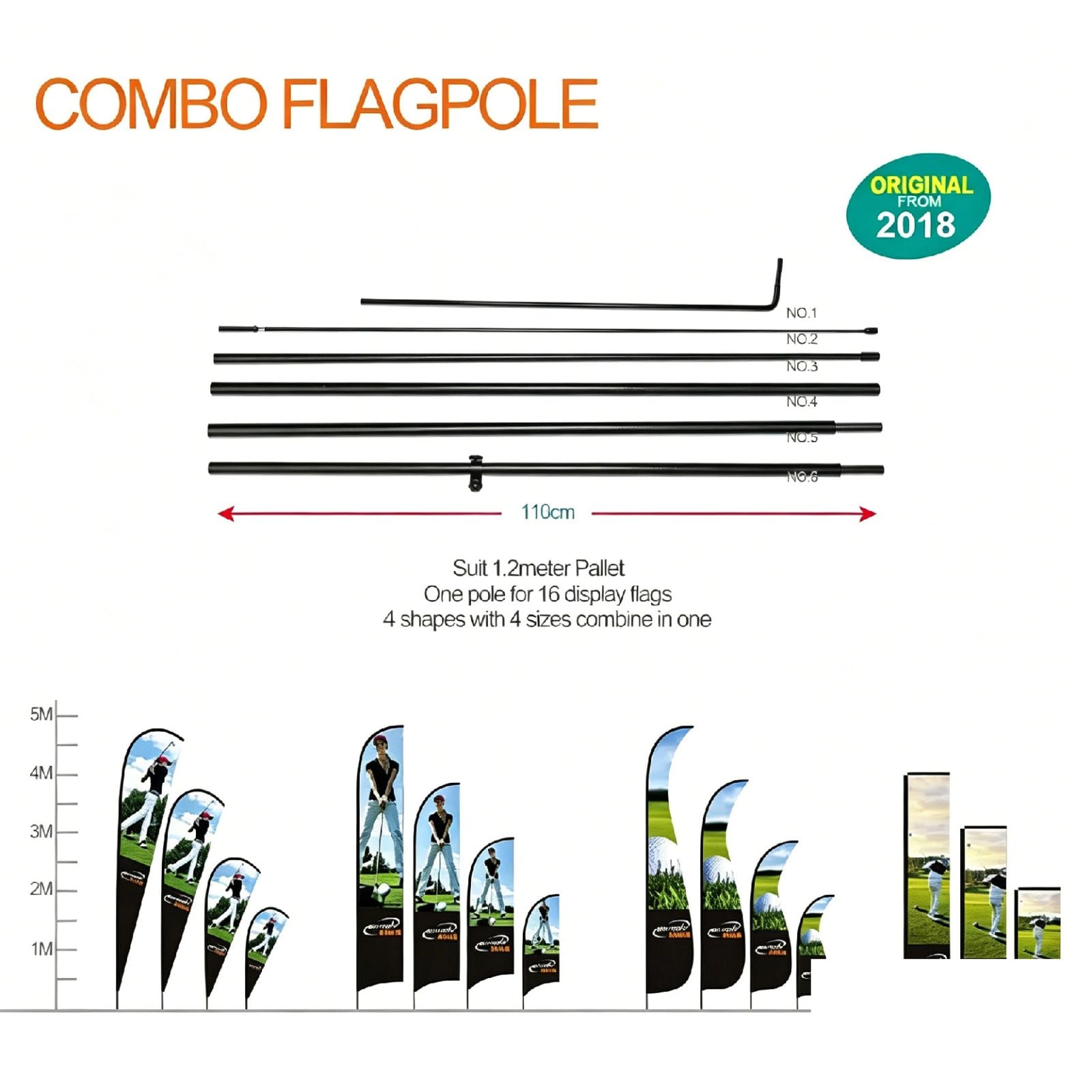
Combo Pole
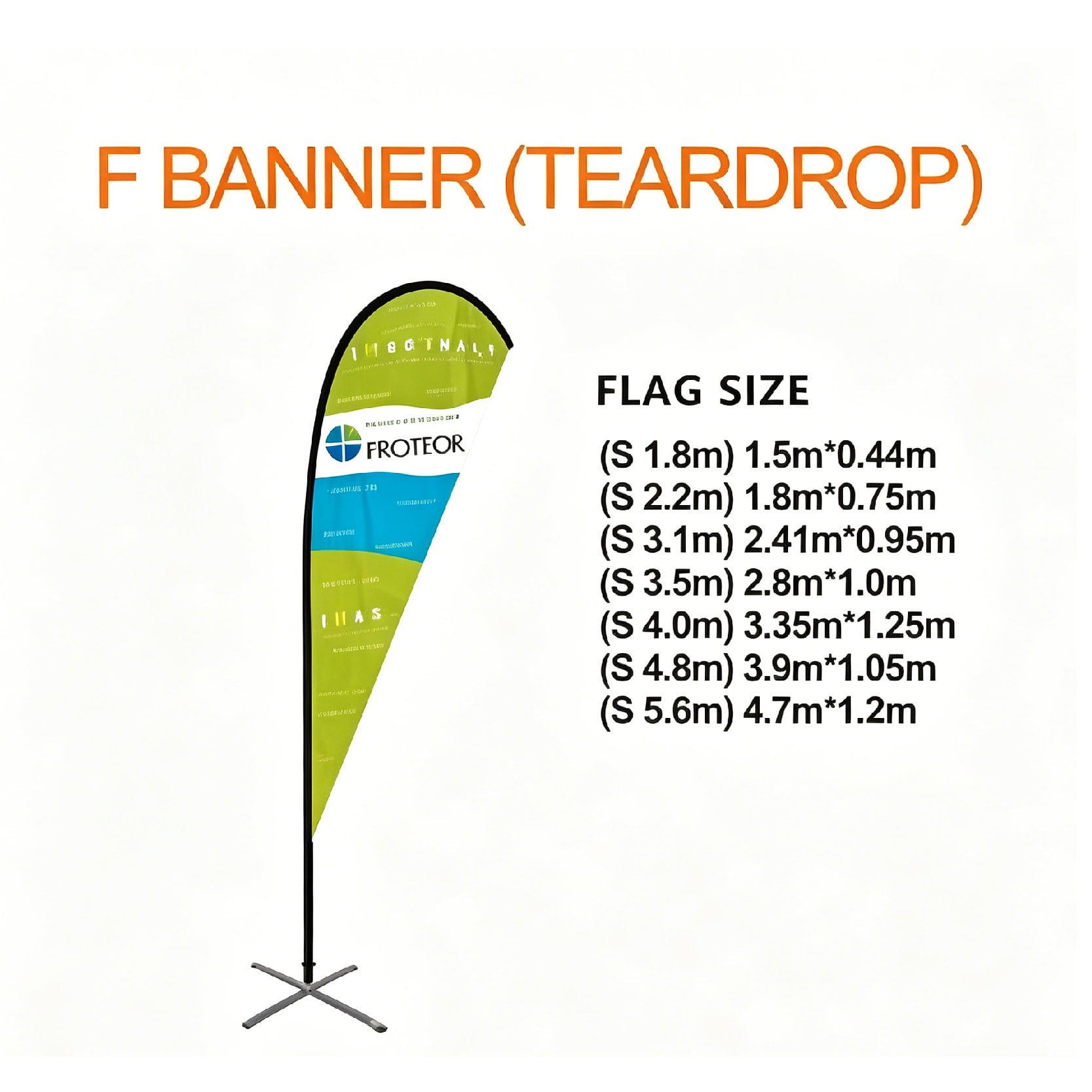
F Banner(Teardrop)
Golf flag pins
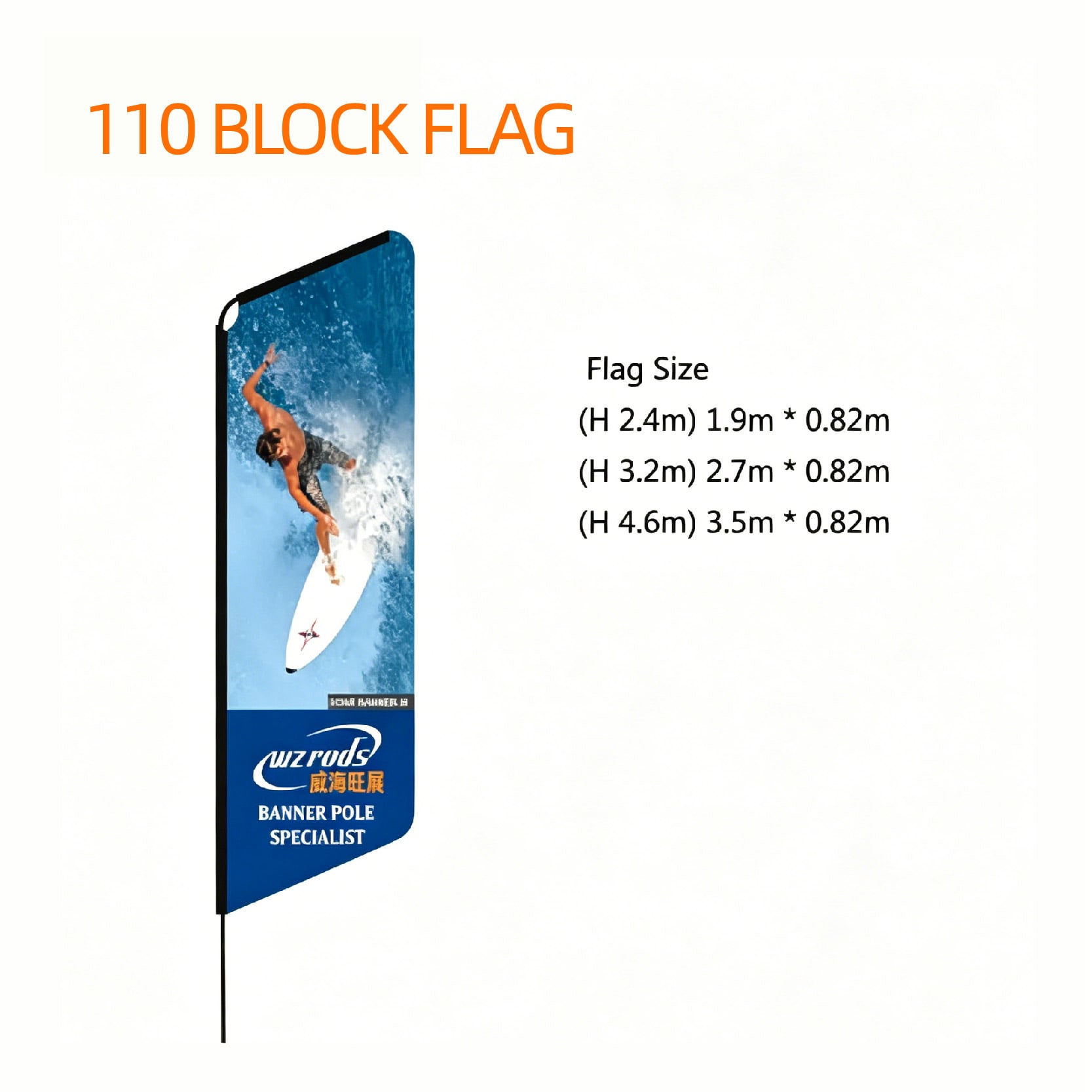
110° H banner
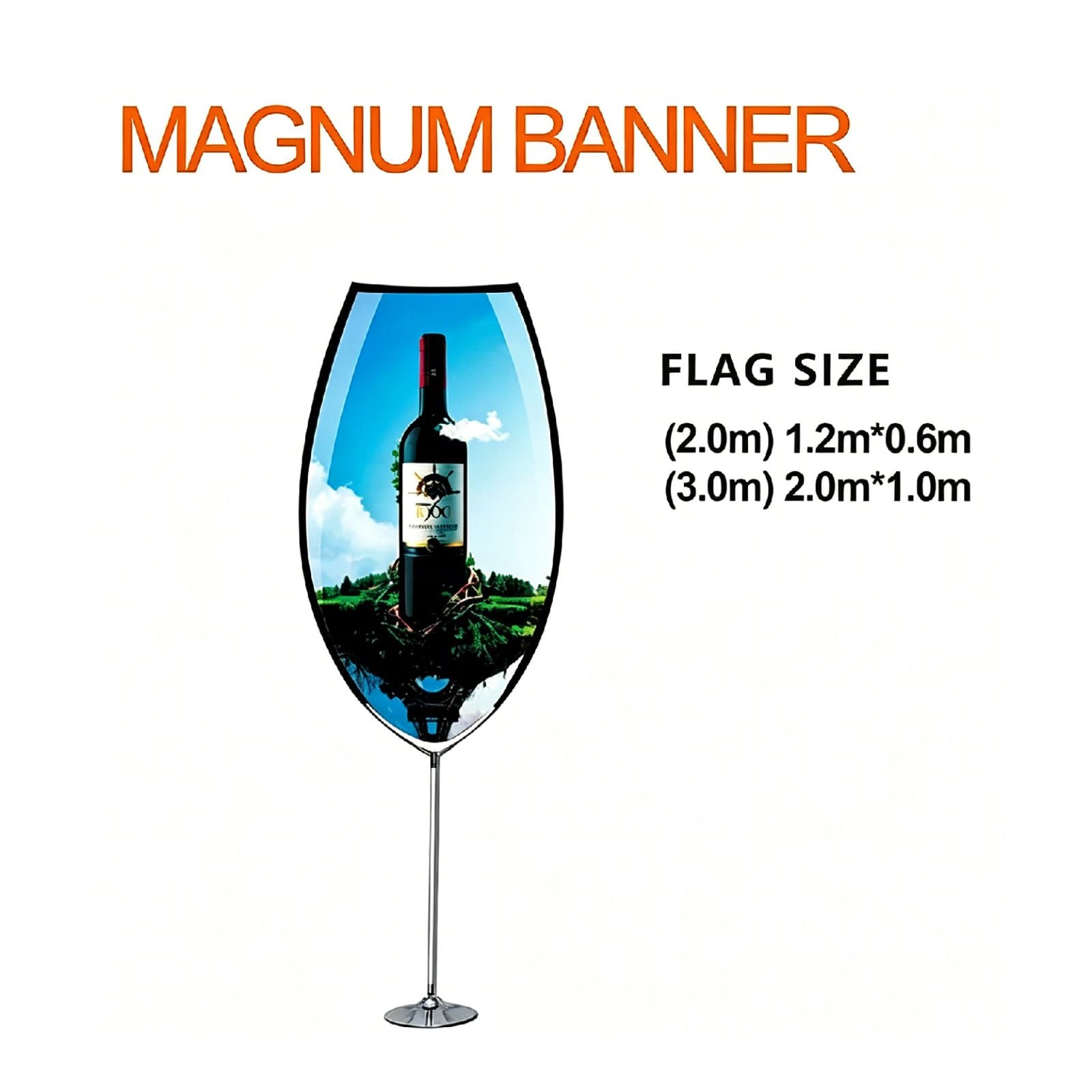
Magnum banner
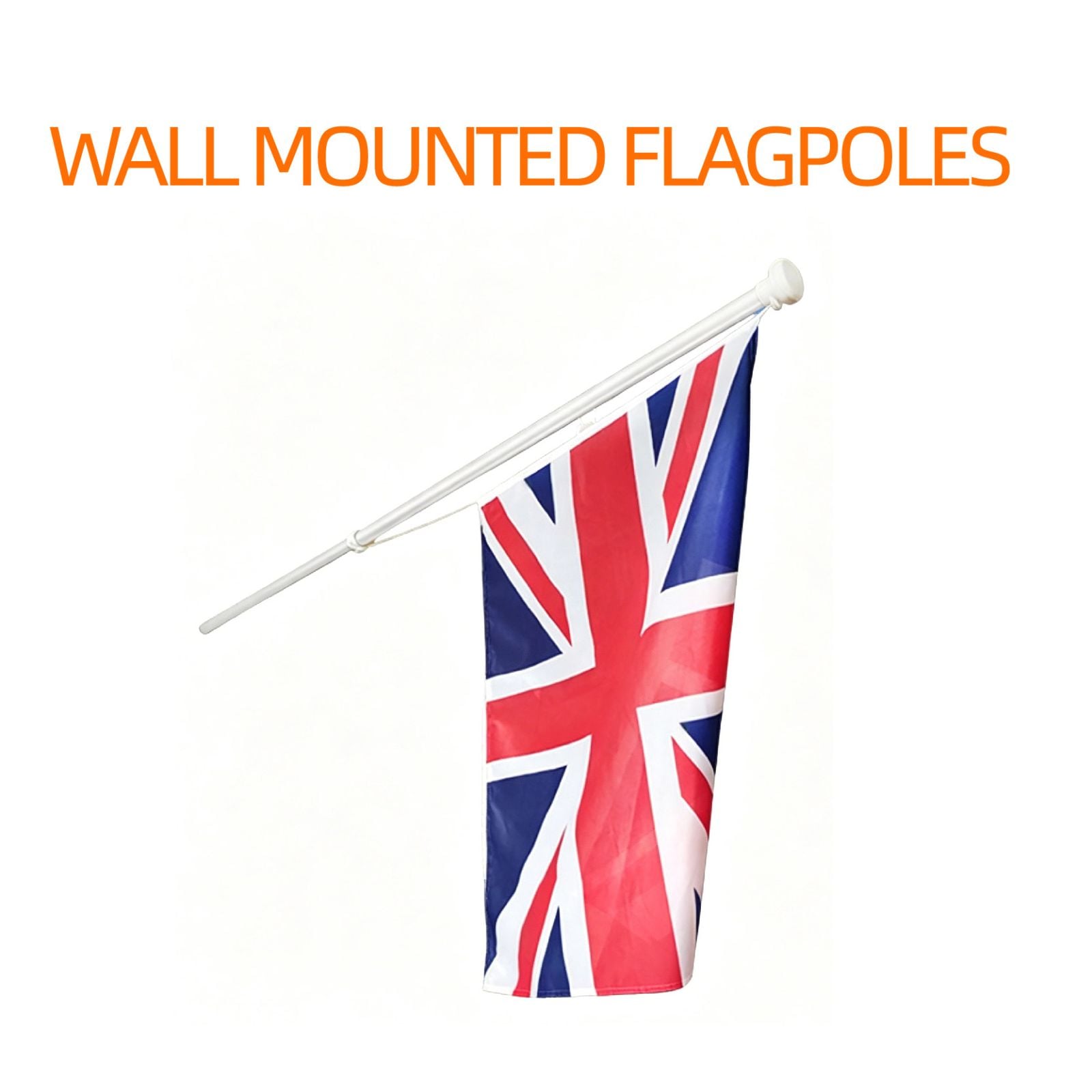
Wall Mounted Flagpole
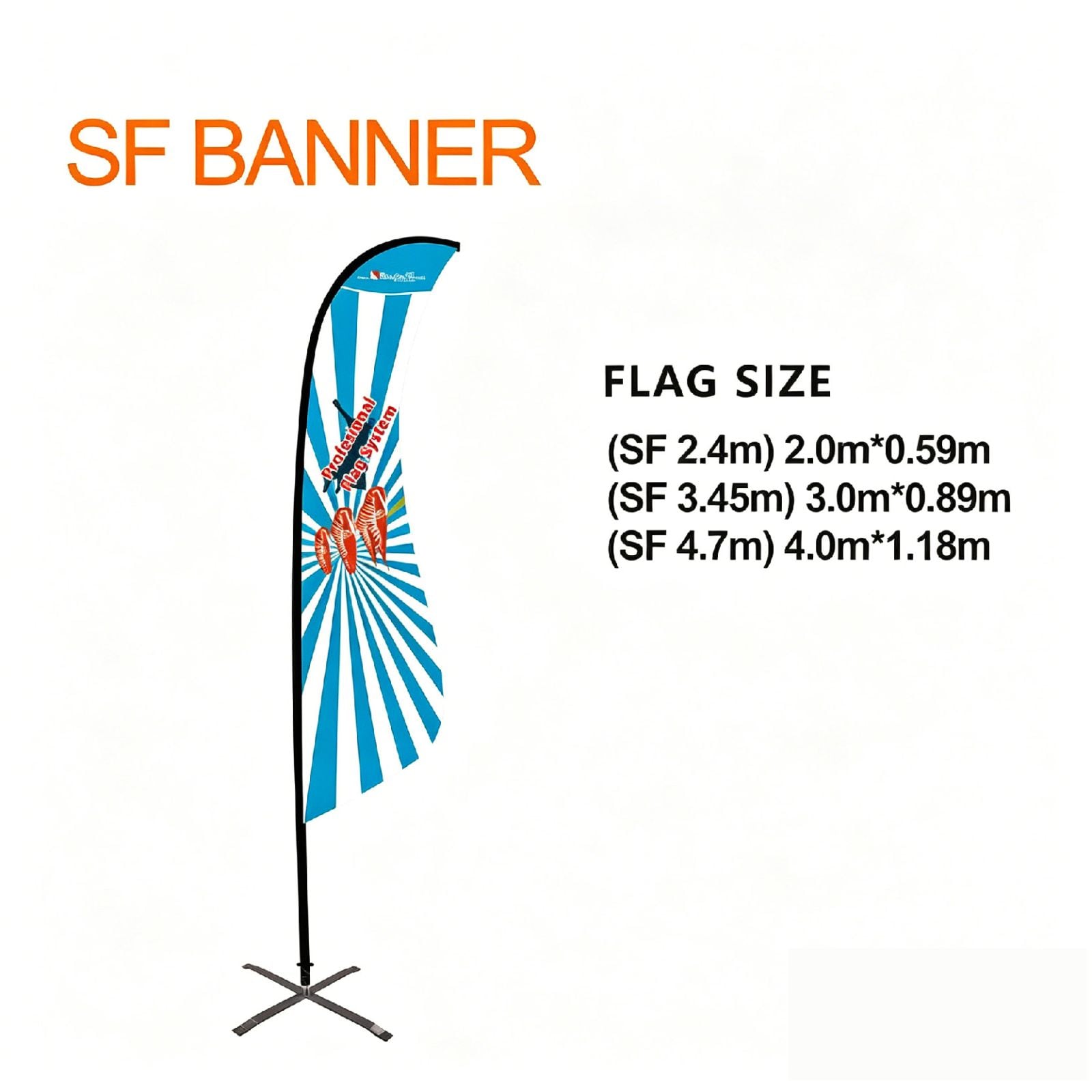
SF Banner
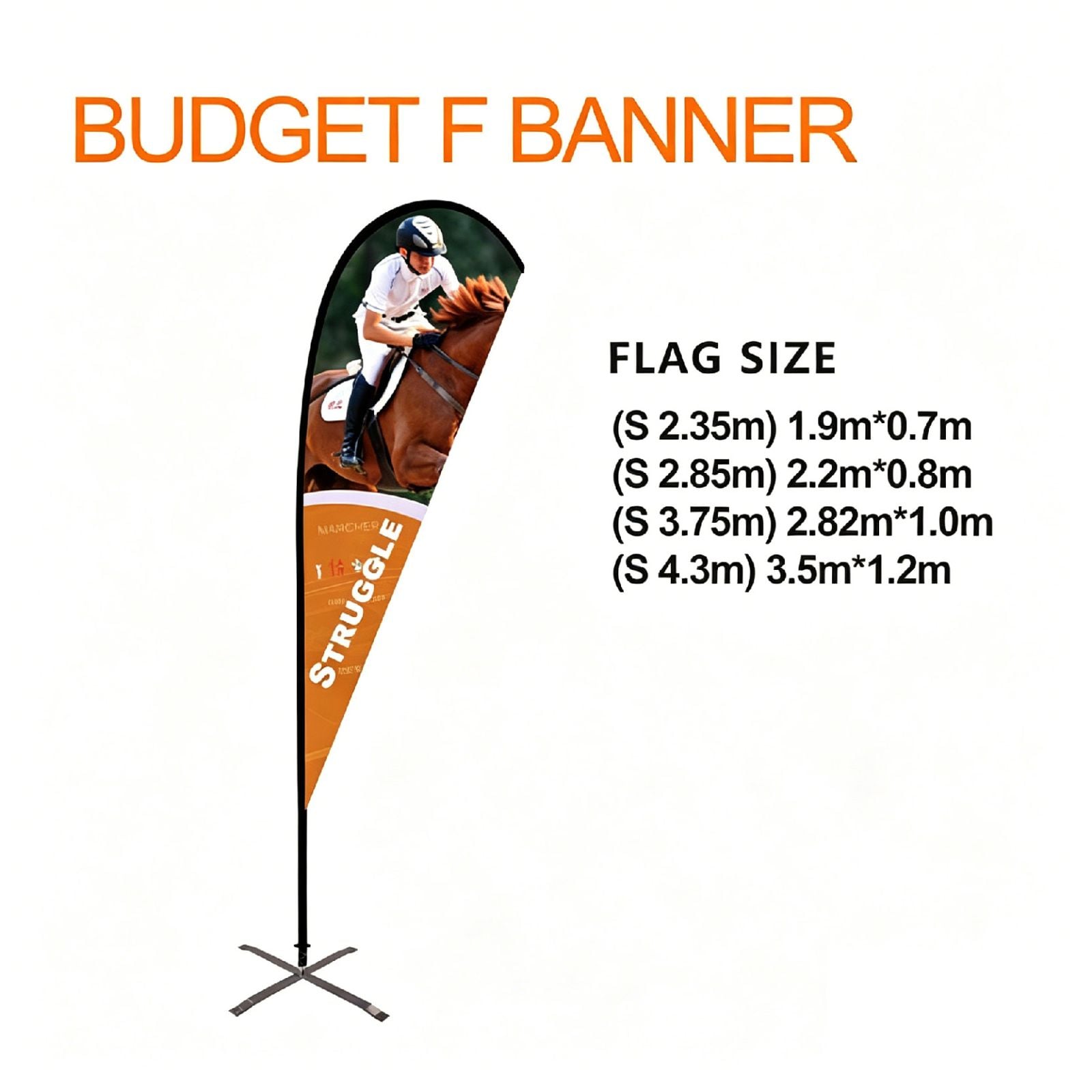
Budget 2in1 flag system
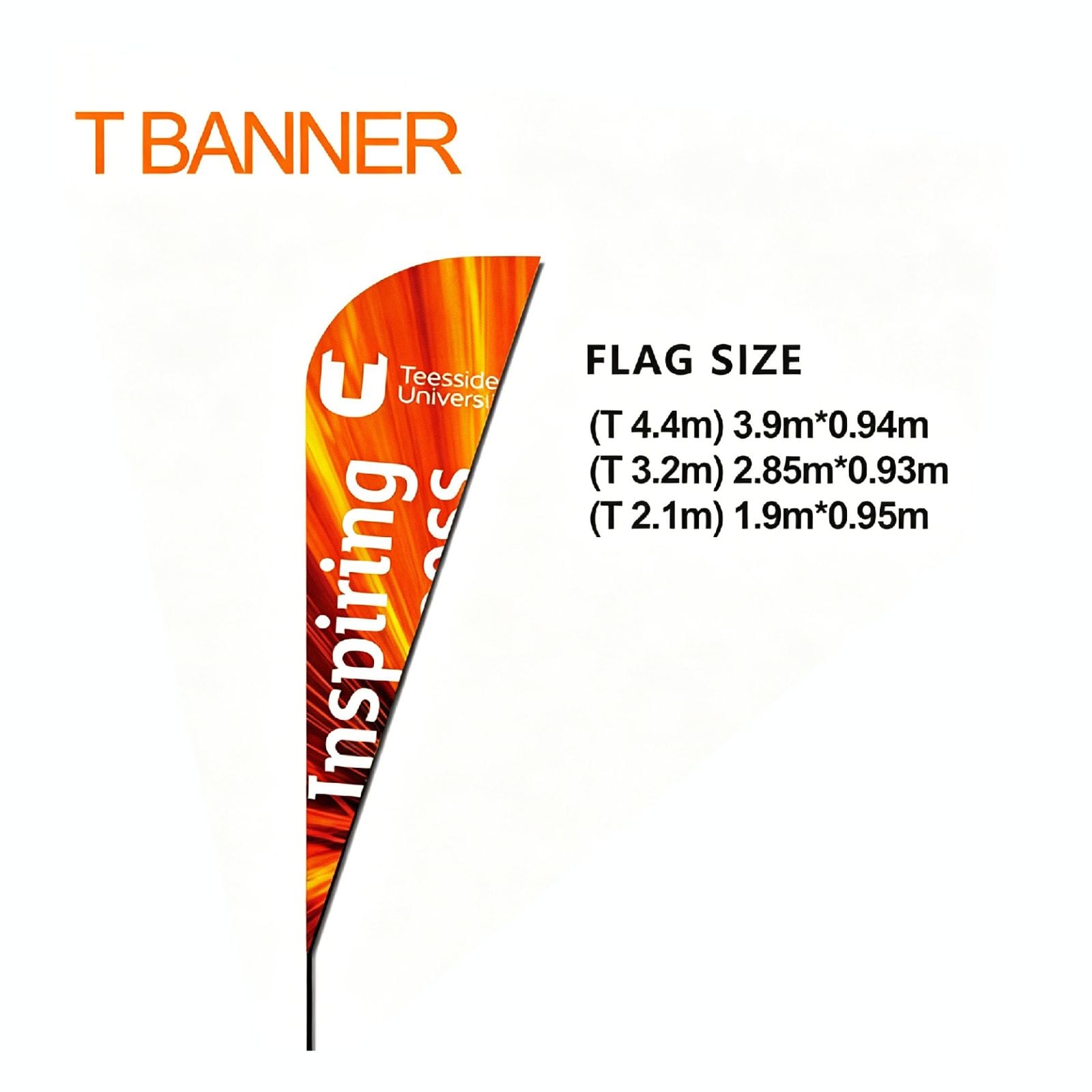
T Banner
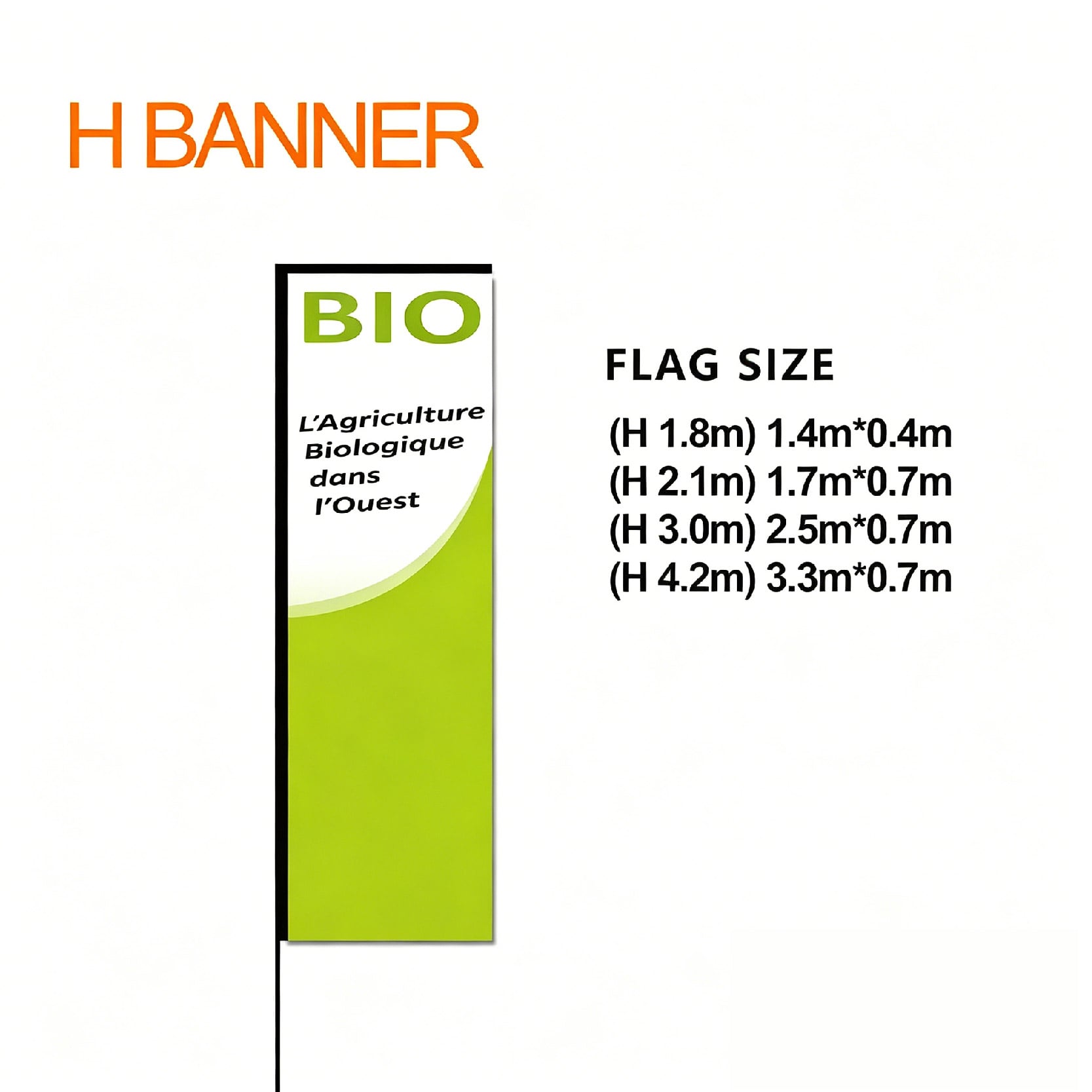
H Banner
Related Articles
29kg Concrete Flag Base - The Complete B2B Buyer's Resource - WZRODS
WZRODS DY451B: 29 kg, HDPE shell, concrete core. Stackable, portable, rust-proof. FOB price US$5.75–$6.85 at MOQ 2 units. Those numbers look unremarkable. Factor in landed cost—import duties lower than aluminum’s under relevant HTS codes, freight savings from less weight per unit of stabilizing mas
Wide Tube Cross Base - The Complete B2B Buyer's Resource - WZRODS
The Wide Tube Cross Base, manufactured by Wzrods in Shandong, China, solves one problem: reliable stability for poles under three meters, without the freight costs and warehouse footprint that heavier alternatives demand.
Rectangular Pipe Cross Base - The Complete B2B Buyer's Resource - WZRODS
The pipe cross flag base is a cross of rectangular steel pipe, powder‑coated, weighing 1.3 kg and spanning 78 cm across its arms. Its center holds a C‑ring shaft that lets the flag rotate with the wind.
X-Shape Backpack Banner - The Complete B2B Buyer's Resource - WZRODS
Economic Cross Base - The Complete B2B Buyer's Guide- WZRODS
When you buy an economic cross base—something like the Wzrods DM‑9, a 77 cm‑long, 1.3 kg iron cross—forget “economic” as a synonym for “cheap.” It means value-engineered.
How to Choose the Right Feather Flag Base for Different Surfaces
Feather Flag - Professional Banner Poles & Systems Manufacturer - WZRODS
How to choose a high-quality backpack flag
The backpack flag concept centers on a frame carried on the back, similar to a backpack, specifically engineered to support a raised flag or banner.