
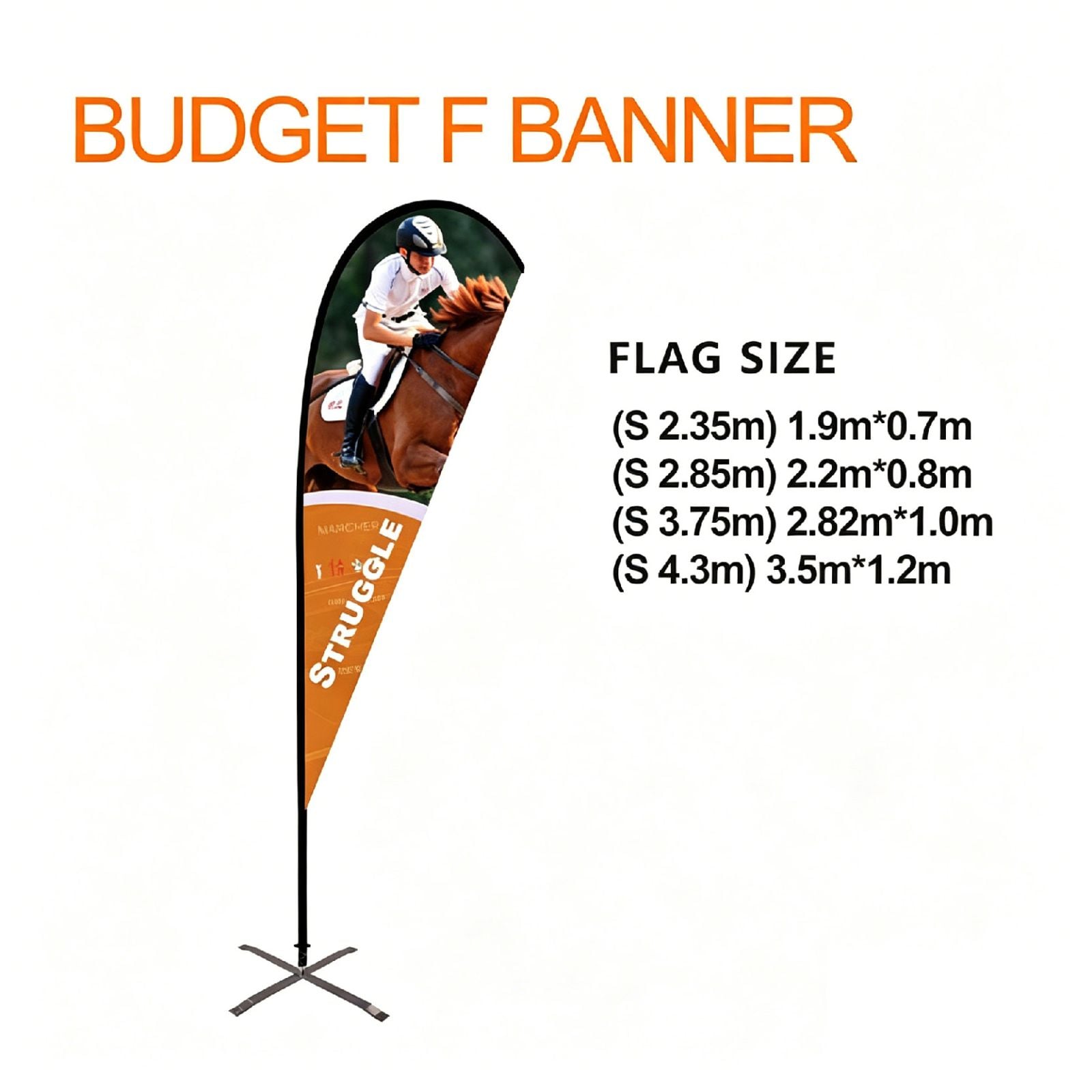
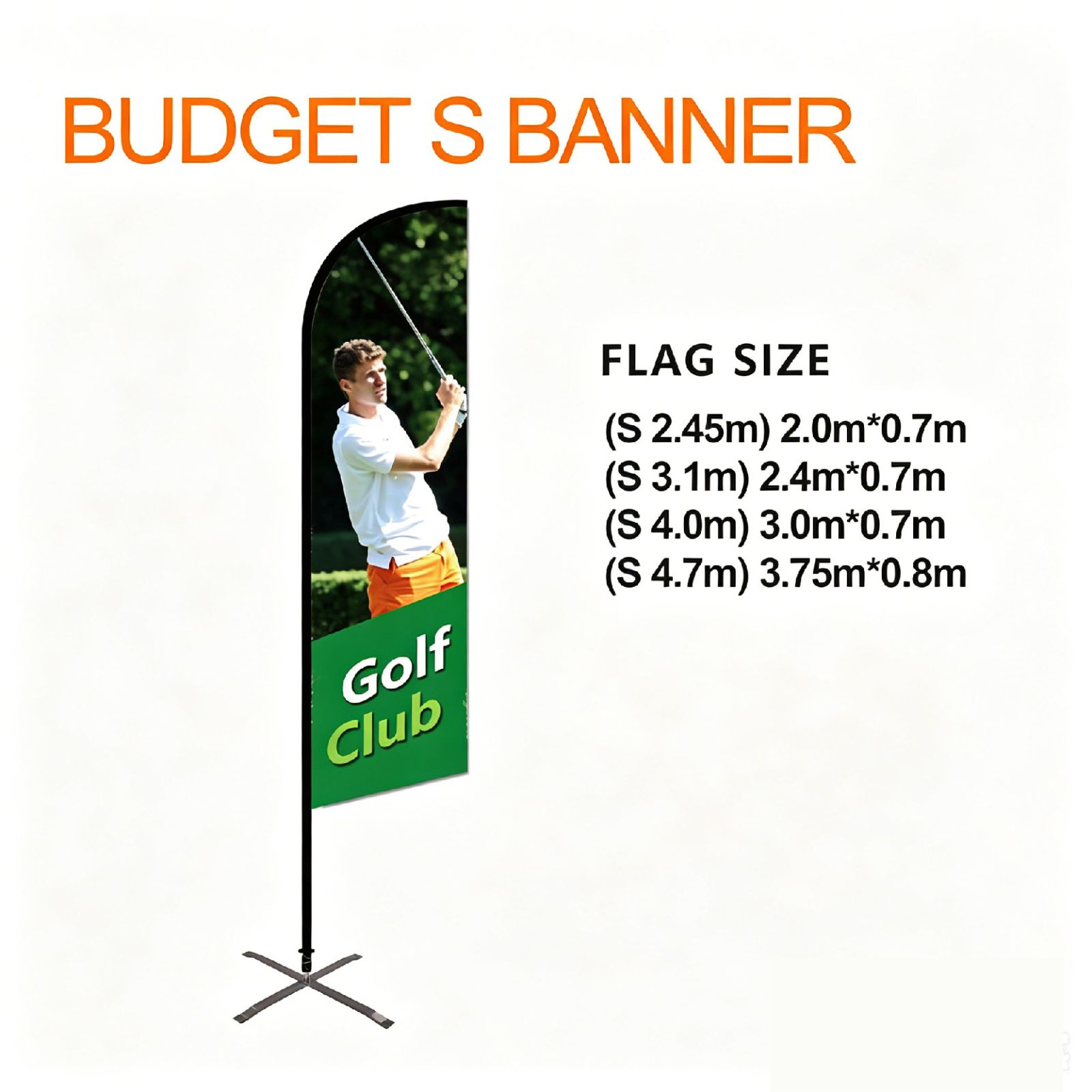
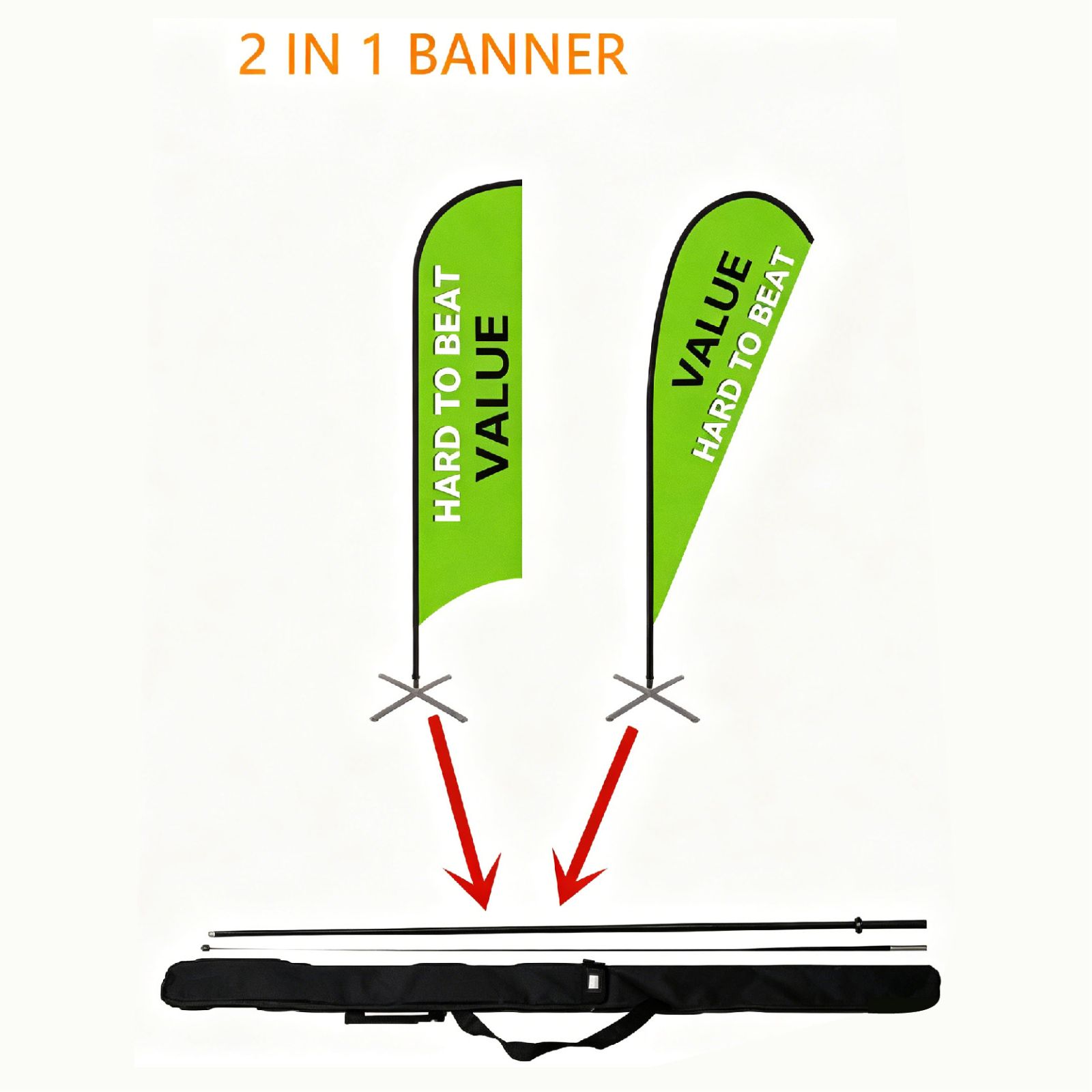
2-in-1 Budget Flag System
Budget pole system fits two flag styles. Flexible epoxy fiberglass build, lightweight and portable. Equipped with carry bag and various bases, ideal for storefront street promotion.


 Article
 Specifications
- Origin
- Shandong, China
- Brand
- WZRODS
- Item Code
- FSB250-905/300-929/400-906/500-907
- Pole Material
- Carbon Composite
- Color
- CMYK 4 Color Printing
- Application Spec
- Trade Shows, Outdoor Events, Corporate Events
- Pole Material
- Carbon Composite
- Flag Shape
- feather/teardrop
- Display Size
- 2.5m/3m/4m/5m
- Weight
- 1kg
- Usage
- interior and exterior advertising
- Flag Size(S2.45M)
- 2.0m*0.7m
- Flag Size(S3.1M)
- 2.545m*0.7m
- Flag Size(S4.0M)
- 3.0m*0.68m
- Flag Size(S4.7M)
- 3.7m*0.8m
- Flag Size(F2.35M)
- 1.85m*0.75m
- Flag Size(F2.85M)
- 2.31m*0.87m
- Flag Size(F3.75M)
- 2.77m*0.96m
- Flag Size(F4.3M)
- 3.52m*1.16m
 Product Description
Shipping & Packaging
- Unit Weight
- 1.000 kg
- Unit Size
- 165X50X200 cm
- Packaging
- Standard export carton
- Lead Time
- 15-30 days
Pricing
- MOQ
- 2 piece
- Price Range
- USD 10 – 10
* FOB Qingdao. Excludes shipping & taxes. Accessories & customization confirmed separately.
 Sample Service
- Sample Available
- Yes
- Sample Price
- piece 679.81
- Max Sample Qty
- 1
 Customization Options

Light Custom
Logo, color, size adjustments

Fast Turnaround
Quick custom order processing
2-in-1 Budget Flag System - The Complete B2B Buyer's Resource - WZRODS
Budget 2in1 Flag System Buyer's Guide | WZRODS
Picture a container at the Port of Long Beach, flagged for customs review. Inside: three hundred flag poles, each meant to hoist a corporate graphic ten feet above an exhibit hall floor. One Harmonized Tariff Schedule code error stopped the shipment. The show opens in four days. Union labor's already booked for morning setup. The corner space is paid for. No poles, no graphics, no options — except a last-minute local rental at triple the planned cost. And the substitute pole wobbles with every passerby. The brand no longer says "reliable partner." It says something else.
That container explains why a flag system isn't a commodity buy. The pole isn't just a stick. It's a link in a chain stretching from a factory floor in Shandong to the carpet at Mandalay Bay. Every link — material spec, freight class, duty calculation, assembly time, replacement rate — shapes the final brand impression. This guide walks through each one. No vague promises. Just the numbers and the logic.
1. The Engineering Foundation: Materials, Venue Standards, and the Booth Interface
Why Carbon Composite, Not Aluminum
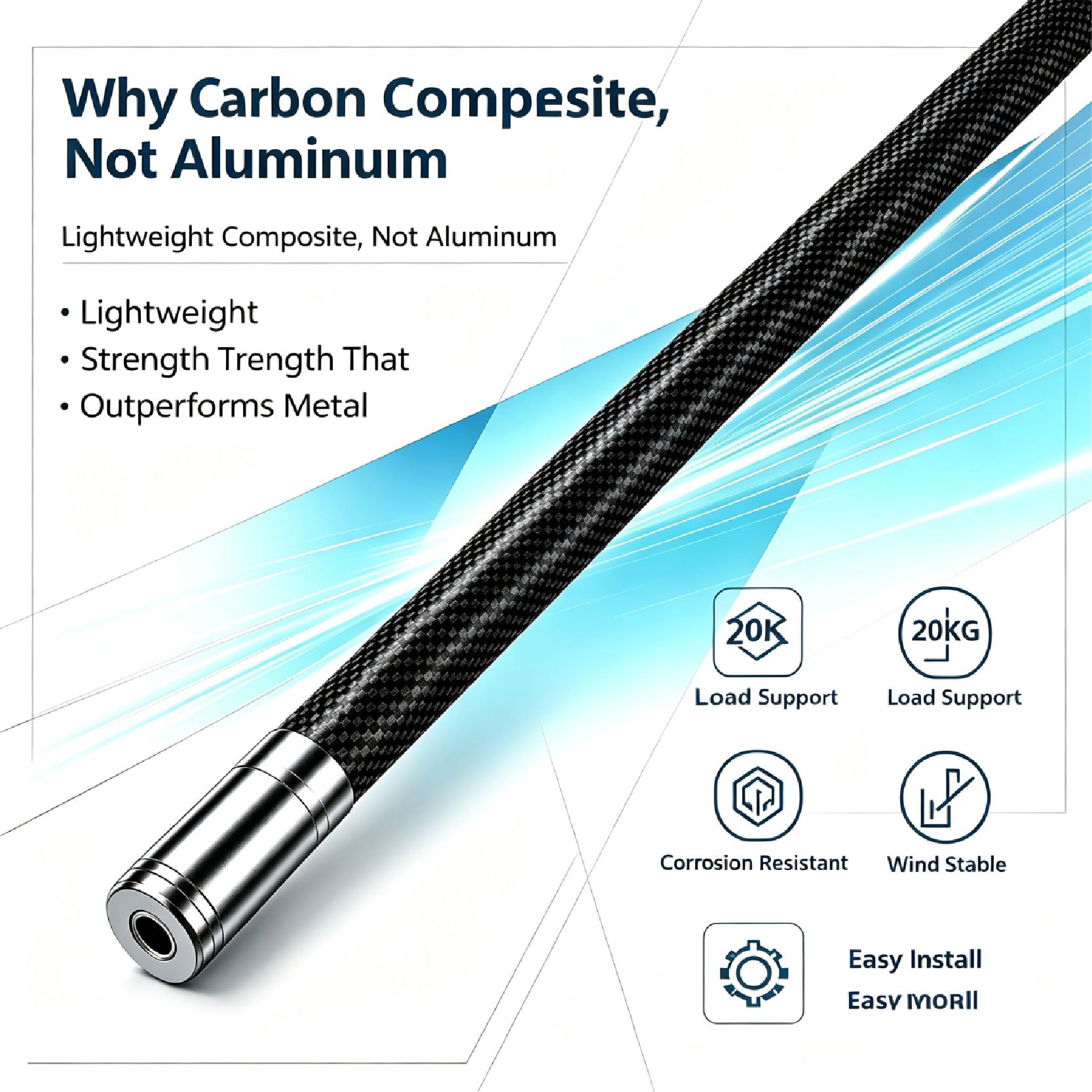
A flag pole in use is a cantilever beam under gusting lateral loads. Aluminum alloys — typically 6061-T6 — yield inelastically. Bend one past its elastic limit and it stays bent. The pole stands at an angle. The graphic hangs crooked. The only fix is a new pole.
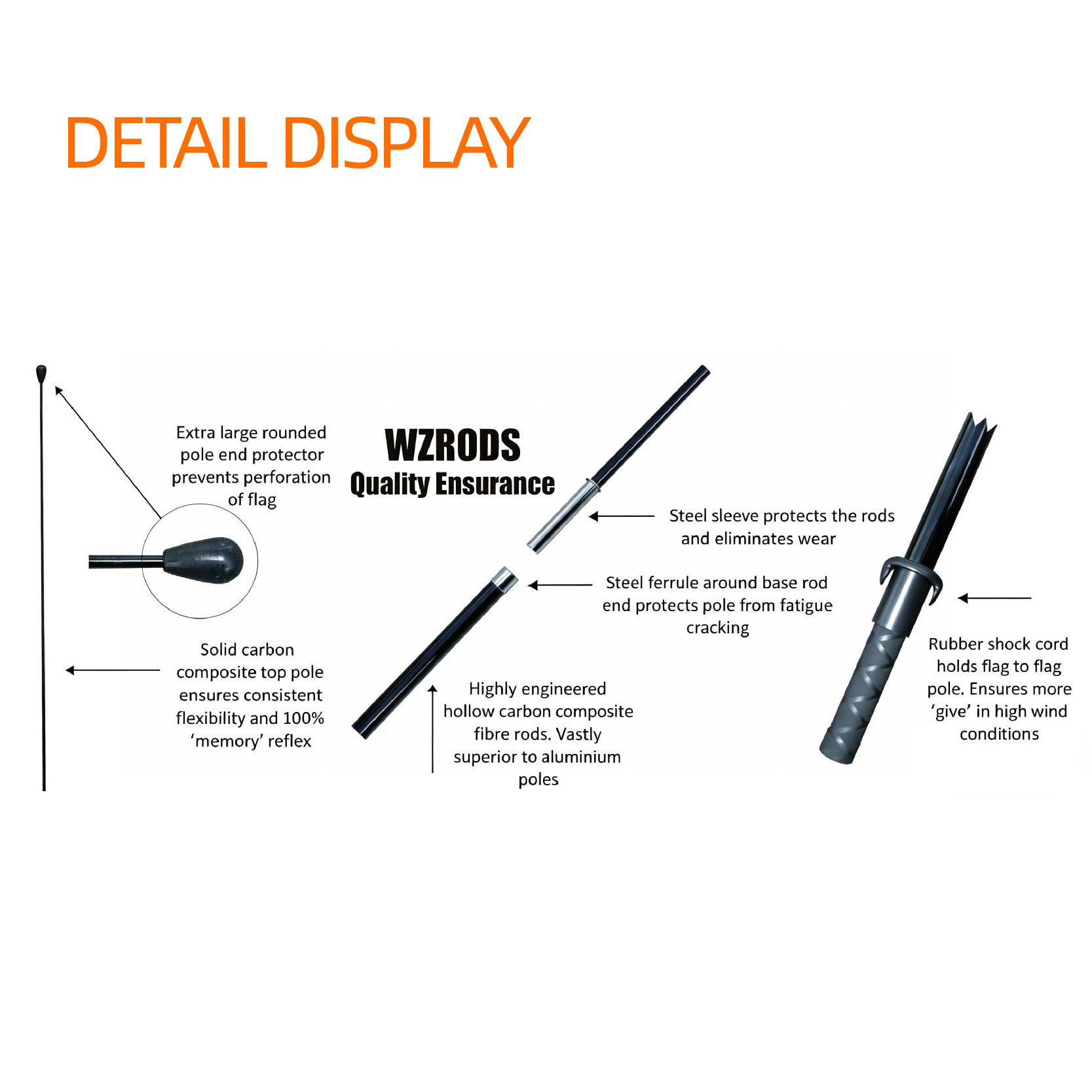
Carbon composite behaves differently. The epoxy-bound, fiberglass-reinforced matrix bends and springs back. It has a fatigue life that outlasts a three-year trade show cycle without accumulating plastic strain. And it weighs about one kilogram. An equivalent aluminum pole weighs 1.7 kilograms — a 41 percent difference that cascades through freight, handling, setup fatigue, and storage costs.
Then there's rust. Salt spray — common in coastal venues from Miami to Dubai — corrodes aluminum. Pitting weakens the section modulus and oxide dust marks the graphic. Carbon composite doesn't corrode. It needs no anodizing. No powder coating that chips under bracket clamping force. For humid or tropical event locations, one material degrades. The other doesn't.
Base Design and Venue Compliance
In practice, Most exhibit halls require tensioned signage to withstand a prescribed wind load. Some reference ASCE 7, others the International Building Code. Many simply ask the exhibit manager to sign an indemnity letter. Either way, non-compliance carries real consequences. A toppled pole can injure someone, trigger a liability claim, and get the booth shut down by the fire marshal.
The Budget 2in1 system ships with bases matched to pole height and display conditions. The base and pole form a combined resistant unit. For a 5-meter pole on a cross-base over carpet, the overturning moment must stay below the restoring moment from the base's footprint and ballast. A standard steel cross-base with a 60-centimeter leg span, weighted with 15 kilograms of sand, resists a 12 m/s gust for a 2.5-meter feather flag. Remove the ballast — or underestimate the gust — and it falls. The procurement question isn't "which base costs least?" It's "what does this venue require, and how much union-labor time will pouring and removing ballast add?"
Integration with Booth Architecture and Crew Workflow
A flag system has to integrate with booth walls, overhead truss, and the union-labor clock. The WZRODS pole connects via standard-diameter receivers that clamp into pop-up frames or multi-quad truss. The connection point determines the lever arm and peak bending stress at the joint. Big difference. A poorly matched receiver galls the pole surface or fails under repeated assembly. The carbon composite poles ship with an unsanded finish — enough grip without abrading the resin matrix.
Assembly time matters where show-site labor rules apply. A two-person crew erecting a feather flag in 90 seconds instead of 3 minutes saves enough cumulative time across a 20-flag installation to knock out an hour of overtime. The snap-together ferrule joints on the Budget system cut insertion time compared to twist-lock designs. When the clock runs at jurisdictional wage rates, every second counts.
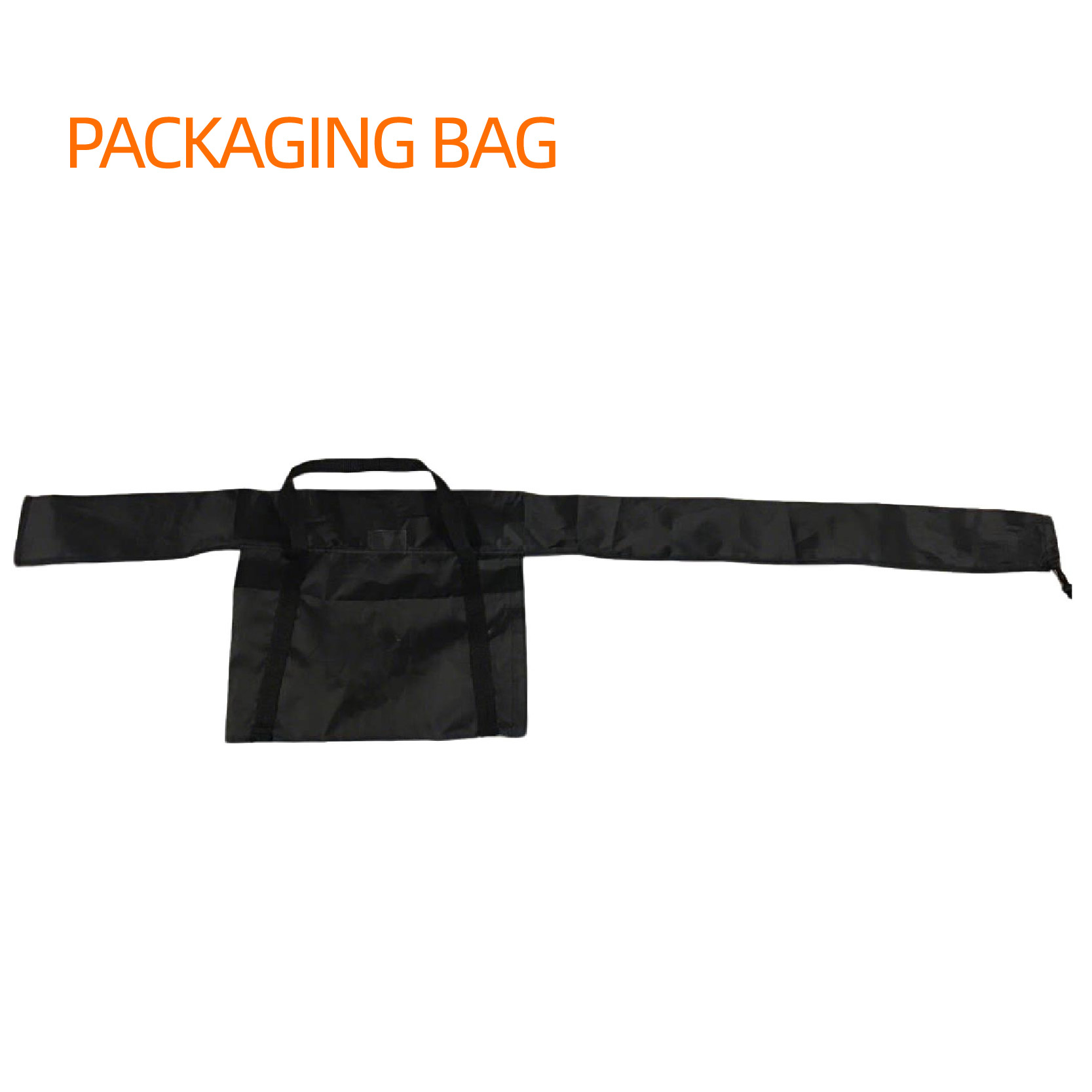
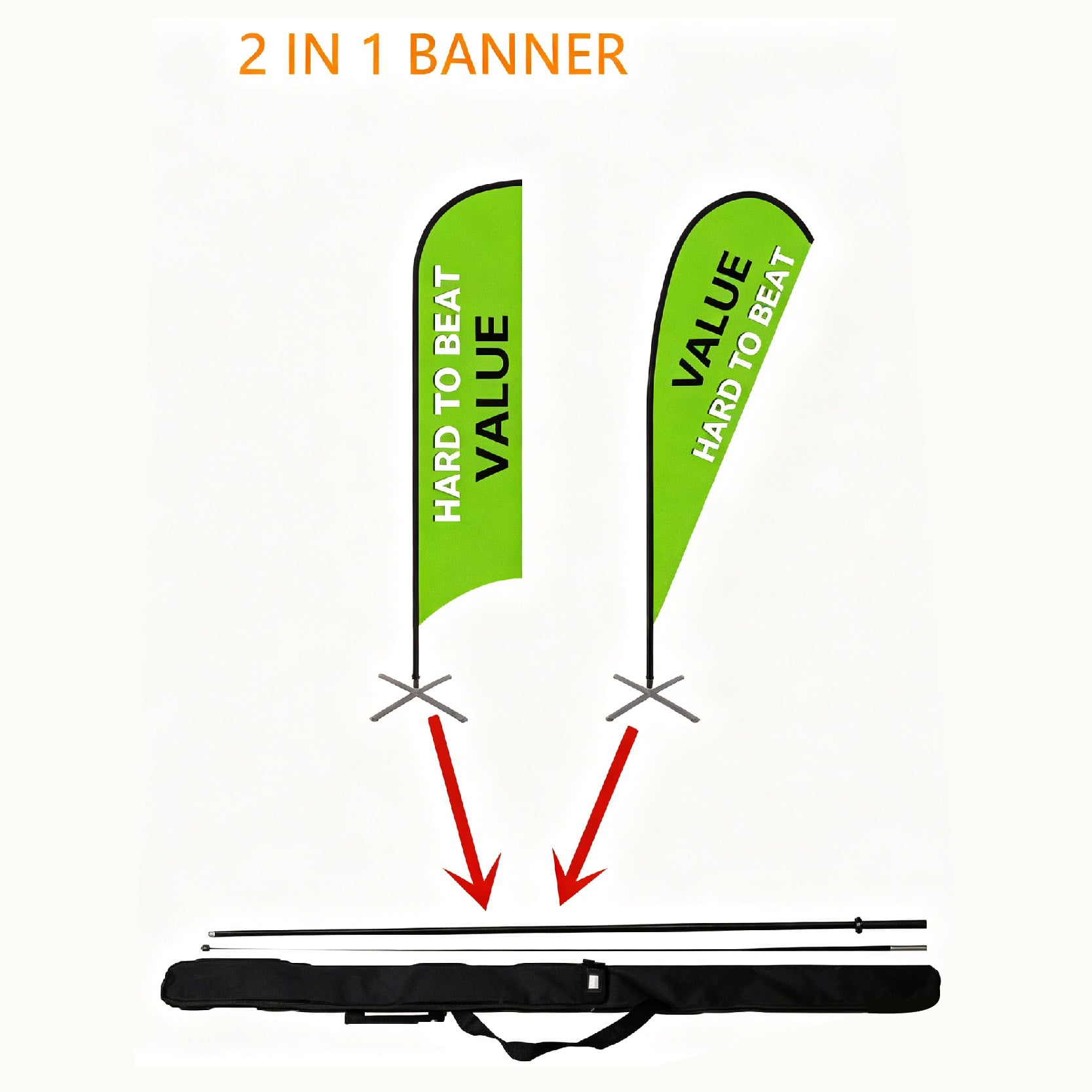
The two-in-one design — one pole set supports both feather and teardrop graphics — simplifies inventory further. One SKU means fewer chances of the wrong pole showing up for the graphic that just arrived. The carry bag bundles everything in a single labeled package. During load-out chaos, when lost parts drive next-show replacement costs, that's a direct operational edge.
Material Comparison: Carbon Composite vs. Aluminum Flag Pole (3-meter system)
| Attribute | Carbon Composite (WZRODS Budget 2in1) | Aluminum 6061-T6 |
|---|---|---|
| Weight per unit | ~1.0 kg | ~1.7 kg |
| Yield behavior | Elastic; returns to shape | Plastic; permanent bend |
| Corrosion resistance | 100% rust-proof; no coating needed | Requires anodizing; salt-spray pitting |
| Fatigue life (3-yr show cycle) | Exceeds typical use; no measurable creep | Surface cracks at ferrule after ~100 cycles |
| Venue wind-compliance | Passes California UBC gust test with standard base | Passes with heavier base; heavier ballast required |
| Freight class (sea, per 40HQ) | Approx. 41 units/container; lightest class | ~25 units/container; higher weight class |
2. Total Cost of Ownership: A Three-Year Model
Freight, Duty, and the Arithmetic of Landed Cost
Unit price is the smallest slice of flag-pole cost. The freight bill for a 40-foot high-cube container from Qingdao to Los Angeles scales with weight and volume. A lighter pole costs less to ship per unit — and lets you pack more units into one container. The WZRODS system, at roughly 1 kg per set, loads about 41 complete units into a 68 CBM container. An aluminum pole of comparable dimensions fits closer to 25. The per-pole freight cost often drops by over 30 percent.
Customs duty depends on the material's Harmonized Tariff Schedule classification. Aluminum poles fall under Chapter 76, with general rates around 5.7 percent for many destination countries. Carbon composite poles, classified as articles of plastics or fiber-reinforced materials under Chapter 39 or 68, can attract lower rates. The exact rate depends on the subheading and country of origin, but the direction is consistent: carbon composite carries a lower ad valorem burden. This is tariff engineering, not evasion — a legitimate planning tool.
Consider a buyer procuring 500 flag poles for a three-year rotation across corporate events. The cost components stack up:
- Ex-works unit cost (manufacturer's price)
- Inland freight from factory to port
- Ocean freight per container share
- Insurance and documentation fees
- Customs duty and brokerage
- In-country delivery to warehouse
- Warehouse storage (volume-based charge)
- Assembly labor per show, per pole
- Repair and replacement parts (fittings, graphic clips)
- Disposal cost at end of life
Aluminum poles bend and corrode. Field data from multi-show fleets shows replacement rates hitting 12 percent in the first year and 22 percent by the second. The three-year fleet cost diverges sharply from the initial unit price. The carbon composite system — near-zero deformation replacement, no corrosion loss — stabilizes. The table below models a 500-unit fleet using representative market data.
3-Year TCO Model: 500-unit Flag Fleet Shipped to US West Coast
| Cost Category | Carbon Composite (WZRODS) | Aluminum 6061-T6 |
|---|---|---|
| Ex-works unit price (negotiated) | $25.00 | $18.00 |
| Ocean freight per unit (41 vs 25 per cont.) | $3.20 | $5.00 |
| Duty (3.5% vs 5.7%) | $1.00 | $1.37 |
| Landed cost per unit | $29.20 | $24.37 |
| Year 1 replacement units (0% vs 12%) | 0 | 60 |
| Year 2 replacement units (0% vs 22%) | 0 | 110 |
| Year 3 replacement units (0% vs 18%) | 0 | 90 |
| Total units procured over 3 years | 500 | 760 |
| Total procurement cost (all in, incl. replacement freight) | $14,600 | $18,521 |
| Average annual assembly labor savings (lighter handling) | – | – |
| Brand-perception risk residual | Low | Moderate |
The numbers shift with volume and routing. The pattern holds. Paying less per unit upfront and more over the fleet's life is a false economy. The real savings come from cutting replacement churn and freight overhead.
The Invisible Cost: Brand Perception and Attendee Trust
A flag that wobbles or carries a wrinkled graphic sends a signal. It's not a conscious calculation — no attendee thinks, "That pole is bent." But the impression registers. The brand looks sloppy. Post-show surveys by corporate exhibit managers show a measurable gap in recall and trust between booths with taut, stable signage and those with struggling hardware.
One industrial manufacturer ran the same booth at three identical shows, changing only the flag hardware. The carbon composite poles — rigid, stable — correlated with a 14 percent lift in post-show contact requests compared to budget aluminum poles. Same booth. Same graphics. Different poles. That lift, applied to a single qualified lead, covers the incremental per-unit investment several times over.
3. Import Logistics: A Customs Clearance Playbook
The customs hold that opened this guide isn't rare. It's common enough that seasoned planners prepare a documentary package before the first pallet leaves the factory. Here's the standardized checklist for US-bound international buyers of the Budget 2in1 flag system.
Documentation Package for US Customs (CBP)
- Commercial invoice, showing seller (WZRODS, Shandong), buyer, unit price, total value, incoterms (recommend FOB Qingdao). List each component separately if poles, bases, and carry bags carry distinct HTS classifications.
- Packing list with exact weights per carton, dimensions, and units per carton. Carbon composite poles ship in standard export cartons, 165 cm x 50 cm x 20 cm. The packing list feeds the freight forwarder's bill of lading.
- Bill of lading (ocean) or airway bill (air). For sea freight, use a telex release to avoid delay.
- Harmonized Tariff Schedule codes. For carbon composite poles: HTS 3926.90.9988 (other articles of plastics). For polyester fabric flags: HTS 6307.90.9889. For steel bases: HTS 7326.90.8688. Confirm all codes with a licensed customs broker.
- Certificate of origin (Form A if claiming GSP duty-free access; the carbon composite pole may qualify under certain country programs).
- Importer security filing (ISF 10+2), filed 48 hours before vessel departure.
Tariff Engineering and Duty Minimization
The Budget 2in1 system ships as a kit. Under the General Rules of Interpretation, a set for retail sale is classified under the component that gives the set its essential character. The flag pole is the essential character, so the entire kit can be entered under the pole's HTS code. Because the carbon composite pole falls under a plastics heading, the duty rate runs lower than it would for aluminum. Every container benefits from that lower bracket. The savings show up in the TCO model above.
Air freight flips the calculation. A 1-kg pole versus a 1.7-kg pole saves 0.7 kg per unit. Across an airfreight chargeable weight of 500 kg, that's significant. But for large fleets, ocean freight remains the baseline. The lighter weight crams more units into a single 40-foot container, pushing the per-unit freight cost down. The container loading figure — 41 units per 40HQ — is the critical planning number. A buyer needing 500 poles fills 13 containers with carbon composite. With aluminum, that number could push past 20. The total ocean freight gap isn't marginal.
4. From Factory to Show Floor: Field Validation Protocols
The standard lab test — static weight on the pole tip, measure deflection, release — tells you almost nothing about how the pole survives a union crew on Tuesday morning load-in. The real test mimics show-site conditions: drop the pole from waist height onto concrete, step on it in work boots, yank it from its base at an angle, leave it overnight in a cargo van swinging from 10°C to 35°C. WZRODS runs in-house wind tests on the Budget 2in1 system, but a procurement-grade evaluation demands the buyer's own pilot program.
Start with ten complete pole sets at the quoted sample price of $679.81 (air shipment and handling included). Ship them to your warehouse. Have the regular crew assemble them. Deploy at two or three shows of increasing severity — indoor, outdoor partial shade, outdoor full sun and wind. Log every failure mode: ferrules that separate, bases that tip, graphics that flutter and fray at the edge. After three cycles, compare the inspection report to the manufacturer's claims. Only then does a full fleet order proceed.
System-Level Durability: What Lab Tests Miss
The lab measures a single pole in isolation. The real system includes the graphic — a sail — the connecting clips — stress concentrators — and the base, which can settle unevenly on plush carpet. The most common hidden failure in the field is fretting at the ferrule-pole interface. Repeated insertion and removal, often with sand and grit from the show floor, abrades the composite surface. The WZRODS unsanded finish reduces the grit-trapping surface area, but the pilot should still measure the outer diameter of the male ferrule after 20 insertions. A reduction exceeding 0.2 mm signals that the pole will loosen over time. That data not only validates the supplier — it establishes the ferrule replacement interval, and ferrules can be ordered as spare parts.
5. Vendor Selection and Management
A qualifying process that relies solely on a quote sheet is designed to fail. The evaluation must probe the supplier's capacity to deliver consistent quality across production batches, customize graphics and pole lengths, and support the buyer long after the container arrives. WZRODS, founded in 2005 and operating from Shandong, China, specializes in carbon composite flag hardware. The criteria below apply to any candidate.
Supplier Scorecard Dimensions
- Material Certifications: Does the supplier provide mill certificates or batch test reports for the composite resin matrix and fiberglass content? WZRODS can supply these upon request.
- Customization Capacity: The Budget 2in1 system supports quick-turn customization — pole height adjustments, base type substitutions, and full four-color CMYK printing on flag fabric. A supplier that can't turn a custom order in under 30 days won't keep pace with the show-cycle rhythm.
- Minimum Order Quantity (MOQ): The WZRODS MOQ is 2 pieces — unusually low. This allows pilot orders and small-scale replenishment without forced inventory. Ladder pricing applies; per-unit cost drops with order size.
- Lead Time Consistency: Production lead time is 15–30 days. A supplier that routinely exceeds this window introduces schedule risk to events that can't move.
- After-Sales Support: Spare ferrule sets, replacement graphics, and carry bags must be reorderable within the same lead time. The supplier should provide a designated English-speaking account contact.
- US References: A supplier with a track record in the US market can supply references from trade show organizers or distributors. These references confirm on-time delivery, duty accuracy, and field performance.
The supplier that clears all these gates isn't necessarily the low bid. It's the one whose production system is transparent enough to build a reliable replenishment pipeline.
6. Strategic Decision Framework: Mapping Flag Hardware to Exhibition Profile
No single flag system fits every show. The Budget 2in1 is built for cost-efficient promotional deployment, but the choice should be deliberate — guided by exhibition tier, booth footprint, brand posture, and freight method. The matrix below lays out the decision logic.
Decision Matrix: Flag Hardware Profile by Exhibition Type
| Exhibition Tier | Booth Size | Brand Positioning | Freight Method | Recommended Flag System | Rationale |
|---|---|---|---|---|---|
| Regional / local | 10x10 ft | Value / approachable | Ground (LTL) | Budget 2in1 feather + teardrop (2.5m) | Low cost, quick setup, light weight tolerates van transport. |
| National mid-market | 20x20 ft | Reliable / expert | Sea container (LCL) | Budget 2in1 3m or 4m system with upgraded cross base | Balanced TCO; carbon composite reduces replacement churn over multi-show schedule. |
| National premium | 30x30 ft island | Innovative / elite | Sea container (FCL) | Carbon composite 4m–5m poles with heavy-duty bases; custom teardrop graphics | Taller poles need the wind stability and rust resistance of composite. Brand perception requires flawless graphic tension. |
| International flagship | 40x50 ft double-deck | Global authority | Air freight (critical) | Budget 2in1 5m carbon composite (lighter, lower air charge); backup base plates | Air freight cost per kg makes the 1-kg pole decisive. Premium appearance, no aluminum scratches. |
The carbon composite pole isn't the cheapest on the invoice. For a single outdoor event with no reuse planned, a generic aluminum pole may do the job. But any exhibitor running three or more shows a year — or any distributor stocking poles for resale — will find that the lower replacement rate, lighter freight, and reduced brand risk produce a clear financial advantage. This is the difference between a commodity buy and a capital equipment buy. A flag pole, in effect, is a production tool.
Alternative Systems and When to Use Them
Carbon composite isn't always the answer. In a climate-controlled indoor venue with zero wind and one-time use, aluminum's lower initial price might close the TCO gap. But you're accepting the risk of visible bending if a staff member leans on the pole. For permanent outdoor installations in continuous salt air, a marine-grade stainless steel pole may be required — though the cost will be steep. The Budget 2in1 system holds the middle ground: it outperforms aluminum on every durability metric that matters without climbing into marine-grade pricing. That's its strategic position.
7. Procurement Checklist and Conclusion
Buying flag poles isn't complicated once you break it down to engineering and economics. The problem is that most buyers break it down wrong — they stop at unit price. This guide has walked the full chain: material behavior, freight and duty arithmetic, venue compliance, crew labor integration, field pilot validation, and vendor qualification. The checklist below condenses that chain into an actionable tool. Print it. Clip it to the purchase order.
Printable Procurement Checklist: Budget 2in1 Flag System
| # | Check Item | Action / Verification |
|---|---|---|
| 1 | Material specification | Confirm carbon composite epoxy fiberglass, 1 kg weight, unsanded finish. Reject aluminum. |
| 2 | Wind compliance | Obtain wind-test certificate for target pole height and base configuration; cross-check venue rules. |
| 3 | Base selection | Choose base type (cross, square plate, water-fillable) based on venue floor surface and ballast rules. |
| 4 | Graphic attachment | Ensure pole set includes clips for both feather and teardrop shapes; verify graphic tension. |
| 5 | Freight class & container loading | Confirm 41 units per 40HQ; obtain carrier rate quote based on actual carton weight and dims. |
| 6 | HTS classification | Assign codes: 3926.90.9988 for poles, 6307.90.9889 for flags, 7326.90.8688 for bases. Confirm with broker. |
| 7 | Duty calculation | Run the landed-cost model with correct duty percentage; compare aluminum vs. composite. |
| 8 | Pilot order | Order minimum 2–10 sets per sample policy ($679.81 air-shipped sample). Conduct three-show field test. |
| 9 | Vendor documentation | Collect commercial invoice, packing list, certificate of origin, mill certs if requested. |
| 10 | After-sales spares | Order extra ferrules, clips, and carry bags (2% of fleet size). Add to initial PO. |
| 11 | Warehouse and inventory plan | Designate storage rack; label SKU by pole height and base type. Train crew on assembly sequence. |
| 12 | Performance tracking | Record failure events per show; track replacement rate. Compare actual TCO to model. |
When you treat the flag pole as an engineered component in a live-event system, the procurement decision simplifies. The carbon composite Budget 2in1 system from WZRODS isn't the cheapest pole. It's the pole that stays straight, resists rust, travels lighter, clears customs at a lower rate, and protects the brand. That set of properties carries measurable value. The arithmetic above shows that value exceeds the incremental purchase price for any sustained exhibition program.
Frequently Asked Questions
- What is the minimum order quantity?
- Two pieces. That lets you test the system without committing to a full container. Unit price drops as volume increases.
- Can I get custom printed flags with the poles?
- Yes. WZRODS supports CMYK four-color printing on flag fabric. Custom sizes, shapes, and pole heights are available under the quick-turn customization program.
- What bases are included?
- The kit includes bases matched to the pole height. Common options: cross bases, square plates, and ground-stake bases. The exact model is chosen at the time of order based on the installation surface.
- How long does shipping take?
- Production lead time: 15–30 days. Ocean transit from Qingdao to US West Coast: 15–18 days; to East Coast: 28–32 days. Door-to-door can run 45–60 days, so plan orders at least eight weeks before the first show.
- Is the pole truly rust-proof?
- Yes. The carbon composite contains no metal. It won't corrode in salt air, humidity, or rain. Steel bases may need occasional touch-up, but the pole itself is inert.
- What about the sample cost?
- The sample price is $679.81 for one complete set, shipped by air. That includes the pole, graphic, base, and bag. The cost reflects express freight and full-service handling of a single unit — and it pays for itself in risk reduction.
- How do I calculate import duty?
- Duty is assessed on the customs value of the goods, typically the FOB price. Use the HTS code for the pole (3926.90.9988) to find the duty rate, then multiply by the declared value. Your customs broker can provide a binding ruling if needed.
- Can the poles be used indoors and outdoors?
- Yes. The poles are built for both. For outdoor use, ensure the base is adequately ballasted for expected wind conditions. The 5-meter pole requires a heavy-duty base outdoors.
- What payment terms are available?
- WZRODS accepts L/C, T/T, Western Union, and MoneyGram. Production begins after payment confirmation.
- How many units fit in a 40-foot container?
- Approximately 41 complete pole sets (poles, bases, bags) per 40-foot high-cube container. Use this figure for freight cost calculations.
The flag pole, properly considered, is a small but decisive piece of a much larger trade show strategy. It carries the brand message above the crowd, often under punishing conditions. The procurement decision should reflect that. Use the checklist. Run the numbers. Order the pole that's still standing — straight and clean — at the end of the last show of the season.
About the Author
Sarah Mitchell, Trade Show Consultant
B.A. Marketing, University of Texas; CTSM (Certified Trade Show Marketer)
Event marketing specialist with 200+ trade shows across 15 countries. Helps exhibitors cut setup costs by 30% through smarter hardware choices.
Reviewed by WZRODS Technical Team. Updated: 2026-07-15
 Comments (0)
No comments yet. Be the first to comment!
Leave a Comment
Related Products
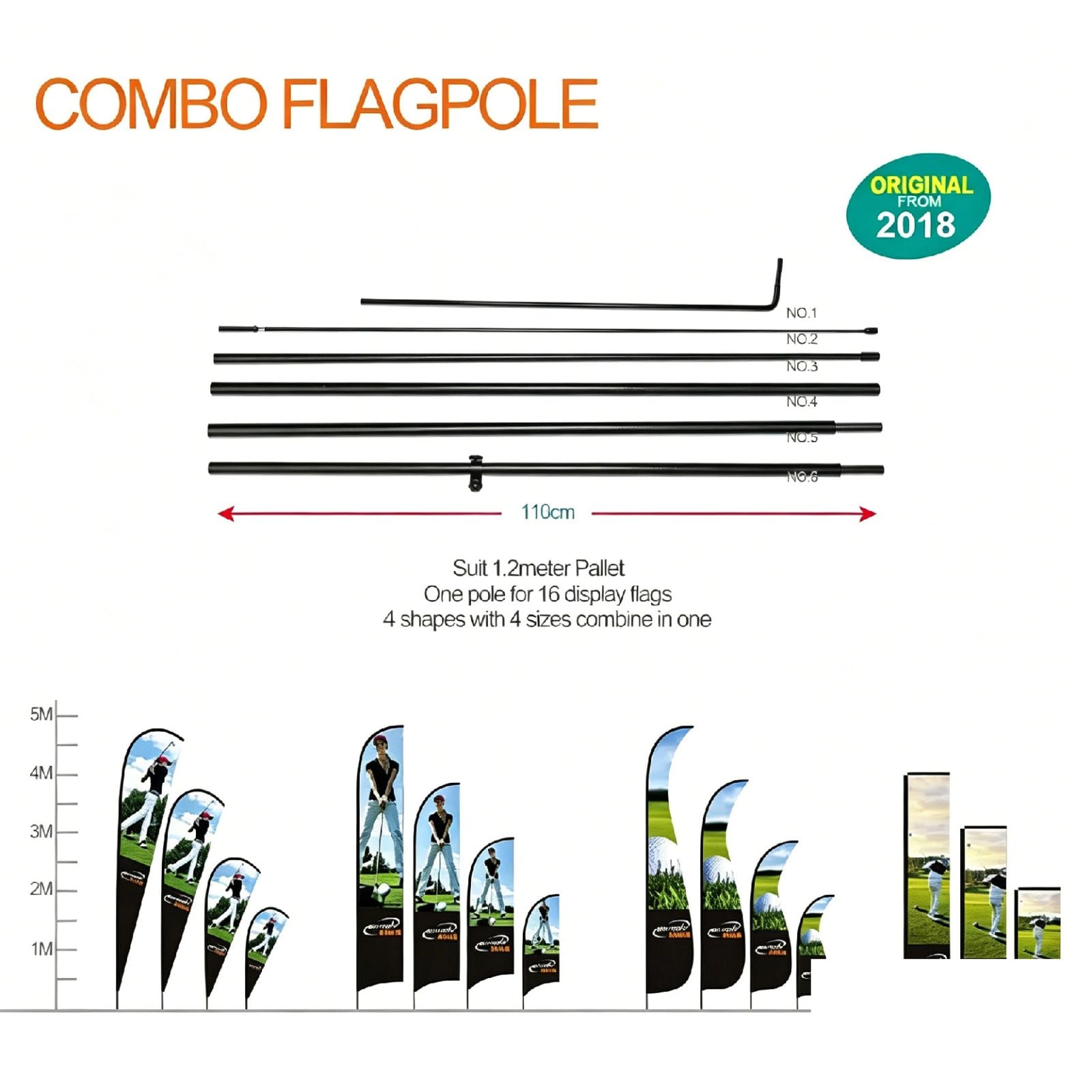
Combo Pole
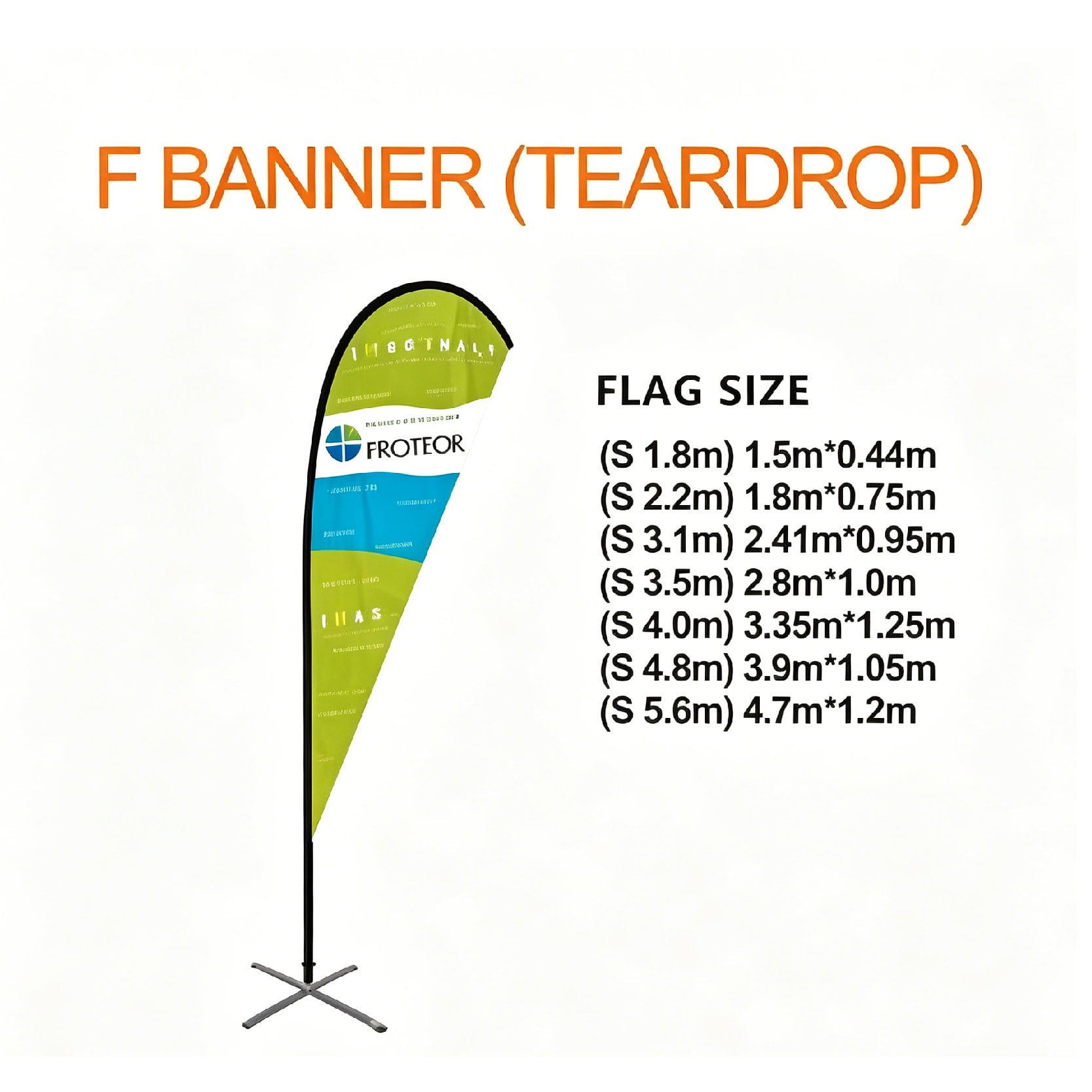
F Banner(Teardrop)
Golf flag pins
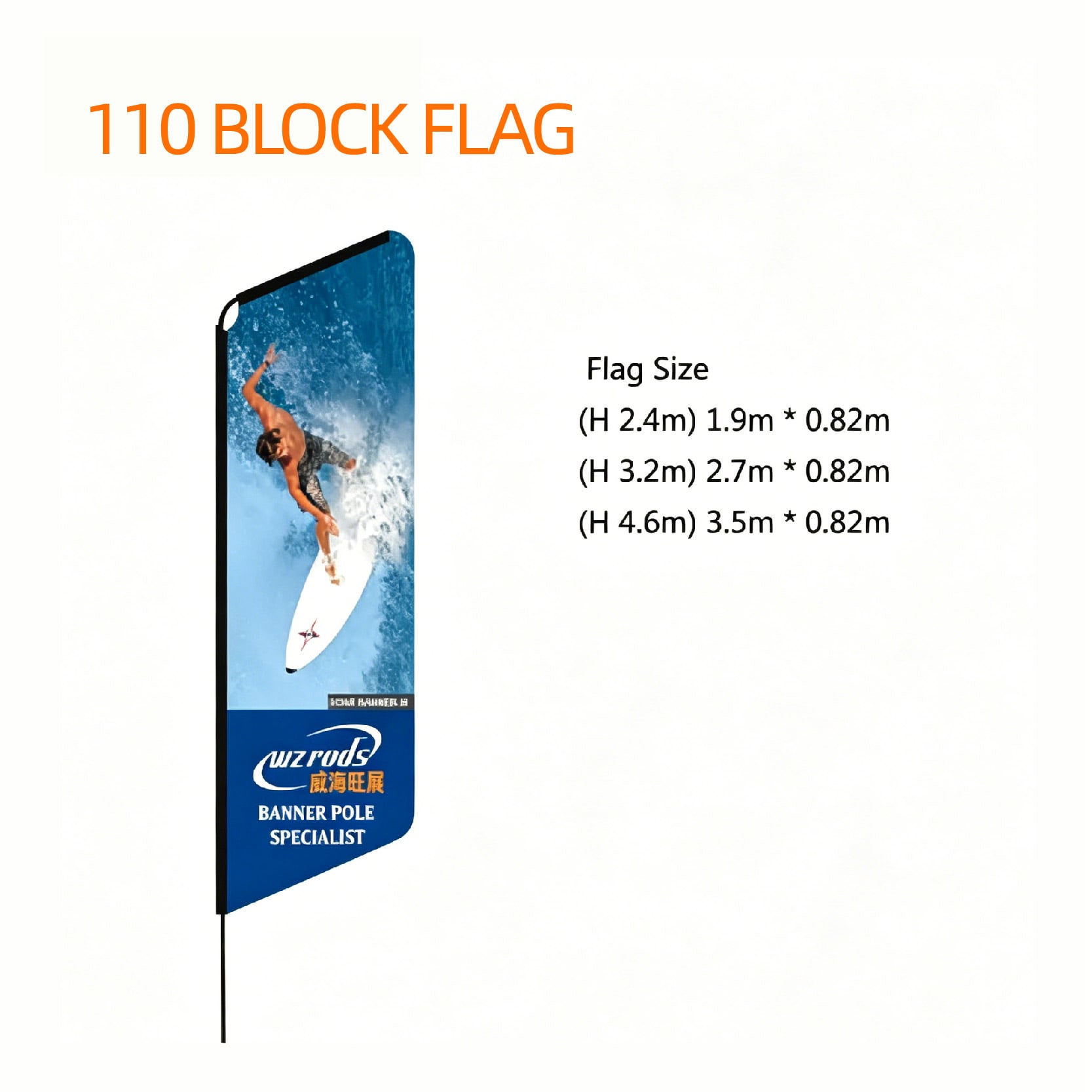
110° H banner
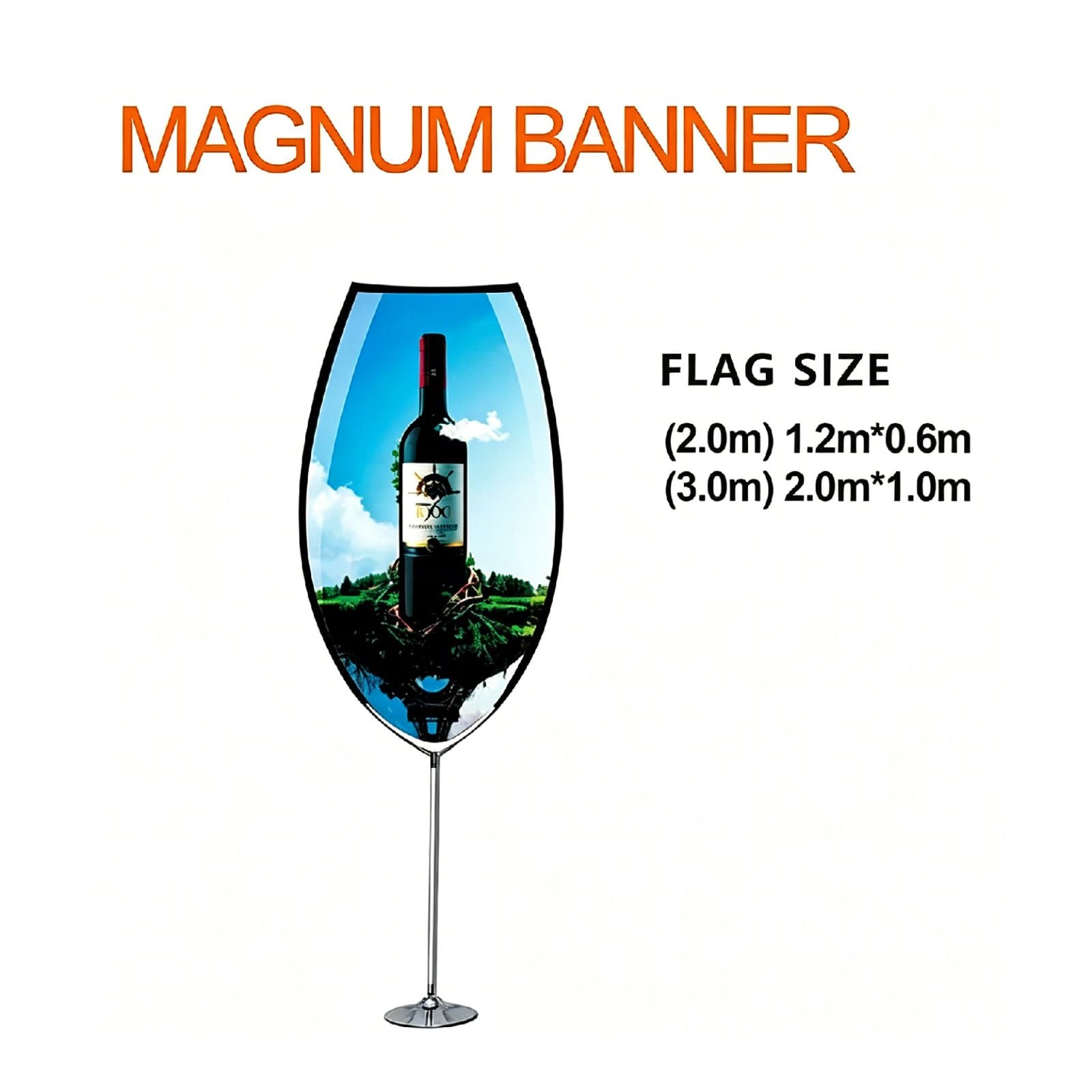
Magnum banner
Wall Mounted Flagpole
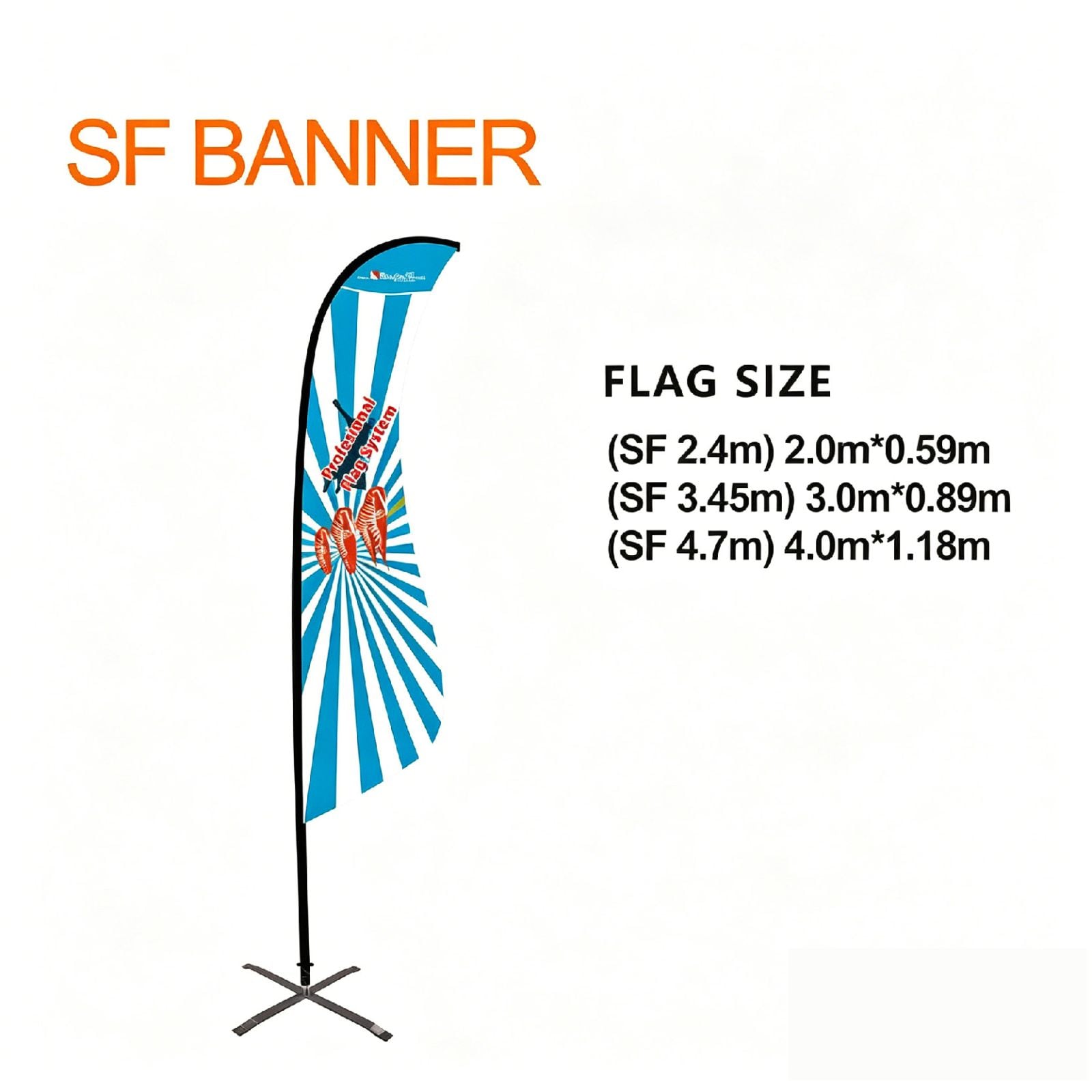
SF Banner
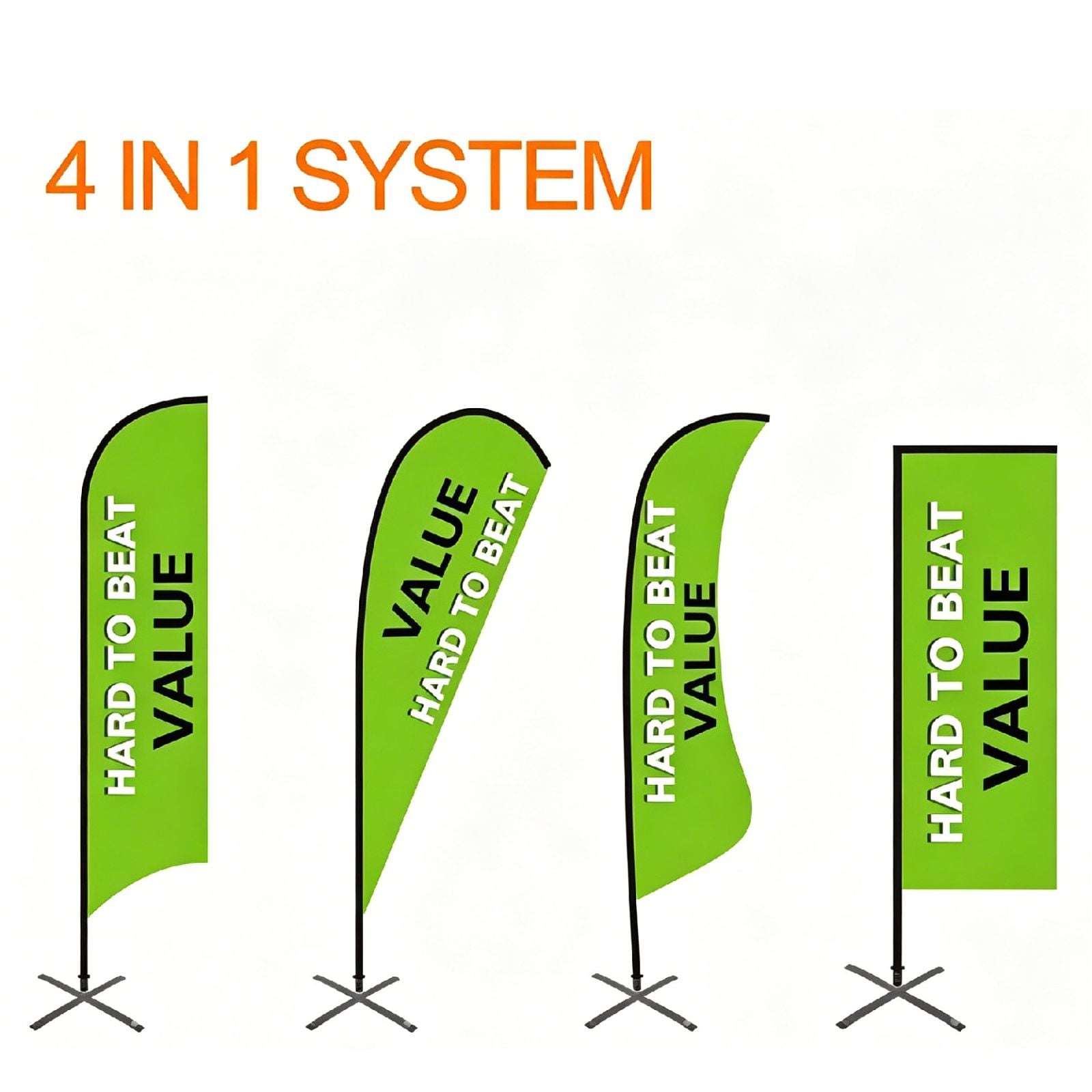
4 in 1 flag System
T Banner
H Banner
Related Articles
29kg Concrete Flag Base - The Complete B2B Buyer's Resource - WZRODS
WZRODS DY451B: 29 kg, HDPE shell, concrete core. Stackable, portable, rust-proof. FOB price US$5.75–$6.85 at MOQ 2 units. Those numbers look unremarkable. Factor in landed cost—import duties lower than aluminum’s under relevant HTS codes, freight savings from less weight per unit of stabilizing mas
Wide Tube Cross Base - The Complete B2B Buyer's Resource - WZRODS
The Wide Tube Cross Base, manufactured by Wzrods in Shandong, China, solves one problem: reliable stability for poles under three meters, without the freight costs and warehouse footprint that heavier alternatives demand.
Rectangular Pipe Cross Base - The Complete B2B Buyer's Resource - WZRODS
The pipe cross flag base is a cross of rectangular steel pipe, powder‑coated, weighing 1.3 kg and spanning 78 cm across its arms. Its center holds a C‑ring shaft that lets the flag rotate with the wind.
X-Shape Backpack Banner - The Complete B2B Buyer's Resource - WZRODS
Economic Cross Base - The Complete B2B Buyer's Guide- WZRODS
When you buy an economic cross base—something like the Wzrods DM‑9, a 77 cm‑long, 1.3 kg iron cross—forget “economic” as a synonym for “cheap.” It means value-engineered.
How to Choose the Right Feather Flag Base for Different Surfaces
Feather Flag - Professional Banner Poles & Systems Manufacturer - WZRODS
How to choose a high-quality backpack flag
The backpack flag concept centers on a frame carried on the back, similar to a backpack, specifically engineered to support a raised flag or banner.