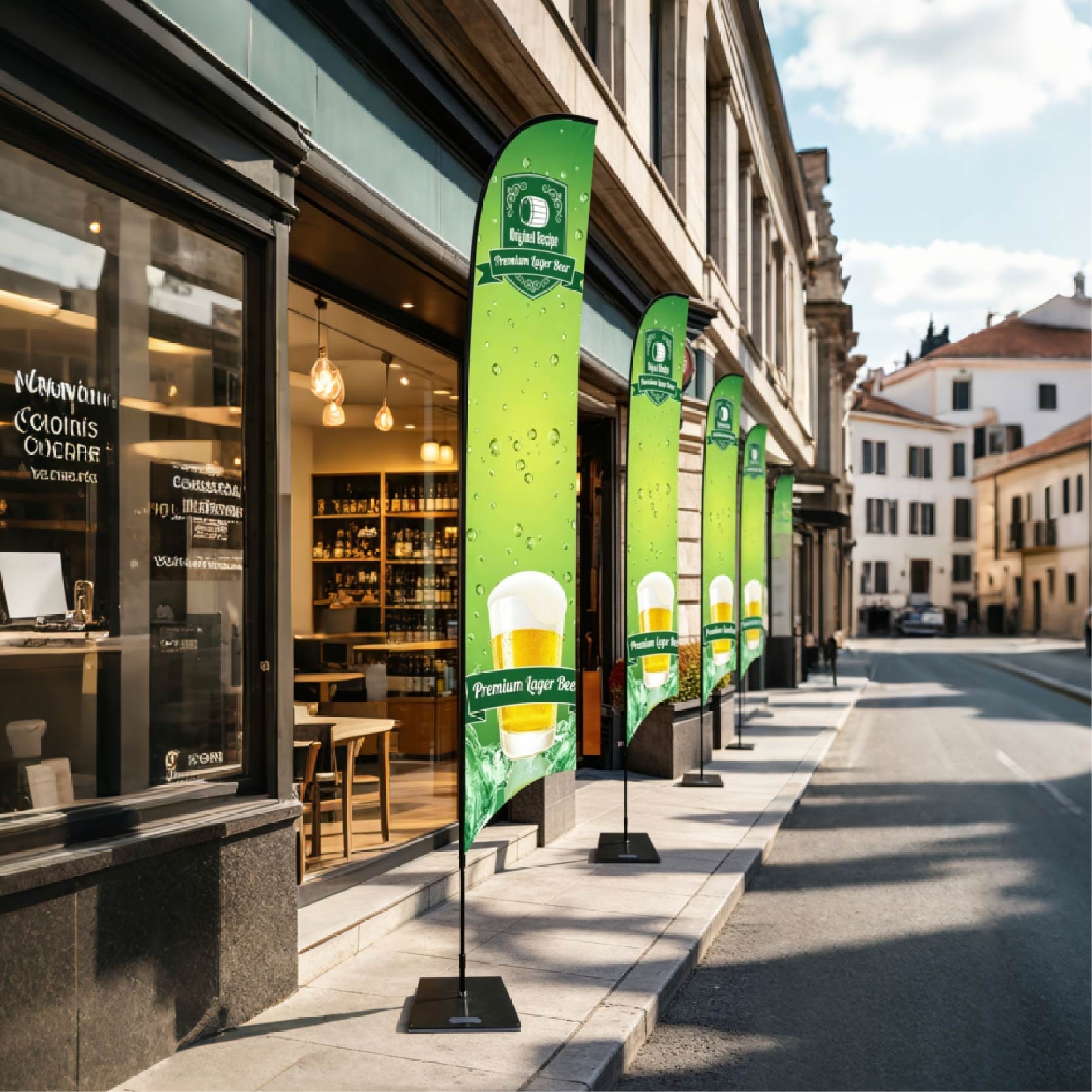
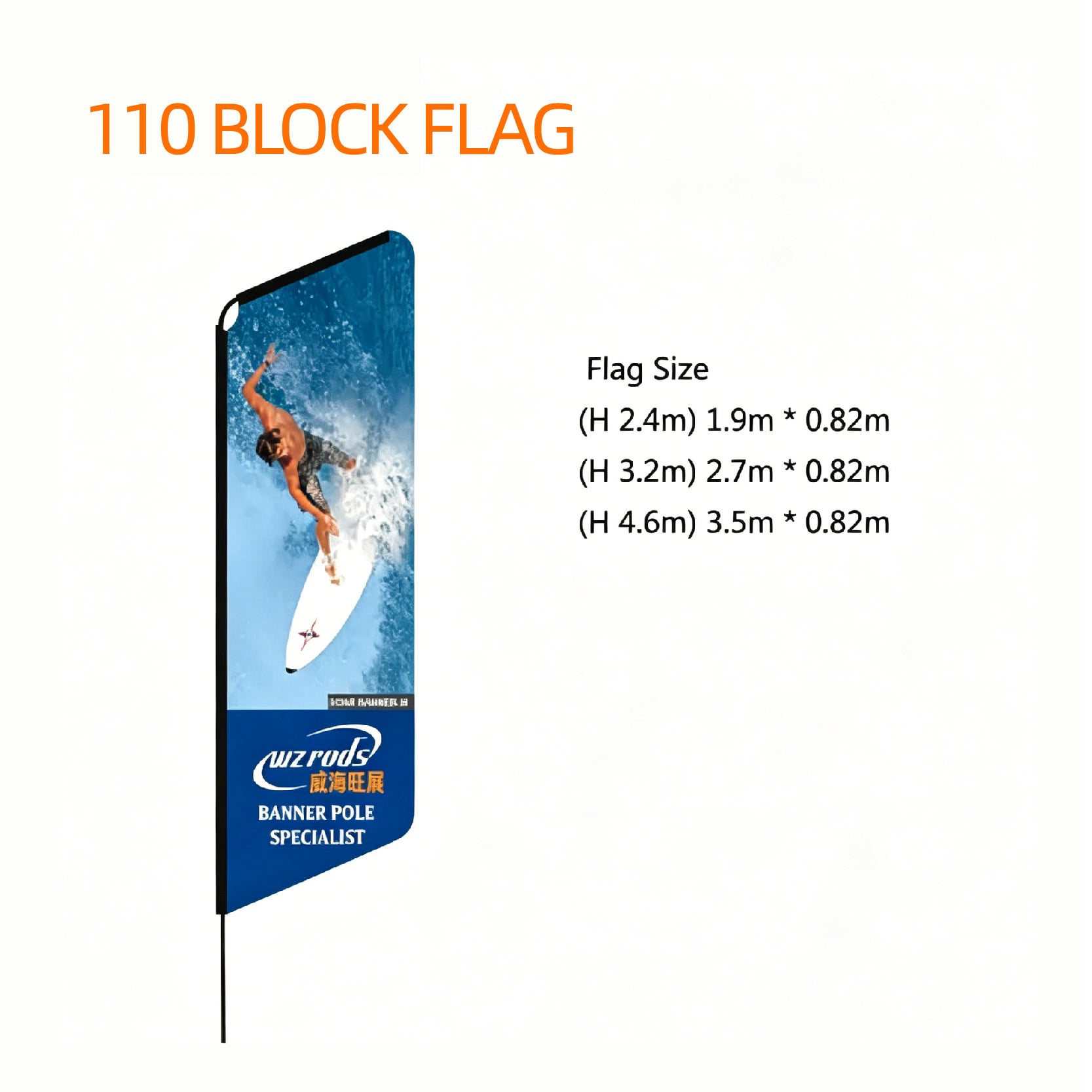
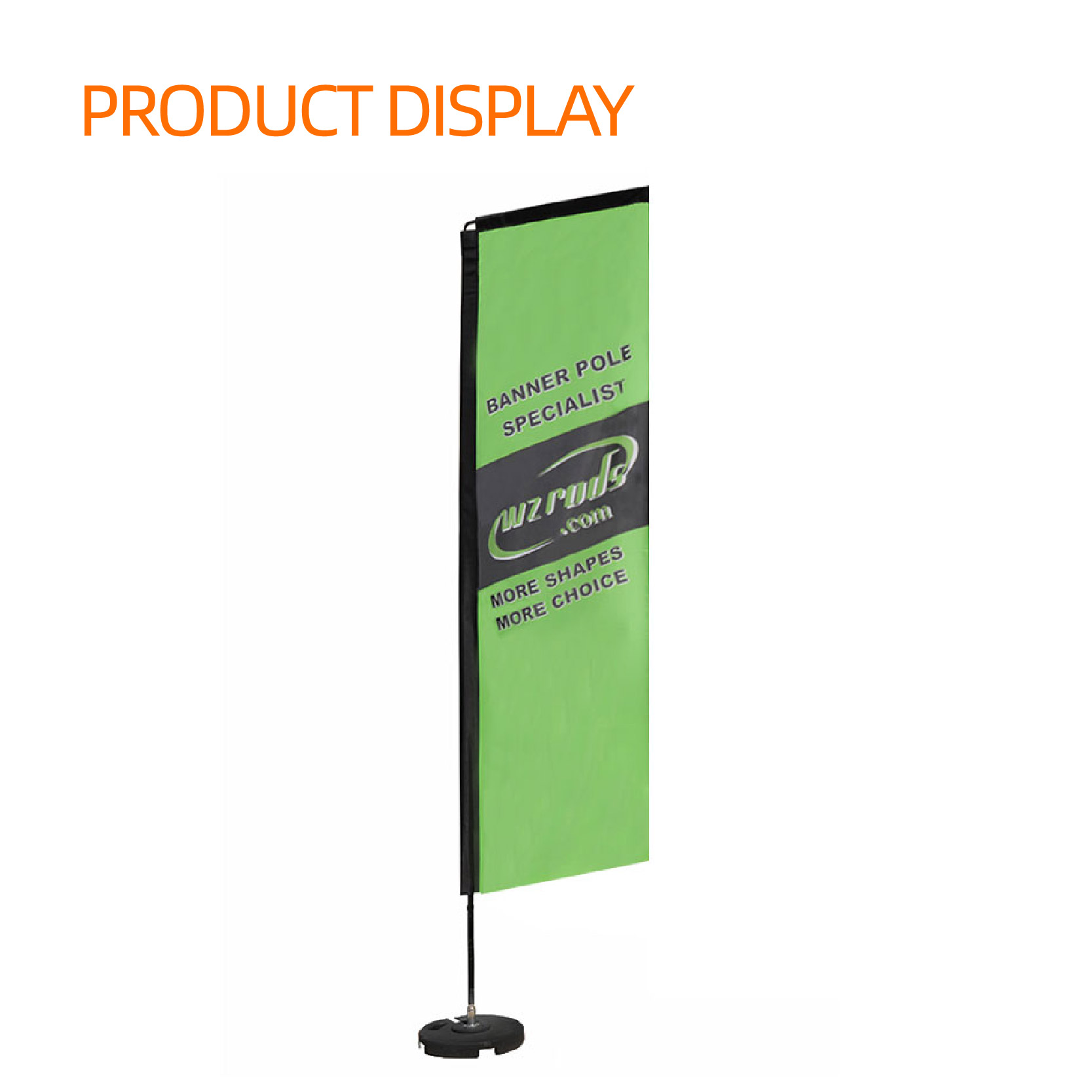
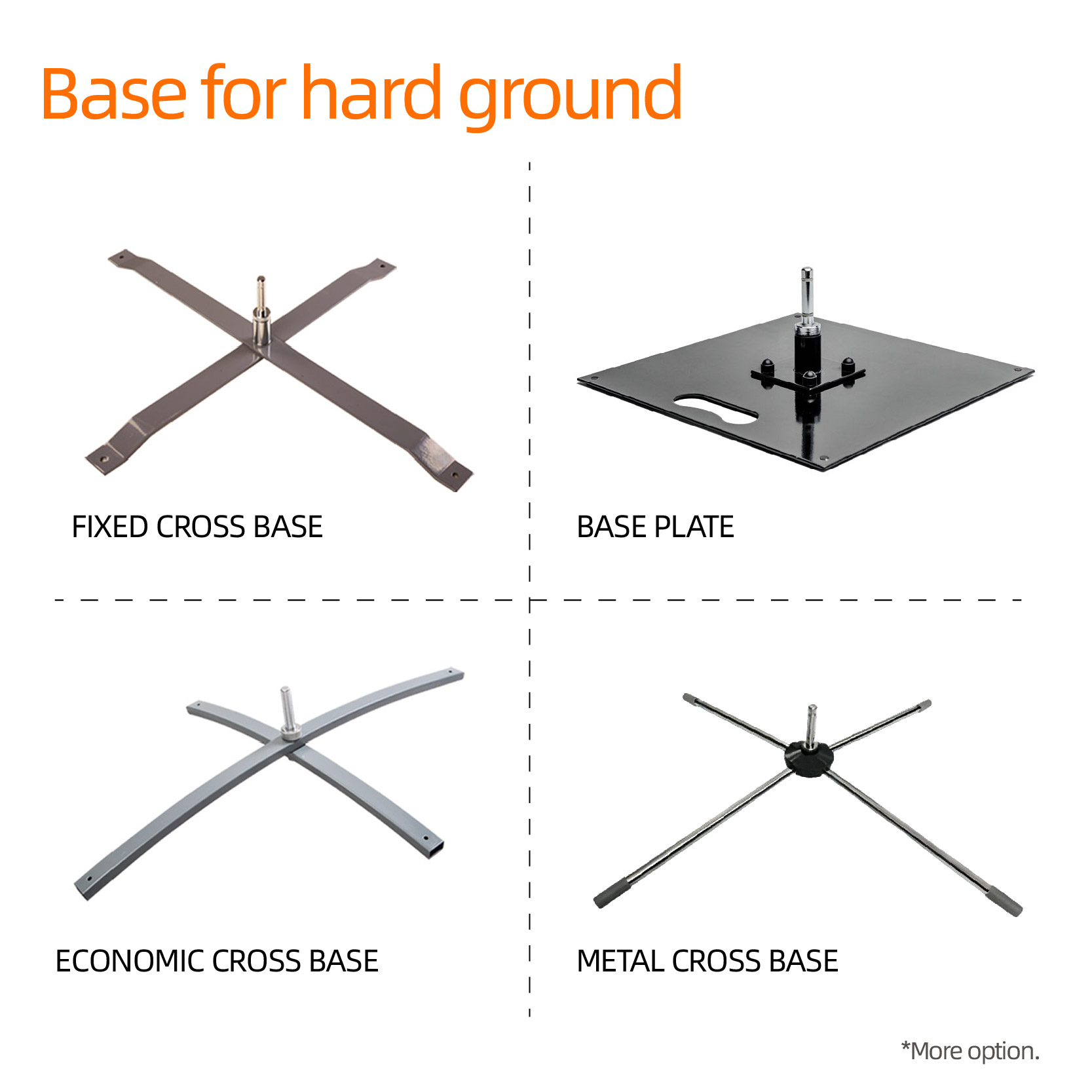
Angled Banner Stand
110° H (Curved banners)banners feature spacious printing. Built with flexible carbon composite pole in 3 sizes, lightweight and portable, equipped with carry bag and base.


 Article
 Specifications
- Origin
- Shandong, China
- Brand
- WZRODS
- Banner Material
- 100% Polyester
- Color
- CMYK 4 Color
- Application Spec
- Trade Shows, Outdoor Events, Sports Events, Retail Promotion
- Printing Method
- Digital Printing, Thermal Transfer Printing, Silk Screen Printing, Digital printing
- Print Color
- 4 color
- Artwork Format
- Ai. Pdf. Eps.PSD
- Moq
- 1 PCS
- Style
- FLYING
- 110H2.5M Size
- 1.77*0.73M
- 110H3.3M Size
- 2.5*0.73M
- 110H4.3M Size
- 3.52*0.73M
- Packaging
- Carry Bag/string rope bag/non-woven bag
- Pole Design
- Plug-in Assembly Design
- Pole Material
- Carbon composite
 Product Description
Shipping & Packaging
- Unit Weight
- HS384:0.9kg; HM385:1.12kg; HL386:1.5kg
- Unit Size
- HS384:115*19*19(cm); HM385:155*17*18(cm); HL386:147*19*20(cm) 10pcs/CTN
- Packaging
- Standard export carton
- Lead Time
- 15-30 days
Pricing
- MOQ
- 1 piece
- Price Range
- USD 8.1 – 19.3
* FOB Qingdao. Excludes shipping & taxes. Accessories & customization confirmed separately.
 Sample Service
- Sample Available
- Yes
 Customization Options

Light Custom
Logo, color, size adjustments

Fast Turnaround
Quick custom order processing
3-Day Design
Free mockup within 3 days
Banner Stand Weights: The Formula for Not Falling Over
Banner Stand Weights: The Formula for Not Falling Over
"How much weight does my banner stand need?" is the question that separates a first-time buyer from a distributor who has already eaten a claim. The honest answer is that the number you need is not printed on any spec sheet, because it depends on where the stand goes — not just what it weighs. But it is calculable, and once you know the formula you can specify with confidence instead of superstition.
Here is the short version before we go through the working:
Required ballast mass (kg) ≈ (1.5 × wind force on the banner × height of the banner's centre) ÷ (9.81 × half the base footprint span)
For a 2.5 m curved banner with about 1.3 m² of print area standing on a base with an 0.8 m span, that works out at roughly 8–15 kg indoors, 17–30 kg in a sheltered outdoor spot, and 35 kg or more once you are in open wind — at which point anchoring beats ballast every time. The rest of this article explains where those figures come from, and how to adjust them for your own sizes, sites and markets.
Banner stand weight is two different numbers
Most of the confusion in this category comes from buyers comparing the wrong figures. There are two masses in play, and they behave completely differently:
- Unit weight — the mass of the pole system, hub and arms that ships in the carry bag. For the WZRODS 110° H banner this is 0.9 kg (HS384, 2.5 m), 1.12 kg (HM385, 3.3 m) and 1.5 kg (HL386, 4.3 m). Lower is better: it cuts freight, handling time and damage in transit.
- Ballast weight — the mass you add at the base to stop the thing tipping. Higher is better, and it has nothing to do with how light the pole is.
Those three sizes, by the way, carry printed areas of 1.77 × 0.73 m, 2.5 × 0.73 m and 3.52 × 0.73 m respectively. Remember those numbers — the sail area is the single biggest driver of the answer.
A lightweight banner stand paired with a properly weighted base is the correct combination. A heavy banner stand with a small base is not. A common mistake in tender documents is to specify "heavy duty banner stand" when what the site actually needs is "small sail area, wide base footprint, local ballast" — and the second one ships cheaper and stands up better.
The formula, step by step
This is standard statics — the same tipping check used for any temporary structure. Work through it in four steps.
Step 1: Velocity pressure
Convert wind speed into pressure. With v in metres per second:
q = 0.613 × v² (N/m²)
Note the square. Doubling wind speed quadruples the load. This is why a stand that is perfectly stable on a calm morning can be on the floor by 3 p.m., and why "we tested it at 20 km/h" tells you almost nothing about 40 km/h.
Step 2: Force on the sail
F = q × Cd × A (N)
A is the projected area of the printed banner in square metres. Cd is a drag coefficient — use 1.2 for a flat, taut banner. This is deliberately conservative: it treats the banner as a solid plate and takes no credit for the way a flexible carbon composite pole spills wind as it deflects.
Step 3: Overturning moment
M = F × h (N·m)
h is the height of the centre of the printed area above the ground, not the height of the stand. For a 2.5 m unit, that is roughly 1.5 m; for 3.3 m, about 1.9 m; for 4.3 m, about 2.3 m.
Step 4: Required ballast
m = (SF × M) ÷ (9.81 × d) kg
d is the horizontal distance from the centre of the base to its tipping edge — half the footprint span — and SF is a safety factor of 1.5 for temporary public-facing equipment. Note that d sits in the denominator: widening the base is cheaper than adding steel. Going from an 0.8 m span to a 1.2 m span cuts the required mass by a third, which is usually a better answer than shipping heavier plates around the world.
Worked example: 110° H banner, 2.5 m
Assume a design gust of 8 m/s (about 29 km/h), an 0.8 m base span, and the HS384 print area of 1.77 × 0.73 m = 1.29 m².
- q = 0.613 × 8² = 39.2 N/m²
- F = 39.2 × 1.2 × 1.29 = 60.7 N
- M = 60.7 × 1.5 = 91 N·m
- m = (1.5 × 91) ÷ (9.81 × 0.40) = 136.5 ÷ 3.924 ≈ 35 kg
Thirty-five kilograms for a 29 km/h breeze. That number surprises people, and it should. It is the reason most freestanding banner stands sold on price fall over in the first real gust: the base in the box is typically a 3–6 kg cross base, which by this calculation is adequate for a quiet indoor corner and nothing else.
Run the same calculation at 5 m/s (18 km/h) and you get 14 kg. At 10 m/s (36 km/h), 54 kg. The curve is steep, and no base is going to keep up with it indefinitely.
Practical ballast by scenario
The table below applies the formula above (Cd 1.2, SF 1.5, 0.8 m base span, no credit taken for pole flex) and rounds to usable figures. Site conditions always override it — see the exposure notes underneath.
| Exposure | Design gust | HS384 (2.5 m) | HM385 (3.3 m) | HL386 (4.3 m) | Recommended approach |
|---|---|---|---|---|---|
| Indoor, low traffic (show floor corner, retail alcove) | negligible | 8 kg | 10 kg | 12 kg | Standard cross base is adequate |
| Indoor, high traffic (aisles, entrances, queue lines, door drafts) | negligible | 15 kg | 20 kg | 25 kg | Weighted plate or filled base |
| Sheltered outdoor (courtyard, under canopy, wall-sheltered) | ~20 km/h | 17 kg | 30 kg | 50 kg | Filled base plus one anchored guy line |
| Open outdoor (plaza, car park, sports perimeter) | ~30 km/h | 38 kg | 67 kg | 115 kg | Anchor to ground — do not rely on ballast alone |
| Exposed / coastal / elevated (pier, rooftop, seafront) | 40 km/h+ | — | — | — | Fixed anchorage, or do not deploy freestanding |
Two footnotes that matter more than the numbers:
- The indoor figures are driven by people, not wind. A 20 N accidental push at head height produces roughly the same overturning moment as a stiff breeze. A 15 kg base on a busy aisle is about protecting the stand from the delegate, not the weather.
- Wind at banner height is not the wind on the weather app. Met stations report at 10 m in open terrain. A stand in a courtyard surrounded by buildings sees materially less; a stand on a seafront promenade sees more. When in doubt, round up one row in the table.
Choosing the base: water, sand or steel
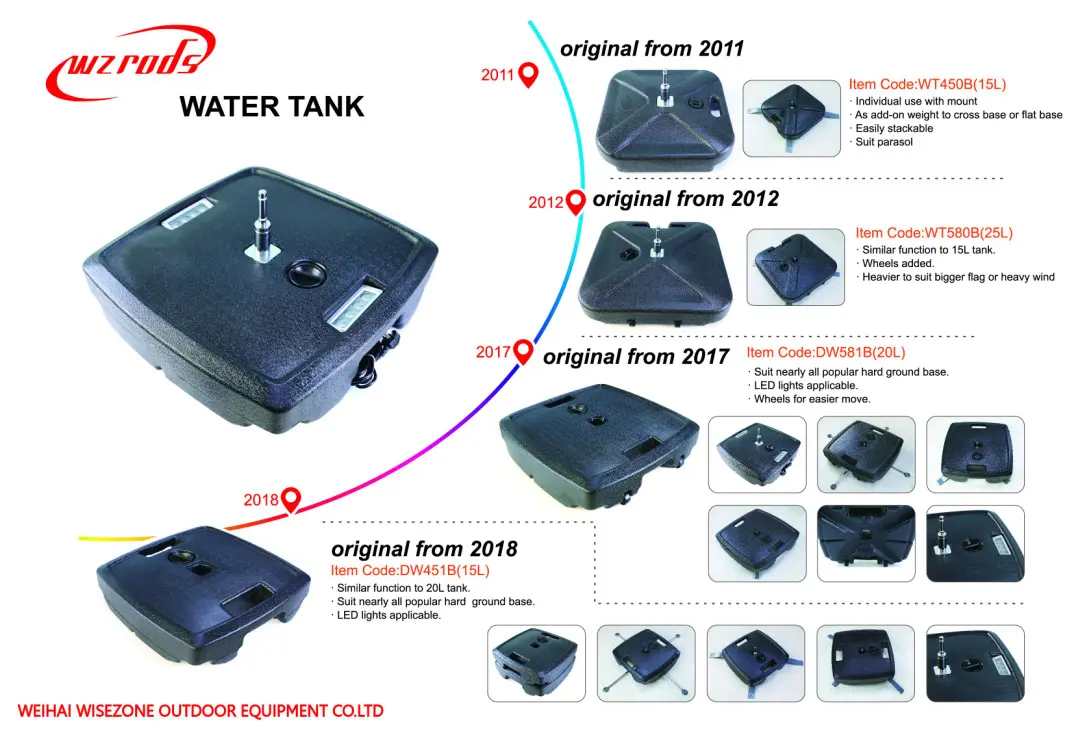
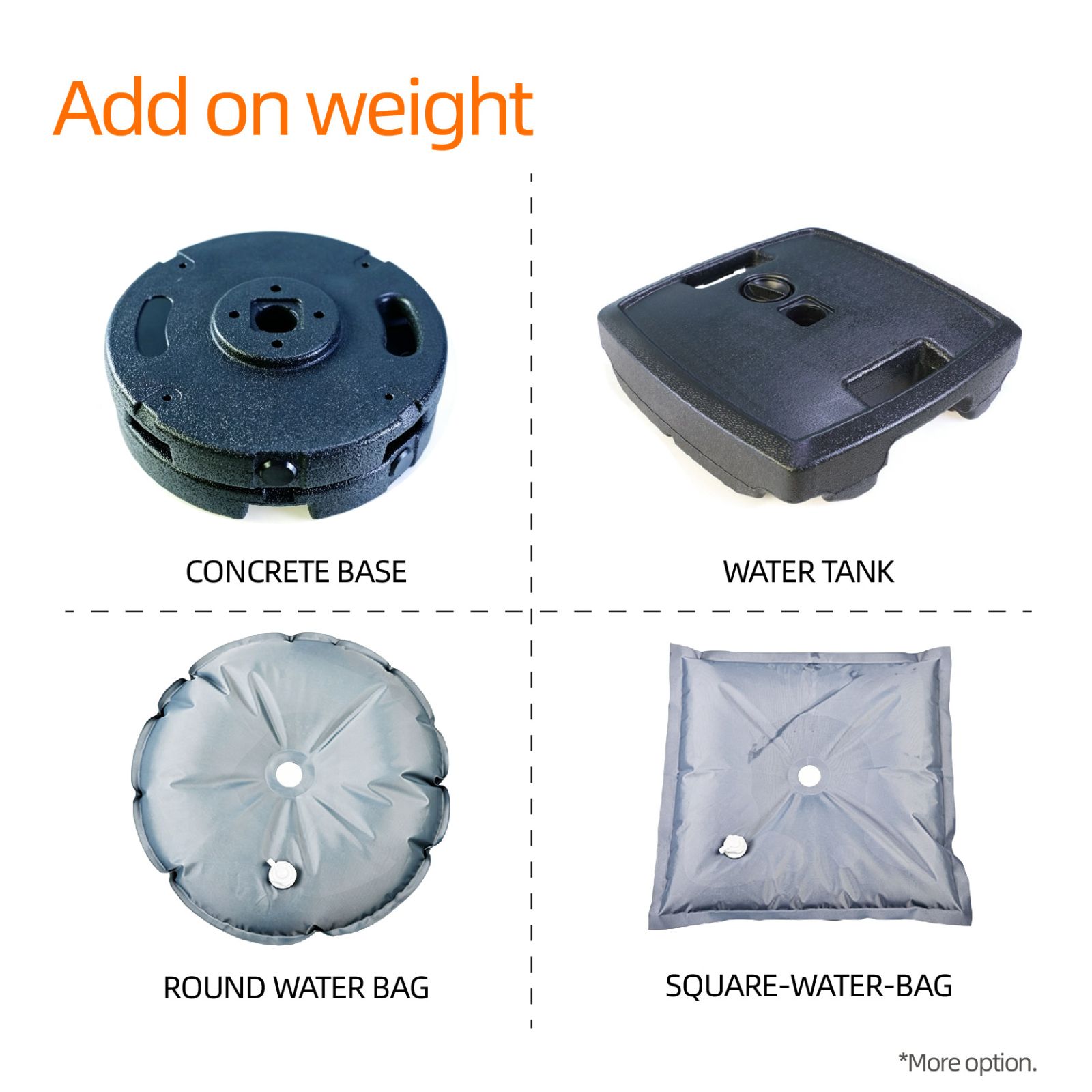
Fillable bases are the standard answer for portable work, but the fill material decides the result. A 15-litre water base holds 15 kg of water — or roughly 24 kg of dry sand in the same mould, because sand is about 60% denser. Same freight cost, 60% more stability. For distributors, that is a useful line in the catalogue: sell the mould, source the ballast locally.
Water has one obvious failure mode. In sub-zero conditions it freezes, expands and splits the mould — so in cold-climate markets, specify sand or a cast-iron plate instead. If you are building a winter event kit, that consideration belongs in the specification from day one, not in the claim afterwards.
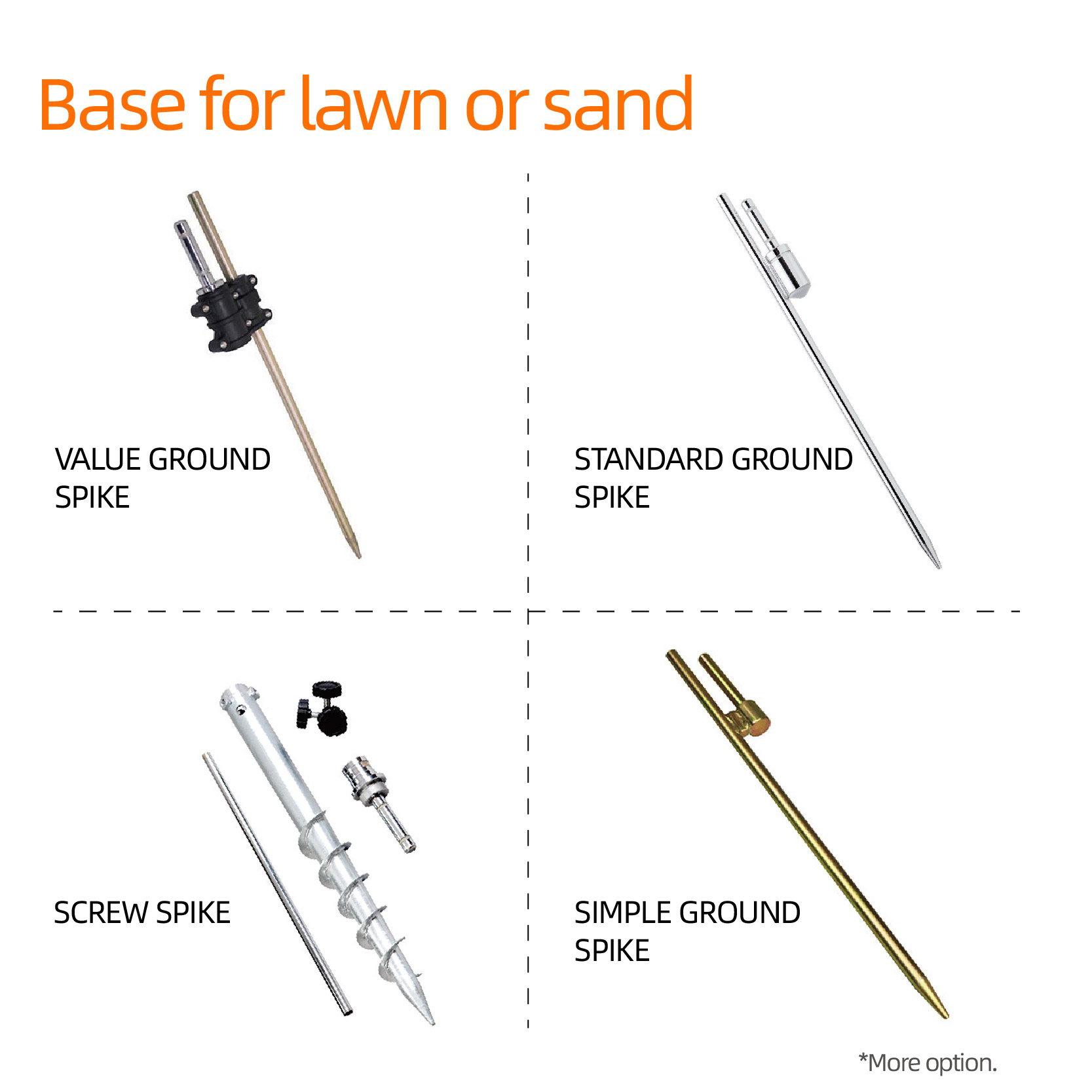
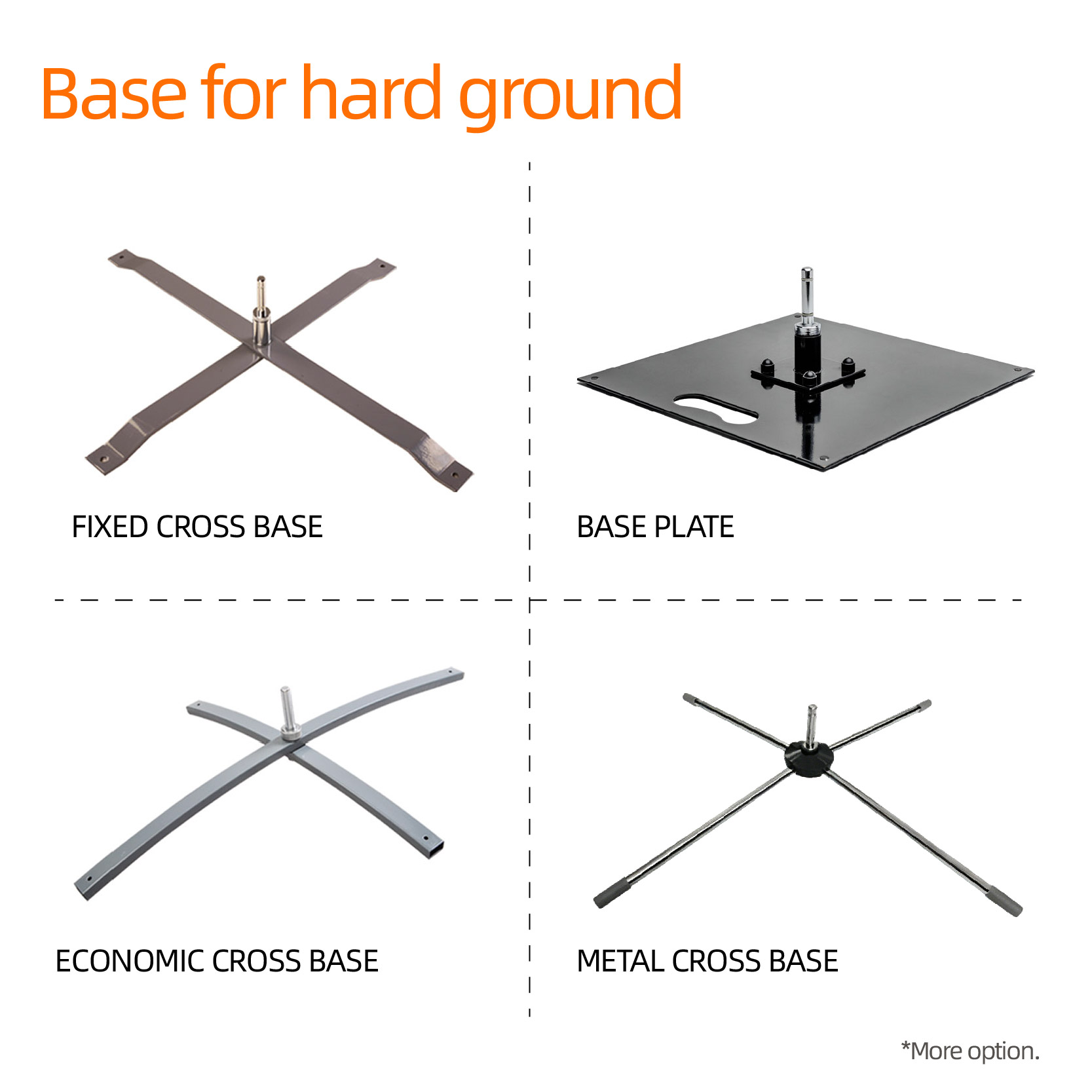
For hard surfaces where stakes are impossible — concrete aprons, cruise terminals, exhibition halls — the base is doing all the work, and a wide, low disc or X-frame with a low centre of gravity outperforms a tall stack of plates. WZRODS holds a utility model patent on its advertising flag disc base (No. ZL 2017 2 0625687.7), which is the kind of detail worth checking when a supplier's base is the weak point in an otherwise good system.
Whatever base you choose, ballast goes on the base plate or spokes, low and centred. Never hang w eights from the pole — you raise the centre of gravity and add a pendulum instead of a foundation.
Why carbon composite changes both sides of the equation
A carbon composite pole bends under gust load and returns; an aluminium pole of the same section deforms permanently. That difference matters twice over.
First, the deflection sheds wind. As the pole curves, the projected sail area drops and the peak load with it, which is why a wind-tested carbon composite system survives conditions that leave an aluminium stand bent at 30 degrees. We deliberately do not take credit for that spill effect in the ballast table above — a conservative specification is a specification that does not depend on the pole behaving perfectly.
Second, the unit weight stays low. At 0.9 kg, 1.12 kg and 1.5 kg, the pole sets ship economically — and because the heavy component is the base, and the base can be sourced locally, you are not paying international freight on dead weight. Ten sets go into one export carton (HS384: 115 × 19 × 19 cm; HM385: 155 × 17 × 18 cm; HL386: 147 × 19 × 20 cm), which keeps container utilisation predictable when you are planning a season's stock.
What the standards require
If you are supplying events rather than decorating a shop, the ballast calculation is not optional. Two European references come up repeatedly:
- EN 1991-1-4 divides Europe into five wind zones with basic wind speeds from 19 to 36 m/s. Outdoor display equipment should be designed against the zone where it will actually be installed — and the top of that range belongs to Nordic and UK coastal locations, not to a generic "European" figure.
- EN 13782 covers temporary structures, including wind load calculation, anchor force and stability verification. Display gantries and entry arches with a span above 3 m generally require a structural calculation sheet. Freestanding banner stands sit outside the heaviest part of that scope, but organisers increasingly ask for the same documentation discipline across the whole site.
This is also where an honest supplier is worth more than a cheap one. If a quotation promises a wind rating without stating the design speed, the terrain category and the ballast assumption behind it, the rating is marketing, not engineering.
The weight you pay for twice: freight, duty and landed cost
For importers, banner stand weight is a cost line before it is a stability question. EU customs valuation uses the CIF basis — cost plus insurance plus freight — and for display equipment, freight typically runs 15–25% of the CIF value. Every kilogram of pole you ship is a kilogram you pay freight on, pay duty on, and then pay again to move from the port to the warehouse.
There is a second lever: carbon composite poles fall under different HTS codes from aluminium equivalents, and generally attract lower import duty. Combined with a lighter ship weight and a base sourced in-market, that usually produces a lower total landed cost than a cheaper-priced aluminium stand — even though the unit price on the invoice is higher. The 110° H banner is not the cheapest banner stand on the market, and we would rather say so than pretend otherwise. It is the one that does not need replacing mid-season.
Where terms get extended, credit risk is the other half of landed cost. China export credit insurance (SINOSURE) covers buyer insolvency, default and political risk at roughly 0.3–1.5% of insured value depending on country and buyer rating, typically indemnifying 80–90%. For distributors in Africa, South America and Eastern Europe it is close to essential; for North America and Western Europe it is optional. Against one defaulted container, it is cheap.
Market note: Spain
Spain illustrates why the exposure column in the table matters more than the average. The market is substantial — UN Comtrade data summarised by TradeDataService puts China's 2025 exports to Spain under HS 761090, the heading most banner-pole and display-structure trade is classified under, at $66.8 million. The economy is $1.91 trillion with 2.7% inflation in 2025, and the euro rate at the time of writing sits near 1 USD ≈ 0.8956 EUR, so euro-denominated quotes need a margin buffer built in.
The wind picture is not uniform. Spain's interior is comparatively benign, but its coasts sit in the upper bands of EN 1991-1-4, and a seafront installation in a coastal town is a different engineering problem from an exhibition hall in Madrid. On the day of writing, the reference reading was 3.1 km/h and 10.1°C with a UV index of 3.95 — exactly the trap. The base gets specified on a calm day and tested on a windy one. Salt aerosol is the other factor: 100% rust-proof poles matter on the Costas in a way they do not inland, and 316 stainless hardware is the difference between a two-season asset and a five-season one.
Field reference: five cruise terminals, 40 km/h, zero failures
A European cruise operator needed branded welcome banners at five port terminals. The first attempt used standard aluminium poles; sea air and salt spray had them corroding within three months, and the concrete quays ruled out ground spikes.
The replacement moved to a Combo Pole system with X-base hard-ground ballast, 316 stainless hardware and 170 g UV-resistant polyester flags — a combination that reached ISO 9227 C5-M corrosion classification. Service life went from three months to 24 months, and the terminals recorded zero fall-overs in 40 km/h sea winds. The operator renewed annually.
The lesson is not "buy the premium pole". It is that the base and the anchor are chosen for the ground, and the pole is chosen for the air. Those are separate decisions, and the ballast formula belongs to the first one.
A 60-second pre-order site check
- Ground: soil, sand, concrete or deck? This eliminates half the base options immediately.
- Exposure: which row of the table above is your worst realistic case?
- Footprint available: can you widen the base? It is cheaper than adding mass.
- Sail area: the largest banner in the range has 2.57 m² of print. That is a serious sail, and it needs a serious answer.
- Banner fabric: if the design is double-sided, check the base cloth. A 110 g fabric printed both sides bleeds through and the reverse image shows through the front; 130 g and above keeps light transmission under 15%. A blockout liner solves it for about $0.20/m² — far cheaper than a reprint.
- Storage and transport: carry bag included, 10 sets per export carton. Confirm carton dimensions against your pallet plan before the order, not after.
Why buyers specify WZRODS for this
We have been making carbon composite flag and banner poles in Shandong since 2005 — 20+ years of quality management, 80+ countries served, and carbon composite produced in-house with batch-to-batch stability verified through incoming inspection. The 110° H banner uses a plug-in assembly design with a curved 110° side arm for a wider print field, ships with a carry bag, and is available with a range of base options matched to your site conditions.
We support private label and neutral packaging, light and fast customisation, 3-day image design, and a mixed-model MOQ that lets a new distributor test three sizes in one market before committing to volume. MOQ is 1 piece, indicative pricing runs USD 8.1–19.3 depending on size and configuration, and lead time is 15–30 days — the same window as sample delivery. Every system carries a 3-year warranty. Payment terms include L/C, T/T, D/P, D/A, Western Union and MoneyGram.
Frequently Asked Questions
How much weight does a banner stand need indoors?
For the 2.5 m size, 8 kg is enough in a quiet corner and 15 kg is the right figure for a busy aisle, entrance or anywhere with door drafts. Scale to roughly 10–20 kg for the 3.3 m and 12–25 kg for the 4.3 m. Indoors, the load case is a person brushing past the pole, not wind — which is why the answer scales with foot traffic rather than weather.
Is a heavier banner stand always more stable?
No. Stability depends on base footprint and the height of the sail far more than on pole mass. Because the footprint span sits in the denominator of the tipping calculation, doubling it halves the ballast required. A light carbon pole on a wide base will outperform a heavy aluminium pole on a narrow one every time — and it ships cheaper.
Can I use a water-filled base outdoors?
Yes, within the exposure limits in the table above, and with two caveats. Water is the least dense practical fill, so the same mould filled with sand gives roughly 60% more mass at no extra freight cost. And in freezing conditions a water-filled base can split; specify sand or cast iron for winter and cold-climate events.
How do I calculate the ballast for a banner size not listed here?
Use the four-step formula: q = 0.613 × v², F = q × 1.2 × A, M = F × h, m = (1.5 × M) ÷ (9.81 × d). Measure A as the projected print area and h as the height of its centre above ground. The method is conservative — it assumes a rigid sail and takes no credit for pole deflection — so treat the result as a minimum, not a target.
What is the unit weight of the 110° H banner, and how does it ship?
0.9 kg for the 2.5 m (HS384), 1.12 kg for the 3.3 m (HM385) and 1.5 kg for the 4.3 m (HL386) — pole system, arms and hub. Ten sets pack per export carton. Bases are specified separately so you can source ballast locally rather than paying international freight on it.
References
- EN 1991-1-4 — Eurocode 1: Actions on structures, Part 1-4: General actions — wind actions (five European wind zones, 19–36 m/s basic wind speeds).
- EN 13782 — Temporary structures: tents — safety (wind load calculation, anchoring, stability verification).
- TradeDataService, UN Comtrade summary (updated 2026-11-01): China exports to Spain under HS 761090, 2025 — $66.8 million.
- IMF World Economic Outlook — Spain real GDP growth projection 1.7% (2031); Spain GDP 2025 $1.91 trillion; inflation 2.7% (2025); USD/EUR reference 0.8956.
- SINOSURE (China Export & Credit Insurance Corporation) — export credit insurance premium range 0.3–1.5%, typical indemnity 80–90%.
- WZRODS product specification sheet — 110° H banner, three sizes, unit weights, print areas, carton dimensions, MOQ, lead time and warranty terms.
- WZRODS project record — European cruise terminal welcome banner installation, ISO 9227 C5-M, 40 km/h sea wind exposure, 24-month service life.
- Utility model patent No. ZL 2017 2 0625687.7 — advertising flag disc base, WZRODS.
- Fabric light-transmission note for double-sided printing — 110 g vs 130 g base cloth, blockout liner cost indication.
 Comments (0)
No comments yet. Be the first to comment!
Leave a Comment
Related Products
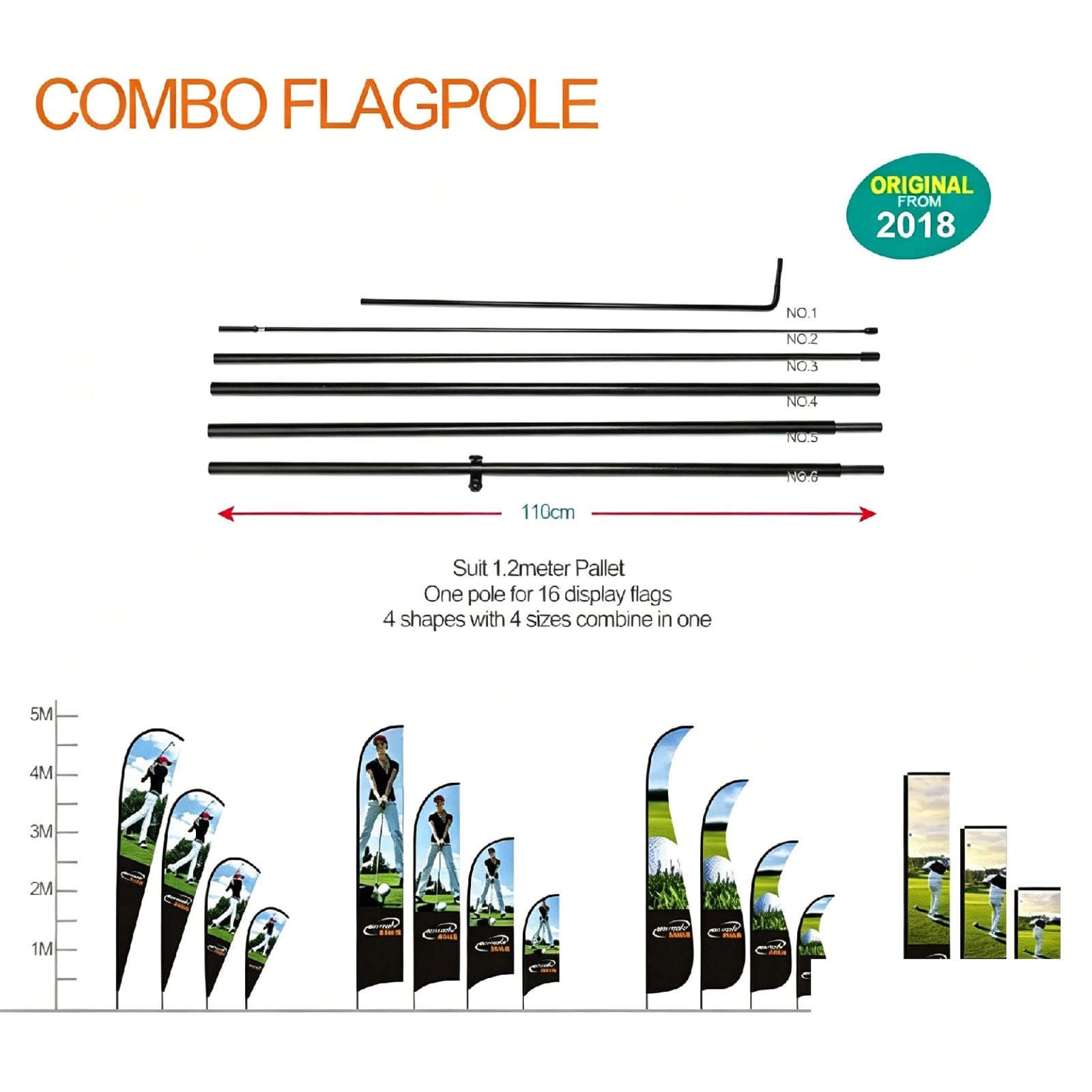
Combo Pole
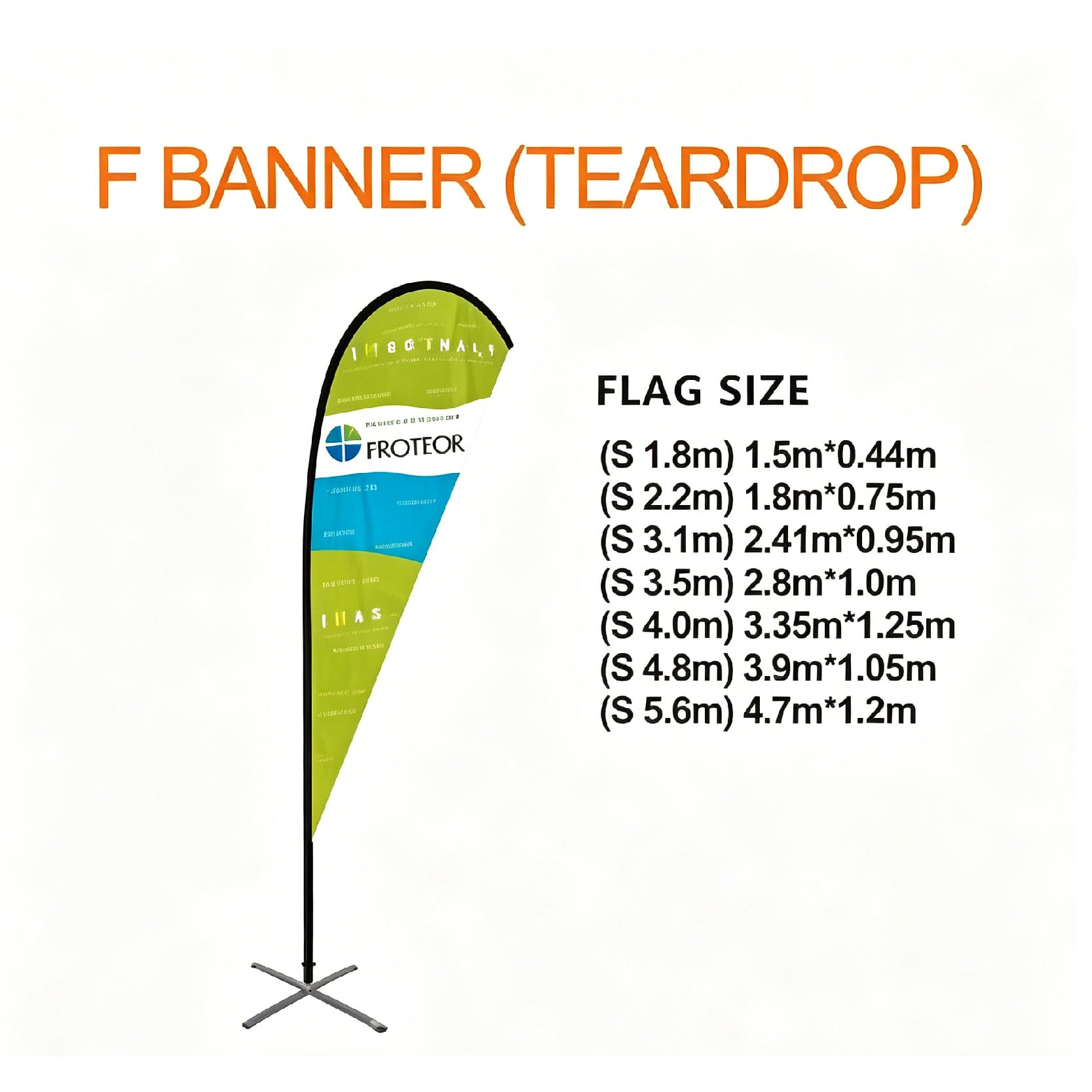
F Banner(Teardrop)
Golf flag pins
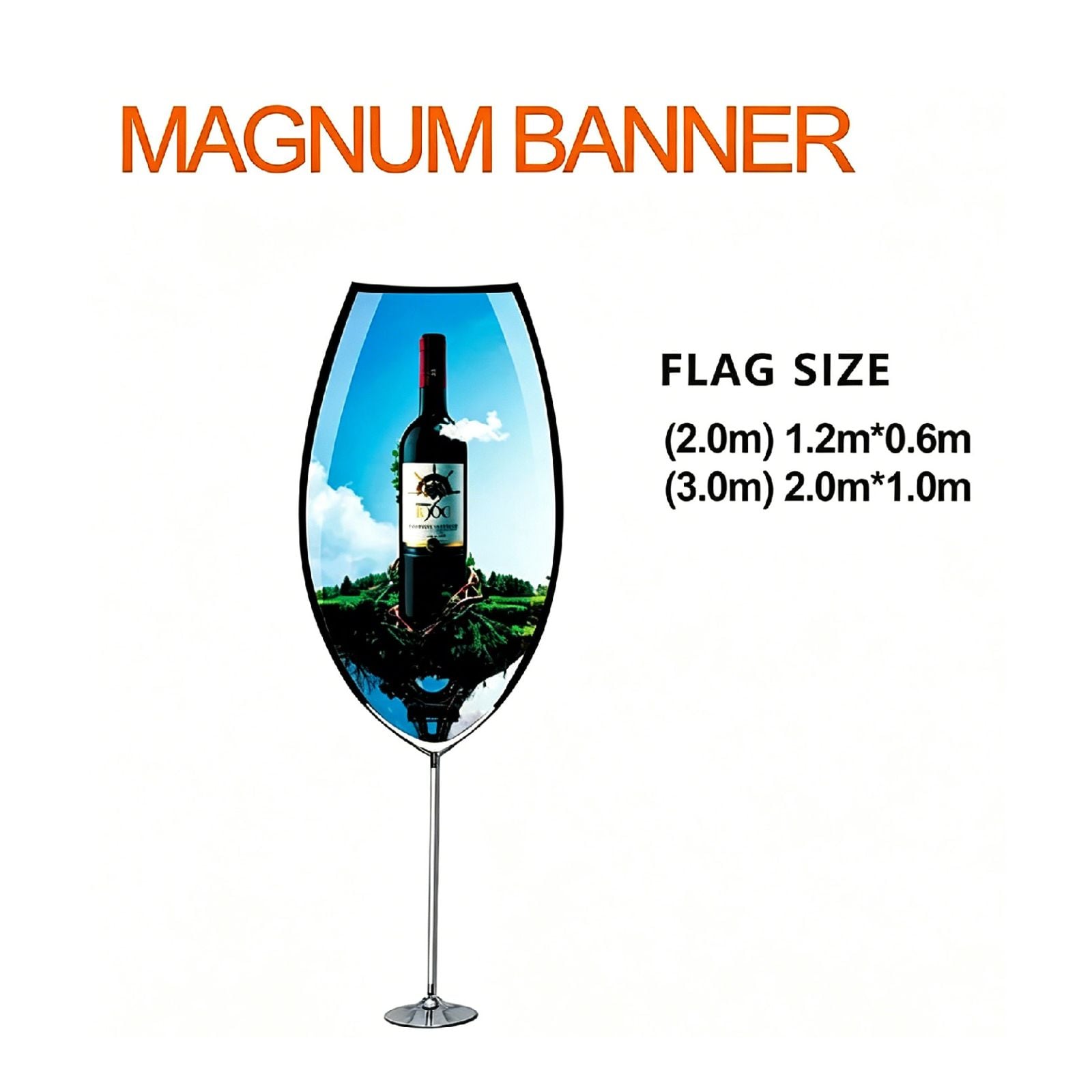
Magnum banner
Wall Mounted Flagpole
SF Banner
Budget 2in1 flag system
4 in 1 flag System
T Banner
H Banner
Related Articles
Half Moon Banners: The Shape That Commands Attention
Half Moon Banners: The Shape That Commands AttentionA half moon banner is a freestanding fabric display built on a curved frame: the printed panel is tensione
Portable Flagpoles: Pack, Carry, and Set Up Anywhere
This guide answers the practical question directly — how do you travel with a portable flagpole — and then goes further, into the specifications that determine whether a pole survives the trip and the deployment.
Ground Banner Stands: The Outdoor Setup Guide
Ground Banner Stands: The Outdoor Setup GuideEvery outdoor banner failure we hear about follows the same script: the pole was fine, the print was fine
Table Flag Stands: The Complete Size Guide
Table Flag Stands: The Complete Size GuideA table flag stand is a small object that fails in very public ways. Too light, and it tips the moment a door opens.
Portable Flag Stands: The Event Pro's Pick
Portable flag stands need balanced portability and wind stability. WZRODS WT-21 stackable solid bases with carbon poles scale weight on-site, outperforming water-fill and aluminum setups.
Feather Banner Stands: The Buyer's Quick Guide
Feather Banner Stands: The Buyer's Quick GuideThe honest answer is that there is no single "best" feather banner stand — there is a best configuration for you