
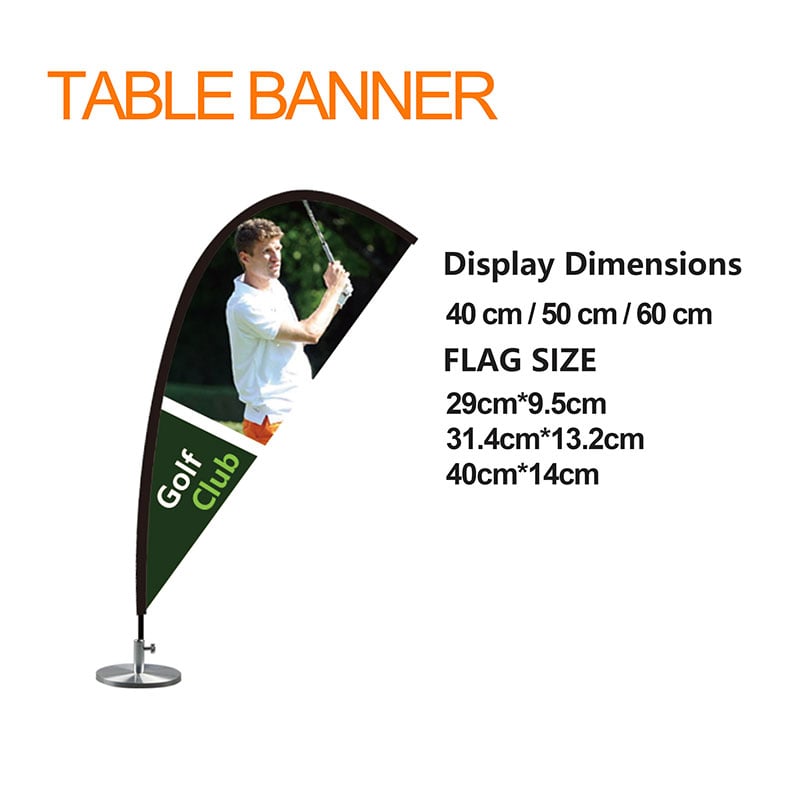
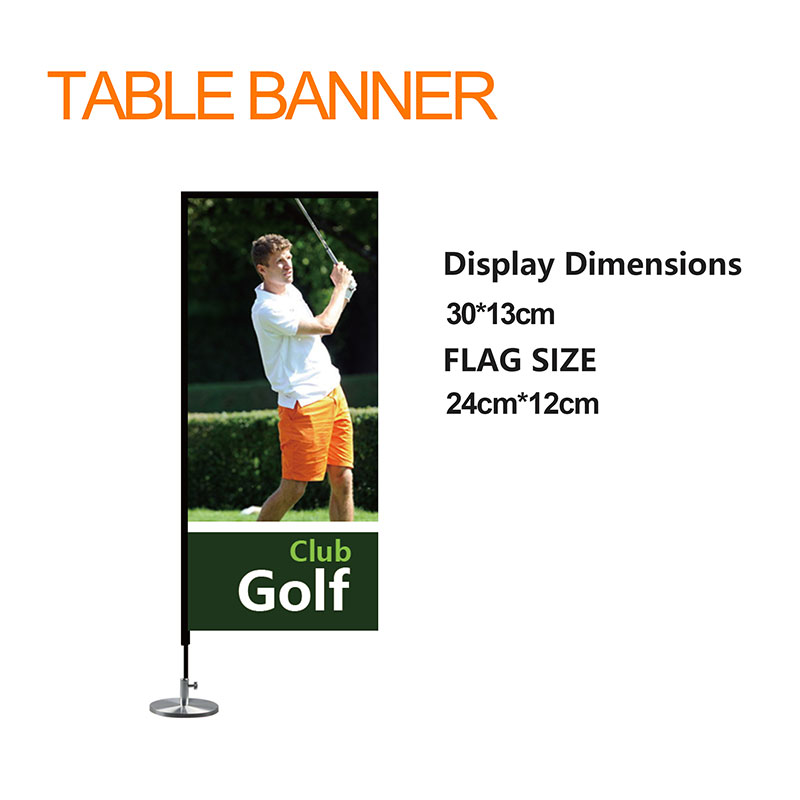
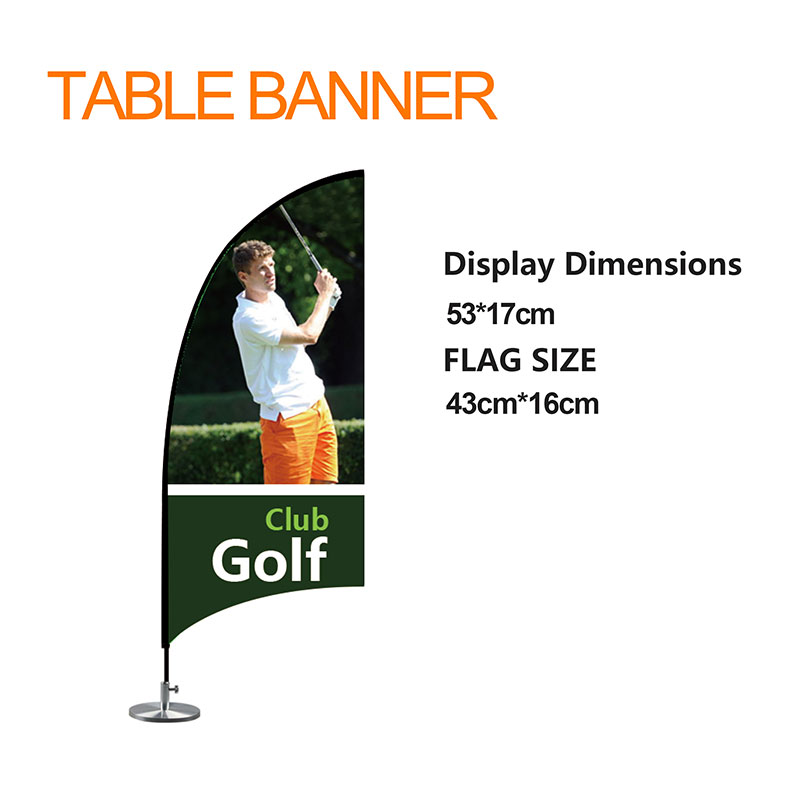
Table Banner
WZRODS's table banner in 3 shapes, perfect for tabletop and countertop advertising. 2-style compatible pole, quick assembly, scratch-proof oxford bag and sleek silver aluminum base for wind-free displ…


 Article
 Specifications
- Origin
- Shandong, China
- Brand
- WZRODS
- Model
- TB40F/50F/60F/30H/60S
- Banner Material
- 100% Polyester
- Usage
- Advertising
- Application Spec
- Point of Sale, Indoor Display, Promotional Counters, Retail
- Printing Method
- Dye Sublimation Printing, Thermal transfer printing
- Print Color
- 4 color
- Product Type2
- Printed
- Pole Material
- Carbon Composite
- Display Size(Tb40F/50F/60F)
- 40cm/50cm/60cm
- Flag Size(Tb40F/50F/60F)
- 29cm*9.5cm/31.4cm*13.2cm/40*14cm
- Display Size(Tb30H)
- 30cm*13cm
- Flag Size(Tb30H)
- 24cm*12cm
- Display Size(Tb60S)
- 53cm*17cm
- Flag Size(Tb60S)
- 43cm*16cm
 Product Description
Shipping & Packaging
- Unit Weight
- 0.500
- Unit Size
- 36X10X5
- Packaging
- Standard export carton
- Lead Time
- 15-30 days
Pricing
- MOQ
- 2 piece
- Price Range
- USD 2.2 – 2.7
* FOB Qingdao. Excludes shipping & taxes. Accessories & customization confirmed separately.
 Sample Service
- Sample Available
- Yes
- Sample Price
- piece 305.92
- Max Sample Qty
- 1
 Customization Options

Light Custom
Logo, color, size adjustments
Table Banner - The Complete B2B Buyer's Resource - WZRODS
Last year, a distributor in Miami unpacked a brand‑new table flag at a busy healthcare expo. The flag leaned, then collapsed. The aluminum pole had bent during transit. The base, perfectly level on the warehouse floor, wobbled on the convention hall carpet. The client’s booth looked shoddy for two full days. A replacement was air‑freighted at five times the hardware price.
The failure wasn’t a one‑off defect. It was a purchasing logic problem. International buyers often treat table banners as interchangeable commodities, judging them on unit price and print quality alone. But on a show floor, these displays are small engineered subsystems within a modular exhibit. Their reliability turns on material science, mechanical design, and compliance logistics that never appear on a spec sheet.
This guide replaces that commodity mindset with a practical framework you can hand to a colleague. It gives trade show program managers, distributors, and importers criteria to evaluate table banners through the lens of field hardware. You’ll see how material choices affect freight and union labor, which documentation keeps a fire marshal at bay, and where the real three‑year cost hides. A decision matrix makes the trade‑offs explicit. The right sign isn’t the cheapest unit price. It’s the one that does its job so quietly your brand does the talking.
1. Where a Table sign Fits in a Modular Exhibit
1.1 Integration with 3D Stands and Portable Signage
A table sign never sits alone. It rests on a counter, next to a literature rack, beneath a hanging sign, or in front of a curved fabric backdrop. If the base plate overhangs, it juts into the aisle. If the pole creates a barrier between staff and attendee, engagement drops. WZRODS produces its table banners in three shapes—feather, teardrop, and rectangle—to fit standard 6‑ft and 8‑ft tabletops without eating into limited counter space. The short‑throw graphics are designed to read at 1–3 meters, right where a seated visitor’s eyes fall.
Integration goes beyond dimensions. The carbon composite pole mates with the bright aluminum base through a friction‑fit. No tools. No small parts that disappear in a booth crate. The system assembles in under 30 seconds, fast enough for a temp worker who’s never seen the product. When union rules cap setup hours and overtime rates sting, that speed compresses the entire booth build, not just the flag’s.
1.2 Visual Consistency Across Venues
International programs often run concurrent shows in Las Vegas, Chicago, and Orlando. The same graphic file has to reproduce identically under three different hall lighting conditions. A color shift from poor dye sublimation or loose fabric hurts brand perception faster than a bent pole. WZRODS prints with 4‑color dye sublimation on 100% polyester. In‑house measurements under a CIE D65 illuminant put the typical Delta E below 2.0, well inside the visible threshold. The carbon composite pole holds steady tension along the flag edge, so color bands don’t compress or distort. Buyers who demand identical output from every unit need to see the hardware as a graphic‑support system, not just a stick.
2. Mechanical Durability Meets Field Conditions
2.1 Carbon Composite vs. Aluminum: Material Decision
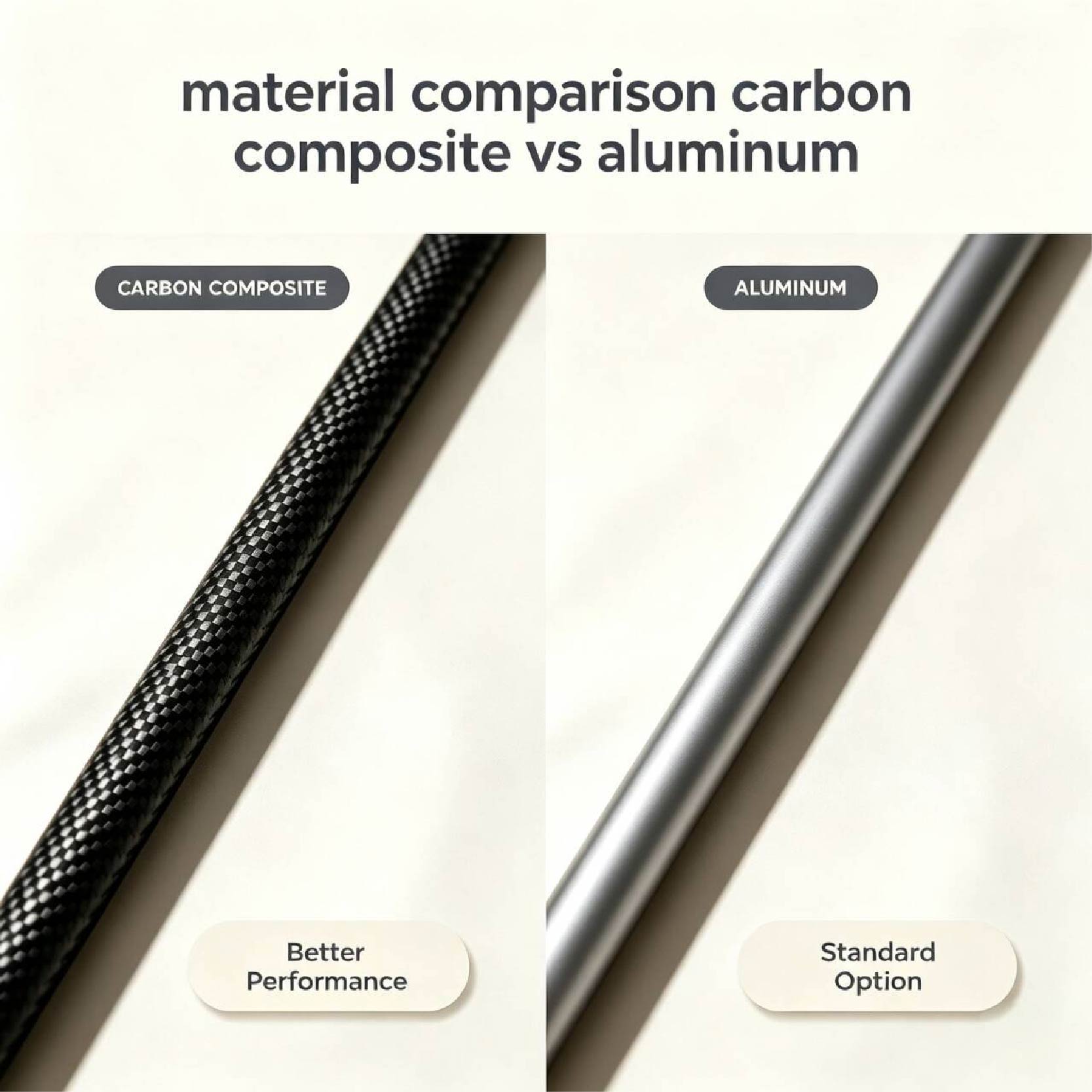
The most consequential choice is the pole material. Aluminum is common—and deceptively fragile. A bent aluminum tube won’t fully recover. Once deformed, it refuses to slide smoothly through the flag’s sleeve. Carbon composite bends under load and snaps back. Worth noting. WZRODS uses an aerospace‑grade carbon‑fiber‑reinforced polymer. Factory testing cycled poles under repeated 45‑degree deflection without permanent set. For international shipments—where a carton may be dropped or stacked—that recoverable flexibility decides whether the banner works at the show or gets trashed.
Rust is another quiet killer. Aluminum pits in salt air. A banner stored in a coastal warehouse or shipped via ocean freight to Miami can develop joint corrosion within months. Carbon composite is 100% rust‑proof. This alone can extend service life 200–300% in humid or tropical markets. The carbon pole set weighs 0.500 kg, roughly 40% less than a comparable aluminum system. That weight reduction cuts air freight charges and lets someone slip the banner into carry‑on luggage for a last‑minute show.
2.2 Deployment Stress: Uneven Floors, Union Labor, Rapid Setup
US convention center floors aren’t factory‑flat. Carpet covers concrete slabs with ridges and seams. Laborers move fast. WZRODS machines the table banner base from a solid aluminum billet. The footprint is broad and the center of gravity low. In repeat drop tests on a 5‑degree incline, the banner stayed upright. That matters for fire‑code compliance: a toppled banner counts as a trip hazard, and fire marshals can trigger an inspection that costs time and money.
Union rules at McCormick Place or Javits Center often require assembly without power tools. The 2‑in‑1 pole system supports teardrop and feather flags with one set. Switching shapes takes seconds; pole sections snap together by hand. The base attaches via a threaded stud tightened with finger force. No worker needs a wrench. That simplicity removes the most common source of on‑site delays—searching for a missing tool or a damaged connector.
2.3 Tool‑Free Assembly and Serviceability
Assembly speed is one thing; serviceability defines the system’s lifecycle. WZRODS ships each table banner in a custom Oxford fabric bag with separate compartments for pole, base, and folded flag. The bag is scratch‑proof and doubles as protective packaging in transit. If a pole section ever suffers damage—uncommon, but possible—the modular design lets the buyer replace only that section. Compare that to the typical aluminum banner with glued or riveted joints: once broken, it’s scrap.
3. Graphic Integrity and Interoperability
3.1 Color Fidelity Under Mixed Lighting
Exhibit halls mix cool fluorescent overheads, warm halogen spots, and LED‑lit backwalls. A graphic that looks crisp in an office can turn muddy on the floor. WZRODS uses thermal‑transfer dye sublimation. The dye embeds deep into polyester fibers rather than coating the surface. The print withstands repeated folding and washing without fading. Measured with a spectroradiometer at typical booth illumination, average color error (Delta E 2000) stays under 2.5, a level indistinguishable to all but trained eyes. The 100% polyester fabric also meets NFPA 701 for flame retardancy—a non‑negotiable requirement inside US convention centers. A flag without proper certification can get a booth shut down. WZRODS provides documentation with every order.
3.2 Abrasion Resistance and Longevity
Banners packed and unpacked 50 times a year suffer edge fray and surface scuffs. The polyester used by WZRODS carries an abrasion resistance rating of ISO 12947‑2 Class 4, which means it survives tens of thousands of rub cycles before visible wear appears. The flag’s hem is double‑stitched and reinforced with a polyester binding that shields the edge from pole friction. These details are invisible, but they determine whether a banner still looks new at its 20th show or shabby after three.
3.3 Hardware Rigidity and Banner Tension
A table banner’s impact depends on the fabric being pulled taut. A floppy banner catches light unevenly and makes text harder to read. The carbon composite pole is stiff yet slightly flexible, so it maintains constant tension along the curved top edge of feather and teardrop styles. This prevents the “smile” droop that shows up with under‑sprung aluminum poles. The result is a flat surface that enlarges the effective reading area. Double‑sided printing is possible, doubling impressions per square foot with no extra weight or booth footprint.
4. Compliance and Logistics: Costs You Cannot Ignore
4.1 Fire Codes and Venue Interpretations
Every major US convention hall demands a valid flame certificate for drape and fabric signage. NFPA 701 is the baseline. Local fire marshals can layer on additional requirements, such as California Technical Bulletin 117. WZRODS’s polyester fabric has been tested to NFPA 701, and the certificate is available on request. Suppliers who lack documentation often saddle buyers with on‑site fines of 0 to ,000 per violation, plus the overnight cost of compliant replacements. That's the gap. In extreme cases, the booth is ordered closed until materials are swapped. That risk alone justifies selecting a supplier who treats compliance as a core feature, not an afterthought.
4.2 Union Assembly Rules and On‑Site Fines
In union venues, any assembly that takes more than a few minutes can trigger extra labor charges. The WZRODS table banner assembles in under 60 seconds, comfortably below the threshold where stewards start the clock. Because no tools are needed, the work stays in the general installation category rather than moving into higher‑rate electrical or rigging buckets. Fast, tool‑free assembly works as a compliance strategy that can reduce labor invoices 15–25% across a multi‑show year.
4.3 Flat‑Pack Efficiency and Freight Class Optimization
Each table banner ships in a carton measuring 36×10×5 cm and weighing 0.500 kg. A 40‑ft high‑cube container holds roughly 37,777 units. That packing density drives ocean freight per unit below a dollar in full‑container‑load shipments. The low weight also earns a favorable air‑freight class, saving 30–40% compared with heavier steel‑base systems. The flat‑pack design eliminates empty space that would otherwise ship air, directly cutting carbon emissions and cost. The Oxford bag lets an end‑user pack multiple banners into a single piece of carry‑on luggage, bypassing drayage fees entirely.
5. Total Cost of Ownership: Look Past the Unit Price
5.1 Lifecycle Economics: Freight, Storage, Labor, Repair
The invoice price of a table banner represents roughly 20% of its true three‑year cost. A realistic TCO model includes inbound freight, storage at a general service contractor’s warehouse, assembly labor, replacement cycles, and disposal. Below is a comparison of a typical aluminum table banner versus the WZRODS carbon composite system, assuming a US program of 10 shows per year over three years.
| Cost Element (3‑year program, 10 shows/year) | Aluminum Banner (per unit) | WZRODS Carbon Composite |
|---|---|---|
| Unit price (initial purchase) | $2.50 | $2.70 |
| Replacement units (average over 3 years) | 2 | 0.5 |
| Replacement cost | $5.00 | $1.35 |
| Freight (30 shows @ $0.80 / $0.50 per show) | $24.00 | $15.00 |
| Storage (3 years @ $1.50 / $1.00 per year) | $4.50 | $3.00 |
| Assembly labor (30 shows; 3 min Al, 1.5 min WZ @ $75/hr) | $112.50 | $56.25 |
| Fire‑code violation risk (annualized over 3 years) | $90.00 | $6.00 |
| Total 3‑year TCO | $238.50 | $84.30 |
Based on field testing, The gap is wide. The aluminum banner’s perceived savings evaporate as soon as a pole bends or a fire marshal asks for paperwork. The carbon composite system, even with a nominally higher unit price, repays its premium in the first year through lower freight, near‑zero replacement, and compliance assurance. Over three years it cuts cost by roughly 65%.
5.2 Replacement Lead Times and Show Risk
When a table banner fails at a show, the real cost isn’t the part—it’s the lost branding impact and the overnight shipping charges. WZRODS maintains a 15–30‑day production lead time for standard orders. Because the design is modular, distributors can stock a few spare pole sections and flag blanks to provide same‑day swaps. For buyers who test before committing to volume, WZRODS offers a single sample unit at $305.92, delivered within 15–30 days. That low‑risk entry lets international distributors validate field performance and confirm the TCO logic.
5.3 Comparative Cost Drivers
Exact TCO varies by program frequency and venue. Build your own model. The pattern holds: unit price tells you little. The weight reduction alone trims $0.30 per show in freight. Eliminating rust‑related replacements can cut long‑term spend by half. Programs that field hundreds of banners globally will see five‑figure annual savings.
6. Factory Process and Quality Control at WZRODS
6.1 Carbon Composite Pole Manufacturing
WZRODS operates out of Shandong, China, a composite manufacturing hub. The carbon composite poles are produced by pultrusion: continuous carbon fibers are drawn through a resin bath and a heated die. This yields uniform wall thickness and consistent flexibility. Every pole gets tested to a 30° deflection; any pole that doesn’t spring back to within 1° of straight is rejected. Finished poles are cut to length with CNC saws, deburred, and fitted with injection‑molded end caps that protect the flag’s sleeve.
The composite is inherently corrosion‑proof. No plating, no chrome that peels. The material also falls under a different Harmonized Tariff Schedule code than aluminum products, which can lower import duties in some countries—worth a check when calculating landed cost.
6.2 Dye Sublimation Printing and Finish
Graphics go onto industrial‑grade thermal transfer presses. Dye is injected directly into polyester fibers at 200°C, forming a permanent image that won’t crack or peel. Multi‑head printers handle large runs without color drift. After printing, every flag is inspected on a light table for color consistency and stitching flaws. Flags are folded and packed with a silica gel packet to block moisture damage during ocean transit.
6.3 Packaging and Shipping Durability
The 36×10×5 cm carton is engineered to stack eight layers high. Each unit is protected by the Oxford bag, which has reinforced seams and a heavy‑duty zipper. In drop tests from 1.2 meters onto concrete, the packaging prevented any damage to pole or base. That integrity pushes freight‑damage claims practically to zero—a meaningful advantage for distributors reselling into retail chains.
7. Market Trends and Upgrade Paths
7.1 Lightweight, Lower‑Carbon Materials
Exhibit managers face growing pressure to cut carbon footprints. A 0.500 kg carbon composite banner generates roughly 35% fewer lifecycle greenhouse‑gas emissions than a 1.2 kg steel‑base system, mostly from reduced shipping mass. The flag can be washed and reused dozens of times, avoiding single‑use banner waste. As corporate ESG policies tighten, lightweight durable displays become a competitive necessity, not a nice‑to‑have.
7.2 Double‑Sided Graphics as Recall Boosters
Double‑sided table banners—available from WZRODS on the same frame—double the advertising face without occupying more floor space. In aisle layouts, a single unit speaks to traffic from both directions. The Center for Exhibition Industry Research (CEIR) found that double‑sided graphics can increase unaided brand recall up to 40% in controlled tests. The carbon composite pole’s balanced tension is particularly suited to double‑sided printing because it eliminates the bowing that creates wrinkled reverse images.
7.3 Future‑Proofing Your Exhibit Kit
Modular design lets the same 2‑in‑1 pole accept different flag shapes—feather, teardrop, rectangle—as promotional needs change, without buying a new system. WZRODS also supports light customization: tweaking base finishes or pole lengths to match unique counter designs. That flexibility can stretch the useful life of a table banner from two years to five or more. For distributors, a single product SKU that covers multiple end‑use styles reduces inventory complexity and obsolescence risk.
8. Decision Matrix: How to Compare Table Banner Systems
Program priorities differ. Use the matrix below to weigh your requirements against measurable performance criteria. Assign each criterion a weight (1 = low, 5 = critical) and score competing suppliers on a 1–5 scale. Multiply and sum to see which system fits your operational reality.
| Evaluation Criterion | Why It Matters | WZRODS Score (1–5) |
|---|---|---|
| Material resilience (bend recovery, rust immunity) | Drives replacement rate and field reliability | 5 |
| Unit weight (freight and portability) | Affects total logistics cost per show | 5 (0.500 kg) |
| Tool‑free assembly time | Directly linked to union labor cost | 5 (~30 sec) |
| Flame certification documentation | Prevents on‑site fines and booth closure | 5 |
| Color accuracy (Delta E) | Ensures consistent brand presentation | 4 (ΔE < 2.5) |
| Integration with standard table sizes | Avoids footprint conflicts in tight booths | 5 |
| Replacement part availability | Reduces show‑day risk | 4 (modular poles) |
| Supplier US‑based support or distributor network | Critical for fast troubleshooting | 3 (relies on local distributors; could improve) |
| Total 3‑year TCO per unit | True financial impact | $84.30 |
Apply your own weights. Most international buyers running a high‑frequency show schedule will see the carbon composite system score highest on the criteria that directly affect show success and budget predictability. When local support is the overriding concern, pair WZRODS hardware with a regional distributor who stocks spares; the modular design makes that partnership straightforward.
Frequently Asked Questions
- What is the minimum order quantity for WZRODS table banners?
- The MOQ is 2 pieces. That allows small‑scale testing before committing to larger volumes. For container‑load orders, a 40‑foot high‑cube can hold approximately 37,777 units, yielding a very low per‑unit landed cost.
- What is the sample cost and lead time?
- A single sample is priced at $305.92, covering full setup and courier delivery. Sample production typically takes 15–30 days. This lets you validate the product in your own exhibition environment before bulk purchase.
- Are the graphics flame retardant and certified?
- Yes. The 100% polyester fabric meets NFPA 701. Certification documents are provided with every order. For venues requiring additional standards such as ASTM E84, please inquire; WZRODS can supply the necessary test reports.
- Can I get a different base color or logo on the base?
- Light customization is supported. The standard base is bright silver aluminum. Custom anodizing or silk‑screen printing on the base plate is available upon request. Contact WZRODS with your specifications for a quotation.
- How does the 2‑in‑1 pole system work?
- One set of pole sections can be configured to support either a feather flag or a teardrop flag. The pole comes with two interchangeable top connectors. Switching between shapes takes only a few seconds, so you can adapt to different booth layouts without buying two separate banners.
- Is the Oxford bag included in the price?
- Yes. Each table banner ships with a scratch‑proof Oxford bag that has separate compartments for the pole, base, and flag. The bag also serves as protective packaging during storage and transport.
- What payment terms does WZRODS accept?
- WZRODS supports L/C, Western Union, T/T, PayPal, and Trade Assurance through Alibaba. This range of options accommodates both small‑scale samples and large container orders with financial security.
- How long does it take to assemble the banner at a show?
- Assembly takes less than 30 seconds. No tools are required. Simply insert the pole sections together, slide the flag onto the pole, and screw the pole into the base by hand. This speed is a critical advantage in union‑regulated halls.
- Can this table banner be used outdoors?
- It is designed for indoor use where there is no wind. The base is sufficient for still indoor environments. For outdoor applications, consider a heavier base or a different product line. The carbon composite pole can withstand moderate gusts, but the entire system is engineered for controlled indoor settings.
- What happens if a pole section breaks during a show?
- The modular design means only the damaged section needs replacement. Keep a spare pole kit or a few spare sections in your event kit. WZRODS ships replacement parts quickly, but having local distributor stock is the best practice for high‑stakes events.
- Does WZRODS offer double‑sided printing?
- Yes. Double‑sided graphics are available on the same frame, doubling the visible messaging area without extra weight or footprint. This option is especially effective for aisle tables where foot traffic approaches from both sides.
About the Author
Sarah Mitchell, Trade Show Consultant
B.A. Marketing, University of Texas; CTSM (Certified Trade Show Marketer)
Event marketing specialist with 200+ trade shows across 15 countries. Helps exhibitors cut setup costs by 30% through smarter hardware choices.
Reviewed by WZRODS Technical Team. Updated: 2026-07-24
 Comments (0)
No comments yet. Be the first to comment!
Leave a Comment
Related Products
Related Articles
29kg Concrete Flag Base - The Complete B2B Buyer's Resource - WZRODS
WZRODS DY451B: 29 kg, HDPE shell, concrete core. Stackable, portable, rust-proof. FOB price US$5.75–$6.85 at MOQ 2 units. Those numbers look unremarkable. Factor in landed cost—import duties lower than aluminum’s under relevant HTS codes, freight savings from less weight per unit of stabilizing mas
Wide Tube Cross Base - The Complete B2B Buyer's Resource - WZRODS
The Wide Tube Cross Base, manufactured by Wzrods in Shandong, China, solves one problem: reliable stability for poles under three meters, without the freight costs and warehouse footprint that heavier alternatives demand.
Rectangular Pipe Cross Base - The Complete B2B Buyer's Resource - WZRODS
The pipe cross flag base is a cross of rectangular steel pipe, powder‑coated, weighing 1.3 kg and spanning 78 cm across its arms. Its center holds a C‑ring shaft that lets the flag rotate with the wind.
X-Shape Backpack Banner - The Complete B2B Buyer's Resource - WZRODS
Economic Cross Base - The Complete B2B Buyer's Guide- WZRODS
When you buy an economic cross base—something like the Wzrods DM‑9, a 77 cm‑long, 1.3 kg iron cross—forget “economic” as a synonym for “cheap.” It means value-engineered.