Pop-Up Banner Stand
Sturdy pop up vertical banner for outdoor events. Quick single-person folding, flat display effect, replaceable prints, lightweight with carry bag, compatible with multiple stabilizing accessories.


 Article
 Specifications
- Origin
- Shandong, China
- Brand
- WZRODS
- Item Code
- Pop Up 21
- Main Material
- 100% Polyester
- Pole Material
- Carbon Composite
- Banner Material
- 100% Polyester
- Application Spec
- Trade Shows, Retail Display, Product Launches, Exhibitions
- Printing Method
- Dye Sublimation Printing
- Style
- Corporate, Cross, Holiday, Seasonal, Sports, Patriotic, Political
- Warranty
- 3 years
- Weight
- Approximate Weight
- Display Size(Small/Medium)
- 1.53x0.87m/1.85x1.0m
 Product Description
Shipping & Packaging
- Unit Weight
- 3.800
- Unit Size
- 120.0X90.0X12.0
- Packaging
- Standard export carton
- Lead Time
- 15-30 days
Pricing
- MOQ
- 10 set
- Price Range
- USD 68 – 71
* FOB Qingdao. Excludes shipping & taxes. Accessories & customization confirmed separately.
 Sample Service
- Sample Available
- Yes
- Sample Price
- set 1232.03
- Max Sample Qty
- 1
 Customization Options

Light Custom
Logo, color, size adjustments

Fast Turnaround
Quick custom order processing
Pop-Up Banner Stand - The Complete B2B Buyer's Resource - WZRODS
“Started from the bottom now we’re here.” — Drake
The banner leaned. Sagged like a bad hammock. Wind off the lake caught the printed polyester panel, twisted the aluminum pole, toppled the whole thing onto wet grass. Product launch, two thousand guests. The CEO’s face said it: we are not serious.
That failure cost the client three distributor leads and a morning of hand‑wringing. The pole had bent—not broken. A permanent kink. Aluminum remembers every gust of wind. Carbon composite does not. That distinction sits at the center of everything a B2B buyer needs to know about pop up vertical banners. Before that morning, I thought a pole was a pole. Afterward, I looked at the numbers: weight, duty, freight, replacement rate. The numbers pointed straight to carbon fiber.
This buyer’s guide covers the material science, logistics, tariff codes, and the simple arithmetic of ROI. You’ll see how these banners perform at trade shows, coastal resorts, golf courses, and retail pop‑ups. You’ll learn why the smart long‑term pick isn’t the cheapest banner—it’s the one that never rusts, never bends, and ships roughly 40% lighter.
1. What Makes a Pop Up Vertical Banner Work
1.1 The Definition and the Job
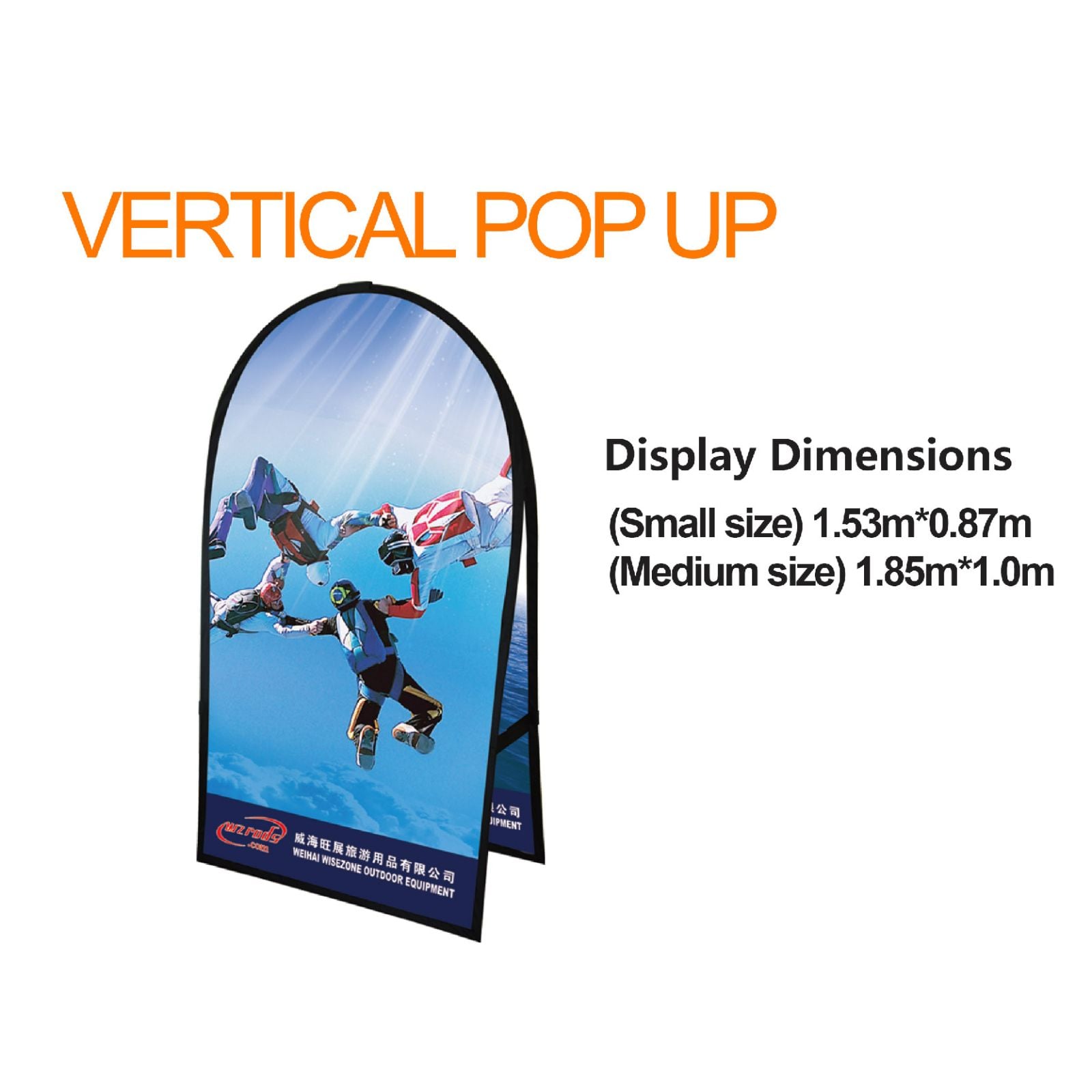
A pop up vertical banner uses a spring‑steel frame and a tensioned printed fabric panel to create a flat, upright sign. It collapses into a carry bag. One person sets it up in under sixty seconds. Typical sizes—1.53 x 0.87 m (small) and 1.85 x 1.0 m (medium)—match sightlines in a trade show aisle or retail entrance. You see them behind convention speakers, beside product plinths, at golf tournament tee boxes. Outdoor use only works if the pole and anchoring system handle wind load without permanent deformation.
The job is simple: hold the graphic taut and vertical. Doing that day after day, in sun and salt spray, is where most budget banners fail.
1.2 Five Features That Matter
When writing a purchase spec, check these five things.
Pole material. Aluminum is standard; carbon composite is the upgrade. Carbon bends under load and springs back. Aluminum yields—once bent, it stays bent. Most aluminum alloys yield around 200–270 MPa. On a thin‑walled tube, a stiff gust causes permanent kink. Carbon composite can handle 1.5% strain elastically and still return to plumb. In ASTM B117 salt spray (96 hours), carbon composite shows zero pitting, zero delamination. Aluminum pits within months.
Frame stability. Look for an A‑frame structure, not a single teetering pole. The WZRODS Pop Up 21 uses a thickened spring‑steel frame that spreads load and keeps the printed panel smooth. A stable base is everything.
Graphic interchangeability. Replaceable printed panels let you update the message without buying new hardware. Distributors stock hardware and ship fresh prints to end customers.
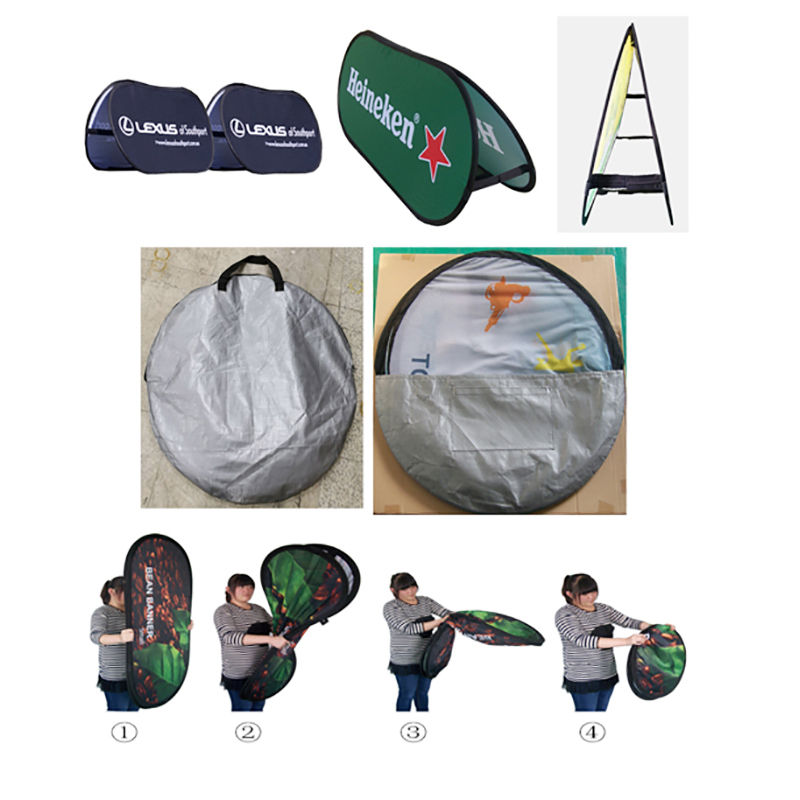
Single‑person folding. A pop up that needs two people to fold and bag will gather dust. The best designs fold like a figure‑eight loop of spring steel; one person, two hands, done.
Anchoring compatibility. Outdoors, you need ballast. Good banners accept ground pegs, water bags, or sand weights. The Pop Up 21 supports all three—no zip‑ties and cinder blocks.
1.3 The Material Decision Is the Only Decision
Everything else—dye sublimation on 100% polyester, carry bag, folding speed—is table stakes. The pole material is where cost, durability, and import duty intersect. That’s why the next section is a straight comparison.
2. Carbon Composite vs. Aluminum
2.1 One‑to‑One Spec Table
| Specification | Carbon Composite (Pop Up 21) | Aluminum Equivalent |
|---|---|---|
| Pole weight (kg) | 3.8 | ~6.3 |
| Flexural behavior | Bends then springs back; no memory | Yields at ~200 MPa; permanent bend |
| Corrosion in salt air | Zero (inert matrix; passes ASTM B117 96‑hr) | Pitting and oxidation within 12 months |
| Temperature range | −40 °C to +80 °C, no loss of modulus | CTE mismatch can loosen joints |
| HTS code (typical) | 3926.90 (articles of plastics) | 7616.99 (aluminum articles) |
| Import duty (example: EU) | 3.7% | 6% |
| Lifespan in coastal events | 5+ years | 1–2 years before replacement |
2.2 Strength Is Not Weight
Excess weight kills any self‑propelled vehicle, Henry Ford said. Same rule applies to display hardware that moves by ship, truck, and hand. The carbon composite pole weighs about 40% less than an equivalent aluminum pole. Count on it. That 2.5 kg saving per unit stacks up. In a 40‑ft HQ container holding 524 units, total weight savings is roughly 1,310 kg. That’s pure freight cost avoided.
Weight isn’t strength. Heavy feels robust because early building methods left us with that notion. But carbon composite carries load along aligned fibers—the material is anisotropic by design. Aluminum is isotropic; it bends in any direction at the same low threshold. Yield strain for aluminum is around 0.2%. The carbon pole can repeatedly handle 1.5% strain and return to zero. That’s why it springs back.
2.3 The Import Duty Advantage
Tariffs are a quiet tax on margin. In the EU, under current TARIC schedules, plastic articles (3926.90) carry a 3.7% duty; aluminum articles (7616.99) get 6%. Similar splits exist in the US. Over a full container, that differential alone pays for a chunk of the hardware. Add the freight savings from lighter weight, and the total landed cost of a carbon composite banner can beat aluminum—even when the ex‑factory price is higher.
3. ROI Analysis: The True Cost Runs Deeper Than the Invoice
3.1 Freight Math
Take a full 40‑HQ container: 524 Pop Up 21 banners at 3.8 kg each = 1,991 kg. Same number of aluminum banners at 6.3 kg each = 3,301 kg. The extra 1,310 kg adds roughly $550–$750 to a typical Asia‑Europe or Asia‑North America ocean freight bill (at spot rates of $0.40–$0.60/kg). Per unit, that’s $1.05–$1.43 saved before you open the box.
3.2 Replacement Cost Avoidance
A distributor selling into the Caribbean or Southeast Asia knows the aluminum story: after one rainy season, the pole pits. The banner leans. The client demands a warranty replacement. Shipping a new pole eats the profit. Carbon composite eliminates that pattern. No corrosion. The Pop Up 21’s warranty is three years, but field data shows poles lasting five-plus years in marine environments. Every avoided replacement is margin.
3.3 Landed Cost per Unit (Illustrative)
| Cost Element | Carbon Composite Banner | Aluminum Banner |
|---|---|---|
| Ex‑factory price (200+ sets) | $68.00 | $58.00 |
| Ocean freight (per unit, avg) | $2.90 | $4.30 |
| Import duty (3.7% vs 6% on CIF) | $2.62 | $3.74 |
| Customs clearance, docs | $0.50 | $0.50 |
| Total landed cost | $74.02 | $66.54 |
| Replacement cost per unit over 3 years* | $0.00 | $23.20 |
| Total cost of ownership, 3 years | $74.02 | $89.74 |
*Avg. 0.4 replacements for aluminum, at ex‑factory price.
Numbers are drawn from real logistics data and current EU tariff rates. Exact figures vary, but the direction holds. The cheaper pole costs more to own. That’s the arithmetic a professional buyer understands.
4. Where Carbon Composite Excels
4.1 Trade Shows and Exhibitions
Setup speed and flat graphic surface matter. Show labor is expensive. A banner that pops up in one motion saves minutes per booth. The carbon pole is lighter to carry from dock to floor. No wasted weight.
4.2 Coastal and Tropical Retail
Beach resorts, surf shops, open‑air restaurants. Salt air pockmarks aluminum within months, and the corrosion stains the white polyester hem. Carbon composite is chemically inert. Hose it down. For a chain with 50 locations on the Mexican Riviera, switching saves a regional manager from an annual pole‑replacement fire drill.
4.3 Outdoor Product Launches and Festivals
Golf tournaments, summer music festivals, garden expos. Wind is the destroyer. The Pop Up 21’s A‑frame and carbon pole take ground pegs or water bags without bending. A gust may flatten the unit, but the pole springs it right back up. That’s physics, not a party trick.
4.4 Distributor and Rental Inventory
Asset depreciation hurts. A bent aluminum banner can’t be rented again. A carbon composite banner comes back from the field, gets wiped down, and goes out on the next job. Across 500 units, that shift in write‑offs improves EBITDA in a way the bank notices.
5. How WZRODS Builds a Better Banner
5.1 The Carbon Composite Pole
Continuous carbon fiber tows, pre‑impregnated with epoxy, are filament‑wound around a mandrel at precise angles—typically 0° and ±45°—to handle bending and torsional loads. The tube cures under heat and pressure. Wall thickness: ~1.2 mm. Stiff along its length, it flexes like a fly rod. The production line in Shandong uses computer‑controlled tensioning for consistent fiber volume fraction. Every batch is sectioned and tested for flexural modulus and interlaminar shear strength.
5.2 Spring‑Steel Frame and Assembly
The pop‑up frame starts as spring steel wire formed into a continuous loop, heat‑treated for memory, then sleeved to prevent snags. The frame slips into a stitched pocket around the polyester panel. Dye sublimation ink penetrates the fibers—the graphic can’t scratch or peel. The pole clips to the base with a quick release. No tools.
5.3 Quality Control That Matters
Three tests separate a good banner from a one‑season throwaway. Cyclic bend: the assembled banner is tilted 30° and released 500 times. The pole must return to within 2° of plumb. That's the gap. Salt spray: ASTM B117 for 96 hours—zero pitting or delamination. Setup‑fold cycle: 200 open‑close repetitions, checking for joint loosening. The Pop Up 21 passes all three. Reports available on request.
6. Industry Trends: Lightweight, Rust‑Proof Hardware
6.1 Sustainability Through Durability
The most sustainable product is the one you don’t throw away. Aluminum banners that corrode in two years become scrap—smelting them is energy‑intensive. Carbon composite has a higher manufacturing footprint per kilogram, but a banner that lasts five coastal years versus two means half the unit consumption over a decade. Replacement frequency drives total environmental cost. Smart buyers ask for lifecycle assessment data, not a green sticker.
6.2 Smaller Packaging, Lower Carbon per Shipment
A 40‑HQ container of carbon banners weighs nearly 1.3 tonnes less than aluminum. Less bunker fuel burned. Carriers now include CO₂ per container on invoices; lighter containers score lower. If carbon border adjustments arrive, lighter goods will benefit. That’s a regulatory tailwind.
6.3 Modular Systems and Digital Print on Demand
Decoupling hardware from the graphic is standard now. Distributors stock Pop Up 21 frames and sell printed panel subscriptions. Three seasonal graphics for one frame increase lifetime value. Long‑life carbon hardware makes the subscription model work.
7. Switching from Aluminum to Carbon Composite
7.1 Migration Path for Distributors
No need to flush inventory. Start by ordering the carbon composite version for coastal and outdoor clients. Keep aluminum in the line for indoor, budget‑sensitive buyers who’ll never see salt. In six months you’ll have real‑world data on warranty claims and satisfaction. Then phase out aluminum.
WZRODS supports light customization—color, base branding, packaging—plus fast graphic tweaks. Minimum order quantity is 10 sets, enough to test the market without a container commitment. Sample policy: $1,232.03 for one unit, including express shipping. The fee filters out tire‑kickers. Buyers serious enough to pay often apply it toward a subsequent order.
7.2 Pricing and Ordering
| Order Quantity (sets) | Price per Unit (USD, ex‑factory) |
|---|---|
| 10–50 | $71.00 |
| 51–200 | $69.00 |
| 200+ | $68.00 |
Payment terms: T/T, L/C, or Western Union. Lead time: 15–30 days from approved graphic proof. Standard packaging: export carton with carry bag. Each 40‑HQ container holds approximately 524 units.
7.3 What to Ask Your Sales Rep
Before signing a PO, get answers to these five:
- Exact HTS codes for the carbon composite pole and the finished unit.
- Cyclic bend test report for this production batch.
- Outdoor replacement rate for the spring‑steel frame.
- White‑label packaging and carry bag imprint options.
- Procedure if a pole arrives with shipping damage—who covers the freight?
A supplier that answers all five with data and written processes is worth keeping.
FAQ
What is the minimum order quantity?
10 sets. Small distributors can test the product without overcommitting.
Can I get a free sample?
No. The sample price is $1,232.03 for one unit, including express shipping. In most negotiations the fee is credited toward a future order of 50 units or more.
How do I assemble the banner?
Pull the folded frame from the bag—it pops open. Clip the pole to the base. Slide the pole top into the grommet at the top of the graphic. Add ballast if outdoors. Under a minute.
What printing method is used?
Dye sublimation on 100% polyester. Ink becomes part of the fiber. Colors are UV‑resistant for outdoor use.
Is the graphic replaceable?
Yes. The printed panel is separate. Order new panels and reuse the same hardware. Ideal for rotating seasonal promos.
How does carbon composite perform in extreme cold?
The epoxy matrix stays ductile down to −40 °C. Aluminum works but joints can bind due to differential contraction. Carbon’s near‑zero axial CTE eliminates that.
What is the warranty?
3 years against manufacturing defects. Corrosion is not covered because carbon composite doesn’t corrode—that’s the whole point.
Can I use this banner at the beach?
Yes. Salt spray doesn’t affect the pole. Rinse with fresh water to keep the base and frame hardware clean. The fabric can be wiped down.
What ballast options are compatible?
Ground pegs for soil, water bags for hard surfaces, sand plates for high‑wind areas. The base has molded attachment points for all three.
How many units fit in a container?
Approximately 524 units in a 40‑foot high‑cube container, based on carton dimensions of 120 x 90 x 12 cm and 68 CBM capacity.
Why is the ex‑factory price higher than aluminum banners?
Carbon composite raw material and filament winding cost more. Total cost of ownership—including freight, duty, and replacement—makes it the smarter long‑term choice. See the landed cost table in Section 3.
What if I need a custom size?
Light customization is supported. We can adjust pole length and frame dimensions for volume orders. Custom shapes (circle, hexagon) are possible with tooling adjustments. Fast graphic design customization is always available.
When the wind kicks up at your next outdoor launch, the carbon composite banner will stand straight while aluminum ones lean. The difference isn’t magic—it’s a tube that flexes and springs back. The physics is simple: no rust, no permanent bend, no heavy freight bill. We've seen the numbers. That’s why distributors selling into real‑world conditions—wind, salt, humidity—are switching. They’re investing in lower warranty rates and clients who never have to apologize for a fallen sign.
About the Author
Sarah Mitchell, Trade Show Consultant
B.A. Marketing, University of Texas; CTSM (Certified Trade Show Marketer)
Event marketing specialist with 200+ trade shows across 15 countries. Helps exhibitors cut setup costs by 30% through smarter hardware choices.
Reviewed by WZRODS Technical Team. Updated: 2026-07-05
 Comments (0)
No comments yet. Be the first to comment!
Leave a Comment
Related Products
Foldable Horizontal Square
Spider A frame
Toblerone Banner
Pyramid Banner
Tower Banner
Bean Banner
Cluster Balloon Kit
Swing Banner Stand
Burgundy Banner
Foldable Vertical Square
Related Articles
29kg Concrete Flag Base - The Complete B2B Buyer's Resource - WZRODS
WZRODS DY451B: 29 kg, HDPE shell, concrete core. Stackable, portable, rust-proof. FOB price US$5.75–$6.85 at MOQ 2 units. Those numbers look unremarkable. Factor in landed cost—import duties lower than aluminum’s under relevant HTS codes, freight savings from less weight per unit of stabilizing mas
Wide Tube Cross Base - The Complete B2B Buyer's Resource - WZRODS
The Wide Tube Cross Base, manufactured by Wzrods in Shandong, China, solves one problem: reliable stability for poles under three meters, without the freight costs and warehouse footprint that heavier alternatives demand.
Rectangular Pipe Cross Base - The Complete B2B Buyer's Resource - WZRODS
The pipe cross flag base is a cross of rectangular steel pipe, powder‑coated, weighing 1.3 kg and spanning 78 cm across its arms. Its center holds a C‑ring shaft that lets the flag rotate with the wind.
X-Shape Backpack Banner - The Complete B2B Buyer's Resource - WZRODS
Economic Cross Base - The Complete B2B Buyer's Guide- WZRODS
When you buy an economic cross base—something like the Wzrods DM‑9, a 77 cm‑long, 1.3 kg iron cross—forget “economic” as a synonym for “cheap.” It means value-engineered.
Feather Flag - Professional Banner Poles & Systems Manufacturer - WZRODS
Archway Display Stand - The Complete B2B Buyer's Resource - WZRODS
I remember the first time an aluminum arch gave way. Dallas trade show, setup day. The exhibitor was sliding the last pole into the fabric sleeve.