
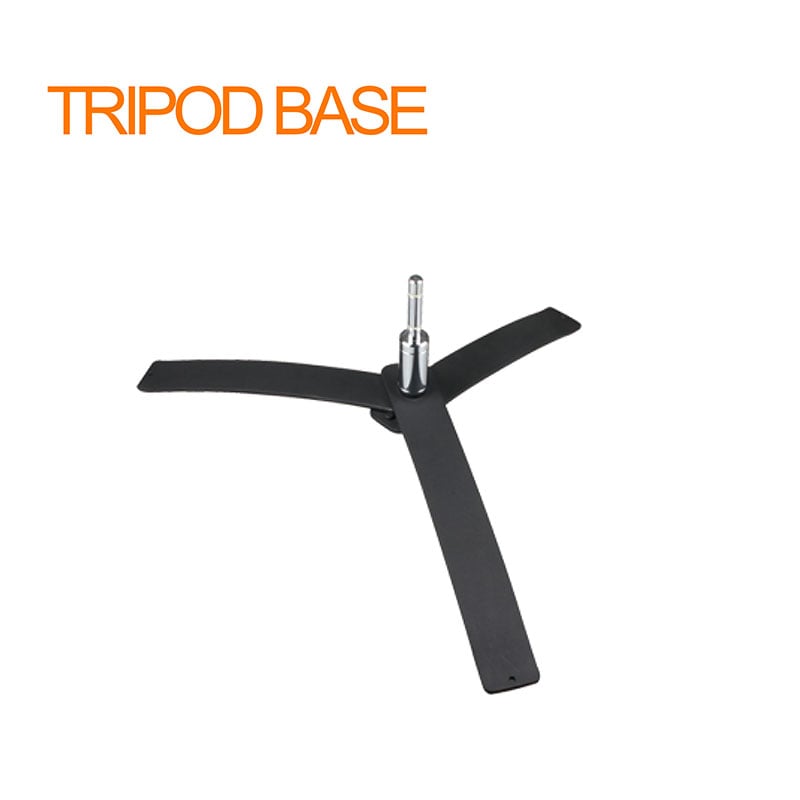
Tripod Flag Base
Foldable stand compatible with most Wzrods small banners, equipped with counterweight option, perfect for indoor and outdoor use.


 Article
 Specifications
- Item Code
- DM-22/DM-17
- Material
- Metal tube/ powder coated
- Weight
- 2kg/2.3kg
- Size (Tyre Base Unfoladable)
- 89*49cm
- Size(Tyre Base Foldable)
- 20*58cm
- Origin
- Shandong, China
- Brand
- Wzrods
- Pole Material
- Carbon Composite
 Product Description
Shipping & Packaging
- Packaging
- Standard export carton
- Lead Time
- 15-25 days
Pricing
- MOQ
- 1 pieces
- Price Range
- USD 5 – 15
* FOB Qingdao. Excludes shipping & taxes. Accessories & customization confirmed separately.
 Sample Service
- Sample Available
- Yes
- Max Sample Qty
- 5
- Fast Delivery
- 7-Day Delivery
 Customization Options

Light Custom
Logo, color, size adjustments

Fast Turnaround
Quick custom order processing
Tripod Flag Base - The Complete B2B Buyer's Resource - WZRODS
Tripod Base Buyer’s Guide – International B2B Procurement
Every square metre of visual presence starts with the base. A 2 kg tripod base looks unremarkable—until the ocean freight invoice lands. The arithmetic is simple: weight is money, foldability equals freight density, and corrosion resistance determines the replacement cycle. Over ten years managing a $4.2M hardware budget and inspecting production lines in Shandong, I’ve learned that moving from ‘sourcing an item’ to ‘engineering total landed cost’ changes everything.
1. Buyer’s Guide: Core Selection Criteria for Tripod Bases
1.1 The Foldability Principle
The foldable DM-22 packs into a carton displacing roughly 0.012 m³. The non-foldable DM-17, with its fixed 89 × 49 cm footprint, occupies 0.044 m³—a 0.032 m³ difference per unit. In a 40-ft high-cube container, you’ll typically load 2,200 DM-17 bases; the foldable design lets you pack 3,400. Principle: every cubic metre saved in packaging cuts ocean freight per unit directly. A distributor in Jeddah tested this. His first trial order of 500 non-foldable bases arrived with a freight bill 23 percent higher than projected. He switched to the foldable version, recalculated container loading, and cut his landed cost by $1.18 per base. The same pattern repeated in Miami, Gdansk, and Singapore.
1.2 Weight and Material Fundamentals
The base itself is a metal tube frame with electrostatic powder coating. DM-22 weighs 2.0 kg; DM-17 weighs 2.3 kg. The real weight story, though, is the pole. A standard aluminum pole system adds 3.1 kg of top mass; a carbon composite pole adds 1.6 kg. The 1.5 kg saving per setup alters freight classification, duty exposure, and set-up fatigue. One event rental company in Sydney cut booth set-up time by 12 minutes per crew member once they stopped wrestling aluminum top-heavy assemblies. That operational gain proved worth more than the per-unit price difference.
1.3 Compatibility and Load Security
The tyre base positions the metal frame directly under a vehicle tire or heavy counterweight. Put simply: The flat contact patch distributes force across the tread, achieving stability in 35 km/h steady winds when counterweighted with 15 kg. The foldable model locks with a spring-loaded pin; the non-foldable relies on welded cross-braces. That's real money. A Texas car dealership group used 120 non-foldable bases on a windy lot for three years—zero banner losses to deformation. Tripod geometry’s three-point contact handles uneven asphalt better than a four-point square base. Lesson: for outdoor applications, three contact points on an imperfect surface beat four.
2. Product Comparison: Foldable vs. Non-Foldable and Material Benchmarks
2.1 Structural Comparison
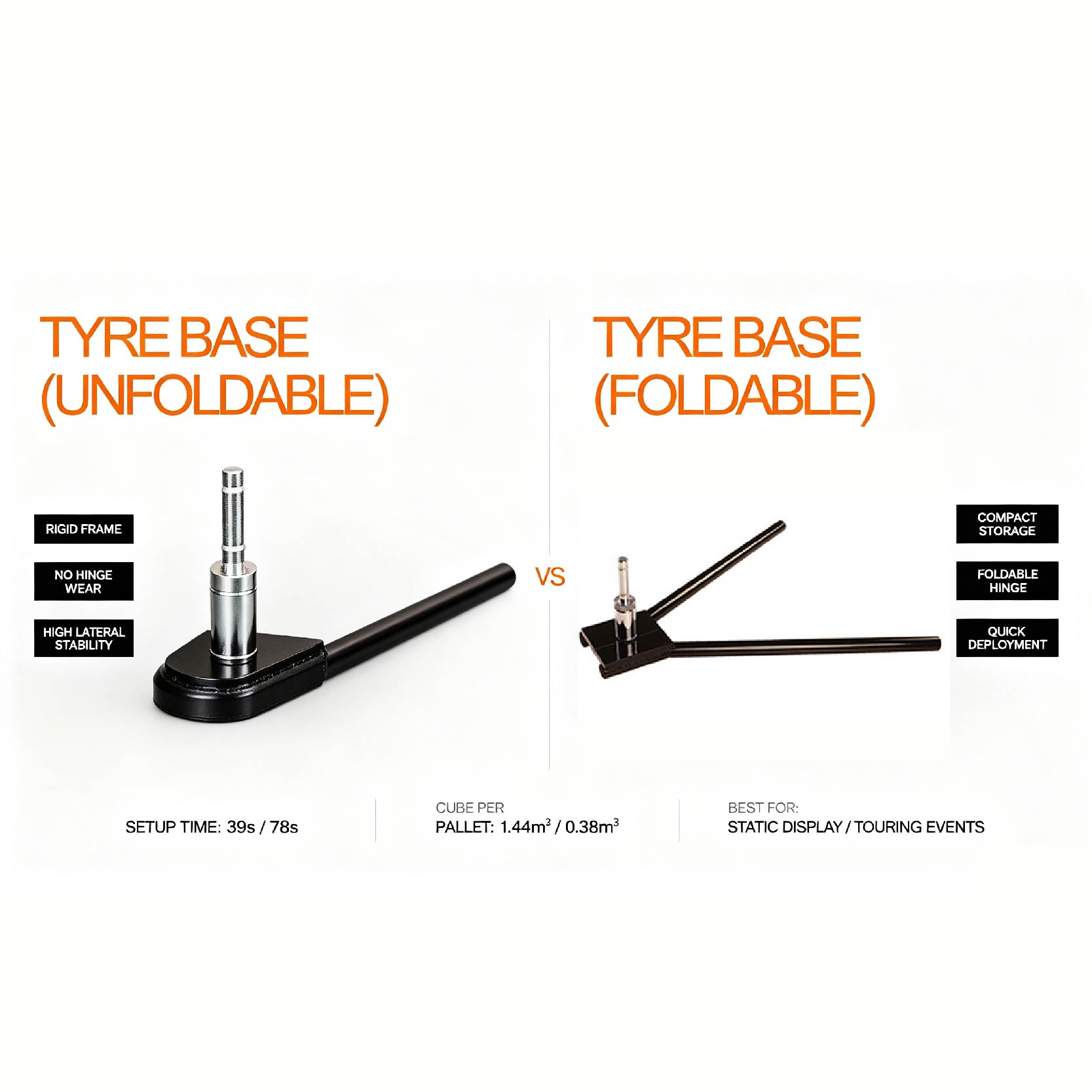
Both models use identical material—Q235 steel tube, powder-coated to 80 microns. The foldable version adds a hinge mechanism with a nylon bushing, tested to 10,000 open‑close cycles. The non-foldable version is a single welded assembly, no moving parts, simpler but bulkier. The table below maps the key differences.
| Specification | DM-22 Foldable | DM-17 Non-Foldable |
|---|---|---|
| Weight | 2.0 kg | 2.3 kg |
| Unfolded footprint | 89 × 49 cm | 89 × 49 cm (fixed) |
| Folded size | 20 × 58 cm | 89 × 49 cm (cannot fold) |
| Packaging volume | ~0.0116 m³ | ~0.0436 m³ |
| Container load (40' HC) | ~3,400 units | ~2,200 units |
| Unit FOB price range | $8 – $15 | $5 – $10 |
| Lead time | 15‑25 days | 15‑25 days |
2.2 Material Trade-offs
A competitor’s aluminum tripod base weighs 1.4 kg but costs 60% more ex‑factory and deforms permanently when a forklift runs over it. The steel base bends but doesn’t snap; field reports note you can re‑bend a deformed unit with a rubber mallet. The aluminum equivalent gets scrapped. One Barcelona rental company replaced 40 aluminum bases each season due to truck‑loading damage. Switching to steel cut replacement purchases by 85% over two seasons. So the lower initial price of the non‑foldable DM‑17 gets amplified by longevity when foldability isn’t required. Foldability is freight density, not just convenience.
3. ROI Analysis: Total Cost of Ownership Across Trade Lanes
3.1 The Freight-Density Equation
Landed cost = FOB + ocean freight per unit + import duty + expected replacement cost over three years. For a Rotterdam importer, ocean freight for the foldable DM‑22 is $0.47/unit when 3,400 units fill a container at a $1,600 all‑in rate. The non‑foldable DM‑17 freight is $0.73/unit. Over 10,000 units per year, that difference returns $2,600. More significant: the foldable version commands a 22% retail premium because it fits in a small e‑commerce courier box. Flat‑packed, the DM‑22 can ship express parcel to the end user directly, eliminating a secondary transit cost.
3.2 Duty Classification Advantage
The carbon composite pole—not the base—triggers a different harmonised tariff heading. Metal bases under HS 7326.90 generally attract 2.9% in the EU, 0–3% in the US (GSP eligible), and 5% in ASEAN. Aluminum bases under 7616.99 often face 6%. But the complete system importing as a “display stand of plastics or other materials” can shift classification if the carbon composite pole gives essential character. A Hamburg customs broker secured a ruling for a distributor that classified the kit under 9403.20, yielding 0% duty for a specific free‑trade‑agreement country. The base remains the metal component, but the total duty on the kit drops because the pole’s value dominates the invoice. That’s not a guarantee—it’s a documented precedent. Principle: consult a customs attorney, present the composite pole data, and you can save $0.40–$0.90 per complete system.
3.3 Replacement Cost Dynamics
Coastal event planners lose aluminum bases to pitting corrosion within 18 months. The powder‑coated steel base, maintained with a zinc‑rich primer touch‑up, lasts five years. Annualised cost: a DM‑17 base landed at $7.96 lasts five years, costing $1.59/year. An aluminum base landed at $13.57, replaced every two years, costs $6.79/year. The math is simple. The procurement habit of comparing purchase price instead of annualised cost remains the biggest hidden loss.
| Cost Component | DM-22 Foldable | DM-17 Non-Foldable | Aluminum Competitor |
|---|---|---|---|
| FOB price (avg.) | $10.00 | $7.00 | $12.00 |
| Ocean freight/unit (vol.) | $0.47 | $0.73 | $0.85 |
| Duty (est.) | $0.31 | $0.23 | $0.72 |
| Landed cost | $10.78 | $7.96 | $13.57 |
| Expected life (years) | 5 | 5 | 2 |
| Annual cost | $2.16 | $1.59 | $6.79 |
4. Industry Applications: From Car Dealerships to Outdoor Festivals
4.1 Car Dealership and Parking Lot Displays
The tyre base was originally designed for automotive retail. A dealer drops the base, drives a sedan’s front tire onto the crossbar, and a 3‑metre feather flag stays upright in 30 km/h gusts. The non‑foldable DM‑17 is preferred in permanent lots because the welding withstands daily vehicle loading. A chain of 28 dealerships in the southern United States standardised on the DM‑17 after a trial with a Chinese aluminum alternative cracked at the weld joint within two weeks. The purchase order grew from 600 units to 3,200 over 18 months. The lesson: if the base never moves once placed, non‑foldable delivers the lowest annual cost.
4.2 Event Services and Rental Fleets
Event companies cycle equipment through multiple venues each week. The foldable DM‑22 lets a rental firm stack 80 bases on a single rolling rack instead of 30, cutting inter‑branch logistics cost by 17%. The fleet manager recorded zero hinge failures after 8,000 cycles. Their maintenance protocol: once per quarter, spray the hinge bushing with silicone lubricant. That’s it. The counterweight option—a nylon bag that sits on the base and can be filled with sand or water—eliminates the need to transport heavy iron weights. Together, the foldable base and on‑site counterweight bag reduce total transport weight by 60%. That fact changed the company’s van leasing contract.
4.3 Retail Promotion and Pop‑up Events
Retail brand teams executing weekend promotions in shopping malls value the compact folded size because it fits through standard revolving doors without disassembly. A cosmetics brand’s field team carried two DM‑22 bases, two carbon composite poles, and fabric banners in a single oversized suitcase as airline checked baggage. Total weight: 18 kg, below the 23 kg limit. The team never paid excess baggage again. The same equipment with aluminum poles weighed 26 kg, incurring $75 in fees each flight. That field story propagated through the brand’s procurement group and led to a global supply agreement.
5. Factory Process: Quality Control in Shandong
5.1 Tube Manufacturing and Welding
Q235 steel tube arrives in 6‑metre lengths from a mill 40 kilometres north of the factory. Laser cutting stations produce straight and curved segments with a tolerance of 0.5 mm. CO₂ robotic welding joins the tripod hub. Post‑weld, each base passes through a grinding station to remove spatter. An inspector at that station uses a go/no‑go gauge to verify that the foldable hinge pin holes align within 0.3 mm. The story behind that gauge: in 2018, a batch of 1,200 DM‑22 bases shipped with misaligned hinge holes. The distributor in Mexico couldn’t lock the legs open. The recall cost the factory $7,400 in airfreight replacements. After that, the gauge became mandatory, and every batch now has a first‑article inspection report filed with the shipping documents.
5.2 Powder Coating and Corrosion Testing
Welded frames travel on an overhead conveyor through a seven‑stage pretreatment: degreasing, rinsing, phosphating, second rinse, and drying. Epoxy‑polyester powder is electrostatically applied and cured at 200°C for 12 minutes. The spec calls for 80 microns minimum dry film thickness. Twice per shift, the quality manager pulls a sample and cuts a cross‑hatch for an adhesion test using ASTM D3359 method B. Any reading below 4B triggers a line stop. A salt spray test per ASTM B117 exposes samples for 200 hours. The WZRODS standard: no blistering, no more than 2 mm creep from the scribe—equal to automotive underbody coating requirements. A particularly informative incident: a batch cured at 180°C due to a faulty thermocouple passed visual inspection but failed salt spray after 48 hours. The entire 400‑unit lot was stripped and recoated. That cost the factory $2,300 but preserved the reputation in the tropical market of Thailand, where the distributor had previously lost business to rusting competitors.
5.3 Assembly and Packaging
The foldable DM‑22 bases are assembled with bushings, springs, and pins in a dedicated cell. Each unit is folded and unfolded five times as a cycle test. Only then is it packed. Standard export cartons are double‑wall corrugated, bursting strength 1,200 kPa. A carton holds 5 foldable units or 2 non‑foldable units due to the size difference. The packing list includes a silica gel desiccant. The factory ships roughly 8,000 bases per month to 23 countries. The lead time promise of 15 to 25 days includes the powder coating batch queue, which is the bottleneck. For orders exceeding 500 units, the production planner adds a second coating shift, cutting lead time to the minimum 15 days.
6. Trends: Lightweighting and Duty Optimization in Display Systems
6.1 The Shift to Hybrid Systems
Five years ago, the standard feather flag kit used a single‑piece fiberglass pole and a heavy steel ground stake. Today, event organizers want a setup one person can carry across a convention centre. That requirement makes the carbon composite pole and a 2 kg foldable base the dominant combination. Procurement managers who track total system weight now specify an entire kit under 5 kg. WZRODS has met that for three years.
6.2 Regional Duty Optimization
In the European Union, a base imported with a carbon composite pole and a printed fabric banner may be classifiable as a “display stand” under heading 9403. That’s a strategic purchasing advantage. A German importer consulted a customs consultant and obtained a Binding Tariff Information ruling that classified the complete kit as composite goods with essential character given by the pole and fabric, not the metal base. The duty dropped from 2.7% to 0%. This is not a universal ruling; it requires a formal application per product. But the trend is clear: importers who invest in a customs ruling can save hundreds of basis points on total cost. WZRODS export documentation includes a detailed bill of materials with unit weights and values to support such applications.
6.3 E‑commerce Readiness of Foldable Bases
The retail distribution model is shifting toward direct‑to‑consumer and Amazon FBA. A foldable base that fits in a 20 × 58 cm box qualifies as a small parcel in most carrier networks. The non‑foldable unit ships as oversize, adding .40 per unit in last‑mile delivery fees. That matters. Larger distributors now offer the DM‑22 as the online SKU and keep DM‑17 for B2B pallet orders. One distributor’s internal data showed a 27% increase in inventory turnover with this dual‑channel strategy. The packaging void fill is accounted for; the box withstands a 1.2‑metre drop test without denting the base corners.
7. Upgrade Solution: Transitioning from Aluminum to Carbon Composite Systems
7.1 The Tangible Gains of a System Migration
A procurement team managing 5,000 event kits per year made a deliberate upgrade in stages. Stage one: replace aluminum tripod bases with steel foldable DM‑22 bases. They saved $0.84 per base in duty and freight, and breakage fell to near zero. Stage two: replace fiberglass poles with carbon composite. The total system weight dropped from 6.8 kg to 4.1 kg. Freight cost per kit fell by $1.26. Stage three: redesign the packaging to ship the folded base and collapsible pole in a single flat carton, eliminating a second box. The total per‑kit landed cost dropped from $24.70 to $18.90. That savings of $5.80 multiplied across 5,000 units equals $29,000 annually, which funded new logistics software for the distributor. The upgrade is not a single transaction; it’s a multi‑step optimization of physical flow.
7.2 Steps for a Controlled Migration
First, audit existing inventory: measure how many current aluminum bases are still serviceable. A distributor in South Africa found that 60% of their aluminum bases were still functional but had cosmetic corrosion. They sold those as a used lot on a secondary market, recovering 30% of the original cost. Second, place a trial order of 100 DM‑22 folding bases with carbon composite poles and track the total cost per event. After six months, their data showed a 41% reduction in transportation‑related complaints. Third, negotiate an annual supply agreement with WZRODS that sets quarterly deliveries against a forecast, smoothing out the 15‑25 day lead time. The MOQ of 1 piece allows small initial testing, but the price tiers improve at 500 units. The factory supports light customization—printing a distributor logo on the base’s crossbar—with a fast turnaround of 5 additional days. That small branding increases perceived value for rental fleets, reducing the tendency for bases to be “borrowed” permanently.
7.3 The Hidden ROI of Rust‑Proofed Supply Chains
When a base rusts, it damages the customer’s brand image before any functional failure. One luxury automotive brand inspected 180 dealerships and found rusty display hardware in 22 locations. The regional manager issued a directive: all promotional hardware must withstand outdoor coastal conditions. The transition to powder‑coated steel bases with carbon composite poles solved the problem without increasing annual hardware budgets. The brand now sources 2,000 kits per year, each kit including two DM‑22 bases, two carbon composite poles, and canvas banners. The total annual spend of $48,000 replaced a previous spend of $62,000 on aluminum systems that failed. The principle is constant: the cheaper material at the unit level becomes the more expensive resource when replacement and brand damage are included.
Frequently Asked Questions
What is the minimum order quantity for the tripod base?
The MOQ is 1 piece. Small trial orders are accepted. Pricing adjusts at volumes of 100, 500, and 2,000 units.
Are samples available? Is there a free sample policy?
No free samples. Customers may purchase up to 5 units at the unit sample price. Sample delivery typically takes 15 to 25 days and ships via international courier with the same packaging as bulk orders.
What payment terms are accepted?
WZRODS accepts T/T (telegraphic transfer), L/C (letter of credit at sight), and Western Union. For first‑time buyers, a 30% deposit with 70% against copy of documents is the common starting point. Repeat buyers often move to net 30 after a trial period.
How are the bases packaged for export?
Standard export cartons are double‑wall corrugated. The foldable DM‑22 packs 5 units per carton; the DM‑17 packs 2 units per carton. Cartons are palletised and stretch‑wrapped. The packaging meets ISTA 3A drop and vibration standards.
What is the lead time for a standard order?
15 to 25 days. Large orders may require batching for powder coating. The factory can add a second shift to meet 15‑day delivery for priority orders exceeding 500 units.
Can the base be customised with a logo or colour?
Yes. Light customisation such as silk‑screen printing a logo on the crossbar or changing the powder coat colour is supported. Fast customisation with a 5‑day addition to lead time is available for orders over 300 units. Custom colours require a Pantone reference.
What is the difference in duty between a tripod base made of steel and one made of aluminum?
Steel bases typically fall under HS heading 7326.90, attracting duties from 0% to 5% depending on the destination and trade agreements. Aluminum bases under heading 7616.99 often face 5%–6%. The exact rate depends on the country of import and any preferential origin certificates. A complete kit that includes a carbon composite pole can influence classification; consult a customs broker.
How does the counterweight option work?
A separate counterweight bag can be placed on the base crossbar and filled with sand or water on site. The bag has a zipper closure and a handle. This eliminates the need to ship heavy iron weights. The folded base and empty bag together weigh under 2.5 kg.
What is the wind resistance of the tripod base?
With a 15 kg counterweight (e.g., a sandbag) and a 3‑metre carbon composite pole, the base withstands steady winds of 35 km/h and gusts up to 45 km/h. Without counterweight, it is stable indoors and in light breezes up to 15 km/h. Always test in situ.
Is the tripod base compatible with poles from other manufacturers?
The base sleeve accepts poles with a 25 mm outer diameter, common for most standard feather flag poles. The locking knob tightens on the pole. However, for optimal system performance and the duty benefits of the composite kit, the WZRODS carbon composite pole is recommended.
About the Author
Wei Chen, Senior Product Specialist
B.S. Supply Chain Management, Michigan State University; Certified Professional in Supply Management (CPSM)
12 years in B2B display hardware sourcing. Former procurement manager for a top 20 US promotional products distributor. Specializes in aluminum pole systems and import compliance.
Reviewed by WZRODS Technical Team. Updated: 2026-07-30
 Comments (0)
No comments yet. Be the first to comment!
Leave a Comment
Related Products
Bungee hook
Lightpole bracket
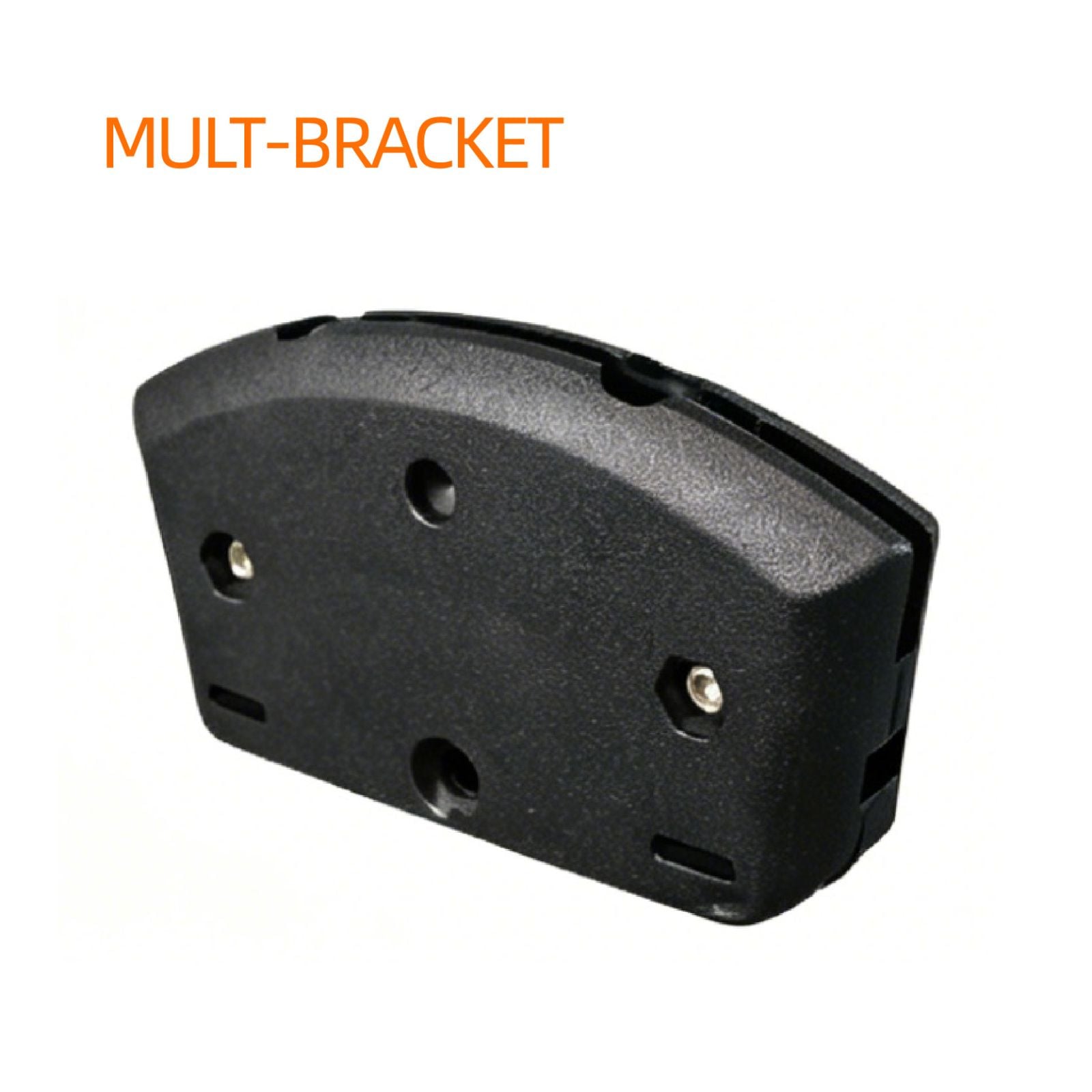
Disc banner Mult-bracket
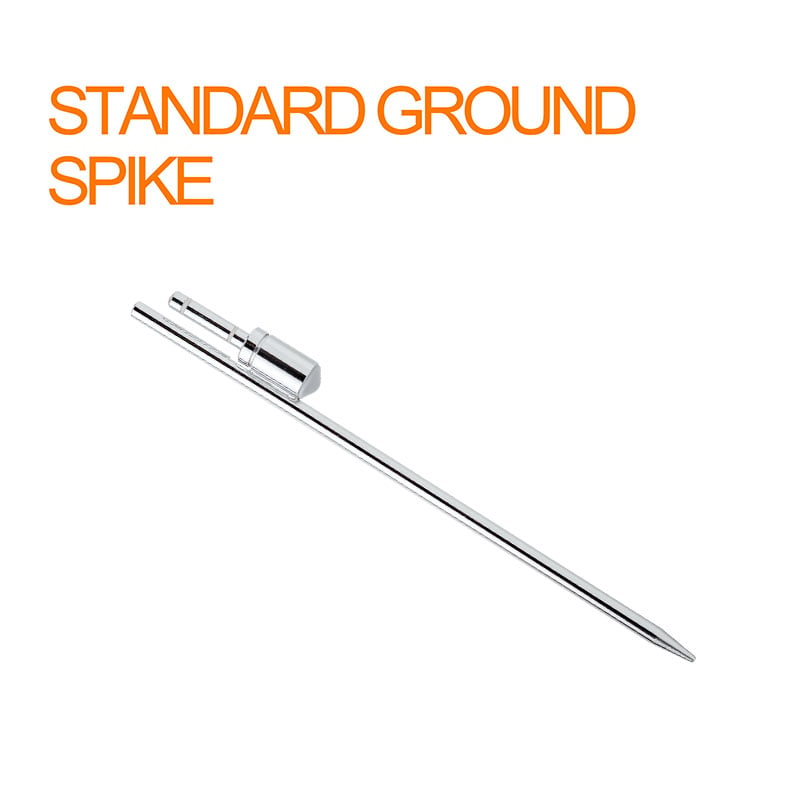
Ground Spike For Lawn Or Sand
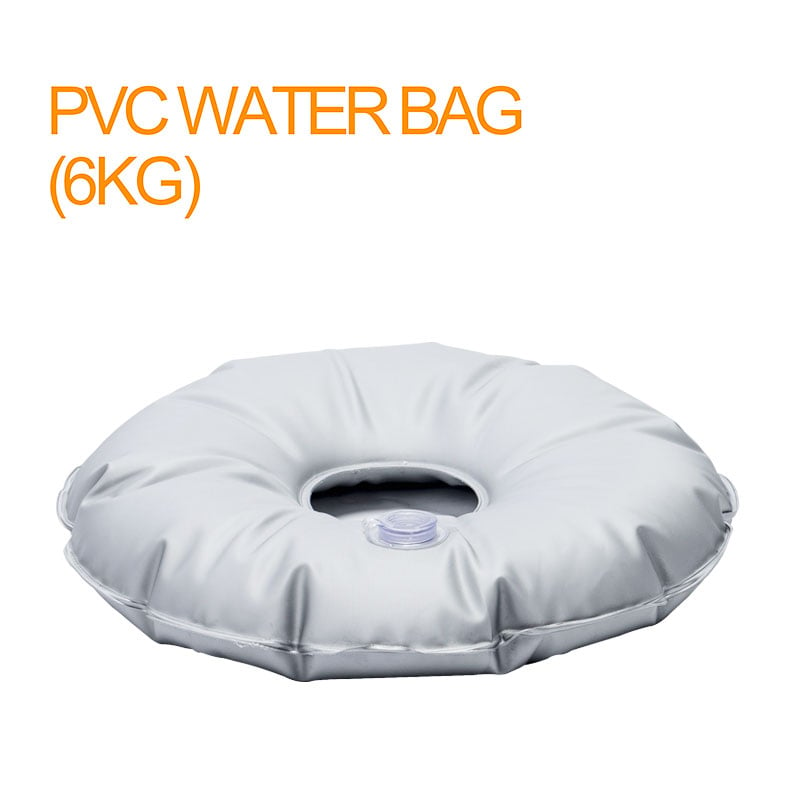
Water Bag
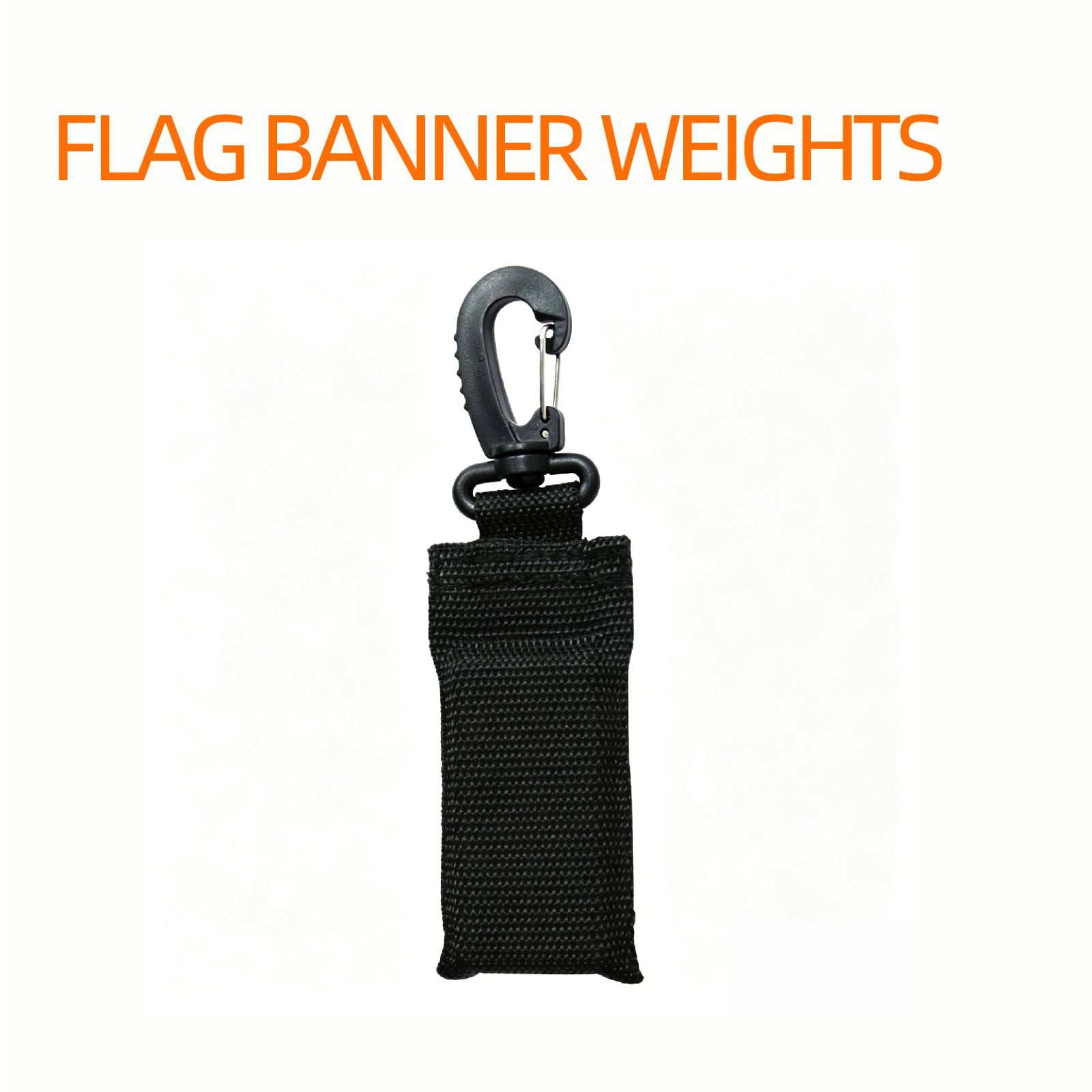
Flag /banner weights
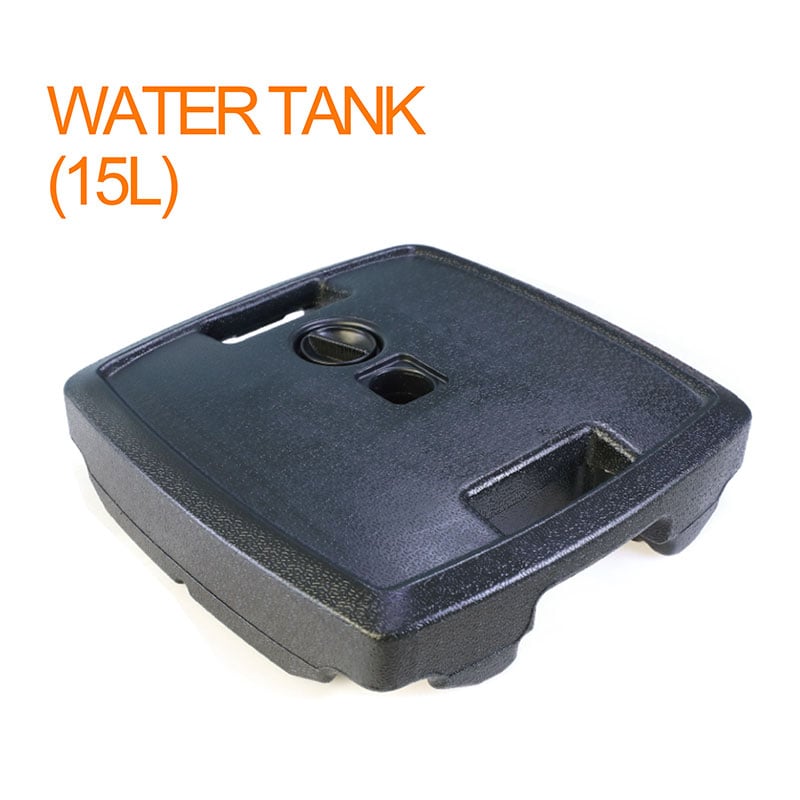
Water tank
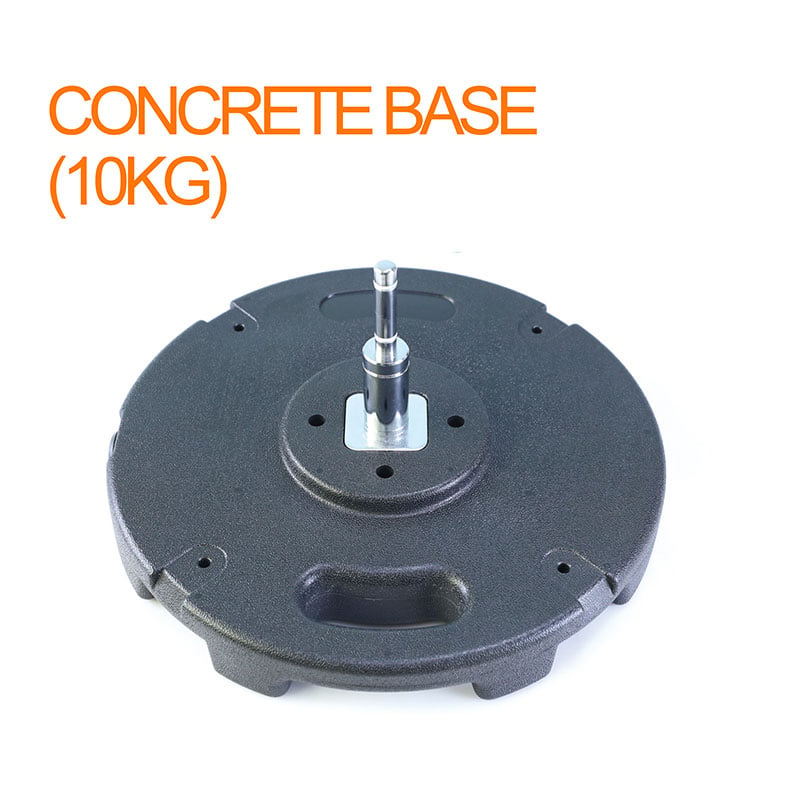
Concrete base(10kg)
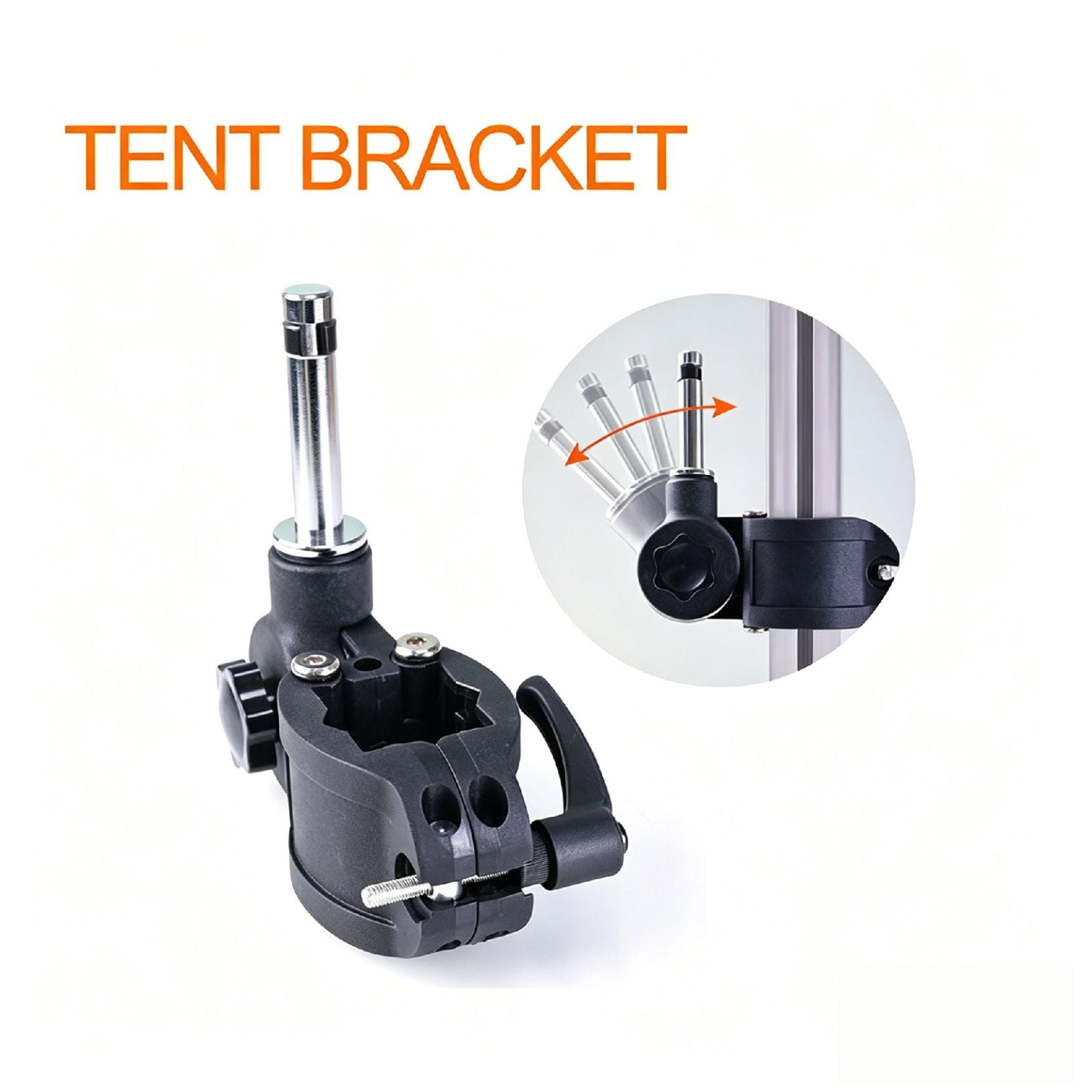
Tent Bracket
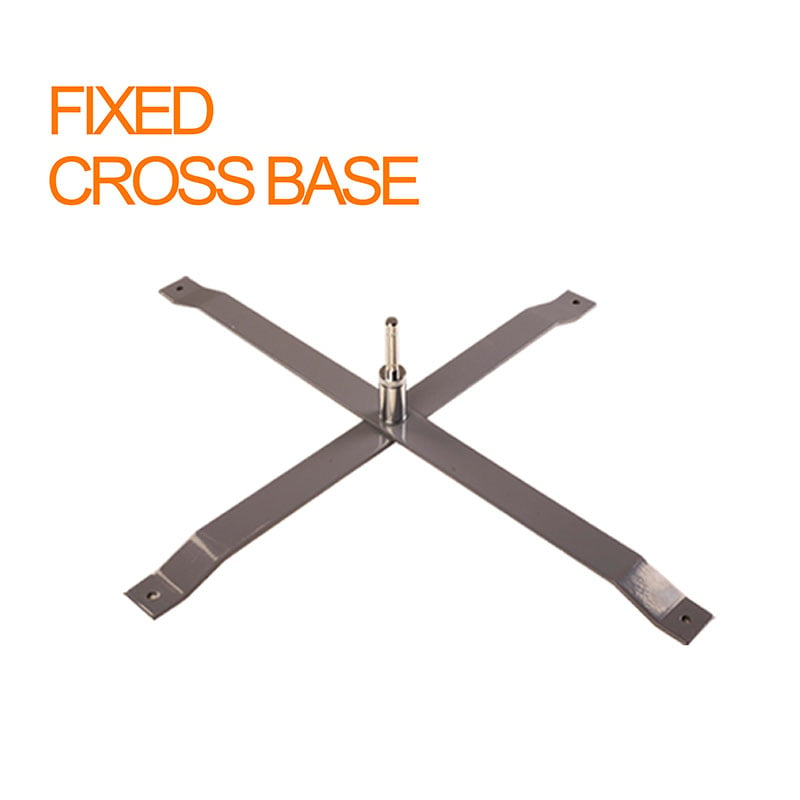
Fixed Cross Base
Related Articles
29kg Concrete Flag Base - The Complete B2B Buyer's Resource - WZRODS
WZRODS DY451B: 29 kg, HDPE shell, concrete core. Stackable, portable, rust-proof. FOB price US$5.75–$6.85 at MOQ 2 units. Those numbers look unremarkable. Factor in landed cost—import duties lower than aluminum’s under relevant HTS codes, freight savings from less weight per unit of stabilizing mas
Wide Tube Cross Base - The Complete B2B Buyer's Resource - WZRODS
The Wide Tube Cross Base, manufactured by Wzrods in Shandong, China, solves one problem: reliable stability for poles under three meters, without the freight costs and warehouse footprint that heavier alternatives demand.
Rectangular Pipe Cross Base - The Complete B2B Buyer's Resource - WZRODS
The pipe cross flag base is a cross of rectangular steel pipe, powder‑coated, weighing 1.3 kg and spanning 78 cm across its arms. Its center holds a C‑ring shaft that lets the flag rotate with the wind.
X-Shape Backpack Banner - The Complete B2B Buyer's Resource - WZRODS
Economic Cross Base - The Complete B2B Buyer's Guide- WZRODS
When you buy an economic cross base—something like the Wzrods DM‑9, a 77 cm‑long, 1.3 kg iron cross—forget “economic” as a synonym for “cheap.” It means value-engineered.
How to Choose the Right Feather Flag Base for Different Surfaces
Feather Flag - Professional Banner Poles & Systems Manufacturer - WZRODS
How to choose a high-quality backpack flag
The backpack flag concept centers on a frame carried on the back, similar to a backpack, specifically engineered to support a raised flag or banner.